Showing posts with label Peninsula Campaign. Show all posts

Wednesday, April 2, 2025

More to the Story of William Braden of Company B

        The Battle of Seven Pines near Richmond, VA in the spring of 1862 is one of the most overlooked yet significant fights of the Civil War. It was the closest major battle fought around Richmond, the Confederate capital, as well as the first fight between the Army of Northern Virginia and the Army of the Potomac. Each side suffered at least 5,000 casualties.

       Why has Seven Pines, also known as Fair Oaks, not been given more attention by scholars? One reason is that the three-day fight ended in significant losses but no distinct winner. Another is that Seven Pines was dwarfed when compared to the series of fights called the Seven Days’ Battles  that had 36,000 total casualties the following month and resulted in the end of Union General George McClellan’s Peninsula Campaign.

     Furthermore, little of the Seven Pines battlefield has been preserved other than a few homes used as hospitals and roadside markers. The landmark Twin Houses are long gone. Today, the battle site has been replaced by the town of Sandston and a portion of the Richmond International Airport.

The 85th PA is in Casey's Division in an exposed position when the fight began. Porter,
 Franklin and Sumner are all on the opposite side of the rushing Chickahominy River. 
                                                    Map by Hal Jespersen, www.cwmaps.com

     Seven Pines nonetheless had great significance in the story of the 85th Pennsylvania. It was not only their first taste of  the conflict  (other than standing in formation during the Battle of Williamsburg a month earlier) but also for being the largest battle in which they ever participated. 

    Battle losses coupled with sicknesses that plagued McClellan’s army on their trek up the Virginia peninsula towards Richmond proved the months of May and June of 1862 to be the most devastating for the 85th in terms of combined  deaths.

       One of those in the 85th killed during the first day of the battle was 22-year old William Braden of Company B from Washington County. Braden’s company had just been replaced on the picket line by Company D when the Confederates launched their attack in the early afternoon of May 31. The 85th PA was soon a part of two retreats in the early hours of the battle from the area around the Twin Houses. 

        We have two first-person accounts from this part of the fight that state that Braden was shot and killed while trying to assist his wounded officer, Lieutenant George H. Hooker, from the field. Hooker survived his wound, was promoted to captain, and lived another 45 years.

From the History of the 103rd Regiment PA Volunteers p. 174

         Private Manaen Sharp, himself a member of Company B, recorded that, “Comrade Braden was helping to carry his wounded captain [Hooker, then a lieutenant] to save him from capture. Another comrade who was assisting, J.F. Speer of Canonsburg heard that sickening thud of a minie ball strike Comrade Braden, who said, ‘I am hit.’ He staggered to the road side….”

     Manaen Sharp wrote his version of the incident in a brief tract called “Amity in the Great American Conflict” in commemoration of Memorial Day in 1903 in which he chronicled the Civil War service of local residents. Sharp owned several furniture stores in Washington County and died in 1920 at the age of 82.

       James F. Speer, who completed carrying Hooker to safety following Braden’s death, was later seriously wounded in the shoulder at the Battle of Second Deep Bottom in 1864 and survived. He returned home to Washington County and found work as a bricklayer and stone mason. Around the turn of the century he worked as a furniture salesman, perhaps in the employ of Manaen Sharp. Speer died in 1924 at the age of 82.

Lt. George H. Hooker


   Since Braden’s  body and those of hundreds of others on both sides were never recovered for individual  burials, Nancy Braden, William’s widow, needed the written testimony of Captain Hooker as proof of her husband’s death in order to qualify for a widow’s pension. In 1865, Hooker wrote, “I hereby certify that Wm. Braden, a private of Company B 85th Pa. Vols., was shot while assisting me from the field at the Battle of Fair Oaks, Virginia on the 31st of May, 1862. He fell severely wounded and is supposed to have died from the effects of his wound.” 


               Hooker a native of the section of Virginia that became West Virginia during the war, was later  promoted to captain and served as an adjutant on the staff of Colonel Joshua B. Howell. Hooker returned home to West Virginia following the war and farmed in Wayne County. He died in 1907 at the age of 66. 

       Besides his young wife, William Braden was survived by a one-year old son, George W. Braden. William Braden also served in Company B with his Nancy’s brother, brother-in-law, George Bigler.

       Compared to the other hundred or so battlefield deaths in the 85th PA regiment during the war, the story of Braden’s battlefield demise is one with many details due to the accounts of Sharp and Hooker.

      Now, because of the diligent work of Doug Carter, a former investigator with the Georgia Bureau of Investigation and a Civil war enthusiast, we can add to  Braden’s story.

       Carter has always had a fascination with the actions during the Civil War in his home state. His great grandfather,  Jesse Taliaferro Carter, enlisted into the 3rd Georgia Reserves at age 17. He served as a guard at the Andersonville and Camp Lawton Prison Camps and later was wounded in the neck in December of 1864 in South Carolina 

          How did Doug Carter become involved in the story of the 85th PA? In his research, Carter, who is also a relative of former President Jimmy Carter, has identified the Georgia  soldier who felled Braden at Seven Pines.

       When I wrote my book about the 85th Pennsylvania regiment, called “Such Hard and Severe Service,” I relied heavily on primary sources; mainly the letters, diaries and memoirs of the men in the that regiment. In the early stages of the war, like for the Battle of Seven Pines, sources were relatively  abundant for review. As the war dragged on however, more soldiers were killed, sent home with illnesses, or simply completed their three-year enlistments, which reduced the number of potential  sources from about a thousand to 150 by the time of Lee’s surrender at Appomattox.

       One recent Confederate source that  came of light through the work of Mr. Carter was a letter written by Private Thomas Inglett of the 28th Georgia regiment. 

First page and cover of Thomas Inglett letter, June 10, 1862
Courtesy of Doug Carter

         It was Inglett who fired the shot that struck down Braden, a fact that Carter  discovered 150 years later. It is a rare circumstance to be able to identify a dead soldier’s shooter so long after the event, if ever.

        Ten days after the battle began, Inglett wrote a letter to his wife.  “I killed one [Yankee] and got a letter out of his pocket that was wrote to him by his wife and I will send it to you and you can read it.”

      The letter that Inglett lifted from Braden’s lifeless body was in fact not written by the Union soldier’s wife. Part of it was written by Israel Bigler and another portion was written by  his13-year old Mary Bigler, whom Inglett thought was the dead soldier's wife.  The letter never actually mentioned Braden’s surname. 

Researcher Doug Carter

    Carter purchased the Inglett letter in 2007, knowing that the Union letter in the envelope was an added bonus. 

    “I like researching,” said Carter. “I was a special agent with the G.B.I. investigating crimes and I like digging. I was determined to find out who this guy [Braden] was.”

         Carter first realized the Union letter was four pages in length. He determined that most of the letter was written by Israel Bigler, a middle-aged farmer from Washington County to “Will” and “George.” The last page was written by “Mary Bigler” to  “Will.” He next had transcribed the Bigler letter, a task not made easy by its  blood-stained nature.  Carter initially thought Will and George were both sons of Israel. Carter’s next step was to  investigate the war services and  lives of both Inglett and Braden to gain a wider knowledge of both men. 

     Inglett’s letter described his role at Seven Pines before he took the fatal shot against Braden. “I got my cap shot off of my head in the fight but I did not get hurt. Our poor boys fell all around me. James Price was killed with a canister shot before we got [with]in six hundred yards of the yankees. Sam Cawley was my file leader and he got shot down and the ball through [threw] blood all over my face and in my mouth, but they did not stop me for I was mad. Our regiment charged them twice and we made them run like dogs from their batteries.”

Portion of letter that Inglett took from Braden's body.
Courtesy of Doug Carter

      But Carter’s investigation of census records of the Israel Bigler household prior to the Civil War indicated that Bigler had no son named William. Braden, however, is listed in the 1860 federal census as a member of the Bigler household who was working as a farm laborer. Other family members were daughters Mary and Nancy who would soon marry William. From the 1850 census, Carter discovered that Israel Bigler did have a son named George Bigler, who was also a member of Company B. The census revealed that  Israel Bigler also had a daughter named Nancy, who married William Braden in 1860. 

      Carter researched military records and found George Bigler and William Braden were in the same company of the 85th PA. By combing through the original 1913 history of the regiment, he determined that Bigler and Braden were both in Company B. He also discovered George had survived the war but that William was killed at Seven Pines. This was the key discovery that indicated that Braden was the owner of the letter confiscated by Inglett.


Wikipedia Commons

 Thomas Inglett, meanwhile, grew up near Augusta, Georgia. He spent over three years in the Confederate army. He lost two fingers on his left hand due to a war wound during the Seven Days Battles a month after Seven Pines but recovered and continued to in his regiment

      Inglett later suffered a leg wound at the First Battle of Darbytown Road on October 7, 1864 and was sent to a Richmond hospital. Ironically, the whole of the 85th PA fought in another battle at Darbytown Road just six days after Inglett was wounded. Most of the regiment went home the next day, having completed their three-year enlistments.

     Tragically, three of Inglett’s infant daughters died while he was in the Confederate service. Inglett died in 1910 at the age of 71 and is buried in the Fort Eisenhower Cemetery in Richmond, Georgia. 

    Nearly a hundred of Inglett’s other Civil War letters can be found at the “Private Voices” website.

       Combining the accounts of Inglett, Sharp and Hooker, several questions arise from the combination of the three stories.

        The Israel Bigler letter had been written at least four months prior to Seven Pines. Why was Braden carrying it in on his person? It seems that he might have possessed a more recent letter at the time of his death.

     Next, was Braden moving  when he was shot? Inglett makes no mention in his letter that Braden was helping to carry away the wounded Hooker with another soldier. If Braden and Speer were on either side of Hooker helping to carry him away, did Inglett aim for the mass of the three men and happened to strike Braden or did he aim for Braden?

Letter from Lt. Hooker in Nancy Braden's Pension File

        Or perhaps were the three Yankees stopped to rest when Braden fell? Sharp’s letter, which may have been directly related to him by Speer,  seems to indicate that Braden was struck fatally but did not die instantly. Hooker wrote that he “presumed” that Braden died quickly from his wound. Did Speer decide that Braden was dead or mortally wounded  when he staggered to the side of the road or was not going to survive, and thus carried on alone to help Hooker? 

      Inglett at  first struck me as a bit cold-blooded in his rather casual mention to his wife that he lifted the letter from Braden’s lifeless body and chose to send it home to her as a souvenir.

         However, when one reviews Inglett’s account of the fight prior to his targeting of Braden, the context makes his action a bit more understandable. Inglett mentioned the wounding of two of his comrades, one of whom splattered blood on his [Inglett’s] face and in his mouth. Inglett notes his own hat was shot from his head. He mentions that these events enraged him and encouraged him to press forward in the fight. This strikes me an a not uncommon reaction to being in a battle in which one’s friends have fallen around you.

        Why was Braden’s body not recovered for burial? The only soldier of the approximately 25 men in the 85th PA who died from the battle who is buried in the Seven Pines National Cemetery, which was later situated in the approximate location on the 85th PA regiment’s camp, is Corporal Joseph Wilgus of Company B. That is only because Wilgus was wounded in the battle and died later. The field on which the 85th fought was soon overrun by Confederates. There was no chance at the end of the battle to return and recover bodies for burial. Another 85th PA soldier who died in the fight, Lieutenant James Reynolds of Company H. His body was left behind near the huge pile of firewood hear the Twin Houses, but his body was also not recovered for burial.

    These questions will likely never be answered. However, due to Carter’s investigative diligence, we have a more complete story of the death of one soldier, William Braden of Washington County, who was one of thousands who died at Seven Pines.

     Below are several depictions of the burial of soldiers after the Battle of Seven Pines

Post-battle photo of the Twin Houses with the seven pine trees in the background.
The foreground was said to have been used to bury 400 soldiers, perhaps including Braden. LOC


View of Seven Pines prior to the battle with the Twin Houses and 7 pine trees to the left.
 The camp of several regiments including the 85th PA can be seen in the background. LOC


Sketch of mass burials being conducted after the battle of Seven Pines.
This view is from the direction of the first Confederate attack with the
pine trees in front of the Twin Houses. LOC


Sunday, May 9, 2021

The Peripatetic Life of Lt. Colonel Norton McGiffin


Norton McGiffin
Property of Ronn Palm Museum of Civil War Images
Gettysburg, PA


         Shortly after the 85th Pennsylvania regiment was organized in the fall of 1861, 37-year old Norton McGiffin of Washington, PA was elected to be the first lieutenant colonel of the regiment. McGiffin would be second-in-command to Colonel Joshua B. Howell, who organized the unit. McGiffin was elected by the officers and was endorsed by the rank-and-file. He was an obvious choice, having served in the Mexican War before going on to a political career in his home county. 

         But after only seven months of service with the 85th Pennsylvania, McGiffin was forced to resign in the spring of 1862 due to illness. He was replaced as lieutenant colonel by another resident of "Little Washington," Henry A. Purviance.  

          During the months of April and May of 1862, when the regiment had just arrived in Virginia for the Peninsula Campaign, 33 men were dismissed for medical reasons. Twelve men had already died from diseases, mainly typhoid fever. 

        Regimental historian Luther S. Dickey wrote, “Lieut. Col. Norton McGiffin’s resignation was accepted, owing to impaired health. This caused universal regret among both officers and men, as he was highly esteemed by all, not only as an efficient officer, but as a most estimable, chivalrous man. The fact that he had served throughout the Mexican War and in the three months’ service before coming to the 85th Regiment had given him great military prestige, and as he was imperturbable in temperament and never gave way to excitement under the most trying circumstances. His final departure was regarded as a distinct loss to the Regiment.”

        McGiffin's time with the 85th regiment was brief; he and the 85th had peripherally participated in just one battle thus far at Williamsburg on May 5 where two of their men were wounded. Although his Civil War record was abbreviated,  McGiffin's overall life was nonetheless one of the most varied and interesting of any of the thousand men who served in the regiment from southwestern Pennsylvania

Siege of Puebla

         McGiffin was one of the few members of the 85th Pennsylvania who had previously participated in battle.  A graduate of Washington [PA] College (now Washington and Jefferson College), he was 22 when that war broke out. McGiffin was planning for a career as a lawyer as he clerked for Judge Nathan Ewing in Uniontown in the 1840's, Then the Mexican War changed the course of his life. During this conflict, he was a private in Company K of the First Pennsylvania Infantry, known as the "Duquesne Grays." McGiffin participated in engagements at Puebla, Vera Cruz and Mexico City, where he stormed the fortress castle of Chapultapec. He was wounded during street fighting at the Siege  of Puebla (1847).  

    Manaen Sharp of the 85th Pennsylvania wrote this brief account of McGiffin's service in the Mexican War around 1900. 

      "[During the Mexican War] McGiffin saw as hard service as any in the greater war of the Rebellion. At the taking of Puebla, after fighting for six weeks, his company was ordered to drive out some cavalry occupying a cross street. He had just been relieved from a 24-hour's picket service, which excused him for the day, but he volunteered to go with the company of 58 muskets. They succeeded in driving the enemy nearly a mile when they ran into as hot a place as could be imagined. They were overpowered and driven back with a loss of 14 killed and 28 wounded, making 2/3 of the company disabled in a few minutes. Comrade McGiffin was hit on the back of the head by something thrown from the top of a building. He recovered from the shock barely in time to dodge something like a crowbar that barely missed him, and striking a heavy door, buried itself 3 inches and stuck fast there."  [Sharp, Amity in the Great American Conflict, 1903]

        McGiffin went home to Little Washington shortly before the end of the war due to his injury. At a banquet at the end of the war held in nearby Canonsburg, McGiffin was presented with a silver-mounted pistol. 


Court House, Sheriff's Residence and Jail
Boyd Crumine's History of Washington County

        A decade after c
oming home from Mexico, McGiffin was elected to be treasurer (1849) of Washington County before being voted to be county sheriff in 1858. He was in that office when the Civil War began in 1861. McGiffin immediately resigned to join the 12th Pennsylvania for three months. Following the expiration of that term of service, he joined the 85th Pennsylvania.

        After the Civil War, McGiffin moved with his family across the state border and lived for four years as a farmer in Ohio County, West Virginia. He moved back to Washington County in 1870.

          Upon his return, McGiffin attended the organizational meeting in Uniontown, Fayette County in 1873 for the postwar regimental association. This group of former members of the 85th regiment would conduct reunions for the next 45 years. McGiffin was elected to be the first president of the association.

         McGiffin went on to hold a wide variety of political positions, both elected and appointed. He was voted into the Pennsylvania State House of Representatives in 1880 and served one year.
  
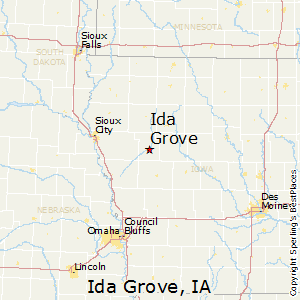
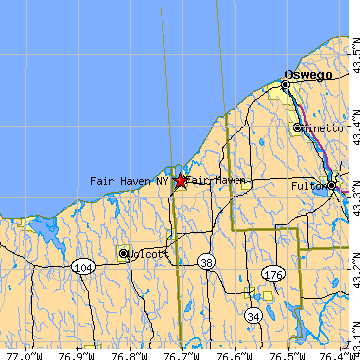
        After his term in the state house, McGiffin lived for four years in Ida Grove, Iowa as a farmer. He then lived for the next four years in Fair Haven, New York near Lake Ontario.


James G. Blaine
LOC


         For the next stage of his life, McGiffin was appointed U.S. Consul at Port Rowan, Ontario, Canada by United States Secretary of State James G. Blaine, a classmate at Washington and Jefferson. This was shortly followed by an appointment to the same position at Port Hope, Canada for two years. In the 1890's, he found his way back home to Little Washington.

        McGiffin died on July 30, 1905 in his home town. He is buried in the city's Washington Cemetery. He was the last survivor of the Mexican War from Washington County. 

           McGiffin had many interesting events and triumphs in his personal life. Several of his children, however, did not fare as well. In 1872, his 17-year old son, Thomas, shot a school principal, Welty J. Wilson, at the Union school in Washington, PA. The story has several versions. All stated that Wilson intercepted a note that young McGiffin had written to a female student. Thomas shot him in the hip when Wilson would not return the note.

          A local version of the incident in a Little Washington newspaper was sympathetic to Thomas. "Young M'Giffin," it said, "has borne the reputation of a quiet and peaceable boy of warm-hearted and generous impulses, and is one of the last who would have been suspected of being involved in a matter of this kind." [Washington Reporter, February 7. 1872, page 1]

         Another Washington County newspaper noted, "there are several sides to the story --one of which accuses the Teacher with reading the note before the whole school and also...making fun of McGiffin's 'love sickness;' also of giving the note to some students  to take to the College and there make it public. If this be so, much of the sympathy will learn toward the boy, as no young man of spirit could quietly brook such a needless insult. Shooting however is not the remedy and must be severely frowned upon. Shooting is getting too terribly common--nearly one half the boys of town and country carry loaded revolvers." [Monongahela Republican, February 8, 1872, page 3]

         On the other hand, the newspaper from Warren, Ohio, the hometown of the teacher, came down hard on the teen. "universal sympathy is extended to Mr. Wilson, as well as to the afflicted parents of the hot-headed young man...we cannot refrain from adding that Mr. Wilson was undoubtedly right in refusing to permit the delivery of the note...the murderous attempt on his life was without just cause or provocation...Young McGiffin should be retired to a state prison or a lunatic asylum for several years until his blood has cooled off and his head become level." [Western Reserve Chronicle, Warren, Ohio, February 14, 1872, page 3]

        Wilson survived and lived until 1925. Thomas eventually moved to Hawaii where he spent the last four decades of his life. He died in 1922 at the age of 68, survived by his wife, Malina, and several children.

         Norton McGiffin's second son, Philo Norton McGiffin, became the most famous member of the family. Philo was a graduate of the U.S. Naval Academy. While at Annapolis, he earned the reputation of an unrepentant prankster. But he also demonstrated personal bravery that would mark his life by rescuing two children from a burning home. Furthermore, during a training session, when it seemed his ship's mast might collapse, he dashed up the rigging to secure the spar and prevent disaster. 

            Unable to gain a commission in the U.S. Navy because of it's small size at the time, Philo became a noted officer in the Chinese navy as an instructor and advisor. Philo McGiffin was the first American to command a modern battleship in wartime at the Battle of the Yalu during the First Sino-Japanese War in the 1890’s. 

Philo McGiffin
Nimitz Library U.S. Naval Academ
y


         Philo suffered numerous wounds during the battle as he personally put out fires, directed artillery and directed movements of his ship, all while receiving fire from four Japanese gunboats. He was in severe pain for the rest of his life. Returning to the United States, he wrote a review of the battle and delivered a few lectures, but finally succumbed to his painful wounds. He shot himself in 1897 and died at the age of 36.

           A few years earlier before the Battle of the Yalu, Philo wrote, "I don't want to be wounded and hate to think of being dreadfully mangled and then being patched up with half my limbs and senses gone, yet a triumph of surgical skill. No I prefer to step down or up or out of this world when my time comes." [The Fall River [MA] Daily Herald, October 2, 1894, page 5]

         Seven years later in 1905, Norton McGiffin was honored on his 80th birthday in Little Washington by the city's G.A.R Post. He was presented with "a fine Morris chair." A letter signed by the members of the post included the following tribute:

       "We congratulate you, sir, that at your very birth, you entered at once upon the inheritance of an honored name, for from that early time when your brave grandfather [Nathaniel] marched in the Pennsylvania line and suffered with [George] Washington at Valley Forge, through him and after him your honored father [Thomas], in his turn filling for many years a large and varied place in business and professional life, the name you bear has occupied a bright and prominent place upon the pages of our country's history." [Pittsburgh Weekly Gazette, January 24, 1904, page 13]


Thursday, December 17, 2020

John E. Michener and the Peninsula Campaign


Captain John E. Michener
Miriam and Ira D. Wallach Division of Art, Prints and Photographs
New York Public Library
. 


       The brief, 40-page chapter in "Prison Life" (1867) about Captain John E. Michener of the 85th Pennsylvania, mentioned in my previous post, offers some heretofore little known details about his three years in the Union army, beginning with information about the Peninsula Campaign. 
        Michener, from Fredericktown, Washington County, PA, first joined the 85th Pennsylvania regiment as a lieutenant in Company D. He was 23 years of age with a wife and newborn daughter. His brother, Ezra, served as an assistant sutler attached to the regiment. Later in the war, in early 1864, Michener would be promoted to captain of Company K. 

        After a brief stay in Washington, DC during the winter of 1861-62, the 85th Pennsylvania was transported to Fort Monroe, Virginia to be part of General George B. McClellan's massive movement to capture Richmond, the Confederate capital, by advancing up the peninsula between the James and York Rivers. This effort, known as the Peninsula Campaign, would prove to be a massive Union failure and starkly shattered the expectation of many northerners that victory would in a short amount of time. 

Position of Casey's Division At Williamsburg in support of Hooker and Kearney

         The first pitched battle of the of the Peninsula Campaign, was fought at Williamsburg on May 5, 1864. Union forces caught up to the rear guard of the Confederate army that was retreating from Yorktown. The battle involved over 70,000 troops and resulted in about 4,000 total casualties, but ended without a decisive winner The Union pursuit continued up the Virginia Peninsula towards Richmond. 

      The 85th Pennsylvania played a supporting role during the engagement. They were called into a line of battle line during the night of May 5, but did not fire their rifles. The men were very excited to be placed in a position to be under fire from artillery for the first time. Although shelled, the regiment suffered just two casualties, their first of the war. Also memorable was the bone-chilling weather, as they stood shivering in formation all night long during a rain storm. More information about the Battle of Williamsburg can be found here.

      What "Prison Life" adds to the story: Because of the minor role played by the 85th Pennsylvania at Williamsburg, "Prison Life" adds little to what is already known. Author T.J. Simpson exalts Michener for parading in front of his men and exhorting them to stand in readiness for an order to advance that never came. Michener deserved credit for encouraging his men, but not on the level described below by Simpson. Although placed under fire for the first time, the Confederate shells directed at them mostly fell behind the men, not upon them or in front of them. Michener displayed plenty of bravery during the war; however, it was a stretch for Simpson to highlight this incident in such sonorous language.

From "Prison Life:" [Standing in formation at Williamsburg] "Here Lieutenant Michener’s coolness and intrepidity was fearlessly displayed and won for him the admiration and confidence of all his comrades. Seizing a musket, he rushed to the front and as if wholly unconscious of danger, continued to encourage and animate his men, both by word and example, in the midst of a most deadly fire, until the close of the battle."

         The Confederate army following the battle continued their withdrawal up the peninsula towards Richmond under the command of General Joseph Johnston with McClellan in pursuit. Nearly a month after Williamsburg, the 85th Pennsylvania was in the front lines for the Battle of Seven Pines. This fight involved 73,000 troops and ended with nearly 14,000 casualties. This three-day fight, the closest ever to Richmond, ended in a draw. Confederates held off the invasion of Richmond, while the Union rallied after nearly being overwhelmed on the first day of the battle. 

        The 85th Pennsylvania, as part of Silas Casey's Division of Erasmus Keyes' Fourth Corps, was in the front lines on the first day of the battle. This inexperienced division, greatly reduced by sickness, fought extremely well, holding off a much larger Confederate strike force until re-enforcements arrived hours later from across the Chickahominy River. For more information about the Battle of Seven Pines as well as an excellent detailed map of the opening of the fight, click here.

        Michener, then a lieutenant in Company D, was on picket duty with the fight commenced along with his captain, William Horn, and a handful of men. Facing overwhelming numbers of Confederates, he and his men struggled to return to their regiment. Several of were captured. While some in others regiments panicked and fled to the rear, Michener was able to coolly lead the rest of the men back to their regiment.

    What "Prison Life" adds to the story: Specific details about Michener's role are provided. Michener, it turned out, was given charge of a group of Confederate prisoners during his return from the picket line by a colonel of another regiment. Michener through Simpson also disclosed the route of his return. 

History of the 103rd Regiment
PA Veteran Volunteer Infantry p.174
Union picket line on the far left; 85th PA to the right of the redoubt along the stage road


  From "Prison Life:"
"Lieutenant Michener was cut off from his division, with the rebels in front and rear, while he and his men were exposed to a galling fire from both friends and foes. With thirteen men belonging to his own company and four of the ninety-sixth New York, he moved through the slashing of newly-fallen timber to the York River railroad, deployed his little squad as skirmishers, and captured three prisoners with the loss of one of the New York boys, who was shot in the head while gallantly fighting at his post. Moving then to the right of the railroad, he succeeded in escaping from his dreadful dilemma and hastened to the point where [General John] Sedgwick fiercely contesting every inch of ground, finally changed defeat into victory and triumphantly closed one of the bloodiest battles of the war."

Michener's route from the picket line along the RR line to Sedgwick's position at the Battle of Seven Pines
History of the 103rd PA by L.S. Dickey, p. 166

Colonel Oliver H. Rippey
61st PA Infantry
Killed at Seven Pines
   

    "Here Lieutenant Michener was directed by Colonel [Oliver H.] Rippey, [61st PA, killed at Seven Pines] a brave and gallant officer, to take charge of some forty-five prisoners and guard them securely until they could be removed to the rear."


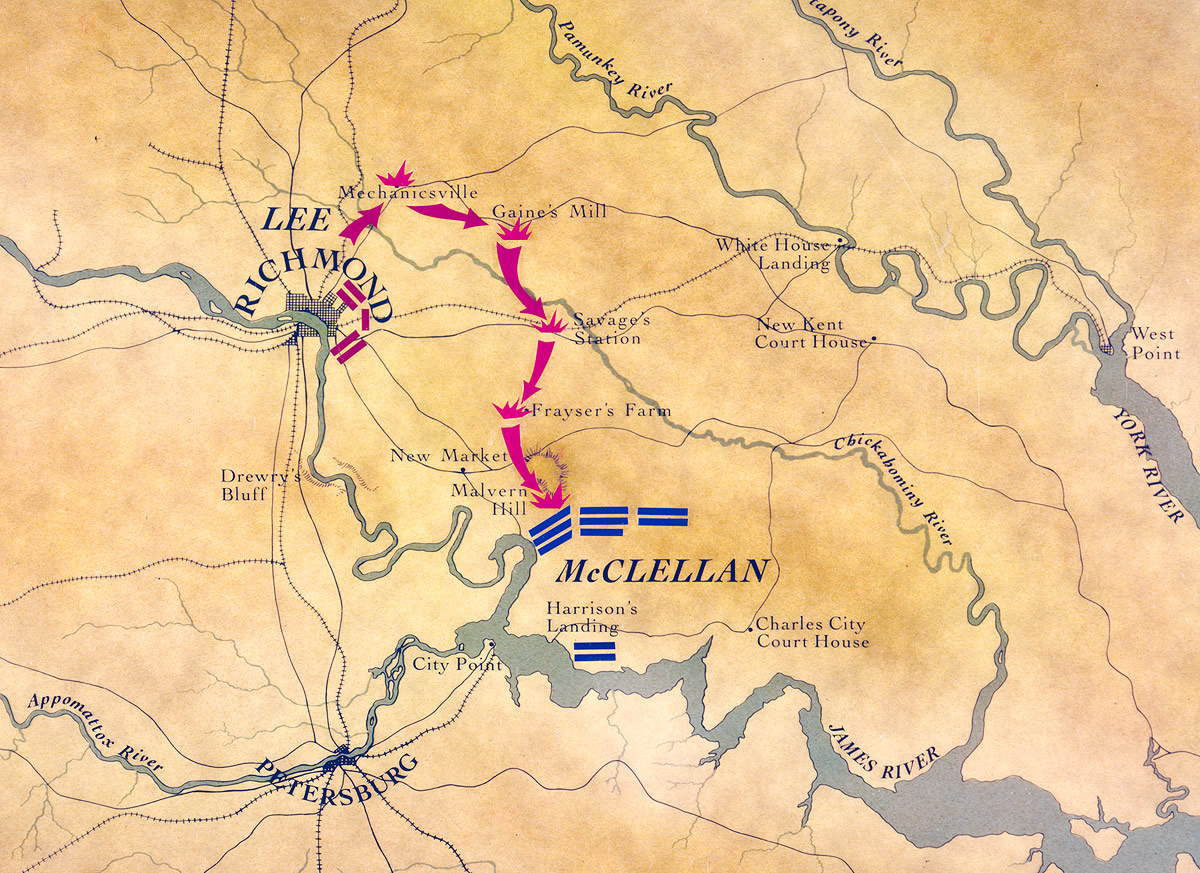
         The 85th Pennsylvania and Silas Casey's entire division, after a severe public rebuke from McClellan, was sent to rear during the ensuing Seven Days' Battles. In late June of 1862, McClellan gave up his plan to capture Richmond. After the final fight at Malvern Hill, the 85th Pennsylvania as part of the division of General John J. Peck (who replaced the scapegoated Casey) guarded the Union retreat. McClellan's huge army set up a defensive position at Harrison's Landing on the James River and sat for six weeks. In mid-August, McClellan's army began loading onto ships and left the peninsula. McClellan called the massive retreat a "change of base." 

       It took several days for the army to be removed aboard transport and barges from Harrison's Landing. The mood of many in the Union army as well as in the North was disappointment and confusion that the Union offensive to end the war had stalled. A Pittsburgh newspaper wrote, "Without a struggle, without even the loss of a single man, the immense Army of the Potomac, officers and men, bag and baggage, stores, tents, horses, ammunition and contrabands, are now far away from Harrison's Landing...steamer after steamer and vessel after vessel passed us steaming or sailing in the direction of Fortress Monroe heavily laden with horses and stores." [Pittsburgh Gazette, August 21, 1862, p.1]

Harrison's Landing
Harper's Weekly


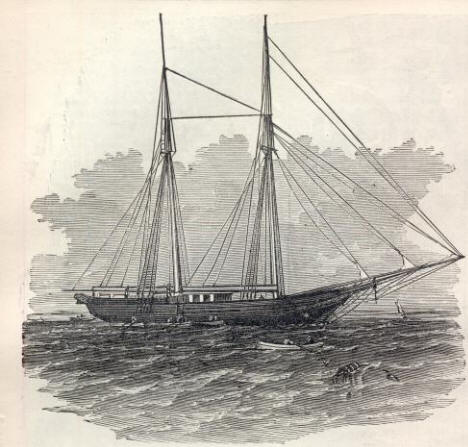
  From "Prison Life:" This vignette displayed Michener's organizational and management skills. [McClellan’s retreat] "At the evacuation of Harrison’s Landing, Lieutenant Michener was detailed to take charge of all the baggage belonging to General Peck’s division. The baggage consisted of trunks, boxes, knapsacks, etc. They had been hastily and carelessly tumbled into crazy old canal hulks by a careless and reckless quartermaster and consequently the boats rapidly filled with water and sunk at the wharf where they had been loaded. To remove this baggage out of these sunken boats to others was a slow and difficult task. In less than eighteen hours, however, Lieutenant Michener with a squad of soldiers and one hundred contrabands [former slave laborers], succeeded in transferring the whole of the baggage from the sunken boats to the schooner W. A. Ellis. After this was accomplished, he was ordered by General Peck to proceed with the schooner to Hampton Creek, Virginia, near Fortress Monroe and land the baggage."

Yellow - water route of baggage barge on the James River
Blue - land route of 85th Pennsylvania
Joel Dorman Steele, 
A Brief History of the United States 


          Most of the Army of the Potomac sailed to Fortress Monroe, Virginia and then on towards Washington, DC. They would soon fight at Second Bull Run, Virginia in August and at Antietam, Maryland in September. The 85th Pennsylvania did not board transports but instead marched back down the peninsula to Fortress Monroe where they stayed while their future assignment was being debated by McClellan and the War Department. The 85th Pennsylvania was eventually sent to Suffolk, Virginia where they spent the next three months.

 Next: John E Michener is in charge of a dangerous mission transporting deserters and stragglers.


Monday, July 27, 2020

George Fisher's Centennial Birthday

          The longest living member of the 85th Pennsylvania regiment was William Mahaney of Company C. Mahaney enlisted into the regiment as a 17-year old in 1861 and died in 1944 at the age of 99, several months shy of his 100th birthday.
       
Lincoln (NE) Star
1-26-1938
The second-longest living soldier in the regiment, the subject of this article, was Corporal George Fisher of Company E. Fisher was 23 when he joined the regiment and died at the age of 100 in Nebraska in 1938.
        About three months prior to his death, a local newspaper in Beatrice, Nebraska wrote an article in celebration of Fisher's 100th birthday. Although intended to be celebratory in nature, the article is a mixture of fact and fiction with somewhat dubious information relating to Fisher's service in the Civil War. Since he was likely the main source for the details of the story, Fisher seems to have misremembered or exaggerated some of the events. Colored by the passage of time, Fisher's remembrances and perhaps some information provided by his children and grandchildren resembled but did not accurately reflect past events.
       This is not meant to disparage a 100-year old man who honorably served his country for three years. It is meant as a warning that obituaries and articles such as this one are not always 100% accurate.
        The article states that Fisher, born in Germany, came to this country alone at the age of 15. After having what little money he had stolen from a hotel room in New York City, the article states that he "walked to Uniontown, PA and got a farm job which he kept 22 years except for time spent in the service of the Union army during the Civil War."
      As a reader, I would like to know what motivated Fisher to "walk" to Uniontown. The distance is over 300 miles and it seems that Fisher could have found work as a farm laborer much closer to New York City.
         The article continues on that, "He [Fisher] enrolled as a private in Co. 'E,' 85th Pennsylvania infantry in September, 1861. He was mustered into service on November 12, 1861 for a three-year enlistment and on August 27, 1863, was wounded by the explosion of an enemy shell."
     
Bombproof in Trench on Morris Island    LOC

          This account of Fisher's wounding is probably correct. In his comprehensive 1915 history of the regiment, historian Luther S. Dickey notes that Company E (Fisher's company) was in the trenches for digging duties near Fort Wagner on Morris Island on the night of August 27, 1863. Several members of Company E were killed by a shell explosion, including John H. Linn and Joseph Neely. Three other soldiers (William Marquis, Henry J. Ridgen and John I. White) later died of wounds suffered in this explosion.
        Although Fisher is not mentioned by name, Dickey writes that the explosion caused "more than a dozen casualties."
        The article continues "Fisher served with Generals Grant and McClellan and fought in the battles of Williamsburg, Charleston, Deep Bottom, Cold Harbor and others."
       There are several issues with this observation. The 85th Pennsylvania did not do much "fighting" at Williamsburg in May of 1862 during the Peninsula Campaign.  The divisions of Joseph Hooker and Phillip Kearney did  most of the fighting for the Union side. The 85th Pennsylvania formed a line and may have gotten off a volley or two into an unseen enemy beyond the tree line. And they were shelled by Confederate artillery. But for the most part they remained in formation and did not advance towards the battle. However, the 85th Pennsylvania did experience hard fighting at Charleston and (Second) Deep Bottom.
        The sentence also states that Fisher (and his regiment) served under Ulysses S. Grant and George B. McClellan. The 85th Pennsylvania assuredly served under McClellan's command during the Peninsula Campaign in Virginia in 1862. But they were never under Grant's direct command, either in the western theater or during the Overland Campaign of 1864. Technically, with Grant in command of the overall Union strategy beginning in March of 1864, every soldier in the Union army served under Grant. But in 1864, while Grant pushed towards Richmond with the Army of the Potomac, the 85th Pennsylvania was in the Army of the James under General Benjamin Butler and later under General Edward O.C. Ord.
        Grant did briefly accompany the Army of the James for part of the pursuit of the Army of Northern Virginia from the Petersburg front to Appomattox in April of 1865, a campaign that culminated with Robert E. Lee's surrender. 
       
LOC
The centennial article then states, "He [Fisher] helped construct the 'Swamp Angel,' a masked battery with which the Union army shelled Charleston...."
          This may have occurred. The regiment was stationed in the interior of Morris Island during the late summer of 1863 when the  Marsh Battery or Swamp Angel battery was under construction. It took much manpower to carry 13,000 sandbags to the site. The Swamp Angel was constructed between James and Morris Islands near Charleston, SC in July and August of 1863. The Swamp Angel floated on hundreds of sandbags (on top of 20 feet of mud), which soldiers carried over wooden planks to the marsh. On August 22, the Swamp Angel began an incendiary bombardment of Charleston, which continued until the 36th shot shattered its breech. 
         A problem here is that the 85th Pennsylvania was heavily involved in another Union effort at the time. Following the failed second assault on Fort Wagner on July 18 led by the black troops of the 54th Massachusetts, the next stage was unglamorous: the digging of a series of trenches or parallels to threaten the sand-walled battery. Along with the 100th New York and 3rd New Hampshire, the 85th Pennsylvania devoted almost all of their efforts in the month of August to this endeavor. Dickey's history of the regiment cites the diary of Commissary Sergeant John B. Bell for a day-to-day account of the regiment at this time. There are numerous references to "fatigue duty at the front," "completed seaward battery at third parallel," and the like, but no direct reference to constructing the Swamp Angel. 
           In his entry for August 17, Bell does state, "Regiment....moved to the front and during the day was engaged at fatigue duty filling gabions to strengthen the fortifications. Marsh Battery was completed ready for mounting guns."
           Next in the obituary,  the following reference is problematical. "...[Fisher] saw the battle of the
LOC
Monitor and the Merrimac.
"
          This could not have occurred. The battle of ironclads took place on March 8-9, 1862. The 85th Pennsylvania did not arrive at Hampton Roads for the Peninsula Campaign until three weeks later on April 1. Yes, several soldiers in the regiment wrote of seeing the Monitor in the waters around Fort Monroe as their ship came in for docking. At another time, the Merrimac was spotted when they were camped near Hampton, VA. But the ironclad battle itself was not witnessed by Fisher or anyone else in the regiment.


        The article concludes with the statement that, "A Republican, the aged man cast his first vote for president for a candidate with whom he shook hands several times, Abraham Lincoln."
         It is possible that Fisher met Lincoln face to face, but to have shaken hands with the president more that once seems to be a stretch. First of all, several soldiers from the regiment claim to have encountered  Lincoln when they were posted near Washington, DC during the winter of 1861-62. When they had free time, the men would often tour the capital city and several wrote that they talked to the president while walking the streets of Washington. 
         Lincoln then crossed paths with the regiment when Lincoln reviewed the entire Army of Northern Virginia in early July of 1862 at Harrison's Landing,VA. Finally, Lincoln was present at City Point,VA on March 25, 1865 and reviewed Union troops, including what may have included some in the 85th Pennsylvania. But Fisher had completed his three-year enlistment and had gone home the previous November.
           Fisher and his wife, Martha Rockwell Fisher from Uniontown, spent the last six decades of his life in York County, Nebraska. He passed away on January 23, 1938, three months after his one-hundredth birthday.     

Monday, June 15, 2020

"If I Never Get Home, I Hope to Meet You in Heaven."

  •          
  • Clarksville, Greene County
    from J.A. Caldwell Greene County 1876
    (Pryor household may be in pink section of map)


            One of the saddest stories in the history of the 85th Pennsylvania was that of Wilson and Robert Pryor. They were father and son, both members of Company D from Clarksville, Greene County. The remaining members of their family, particularly Wilson's wife, Catherine, were dealt a cruel fate during the course of the war.

          Wilson and Robert enlisted together into Company D of the 85th Pennsylvania in September of 1861. Wilson was 49 years of age; his son was 18. They served in the regiment together from training camp  in Uniontown, PA,  to fort construction in Washington, DC and  through the Peninsula Campaign in Virginia.

      There are hints that young Robert was the male figurehead of the family for his mother and younger siblings even before the pair went off to war. Wilson Pryor seems to have had an alcohol problem for many years before his enlistment. Robert may have wanted his father in Company D with him to perhaps help him cope with life; their service would also provide a steady income in order to send money home to Clarksville to support the rest of the family.

        Wilson Pryor apparently was ailing during the Peninsula Campaign. Robert wrote home to his mother sometime in the summer of 1862 that, "Pap [Wilson] wants you to try and stay where you are till he gets home if you can. That is if he ever gets home. I hope to God we may both get home safe again. If I ever get home safe you shall never want for anything, but if I never get home I hope to meet you in heaven."

        After 14 months in the regiment, Wilson Pryor was sent home on a medical discharge in early 1863. Mr. Pryor was in poor health when he died a few months later on June 4, 1863. The cause of death was an apparent suicide by hanging in his hometown. He was buried in the Burson Cemetery in Clarksville, Greene County.

         A local newspaper recorded Pryor's death in this blunt manner.  “Wilson Prior of Clarksville, in this [Greene] County, committed suicide in an old, unoccupied dwelling of that village on Thursday last. It is supposed he was laboring under mental aberration. His body was not found till Monday morning, when an inquest was held. The deceased was a returned volunteer, and left a large family of children.”'

        In the months between is father's discharge and his death, Mrs. Pryor had to go to efforts to conceal the money sent home by her son. Catherine later stated in an affidavit that Wilson Pryor "...was of intemperate habits [drinking] and that in order to prevent him from squandering the money sent by Robert Pryor, her said son, it was necessary for her to conceal the fact of having received said money from her husband."


Harper's Weekly  February 28,  1863

           The affidavit also stated that Robert was supporting his family even before joining the 85th Pennsylvania regiment. "[he contributed]...two hundred dollars...by laboring at home for his parents." During his nearly three years in the service, he sent $115 home to Catherine as well. The strain to provide for his mother and siblings only increased in the months following his father's death. Plus Robert had to deal with the harsh conditions of the war itself.


           In the late summer of 1863, with his regiment stationed on Morris Island, SC, Robert and his regiment were digging trenches to prepare for a third assault on Fort Wagner. Robert wrote home that, "We are now in sight of Charleston and its defenses. we go within 100 yards of their forts every night and are very much exposed to their shell and canister. One day there was a shell come over and blowed one man all to pieces and wounded 5 men."


LOC


         Writing from Folly Island, SC in the spring of 1863, Robert discussed with his mother the death of his father. Robert wrote, "You said it was reported around Greene County that Pap tryed to hang himself [while he was] in the army. There is nothing of it. It is a lie...Let me know if you can get a house and a lot of about 3 or 4 acres. I don't want you to go back to the old place."

         Several months later, Robert wrote, "You told me Pap was in his right mind when he killed himself. I don't believe he was or he would not have done it."

         Robert, however, added a warning for his younger brother, David. "Tell David to never touch whiskey, Mother. I want you to raise them children wright. I know you can do it and keep on good terms with all the neighbors...Let's quit talking about Pap."

         Robert Pryor remained with the regiment through the Siege of Charleston, South Carolina, and then the  Bermuda Hundred Campaign in Virginia in 1864. 

        At the Second Battle of Deep Bottom, Robert was captured. He may have been a part of a contingent of troops who, after capturing a Confederate earthwork, became overzealous and pursued the retreating enemy into Confederate lines where they were taken prisoner.

         Robert died in captivity from exposure and malnutrition at the infamous


Andersonville prison camp in Georgia. 

        Along with fellow Company D comrade James Meeks, it was assumed the pair had been killed at Second Deep Bottom. But another captured member of Company D, Joseph Burson, lived long enough upon his release to disclose the fates of Meeks and Pryor to his father.


LOC


        Just prior to his capture, Pryor wrote home to his mother that, "I expect to be home in two months. my time is out the 15 of September, that is when my inlistment runs out."

         Corporal Burson of Company D was exchanged but died on the way back to western Pennsylvania. Catherine Pryor received a letter from Burson's uncle informing him of Robert's death in Andersonville. It said, "I received a letter from my brother last night [Joseph] is lying in bed in Annapolis [hospital]. He tells me your son Robert Pryor is dead. My brother said he died of starvation."  

The fate of Catherine Pryor and her family is unknown.