|
| Lincoln (NE) Star 1-26-1938 |
About three months prior to his death, a local newspaper in Beatrice, Nebraska wrote an article in celebration of Fisher's 100th birthday. Although intended to be celebratory in nature, the article is a mixture of fact and fiction with somewhat dubious information relating to Fisher's service in the Civil War. Since he was likely the main source for the details of the story, Fisher seems to have misremembered or exaggerated some of the events. Colored by the passage of time, Fisher's remembrances and perhaps some information provided by his children and grandchildren resembled but did not accurately reflect past events.
This is not meant to disparage a 100-year old man who honorably served his country for three years. It is meant as a warning that obituaries and articles such as this one are not always 100% accurate.
The article states that Fisher, born in Germany, came to this country alone at the age of 15. After having what little money he had stolen from a hotel room in New York City, the article states that he "walked to Uniontown, PA and got a farm job which he kept 22 years except for time spent in the service of the Union army during the Civil War."
As a reader, I would like to know what motivated Fisher to "walk" to Uniontown. The distance is over 300 miles and it seems that Fisher could have found work as a farm laborer much closer to New York City.
The article continues on that, "He [Fisher] enrolled as a private in Co. 'E,' 85th Pennsylvania infantry in September, 1861. He was mustered into service on November 12, 1861 for a three-year enlistment and on August 27, 1863, was wounded by the explosion of an enemy shell."
The article states that Fisher, born in Germany, came to this country alone at the age of 15. After having what little money he had stolen from a hotel room in New York City, the article states that he "walked to Uniontown, PA and got a farm job which he kept 22 years except for time spent in the service of the Union army during the Civil War."
As a reader, I would like to know what motivated Fisher to "walk" to Uniontown. The distance is over 300 miles and it seems that Fisher could have found work as a farm laborer much closer to New York City.
The article continues on that, "He [Fisher] enrolled as a private in Co. 'E,' 85th Pennsylvania infantry in September, 1861. He was mustered into service on November 12, 1861 for a three-year enlistment and on August 27, 1863, was wounded by the explosion of an enemy shell."
 |
| Bombproof in Trench on Morris Island LOC |
This account of Fisher's wounding is probably correct. In his comprehensive 1915 history of the regiment, historian Luther S. Dickey notes that Company E (Fisher's company) was in the trenches for digging duties near Fort Wagner on Morris Island on the night of August 27, 1863. Several members of Company E were killed by a shell explosion, including John H. Linn and Joseph Neely. Three other soldiers (William Marquis, Henry J. Ridgen and John I. White) later died of wounds suffered in this explosion.
Although Fisher is not mentioned by name, Dickey writes that the explosion caused "more than a dozen casualties."
The article continues "Fisher served with Generals Grant and McClellan and fought in the battles of Williamsburg, Charleston, Deep Bottom, Cold Harbor and others."
There are several issues with this observation. The 85th Pennsylvania did not do much "fighting" at Williamsburg in May of 1862 during the Peninsula Campaign. The divisions of Joseph Hooker and Phillip Kearney did most of the fighting for the Union side. The 85th Pennsylvania formed a line and may have gotten off a volley or two into an unseen enemy beyond the tree line. And they were shelled by Confederate artillery. But for the most part they remained in formation and did not advance towards the battle. However, the 85th Pennsylvania did experience hard fighting at Charleston and (Second) Deep Bottom.
Although Fisher is not mentioned by name, Dickey writes that the explosion caused "more than a dozen casualties."
The article continues "Fisher served with Generals Grant and McClellan and fought in the battles of Williamsburg, Charleston, Deep Bottom, Cold Harbor and others."
There are several issues with this observation. The 85th Pennsylvania did not do much "fighting" at Williamsburg in May of 1862 during the Peninsula Campaign. The divisions of Joseph Hooker and Phillip Kearney did most of the fighting for the Union side. The 85th Pennsylvania formed a line and may have gotten off a volley or two into an unseen enemy beyond the tree line. And they were shelled by Confederate artillery. But for the most part they remained in formation and did not advance towards the battle. However, the 85th Pennsylvania did experience hard fighting at Charleston and (Second) Deep Bottom.
The sentence also states that Fisher (and his regiment) served under Ulysses S. Grant and George B. McClellan. The 85th Pennsylvania assuredly served under McClellan's command during the Peninsula Campaign in Virginia in 1862. But they were never under Grant's direct command, either in the western theater or during the Overland Campaign of 1864. Technically, with Grant in command of the overall Union strategy beginning in March of 1864, every soldier in the Union army served under Grant. But in 1864, while Grant pushed towards Richmond with the Army of the Potomac, the 85th Pennsylvania was in the Army of the James under General Benjamin Butler and later under General Edward O.C. Ord.
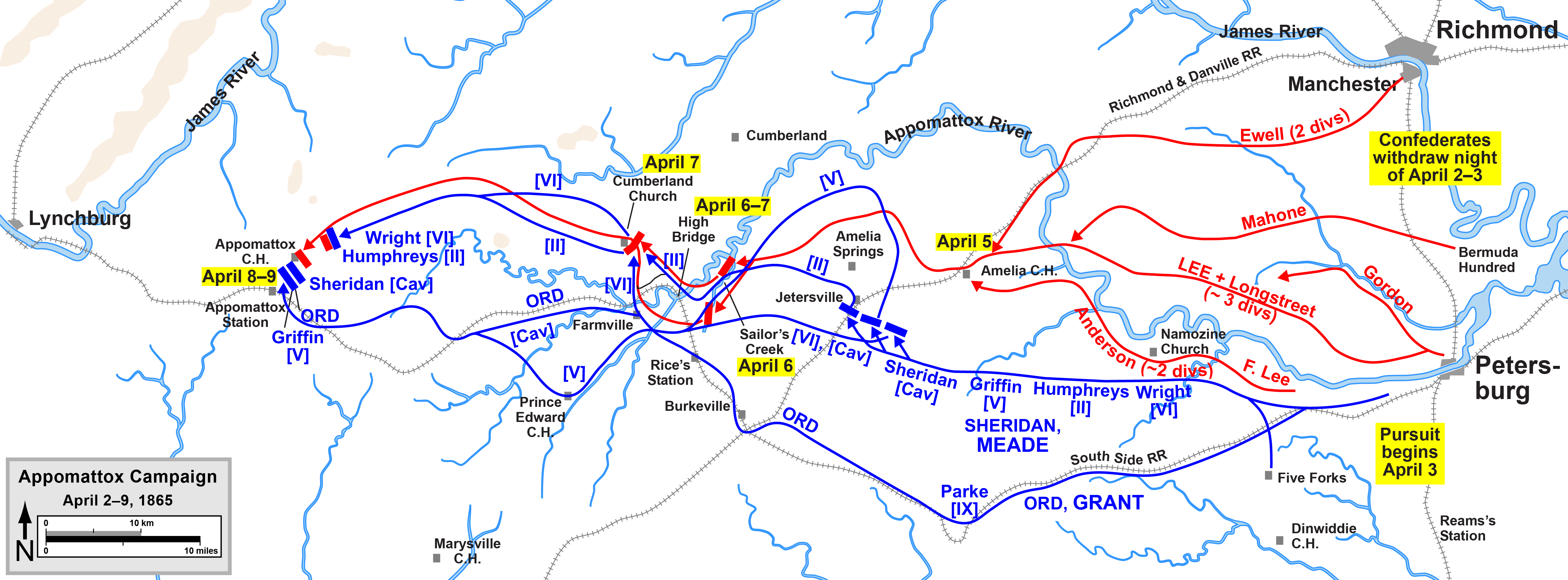
Grant did briefly accompany the Army of the James for part of the pursuit of the Army of Northern Virginia from the Petersburg front to Appomattox in April of 1865, a campaign that culminated with Robert E. Lee's surrender.
The centennial article then states, "He [Fisher] helped construct the 'Swamp Angel,' a masked battery with which the Union army shelled Charleston...."
This may have occurred. The regiment was stationed in the interior of Morris Island during the late summer of 1863 when the Marsh Battery or Swamp Angel battery was under construction. It took much manpower to carry 13,000 sandbags to the site. The Swamp Angel was constructed between James and Morris Islands near Charleston, SC in July and August of 1863. The Swamp Angel floated on hundreds of sandbags (on top of 20 feet of mud), which soldiers carried over wooden planks to the marsh. On August 22, the Swamp Angel began an incendiary bombardment of Charleston, which continued until the 36th shot shattered its breech.
 |
| LOC |
This may have occurred. The regiment was stationed in the interior of Morris Island during the late summer of 1863 when the Marsh Battery or Swamp Angel battery was under construction. It took much manpower to carry 13,000 sandbags to the site. The Swamp Angel was constructed between James and Morris Islands near Charleston, SC in July and August of 1863. The Swamp Angel floated on hundreds of sandbags (on top of 20 feet of mud), which soldiers carried over wooden planks to the marsh. On August 22, the Swamp Angel began an incendiary bombardment of Charleston, which continued until the 36th shot shattered its breech.
A problem here is that the 85th Pennsylvania was heavily involved in another Union effort at the time. Following the failed second assault on Fort Wagner on July 18 led by the black troops of the 54th Massachusetts, the next stage was unglamorous: the digging of a series of trenches or parallels to threaten the sand-walled battery. Along with the 100th New York and 3rd New Hampshire, the 85th Pennsylvania devoted almost all of their efforts in the month of August to this endeavor. Dickey's history of the regiment cites the diary of Commissary Sergeant John B. Bell for a day-to-day account of the regiment at this time. There are numerous references to "fatigue duty at the front," "completed seaward battery at third parallel," and the like, but no direct reference to constructing the Swamp Angel.
In his entry for August 17, Bell does state, "Regiment....moved to the front and during the day was engaged at fatigue duty filling gabions to strengthen the fortifications. Marsh Battery was completed ready for mounting guns."
Next in the obituary, the following reference is problematical. "...[Fisher] saw the battle of the
Monitor and the Merrimac."
This could not have occurred. The battle of ironclads took place on March 8-9, 1862. The 85th Pennsylvania did not arrive at Hampton Roads for the Peninsula Campaign until three weeks later on April 1. Yes, several soldiers in the regiment wrote of seeing the Monitor in the waters around Fort Monroe as their ship came in for docking. At another time, the Merrimac was spotted when they were camped near Hampton, VA. But the ironclad battle itself was not witnessed by Fisher or anyone else in the regiment.
Next in the obituary, the following reference is problematical. "...[Fisher] saw the battle of the
 |
| LOC |
This could not have occurred. The battle of ironclads took place on March 8-9, 1862. The 85th Pennsylvania did not arrive at Hampton Roads for the Peninsula Campaign until three weeks later on April 1. Yes, several soldiers in the regiment wrote of seeing the Monitor in the waters around Fort Monroe as their ship came in for docking. At another time, the Merrimac was spotted when they were camped near Hampton, VA. But the ironclad battle itself was not witnessed by Fisher or anyone else in the regiment.
The article concludes with the statement that, "A Republican, the aged man cast his first vote for president for a candidate with whom he shook hands several times, Abraham Lincoln."
It is possible that Fisher met Lincoln face to face, but to have shaken hands with the president more that once seems to be a stretch. First of all, several soldiers from the regiment claim to have encountered Lincoln when they were posted near Washington, DC during the winter of 1861-62. When they had free time, the men would often tour the capital city and several wrote that they talked to the president while walking the streets of Washington.
Lincoln then crossed paths with the regiment when Lincoln reviewed the entire Army of Northern Virginia in early July of 1862 at Harrison's Landing,VA. Finally, Lincoln was present at City Point,VA on March 25, 1865 and reviewed Union troops, including what may have included some in the 85th Pennsylvania. But Fisher had completed his three-year enlistment and had gone home the previous November.
Fisher and his wife, Martha Rockwell Fisher from Uniontown, spent the last six decades of his life in York County, Nebraska. He passed away on January 23, 1938, three months after his one-hundredth birthday.
Fisher and his wife, Martha Rockwell Fisher from Uniontown, spent the last six decades of his life in York County, Nebraska. He passed away on January 23, 1938, three months after his one-hundredth birthday.