Showing posts with label Battery Wagner. Show all posts

Wednesday, May 6, 2026

A Life of Service: Mark Gordon of the 85th Pennsylvania


Experiences in the Civil War (link below)

      Like all Civil War soldiers, like soldiers of any war, 18-year old Marquis Lafayette “Mark” Gordon of Greene County pondered how he would react to being subjected to  enemy fire for the first time. Would he show bravery or cowardice or something in between? Would he stand and fight to protect his comrades and his cause or would he freeze or “skedaddle”?

        Gordon, a highly thoughtful young man and a member of Company G the 85th Pennsylvania Volunteers, got his answer in 1862 on a chilly night during a battle in Virginia.

Battle of Williamsburg
85th PA is in Keyes Corps
Map Courtesy of Hal Jespersen  www.cwmaps,com

        On May 5, 1862 at Williamsburg, Virginia, Gordon’s regiment was called forward in reserve after the start of the first pitched battle of the Peninsula Campaign where  Union divisions under Joseph Hooker and Philip Kearny attacked the rearguard of the Confederate army during its escape from Yorktown. (The overall Union goal of the campaign was to make a water landing at Fort Monroe, march up the Virginia peninsula formed by the James and York Rivers and capture Richmond, the Confederate capital).

Colonel Joshua B. Howell
from Dickey's history of the 85th PA

        The 85th Pennsylvania volunteer regiment had been organized in the fall of 1861 by Joshua Blackwood Howell, a prominent attorney from Uniontown, PA. Howell’s soldiers came from four counties in the southwest corner of Pennsylvania: Greene, Fayette, Washington and Somerset. 

     Gordon hailed from Waynesburg, the county seat of Greene County. Gordon was a young school teacher when the war broke out. He chose to volunteer into the Union army to help suppress the rebellion of eleven southern states and preserve the 85-year old republic.

    The "Pursley Guards" which became a part of Company G were organized by Gordon’s father, John “Adam” Gordon, a prominent Waynesburg citizen. Adam Gordon was serving as the first superintendent of schools for Greene County when hostilities broke out. Also serving in Company G were Mark Gordon, his uncle, John Crawford and two cousins, Reason Strosnider and Owen Pitcock.

John Adam Gordon
Experiences in the Civil War

           When they arrived at training camp in Uniontown, Adam Gordon and his son along with the rest of the Pursley Guards were consolidated with another undermanned company to form Company G. Isaac Abraham of Smithfield in Fayette County was chosen as captain and Adam Gordon became the new company’s first lieutenant.

        Seven months later, at Williamsburg, Mark Gordon was called forward during a cold, misty rain with the rest of his regiment. The 85th Pennsylvania, stationed on the edge of a wooded area, was advanced 500 yards to relieve another Pennsylvania regiment, the 93rd. Some men in Gordon’s regiment had to step over the dead bodies of fallen soldiers to get to their assigned position, surely a sobering sight for these untested men. The 85th PA and their brigade remained in reserve for the rest of the battle. The entire brigade stood in formation for eighteen hours during a bone-chilling night until the fighting ahead of them finally ceased. The battle ended in a draw, and Confederates continued their movement up the peninsula towards Richmond.

        The 85th Pennsylvania was not directly engaged in the battle. They were subjected to cannon fire from a Confederate battery about a half-mile away. Most of these projectiles fell harmlessly in the trees in front of them or in their rear as the regiment fired several blind vollies of musket balls towards the Confederate position at Fort Magruder.  

        Two men in the regiment were nonetheless wounded, one severely. A piece of shrapnel cut the face of Captain John Morris of Company F, who was also from Greene County. More seriously, a shell struck down Sergeant Daniel Miller of Company K. Miller’s lower body was badly mangled. Both of his legs were amputated and he soon died in a Philadelphia hospital.

William Elliott Finley
from his memoir The Private's Life

         The wounds suffered by Morris and Miller were the only two casualties in the 85th Pennsylvania regiment that night. But Corporal William Elliot Finley of Company I wrote that the experience was terrifying for these green troops. He wrote, “The cries of the wounded and dying, the incessant and doleful patter of the falling rain together with the irregular picket firing in front, all conspired to make it a night of horror and unrest.” [1]

     The briskly cold night also had a harmful effect on scores of troops, including Mark Gordon. Many became ill. One member of Company A, John Neill of Washington, PA, remembered hearing his comrades’ teeth chattering up and down the line during the long night of standing in formation.

         M.L. Gordon later wrote of this first battlefield experience nearly thirty years later in his memoir called “Experiences in the Civil War.”  This account was privately published after M.L. Gordon’s death by his son, Donald.

        Gordon was raised in a religious environment at Waynesburg. He attended church and sat in as his father taught a Bible class to adults on Sunday afternoons. At Williamsburg, Mark Gordon found that he was not overcome with a paralyzing fear of battle, nor sacrificial bravery either. Instead, he was enveloped by a sense of spiritual serenity. “I can remember now the thought came to me, ‘What if I should be killed?’ I think I had been a Christian before, but I can remember how clearly the thought came to me that while my death might be a loss to my friends, it could bring no loss to me.’”

Civil War ambulance   LOC

     Gordon became ill from exposure at Williamsburg and was sent to a nearby camp hospital. He was recovering at a larger hospital in Newport News when many sick men were transferred to New York City to make room for casualties from the battle of Seven Pines [also known as Fair Oaks] that began later that month. Gordon therefore missed this fight in which his regiment suffered close to a hundred men killed and wounded.

       Of his illness, Gordon later remembered, “I began to feel the effects of the night before Williamsburg. A heavy fever set in, and as we had no way of transport for sick men, I fell behind. From the time we left Yorktown, it had been raining much of the time, and the roads were simply awful. Late that night I fell in with an ammunition train, and one of the drivers was kind enough to let me ride on one of his wagons, though he had no right to do so. I suppose he saw how sick a boy I was.” [2]

       After some time at home in Waynesburg following his stay in New York City to recover, Gordon rejoined his regiment after an absence of three months.  Ironically, his father by this time had been transferred to an ambulance corps and the two would spend the rest of the war apart from each other. 

     Mark became ill several more times over the next two years. But unlike 300 men from the 85th PA who were discharged for medical reasons between 1861 to 1864, Gordon returned to the regiment after each sickness and eventually finished his three-year enlistment.

         Gordon would be shot at and shelled many times during the campaigns in Charleston, South Carolina in 1863 and Bermuda Hundred, Virginia in 1864. The life-or-death realization of combat brought some soldiers closer to their faith. Others saw the horrific destruction around them and questioned a belief in a higher being. For his part, Gordon’s faith in God was strengthened by the war. Half of his postwar years would be spent overseas as a Christian missionary.

      Two years after his return from the war, Gordon finished his degree at Waynesburg College. He went on to achieve advanced degrees in both theology from Andover Theological Seminary in Massachusetts and in medicine from Columbia University. He spent 17 years of his postwar life in Japan and wrote two books about his time there. Prior to leaving for Japan, he married school teacher Agnes Donald in 1872. Together the couple had three children.

      In 1889, while serving in Japan, he was encouraged by his son, Donald, to write about his time in the Civil War. Mark Gordon died in Massachusetts in 1900 at the age of 57.

      Gordon’s Civil War memoir includes a dozen letters written to his uncle, William Gordon. It therefore offers the reader a contrast between Mark Gordon’s thoughts in real time (his letters and diary notes) and his narrative written a quarter-century later.

     Gordon occasionally offered political observations in his war letters. In 1863, referring to the Emancipation Proclamation which went into effect a few weeks earlier, he wrote, as a pro-Union Democrat, “He [Lincoln] has adopted measure which we believe ruinous, yet for his misdeeds shall we desert our country [?] [3]

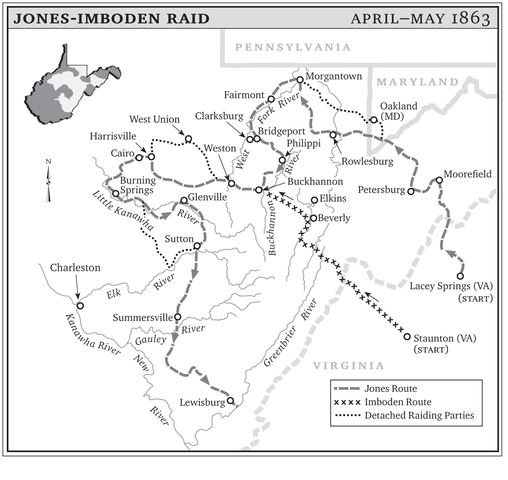
      Meanwhile, in the spring of 1863, western Pennsylvania was threatened with invasion as Confederate General William “Grumble” Jones led an expedition through western Virginia as far north as Morgantown, just five miles from the Greene County border. This Confederate raid had three purposes: to discourage western Virginians from carrying through with separation and statehood, to disrupt Union transportation and supplies, and to capture livestock for the Confederate cause.

       It was the latter goal that most alarmed the people of southwestern Pennsylvania, who were afraid that the raid would proceed up through their counties to the federal arsenal in Pittsburgh. Consequently, temporary militias were formed, bank holdings were sent away to safe locations, and farmers tried to hide their horses and cattle among the rolling hills of the area. In the end, the raiders stopped at Morgantown and then veered back into the western counties of West Virginia.

      Stationed on Folly Island near Charleston at the time, Gordon got a big chuckle when he read hometown newspapers of the panic caused by Jones’ marauders. He wrote to his uncle, “Our boys had a great time after the arrival of the last mail, laughing over the scare some of the people in Greene Co. had at the time of the threatened invasion by the Rebels, although I suspect, it was no laughing matter then…I think there were some men who should have shown more pluck than to run off with their horses and cattle & [potentially] leave their wives and children in the hands of a merciless, vagabond band of guerillas.” [4]

Union Camp on Morris Island    LOC

       While stationed on Morris Island, home of the famous Confederate stronghold Battery Wagner, Gordon crossed paths with Clara Barton, the most famous nurse of the Civil War and later the founder of the American Red Cross.

Clara Barton    LOC

     Barton was in the Charleston theater of the war to tend to the soldiers and also out of concern for her brother, David, a northern entrepreneur who had stayed in North Carolina when the war began to guard his various business ventures. Clara Barton set up a field hospital on Morris Island. While she tended to a wounded comrade from his company, Gordon wrote, “Away in the night Miss Barton came in and went round among the wounded, talking to them in such a nice way, that I could hardly repress the mental ‘God Bless You!’ that came to my lips and if I had followed my heart would have went up and kissed her right there before them all!” [5]

       While stationed on Morris Island, Gordon witnessed two failed infantry assaults on Battery Wagner in July of 1863 that resulted in thousands of Union casualties. In both cases, the 85th Pennsylvania was slated to participate in secondary attacks on the battery once the battery walls were breached, but in each case, the follow-up assaults were called off due to massive Union losses.

    The second assault was led by the 54th Massachusetts, a regiment of African Americans that suffered over 250 casualties but earned the respect of a generation of white Union soldiers like Mark Gordon. Shortly after the assault, Gordon wrote, “In regard to…arming the Negroes…I was opposed to many if not all of them but a close observation of the progress of the war has convinced me that in some instances, I was wrong.” [6]

54th storming Battery Wagner    LOC

        A year later, the 85th Pennsylvania became part of the newly formed Army of the James under General Benjamin Butler and was transferred to the Bermuda Hundred peninsula in Virginia between Richmond and Petersburg.

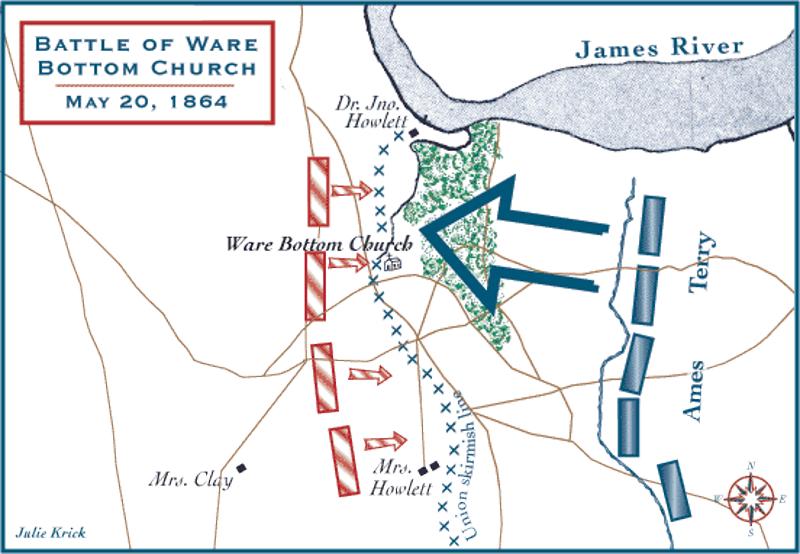
      On May 20, 1864, the regiment became engaged in a vigorous skirmish with the enemy at Ware Bottom Church. Gordon wrote, “Here we had the hardest direct fighting of my whole experience. They advanced within a hundred yards of us determined to drive us, but we were as determined to hold our ground. I here shot so fast as to make my gun-barrel so hot that it was uncomfortable to hold – the only time I ever had such an experience.” [7]

Marquis Lafayette Gordon
Experiences in the Civil War


Doshisha U. regents
from Thirty Eventful Years

       Gordon's postwar career showed a commitment to his now strengthened religious ideals. In Japan, Gordon lived in Osaka and became a professor of theology at Doshisha University in Kyoto. Gordon’s arrival came just after the Mejia Restoration when Japan became less isolationist and opened its borders to western visitors and ideas. Christianity was allowed after a ban that lasted two centuries.

      In 1889, while the time of his service in Japan was coming to a close, he was encouraged by his son, Donald, to write about his time in the Civil War. Mark Gordon died in Massachusetts in 1900 at the age of 57 shortly after his return from overseas.

        Prior to his death, in 1891, he had began writing “An American Missionary in Japan.” In the preface, he gave two reasons for writing this book. One was to record “the wonderful manner in which the religion of Christ is approaching the minds and hearts and lives of the Japanese people.” The other reason was to “outline the way in which missionaries…carry on to success the work for which they are sent out.”  [8]

       During his time in Japan, the Asian nation was swinging back and forth between opening up to foreigners to acquire more technology and knowledge on one hand, to on the other shutting down its borders to outside influences. As a doctor as well as a religious teacher, foreigners like Gordon had been welcomed more for their medical knowledge than their Christian teachings. By the time he left Japan, Christianity was seen as a threat to a growing Japanese nationalism movement.

      During a trip to Massachusetts in 1892, Gordon delivered a church sermon gave a sermon, comparing his trip to America to a soldier in the field. Gordon “came [home] as a soldier who visits another part of the battlefield and tells his comrades how the battle is going.”

Gordon as a medical missionary
Thirty Eventful Years

       Gordon added, “We are working for a civilized people…The Japanese ideas of etiquette must be respected if we would influence them. Etiquette requires me to remove my hat when I enter an American house; the Japanese remove their shoes. The Japanese are a progressive nation. Railroads and telegraphs have been introduced…Two years ago, it seemed as though the days of the Japanese missions were nearly ended, but the pendulum has swung the other way and there is an earnest demand for American missionaries.” [9]

       The last year of his life, 1900, was an active one. He finished writing his second book on his missionary experiences called “Thirty Eventful Years: The Story of the American Board Mission in Japan, 1869-1899” which was posthumously published in 1901.

        In the preface to this second work, Gordon's son, Donald, wrote: “The toil of these years had unmistakenly left its mark upon him, and many of his friends wished he had spared himself this new labor... Later, he himself clearly recognized the unwisdom of the undertaking but kept himself bravely at his task though with great weariness of the flesh and although there was even then creeping in upon him the fatal disease which ended his life on November 4, 1900.” [10]

      In “Thirty Eventful Years in Japan,” Gordon was overwhelming upbeat about his missionary experience. Gordon nonetheless included one vignette that demonstrated the danger faced by his family and fellow western missionaries towards the end of his mission. The group had received a chilling letter from some Japanese citizens who wished to expel all foreigners from Japanese soil.

     The anonymous letter stated, “You have come from a far county with the evil religion of Christ... With bad teaching you are gradually deceiving the people but we know your hearts, and hence we shall soon with Japanese swords inflict the punishment of Heaven upon you...In ancient times, when Buddhism first came to Japan, those who brought it were killed; in the same way you must be killed. But we do not wish to defile the sacred soil of Japan with your abominable blood. Hence take your families and go quickly.” [11]

        Perhaps due to this admonition or to his failing health (or both), Gordon came home to the United States. Seven months prior to his death, Gordon delivered an address at an evangelical conference entitled, “The Best Method of Dealing Personally with Unconverted and Inquirers.”  One month later, he was invited by the American Board of Missions to lead missionary efforts in the Hawaiian Islands (that had a large population of Japanese field workers) but had to turn down the offer due to his declining physical condition.

      In September of 1900, Gordon conducted the marriage of his son, Donald, to Louise Ayer in Boston. Gordon died a few weeks later from anemia at age 57 and is buried in Andover, Massachusetts.

        Today, M.L. Gordon’s legacy of achievement lives on among numerous descendants. These include his great grandson and namesake, Mark Gordon, who in 2018 was elected governor of Wyoming.

Governor Mark Gordon of Wyoming

   Endnotes

1.     The Private’s History, William Elliot Finley, 1867, p. 10

2.     2   Experiences in the Civil War, M.L. Gordon, edited by Donald Gordon, 1922, p.31

3.     3. Experiences in the Civil War, M.L. Gordon, p.7

4.     4. Experiences in the Civil War, p.34

5.     5. Experiences in the Civil War, p.39

6.     6.   Experiences in the Civil War, p.41

7.     7. Experiences in the Civil War, p. 59

8.     8. An American Missionary in Japan, M.L. Gordon, 1892, Cambridge, MA

9.     9. The Fitchburg (Mass.) Sentinel, March 17, 1892, page 6

1      10. Thirty Eventful Years in Japan, M.L. Gordon, 1901, Boston

        11. Thirty Eventful Years, p. 12


Sunday, February 21, 2021

John E. Michener and the Attempt to Capture Battery Gregg


Morris Island, Battery Wagner and Batter Gregg
Robert Knox Sneden    LOC

          In August of 1863, Lieutenant John E. Michener and his regiment, the 85th Pennsylvania, were stationed on Morris Island near Charleston, South Carolina. They were part of a Union effort to recapture Fort Sumter and subdue Charleston, the city considered the heart of the rebellion. The 85th Pennsylvania spent the month assigned to the arduous task of digging a series of parallels or trenches that the Union hoped would eventually lead to the capture of Battery Wagner, the key Confederate sand-walled fort. A bit farther towards the tip of the island at Cummings Point lay Battery Gregg

Lt. John E. Michener
New York Public Library

          The 85th Pennsylvania had arrived in South Carolina in late January of 1863 from New Bern, North Carolina. They first spend a few weeks at St. Helena Island. In early April, the invaded Folly Island and found it had been abandoned. The were stationed on Folly Island for several months until they crossed Light House Inlet to Morris Island, where they would spend about three months.

          In July  the 85th Pennsylvania did not participate in either of two assaults upon Battery Wagner, the key Confederate sand-walled fort that helped guard Charleston Harbor and Fort Sumter. During these two assaults, hundreds of Union soldiers fell trying to capture the structure. [Last month's blog entry was about Michener's command of the barge that ferried the famous African-American 54th Massachusetts from Folly Island to Morris Island for the second assault on Battery Wagner]. However, during the ensuing month-long work digging five parallels, the 85th Pennsylvania lost more men that any other federal regiment. Among the wounded was their leader, Colonel Joshua B. Howell who nearly died when the bombproof that he occupied had a direct hit from a Confederate shell on August 18. While Howell recovered from a severe concussion, the regiment was led by Lieutenant Colonel Henry A. Purviance. He was instantly killed by a friendly-fire incident a few days later on August 30 when a Union shell prematurely exploded directly over his head while he led his troops in a trench.

Storming Battery Wagner's Rifle Pits
Frank Leslie's Illustrated Newspaper       9-26-1863

       On August 26, with the parallels nearing completion, three hundred men from the 24th Massachusetts captured the Confederate rifle pits in front of Battery Wagner. With the distance to Battery Wagner vastly closer, for a third time, a third infantry  action to storm the walls of the structure was scheduled. Ahead of this third assault, a stealthy movement This was intended to be a stealthy up Vincent's Creek was planned to capture Battery Gregg and surround Wagner. About 150 men from four or five regiments were chosen for this assignment, including the 85th Pennsylvania, 100th New York, 3rd New Hampshire, and the 104th Pennsylvania. The mission, under the command of Major Oliver Sanford of the 7th Connecticut.

[AUTHOR NOTE: Sources differ about the number as well as which regiments participated in the assault. All agree that the 85th Pennsylvania and the 100th New York were involved. But the other regiments are varied.  Even though the commander of the assault, Oliver S. Sanford, was a member of the 7th Connecticut, the author could find no evidence that his regiment participated. Interestingly, in his 1905 "History of the Seventh Connecticut Volunteer Infantry," soldier and historian Stephen Walkley did not mention the Battery Gregg mission at all, including Sanford's role as leader.]


Path along Vincent's Creek to Battery Gregg
Map by Robert Know Sneden    LOC

       The mission against Battery Gregg was hampered by two unforeseen events. First, cloud cover evaporated and a bright moon revealed the Union boats on their way to Gregg. Second, when a Confederate boat with about 12 men aboard was spotting leaving the battery, Lieutenant Francis J. Higginson, in charge of the naval personnel and in control of the assault boats,  ordered his men to open fire. The boat was captured but the presence of Union  assaulters was revealed, and the mission was called off.

         The Union tried again the next night, but Battery Gregg, now on full alert,  immediately began shelling the Union boats before they reached the shore. Again, the mission was cancelled.

          Plans for a Union land assault upon Batteries Wagner and Gregg went forward anyway. But when the federals approached Battery Wagner on the morning of September 7, they found it had been abandoned. Battery Gregg was left unmanned as well. Confederate troops inside had escaped in the early morning hours. 

    Below is an excerpt from "Prison Life" by author T.J. Simpson, a short 1867 work about John E. Michener's war experiences, followed by a second version of the event from Lieutenant George Stowits of the 100th New York.

Carrying boats up Morris Island for the Assault
Harpers Weekly 10-3-1863
    "Two nights before the evacuation of Forts Wagner and Gregg," wrote Simpson, "a boat expedition had been planned by General [Alfred] Terry to proceed up Light-House creek to Charleston harbor, surprise Fort Gregg, capture and blow up the magazine and retire. Major [Oliver S.]  Sanford of the Sixth Connecticut was ordered to the command of the expedition. Details were made for the Eighty-fifth and One Hundred and Fourth Pennsylvania Volunteers and two other regiments, in all about two hundred men. Lieutenant Michener had charge of two boats of twenty men. Captain [Rolla] Phillips and [William] Kerr of the same [85th PA] regiment had charge also of three or four boats of the command. These small boats were manned by sailors and proceeded slowly and cautiously up the stream until they arrived in Charleston harbor, and between Forts Sumter and Gregg, the point to be assailed. As the boats arrived opposite Payne’s dock, they successfully formed on the right by filing into line and moved steadily forward for the intended assault. At the moment the boats struck the beach, the men were to rush for the fort without waiting to form in line of battle. A knowledge of their position by the enemy would have proved perilous in the extreme, for they were then directly in the center and in close range of a chain of regel forts and batteries that could have destroyed them in a moment. The moon, unfortunately for the expedition, began to rise at that moment and when they had arrived within less than a hundred yards of Fort Gregg, were discovered and repulsed.                    

          "The enemy at once sent up a signal and soon Forts Johnston and Moultrie and battery Beauregard had united in raising one continued shower of shot and shell upon them. Major Sanford, seeing the utter hopelessness of then making an attack, ordered the boats to rapidly withdraw. This order was, at first, but imperfectly understand on account of the great excitement; and hence, while some of the boats were beating a hasty retreat, others were pulling for the beach. The mistake, however, was soon rectified and all rushed to get beyond the range of the batteries, to add to the confusion, oars would get foul, boats run into each other, and some even goaground. In the midst of this dreadful dilemma a cannon ball went crashing through the side of Lieutenant Michener’s boat, and it was with the greatest difficulty kept from sinking. Astonishing as it may appear, but few lives were lost in this bold and daring adventure, and the boats returned in safety."

Approaching Battery Gregg
Harper's Weekly  10-3-1863
          Interestingly, Michener, through author Simpson, does not blame naval personnel for exposing the Union boats by firing upon the departing Confederate craft; but Michener did  state that moonlight gave away their location. Also, "Prison Life" makes no mention of the second assault upon Battery Gregg that was called off before any of the Union boats reached the shoreline.

        Perhaps the best  account of the mission against Battery Gregg came from Lieutenant Stowits of the 100th New York. Stowits was a member of the assault team, but was unimpressed by the planning and leadership prior to the assault. Many lives would have been lost in what he felt was a poorly-planned assault. 

Lt. George Stowits, 100th New York
History of the 100th Regiment   p,187
        "Five hundred men were detailed from four of the most reliable regiments, and the command of the expedition was entrusted to Maj. Sandford of the Seventh Connecticut...We remember the visit of the Chaplain to the tent of the writer to ascertain if we could swim. When assured we could, he responded that it was favorable. We knew not then of our detail for the expedition. Boats had been collected in one of the creeks, and the men assembled near the camp of the boat infantry, and awaited darkness, before embarking...Scanning the manner of Maj. Sandford [sic], and his apparent, to us, unfitness for so a responsible a work, we could not but feel that many brave men, if landed, would be destroyed.

      "Files for spiking the guns were put into the hands of men selected for that purpose. On inquiry as to what should be used for driving the files, the answer was given that anything that lay around the gun. To us, that was too uncertain. We obtained permission to leave the guns of the men selected, and ordered them to use the flat side of the bayonet, that no time should be lost in searching in the sand or battery for what might not be at hand. The orders were to head the boats for the beach, land, form, and rush for the fort, spike the guns, blow up the magazine and retire...We endeavored to impress our men with the danger, as well as the importance of the enterprise, that each man should act for himself and as though he was to do the work alone and unaided. In consequence of the limited number of boats a large number were left behind. The boats were filled with a quiet, thoughtful band. We glided along with the music of shell overhead, exploding and striking the water about. As we neared the bay a boat shot out from Gregg. She was hailed. No attention paid. We fired and brought her to. We captured a surgeon, major and ten men. The garrison was aroused, and we were ordered back. The next night a second attempt was made, with no better success. The enemy opened on the boat and drove them of. The loss was slight. Thus ended an ill-conceived and fruitless. enterprise."

Union camp on Morris Island    LOC


Friday, January 29, 2021

John E. Michener and the 54th Massachusetts

Colonel Robert Gould Shaw
54th Massachusetts
LOC


         In reviewing the brief 1867 biography called "Prison Life" [acquired courtesy of the New York Public Library] about Captain John E. Michener of the 85th Pennsylvania, one of the most interesting incidents recounted was Michener's connection to the charge by the famous 54th Massachusetts regiment upon Battery Wagner near Charleston, SC in 1863. Michener, it turned out, was in command of the barge that took this entire regiment of black troops to Morris Island shortly before they led a fateful and deadly Union charge. This assault was the basis for the 1990 movie called "Glory" starring Denzel Washington, Morgan Freeman and Matthew Broderick. 

         This assault was the second failed Union attempt to capture Battery Wagner. In both cases, the 85th Pennsylvania was assigned reserve duty. While two regiments from their brigade were with the 54th Massachusetts in the attack, but the 85th Pennsylvania was assigned to follow up the initial charge once the structure was breached. In both cases, the secondary assault was called off.

         With the Emancipation Proclamation having gone into effect a few months earlier,  African American troops had begun to be used more extensively by the Union to fight the war. The charge by the 54th Massachusetts is generally considered a turning point because it demonstrated the fighting ability and tenacity of the black troops and helped them generally gain acceptance from many, perhaps most, of their white comrades. Despite their inability to hold the Battery Wagner once the walls were breached, the high number of casualties and courage they displayed dispelled many assumptions among Union soldiers that black troops lacked discipline and would not fight with military discipline. 

         Black regiments such as the 54th Massachusetts were commanded by white officers. Colonel Robert Gould Shaw was chosen to lead this regiment, which actually had troops from various states including Pennsylvania. Shaw, age 25, was from an abolitionist family from Boston.

       The 85th Pennsylvania spent a nearly a year, from February of 1863 until January of 1864, in South Carolina in what turned out to be a futile attempt to capture Fort Sumter and the city of Charleston. The campaign is remembered for the two failed assaults on Battery Wagner that cost hundreds of Union lives, followed by a trench digging operation that eventually led to the abandonment of the structure by the Confederates.  It was assumed that Fort Sumter would soon follow, but the fort where the war began in April of 1861 did not return to Union hands until the last months of the war nearly four years later. 

      In the digging operation, which lasted nearly two months, the 85th Pennsylvania lost more men than any other Union regiment. Their entire campaign around Charleston is covered extensively in my book, "Such Hard and Severe Service: The 85th Pennsylvania in the Civil War," published by Monongahela Books.

      In the two assaults, on July 10 and 17, the 85th Pennsylvania was tasked to perform secondary assault duties once the battery was taken. Since the initial assaults both failed, the 85th Pennsylvania was not called upon to attack the fort.

      The second assault on July 17 was led by the famous 54th Massachusetts, a black regiment under the command of Colonel  Shaw. Shaw was killed along nearly a hundred of his men. Another 300 were wounded. 

Union camp on Folly Island    LOC

       The profile of Lieutenant John E. Michener in  "Prison Life," an 1867 brief account of his war service, relates that the young officer from Washington County spoke with Shaw on the barge that transported the 54th Massachusetts across Lighthouse Inlet from Folly Island to Morris Island for their fateful charge. 

        Below is the passage from "Prison Life." It begins with a summary of the 85th Pennsylvania's first few months of the Charleston campaign. It is interspersed with a first-hand account of the passage by a member of the black regiment, Luis F. Emilio.

          From "Prison Life:"  "The Eighty-Fifth Pennsylvania Volunteers and the One-hundredth New York regiments were the first to get possession and establish themselves on Folly Island. Here the Eighty-fifth Pennsylvania Volunteers, the Sixty-second and Sixty-seventh Ohio, the Thirty-ninth Illinois and the One-hundredth New York regiment were assigned to the command of Brigadier General [Israel] Vogdes. Light-house Inlet intervened,

Major Israel Vogdes
National Archives
dividing Folly Island from Morris Island. General Gilmore directed General Vogdes to construct a battery under cover of darkness upon the eastern point on Folly Island, directedly opposite to and within three hundred yards of the rebel works. Here was a natural formation, sand bank, thrown up by the waves of the sea, making a complete fortification, which only required a little rounding up and strengthening.

        "The rebel pickets paced the opposite shore, wholly ignorant of our operations or intentions, and under the impression that but a small force of Yankees was there. Accordingly, the rebel only sent over a mortar shell occasionally, by way of compliment, which did but little damage. Working parties only went to the front after darkness set in, and retired before daylight the next morning.

          "Breastworks, traverses and magazine were soon completed, and the huge guns mounted. Shot, powder and shell were conveyed to the magazine in wagons drawn by horses, mules being considered too noisy for that quiet operation. Even orders and commands were required to be given in a whisper and a cough or sneeze was positively prohibited. Had the presence of a working party or our operations then been known to the enemy they could easily have destroyed the entire Union force with their heavy guns. During the last six nights, Lieutenant Michener, with one hundred men of the Eighty-fifth Pennsylvania Volunteers, had been constantly engaged upon the work, and the last night prior to the opening of the siege performed the very difficult and dangerous task of stowing away the barrels of powder in the rough and hastily constructed magazine.

Folly Island, Light House Inlet Morris Island, and Fort Sumter
National Tribune, Washington, DC, 4-30-1891, p.1


    "On the day of the assault on Fort Wagner, Major Ed. Campbell
[of the 85th Pennsylvania]…detailed Lieutenant Michener to take charge of the transportation [across Lighthouse Inlet] and furnish boats to carry troops, stores and artillery. Colonel Robert G. Shaw, with the Fifty-fourth Massachusetts (colored) regiment arrived in the afternoon to take part in the assault. Lieutenant Michener succeeded in getting the entire regiment in a large barge and had them quickly towed over to Morris Island. Colonel Shaw, after kindly proffering Lieutenant Michener a cigar and thanking him for his prompt assistance in getting his regiment across, remarked, 'That if his black boys had any show whatever, the stars and stripes would be floating over Fort Wagner before sunset.'

      From Luis F. Emilio of the 54th Regiment: "After a march of some six miles, we arrived at Light- house Inlet and rested, awaiting transportation. Tuneful voices about the colors started the song, 'When this Cruel War is Over,' and the pathetic words of the chorus were taken up by others. It was the last song of many; but few then thought it a requiem. By ascending the sand-hills, we could see the distant vessels engaging Wagner. When all was prepared, the Fifty -fourth boarded a small steamer, landed on Morris Island, about 5 p. m., and remained near the shore for further orders." [History of the 54th Regiment of Massachusetts Volunteer Infantry, p.68]


54th Massachusetts at Fort Wagner   LOC


       From "Prison Life:"  "Colonel Shaw’s regiment was the first colored regiment organized in the free States, and both the Colonel and his brave boys shared in a mutual anxiety to show to their country and the world that it was not in vain that blacks as well as whites had been summoned to battle for its life and the freedom of man. …it went forward…to take its place in the front line of the assaulting column…the distance to be crossed at double-quick was half a mile. Not many, however, of these brave men fell until the pierced but unshaken column had almost reached the ditch and was within short musket range of the fort when a sheet of fire from small arms lighted up the enshrouding darkness while howitzers in the bastions raked the ditch as our men swept across it and hand grenades from the parapet tore through them as they climbed the seamed and ragged face of the fort and planted their colors for a moment on top.

         "Here fell Colonel Shaw, killed instantly. Here also fell General [George] Strong, mortally wounded, with Colonel [John L.] Chatfield and many other brave and gallant officers…."

Tuesday, August 4, 2020

Capture of Lt. James B. Washington

           
Casey's Division is circled. The line is the position of Casey's pickets.
The "X" is the approximate location of J.B. Washington's capture.
From Battles and Leaders of the Civil War, II; 1887, p.227


           In reviewing obituary records for the men of the 85th Pennsylvania infantry regiment from the Civil War, I came across this brief notation for Private George Washington Anderson of Company H. It pertains to an event that precluded the Battle of Seven Pines (Fair Oaks) near Richmond, VA that began on May 31, 1862.
        "During one of the Virginia campaigns, while doing picket duty, he [Anderson] captured Major J.B. Washington of the Confederate army, now and for a number of years past secretary of the Pittsburg and Connellsville branch of the B&O R.R. Major Anderson and Mr. Washington met in Somerset a few years since, when their recognition was mutual and they spent a pleasant hour talking over their war experience." (Somerset (PA) Herald,  October 20, 1897, p.3)
           If true, the capture of Washington by Anderson would be a notable occurrence from the battle by
Picket Duty    LOC
a member of the 85th Pennsylvania.  Many accounts of the Battle of Seven Pines mention Washington's capture, but Anderson's obituary is the only one I have come across that states the identity of the  soldier who captured him. [If any reader has further information about Washington's capture, I would appreciate a response.]
          It is confirmed that members of the 85th Pennsylvania were on picket duty that day. Lieutenant John E. Michener wrote, "There on Saturday of May 31st, without any support, our little Division was attacked by an overwhelming force of the enemy's best men, and after suffering a heavy loss, was repulsed...I was on picket duty in front of the swamp, and had instructions to hold my ground till the last." [Michener letter courtesy of Margaret Thompson]
          Private Milton McJunkin also wrote, "...our Company was on picket at the time so you see I saw the whole performance. About 1 o’clock the rebs fired three shots into our camp to give Casey warning. At the same time we, that is us pickets, were attacked by 5 brigades and nearly surrounded. Our Company was in the centre of the line and was cut in two so you see we had to retreat as it was useless for 200 pickets to try to check 5,000 of the best troops Jeff [Jefferson Davis] had so we scattered and got to camp the best way we could..." [The Bloody 85th: The Letters of Milton McJunkin, a Western Pennsylvania Soldier in the Civil War, by Palm, Sauers and Schroeder, p. 39]
           The capture of Washington, who was apparently performing a reconnaissance just prior to the Confederate attack, was significant. The Confederate attack in the early afternoon of May 31 nearly overwhelmed the division of Silas Casey, which was outnumbered 2-to-1 or 3-to-1. The 85th Pennsylvania was in the thick of the early fighting that day, in the brigade of General Henry Wessells, stationed near a battery during the early part of the battle. Pushed back to a line of trees, Colonel Joshua B. Howell rallied his 85th Pennsylvania regiment and parts of others to boldly advance towards a rifle pit and temporarily regain control of the position. Howell's men had to fall back once again, but not before buying precious time for Union reinforcements from across the Chickahominy River to arrive later in the afternoon and stop the Confederate advance.
          Despite their efforts, Army of the Potomac commander George B. McClellan (based on the questionable account of General Samuel Heintzelman of the Third Corps) chose not to praise Casey's Division for their stand but to disparage them publicly for their retreat after two or three hours of fighting.
         Casualties in the 85th Pennsylvania numbered around 30 dead and another 50 or so wounded.
        One of the charges made against General Casey was that he was unprepared for a Confederate attack. But in truth, Casey knew the precariousness of his position and was furiously trying to reinforce in anticipation of a rebel attack.
        The capture of Washington several hours prior to the battle only served to intensify the Union belief that an attack was imminent.
         Many accounts of the Battle of Seven Pines mention Washington's capture, but Anderson's obituary is the only one I have come across that says who captured him.
       Luther S. Dickey wrote the official history of the regiment in 1915, about 18 years after Anderson's death. He mentioned Washington's capture on that day but did not mention Anderson's role.
          "During the forenoon of May 31, the enemy appeared in force in front of the pickets immediately north of the Williamsburg Road. Shortly after 10 'clock A.M., Lieut. J.B. Washington , an aide-de-camp on the staff of General Joseph E. Johnston, was captured by Casey's pickets on the Nine-mile road and taken to Gen. [Silas] Casey's headquarters, and thence to Gen. [Erasmus] Keyes' headquarters..." [Dickey, p.71]
          Keyes immediately notified McClellan's staff of Washington's capture. "This young gentleman [Washington] was handsomely captured by our pickets on the right...In connection with the appearance with this young officer, on our right near our lines, I will state that the general officer of the day, Col. Hunt of Casey's division, heard the cars running through the night continually. Yesterday there was much stir among the enemy, and everything on his part indicates an attack on our position, which is only tolerably strong, and my forces too weak to defend it properly." [Dickey, p.72]
       
         Anderson died on October 14, 1897 in Ursina, Somerset County, Pennsylvania at the age of 65. He served three full years in Company H, comprised of men from Somerset County and led at the start of the war by young Captain James B. Tredwell. After the war, Anderson held a variety of positions in Ursina, including constable, justice of the peace, town council member and judge. 
       Incidentally, Anderson's obituary mentions that he and Washington met after the war in Somerset to discuss their meeting at Seven Pines. This is entirely plausible, since Washington for a time managed the Somerset branch of the B&O Railroad.
         During the summer of 1863, the 85th Pennsylvania was stationed on Morris Island, South Carolina. After two failed assaults on Battery Wagner at the northern end of the island, the 85th Pennsylvania was tasked with the arduous duty of digging a series of parallels or trenches that approached Battery Wagner. Many were killed and wounded during the digging operation, falling victim to enemy sharpshooters and shelling from five Confederate forts.
           After the end of the operation, which resulted in the Confederate abandonment of Battery Wagner,
Gillmore Medal
History of the Negro Troops in the War of the Rebellion, 1888
several soldiers in each regiment were nominated by their officers for special Fort Sumter Medals, also called "Gillmore Medals" for valorous service. Anderson was one of eight men from his regiment who were awarded this honor.
         James Barroll Washington, meanwhile,  was born in 1839 and was 23 years old at the time of his capture. He was born in Baltimore and was a graduate of West Point where he was a classmate of future General George Armstrong Custer At Seven Pines, after being captured, Washington posed with Custer, then a captain in the 5th Cavalry, for several photos, including the one below.
   
Matthew Brady photo of Washington and Custer
at Seven Pines on the day of Washington's capture    LOC

          Washington was part of a prisoner of exchange four months after his capture in September of 1862 at Aiken's Landing, Virginia. He then served the Confederacy in Alabama. He became a corporate executive of the Baltimore & Ohio Railroad and died in Pittsburgh, Pennsylvania in 1900. He is buried in his hometown of Baltimore.
          Interestingly, Washington's father, Lewis Washington, also has a prominent place in history. Lewis Washington, a great grandnephew of President George Washington, was one of the hostages taken by radical abolitionist John Brown in 1859 during his infamous raid on the arsenal at Harper's Ferry, Virginia. After Brown and his men holed up in the town's fire house with the hostages, it was Washington who pointed out Brown after U.S. Marines broke down the engine house doors and end the standoff.
John Brown' provisional army with hostages on the left in Harper's Ferry engine house
Lewis Washington is depicted as the second man from the left    LOC