Showing posts with label Ware Bottom Church. Show all posts

Wednesday, May 6, 2026

A Life of Service: Mark Gordon of the 85th Pennsylvania


Experiences in the Civil War (link below)

      Like all Civil War soldiers, like soldiers of any war, 18-year old Marquis Lafayette “Mark” Gordon of Greene County pondered how he would react to being subjected to  enemy fire for the first time. Would he show bravery or cowardice or something in between? Would he stand and fight to protect his comrades and his cause or would he freeze or “skedaddle”?

        Gordon, a highly thoughtful young man and a member of Company G the 85th Pennsylvania Volunteers, got his answer in 1862 on a chilly night during a battle in Virginia.

Battle of Williamsburg
85th PA is in Keyes Corps
Map Courtesy of Hal Jespersen  www.cwmaps,com

        On May 5, 1862 at Williamsburg, Virginia, Gordon’s regiment was called forward in reserve after the start of the first pitched battle of the Peninsula Campaign where  Union divisions under Joseph Hooker and Philip Kearny attacked the rearguard of the Confederate army during its escape from Yorktown. (The overall Union goal of the campaign was to make a water landing at Fort Monroe, march up the Virginia peninsula formed by the James and York Rivers and capture Richmond, the Confederate capital).

Colonel Joshua B. Howell
from Dickey's history of the 85th PA

        The 85th Pennsylvania volunteer regiment had been organized in the fall of 1861 by Joshua Blackwood Howell, a prominent attorney from Uniontown, PA. Howell’s soldiers came from four counties in the southwest corner of Pennsylvania: Greene, Fayette, Washington and Somerset. 

     Gordon hailed from Waynesburg, the county seat of Greene County. Gordon was a young school teacher when the war broke out. He chose to volunteer into the Union army to help suppress the rebellion of eleven southern states and preserve the 85-year old republic.

    The "Pursley Guards" which became a part of Company G were organized by Gordon’s father, John “Adam” Gordon, a prominent Waynesburg citizen. Adam Gordon was serving as the first superintendent of schools for Greene County when hostilities broke out. Also serving in Company G were Mark Gordon, his uncle, John Crawford and two cousins, Reason Strosnider and Owen Pitcock.

John Adam Gordon
Experiences in the Civil War

           When they arrived at training camp in Uniontown, Adam Gordon and his son along with the rest of the Pursley Guards were consolidated with another undermanned company to form Company G. Isaac Abraham of Smithfield in Fayette County was chosen as captain and Adam Gordon became the new company’s first lieutenant.

        Seven months later, at Williamsburg, Mark Gordon was called forward during a cold, misty rain with the rest of his regiment. The 85th Pennsylvania, stationed on the edge of a wooded area, was advanced 500 yards to relieve another Pennsylvania regiment, the 93rd. Some men in Gordon’s regiment had to step over the dead bodies of fallen soldiers to get to their assigned position, surely a sobering sight for these untested men. The 85th PA and their brigade remained in reserve for the rest of the battle. The entire brigade stood in formation for eighteen hours during a bone-chilling night until the fighting ahead of them finally ceased. The battle ended in a draw, and Confederates continued their movement up the peninsula towards Richmond.

        The 85th Pennsylvania was not directly engaged in the battle. They were subjected to cannon fire from a Confederate battery about a half-mile away. Most of these projectiles fell harmlessly in the trees in front of them or in their rear as the regiment fired several blind vollies of musket balls towards the Confederate position at Fort Magruder.  

        Two men in the regiment were nonetheless wounded, one severely. A piece of shrapnel cut the face of Captain John Morris of Company F, who was also from Greene County. More seriously, a shell struck down Sergeant Daniel Miller of Company K. Miller’s lower body was badly mangled. Both of his legs were amputated and he soon died in a Philadelphia hospital.

William Elliott Finley
from his memoir The Private's Life

         The wounds suffered by Morris and Miller were the only two casualties in the 85th Pennsylvania regiment that night. But Corporal William Elliot Finley of Company I wrote that the experience was terrifying for these green troops. He wrote, “The cries of the wounded and dying, the incessant and doleful patter of the falling rain together with the irregular picket firing in front, all conspired to make it a night of horror and unrest.” [1]

     The briskly cold night also had a harmful effect on scores of troops, including Mark Gordon. Many became ill. One member of Company A, John Neill of Washington, PA, remembered hearing his comrades’ teeth chattering up and down the line during the long night of standing in formation.

         M.L. Gordon later wrote of this first battlefield experience nearly thirty years later in his memoir called “Experiences in the Civil War.”  This account was privately published after M.L. Gordon’s death by his son, Donald.

        Gordon was raised in a religious environment at Waynesburg. He attended church and sat in as his father taught a Bible class to adults on Sunday afternoons. At Williamsburg, Mark Gordon found that he was not overcome with a paralyzing fear of battle, nor sacrificial bravery either. Instead, he was enveloped by a sense of spiritual serenity. “I can remember now the thought came to me, ‘What if I should be killed?’ I think I had been a Christian before, but I can remember how clearly the thought came to me that while my death might be a loss to my friends, it could bring no loss to me.’”

Civil War ambulance   LOC

     Gordon became ill from exposure at Williamsburg and was sent to a nearby camp hospital. He was recovering at a larger hospital in Newport News when many sick men were transferred to New York City to make room for casualties from the battle of Seven Pines [also known as Fair Oaks] that began later that month. Gordon therefore missed this fight in which his regiment suffered close to a hundred men killed and wounded.

       Of his illness, Gordon later remembered, “I began to feel the effects of the night before Williamsburg. A heavy fever set in, and as we had no way of transport for sick men, I fell behind. From the time we left Yorktown, it had been raining much of the time, and the roads were simply awful. Late that night I fell in with an ammunition train, and one of the drivers was kind enough to let me ride on one of his wagons, though he had no right to do so. I suppose he saw how sick a boy I was.” [2]

       After some time at home in Waynesburg following his stay in New York City to recover, Gordon rejoined his regiment after an absence of three months.  Ironically, his father by this time had been transferred to an ambulance corps and the two would spend the rest of the war apart from each other. 

     Mark became ill several more times over the next two years. But unlike 300 men from the 85th PA who were discharged for medical reasons between 1861 to 1864, Gordon returned to the regiment after each sickness and eventually finished his three-year enlistment.

         Gordon would be shot at and shelled many times during the campaigns in Charleston, South Carolina in 1863 and Bermuda Hundred, Virginia in 1864. The life-or-death realization of combat brought some soldiers closer to their faith. Others saw the horrific destruction around them and questioned a belief in a higher being. For his part, Gordon’s faith in God was strengthened by the war. Half of his postwar years would be spent overseas as a Christian missionary.

      Two years after his return from the war, Gordon finished his degree at Waynesburg College. He went on to achieve advanced degrees in both theology from Andover Theological Seminary in Massachusetts and in medicine from Columbia University. He spent 17 years of his postwar life in Japan and wrote two books about his time there. Prior to leaving for Japan, he married school teacher Agnes Donald in 1872. Together the couple had three children.

      In 1889, while serving in Japan, he was encouraged by his son, Donald, to write about his time in the Civil War. Mark Gordon died in Massachusetts in 1900 at the age of 57.

      Gordon’s Civil War memoir includes a dozen letters written to his uncle, William Gordon. It therefore offers the reader a contrast between Mark Gordon’s thoughts in real time (his letters and diary notes) and his narrative written a quarter-century later.

     Gordon occasionally offered political observations in his war letters. In 1863, referring to the Emancipation Proclamation which went into effect a few weeks earlier, he wrote, as a pro-Union Democrat, “He [Lincoln] has adopted measure which we believe ruinous, yet for his misdeeds shall we desert our country [?] [3]

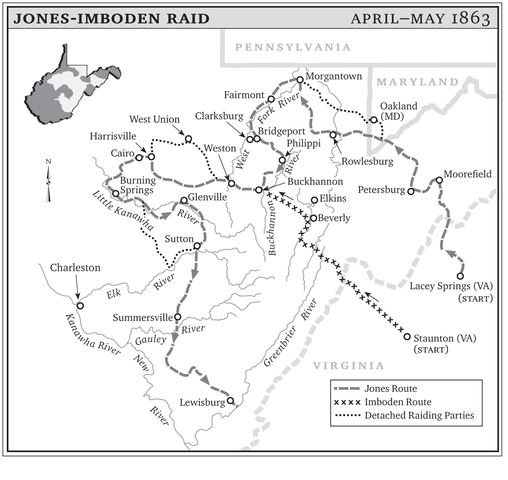
      Meanwhile, in the spring of 1863, western Pennsylvania was threatened with invasion as Confederate General William “Grumble” Jones led an expedition through western Virginia as far north as Morgantown, just five miles from the Greene County border. This Confederate raid had three purposes: to discourage western Virginians from carrying through with separation and statehood, to disrupt Union transportation and supplies, and to capture livestock for the Confederate cause.

       It was the latter goal that most alarmed the people of southwestern Pennsylvania, who were afraid that the raid would proceed up through their counties to the federal arsenal in Pittsburgh. Consequently, temporary militias were formed, bank holdings were sent away to safe locations, and farmers tried to hide their horses and cattle among the rolling hills of the area. In the end, the raiders stopped at Morgantown and then veered back into the western counties of West Virginia.

      Stationed on Folly Island near Charleston at the time, Gordon got a big chuckle when he read hometown newspapers of the panic caused by Jones’ marauders. He wrote to his uncle, “Our boys had a great time after the arrival of the last mail, laughing over the scare some of the people in Greene Co. had at the time of the threatened invasion by the Rebels, although I suspect, it was no laughing matter then…I think there were some men who should have shown more pluck than to run off with their horses and cattle & [potentially] leave their wives and children in the hands of a merciless, vagabond band of guerillas.” [4]

Union Camp on Morris Island    LOC

       While stationed on Morris Island, home of the famous Confederate stronghold Battery Wagner, Gordon crossed paths with Clara Barton, the most famous nurse of the Civil War and later the founder of the American Red Cross.

Clara Barton    LOC

     Barton was in the Charleston theater of the war to tend to the soldiers and also out of concern for her brother, David, a northern entrepreneur who had stayed in North Carolina when the war began to guard his various business ventures. Clara Barton set up a field hospital on Morris Island. While she tended to a wounded comrade from his company, Gordon wrote, “Away in the night Miss Barton came in and went round among the wounded, talking to them in such a nice way, that I could hardly repress the mental ‘God Bless You!’ that came to my lips and if I had followed my heart would have went up and kissed her right there before them all!” [5]

       While stationed on Morris Island, Gordon witnessed two failed infantry assaults on Battery Wagner in July of 1863 that resulted in thousands of Union casualties. In both cases, the 85th Pennsylvania was slated to participate in secondary attacks on the battery once the battery walls were breached, but in each case, the follow-up assaults were called off due to massive Union losses.

    The second assault was led by the 54th Massachusetts, a regiment of African Americans that suffered over 250 casualties but earned the respect of a generation of white Union soldiers like Mark Gordon. Shortly after the assault, Gordon wrote, “In regard to…arming the Negroes…I was opposed to many if not all of them but a close observation of the progress of the war has convinced me that in some instances, I was wrong.” [6]

54th storming Battery Wagner    LOC

        A year later, the 85th Pennsylvania became part of the newly formed Army of the James under General Benjamin Butler and was transferred to the Bermuda Hundred peninsula in Virginia between Richmond and Petersburg.

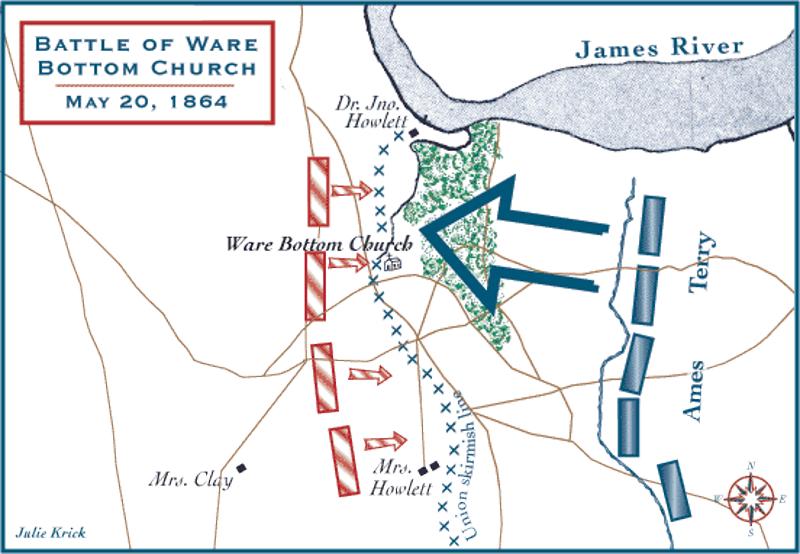
      On May 20, 1864, the regiment became engaged in a vigorous skirmish with the enemy at Ware Bottom Church. Gordon wrote, “Here we had the hardest direct fighting of my whole experience. They advanced within a hundred yards of us determined to drive us, but we were as determined to hold our ground. I here shot so fast as to make my gun-barrel so hot that it was uncomfortable to hold – the only time I ever had such an experience.” [7]

Marquis Lafayette Gordon
Experiences in the Civil War


Doshisha U. regents
from Thirty Eventful Years

       Gordon's postwar career showed a commitment to his now strengthened religious ideals. In Japan, Gordon lived in Osaka and became a professor of theology at Doshisha University in Kyoto. Gordon’s arrival came just after the Mejia Restoration when Japan became less isolationist and opened its borders to western visitors and ideas. Christianity was allowed after a ban that lasted two centuries.

      In 1889, while the time of his service in Japan was coming to a close, he was encouraged by his son, Donald, to write about his time in the Civil War. Mark Gordon died in Massachusetts in 1900 at the age of 57 shortly after his return from overseas.

        Prior to his death, in 1891, he had began writing “An American Missionary in Japan.” In the preface, he gave two reasons for writing this book. One was to record “the wonderful manner in which the religion of Christ is approaching the minds and hearts and lives of the Japanese people.” The other reason was to “outline the way in which missionaries…carry on to success the work for which they are sent out.”  [8]

       During his time in Japan, the Asian nation was swinging back and forth between opening up to foreigners to acquire more technology and knowledge on one hand, to on the other shutting down its borders to outside influences. As a doctor as well as a religious teacher, foreigners like Gordon had been welcomed more for their medical knowledge than their Christian teachings. By the time he left Japan, Christianity was seen as a threat to a growing Japanese nationalism movement.

      During a trip to Massachusetts in 1892, Gordon delivered a church sermon gave a sermon, comparing his trip to America to a soldier in the field. Gordon “came [home] as a soldier who visits another part of the battlefield and tells his comrades how the battle is going.”

Gordon as a medical missionary
Thirty Eventful Years

       Gordon added, “We are working for a civilized people…The Japanese ideas of etiquette must be respected if we would influence them. Etiquette requires me to remove my hat when I enter an American house; the Japanese remove their shoes. The Japanese are a progressive nation. Railroads and telegraphs have been introduced…Two years ago, it seemed as though the days of the Japanese missions were nearly ended, but the pendulum has swung the other way and there is an earnest demand for American missionaries.” [9]

       The last year of his life, 1900, was an active one. He finished writing his second book on his missionary experiences called “Thirty Eventful Years: The Story of the American Board Mission in Japan, 1869-1899” which was posthumously published in 1901.

        In the preface to this second work, Gordon's son, Donald, wrote: “The toil of these years had unmistakenly left its mark upon him, and many of his friends wished he had spared himself this new labor... Later, he himself clearly recognized the unwisdom of the undertaking but kept himself bravely at his task though with great weariness of the flesh and although there was even then creeping in upon him the fatal disease which ended his life on November 4, 1900.” [10]

      In “Thirty Eventful Years in Japan,” Gordon was overwhelming upbeat about his missionary experience. Gordon nonetheless included one vignette that demonstrated the danger faced by his family and fellow western missionaries towards the end of his mission. The group had received a chilling letter from some Japanese citizens who wished to expel all foreigners from Japanese soil.

     The anonymous letter stated, “You have come from a far county with the evil religion of Christ... With bad teaching you are gradually deceiving the people but we know your hearts, and hence we shall soon with Japanese swords inflict the punishment of Heaven upon you...In ancient times, when Buddhism first came to Japan, those who brought it were killed; in the same way you must be killed. But we do not wish to defile the sacred soil of Japan with your abominable blood. Hence take your families and go quickly.” [11]

        Perhaps due to this admonition or to his failing health (or both), Gordon came home to the United States. Seven months prior to his death, Gordon delivered an address at an evangelical conference entitled, “The Best Method of Dealing Personally with Unconverted and Inquirers.”  One month later, he was invited by the American Board of Missions to lead missionary efforts in the Hawaiian Islands (that had a large population of Japanese field workers) but had to turn down the offer due to his declining physical condition.

      In September of 1900, Gordon conducted the marriage of his son, Donald, to Louise Ayer in Boston. Gordon died a few weeks later from anemia at age 57 and is buried in Andover, Massachusetts.

        Today, M.L. Gordon’s legacy of achievement lives on among numerous descendants. These include his great grandson and namesake, Mark Gordon, who in 2018 was elected governor of Wyoming.

Governor Mark Gordon of Wyoming

   Endnotes

1.     The Private’s History, William Elliot Finley, 1867, p. 10

2.     2   Experiences in the Civil War, M.L. Gordon, edited by Donald Gordon, 1922, p.31

3.     3. Experiences in the Civil War, M.L. Gordon, p.7

4.     4. Experiences in the Civil War, p.34

5.     5. Experiences in the Civil War, p.39

6.     6.   Experiences in the Civil War, p.41

7.     7. Experiences in the Civil War, p. 59

8.     8. An American Missionary in Japan, M.L. Gordon, 1892, Cambridge, MA

9.     9. The Fitchburg (Mass.) Sentinel, March 17, 1892, page 6

1      10. Thirty Eventful Years in Japan, M.L. Gordon, 1901, Boston

        11. Thirty Eventful Years, p. 12


Thursday, July 1, 2021

Stories from Company B


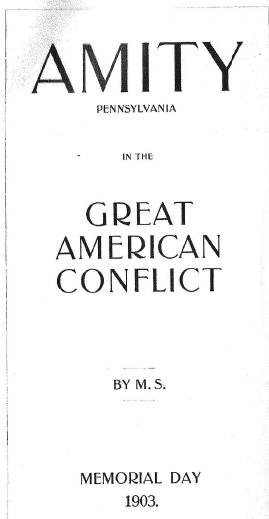
        The title of this article is from a pamphlet written in 1903 to celebrate Memorial Day in Amity, a small community in Washington County, Pennsylvania. While doing research for my book, "Such Severe and Hard Service: The 85th Pennsylvania in the Civil War," I came across an online reference to this booklet. Margaret Farrabee of Amity generously emailed me a copy, and I was able to use several citations for my book.

      The booklet was written early in the 20th century by 66-year old Manaen Sharp, who had served im Company B of the 85th Pennsylvania regiment. Sharp spent a year with the 85th before receiving a medical discharge. After the war, Sharp became a successful business man who owned furniture stores in Amity, Beallsville, and Little Washington, all in Washington County. He also served for a time as county treasurer. He died in 1920 at the age of 82 and is buried in Little Washington. His 1903 booklet chronicled the Civil War service of residents from the Amity area.

       Sharp wrote a paragraph or two about 40 or so soldiers from Amity and the surrounding area, including several from his own Company B of the 85th. [Sharp also included soldiers from other regiments, including the 140th Pennsylvania, the 22nd Pennsylvania Cavalry, and the 1st West Virginia Cavalry]. In doing so, Sharp recounts a series of interesting stories about many of the soldiers. Undoubtedly, Sharp was present for at least some of the events he described. In other cases, he surely heard the stories as they were passed around the campfire. Some others he learned about after the war, perhaps at regimental reunions. Below, I have quoted Sharp [in italics] concerning several members of his company.

     I have included some of my own comments in red.

LOC

CHRISTOPHER ANDERSON: At the battle of Fair Oaks, while aiming his gun, it was hit between his hands and disabled. He reached for the gun of a dead comrade and used it to good purpose.

Anderson returned home from the war. He died in 1877 and is buried in the Lone Pine Cemetery in Amity. 

Burying the Dead at Seven Pines
Harper's Weekly 7-19-1862
WILLIAM BRADEN: When driven back at Fair Oaks [Seven Pines], Comrade Braden was helping to carry his wounded captain [George H. Hooker] to save him from capture. The comrade, J.F. Speer of Canonsburg who was assisting, heard the sickening thud of a minie ball strike Comrade Braden, who said, 'I am hit.' He staggered to the road side and that is all that is known. He is buried among the unknown, but where? 

This story is confirmed by Captain Hooker, who wrote a letter in the pension file for Braden's widow, Nancy. “I hereby certify that Wm. Braden, a private of Company B 85th Pa. Vols, was shot while assisting me from the field at the Battle of Fair Oaks [Seven Pines] Virginia on the 31st day of May, 1862. He fell severely wounded and is supposed to have died from the effects of his wound.” 


Camp on Morris Island
Frank Leslie's Illustrated Newspaper

CYRUS [JOSIAH] BRATTON: His grave is on Morris Island, S.C....The autumn of 1863, he was excused from duty on account of sickness, but stayed in his quarters; his discharge papers were signed and with high hopes he expected to start for home in the morning. His messmate got breakfast and went to awaken him and found him in the sleep that knows no waking.

Bratton died of chronic diarrhea at age 25. 

JOHN CLAYTON: He was mortally wounded at Deep Bottom and taken to the hospital at Fortress Monroe where he died and is buried in the cemetery at the fort. At the Battle of Kingston [Kinston, NC] in loading his piece, he spilled the powder but rammed the bullet. He sat down where he stood in the battle line, unbreeched his gun, took out the ball, put his piece together, reloaded, putting in both balls with the remark, 'I will try and ring two of them this time.'

Clayton died from a gunshot wound to the thigh. He is buried in Hampton National Cemetery.

Attack Route Upon Battery Gregg
Robert Knox Sneden  LOC
LEONARD HAMMERS: In his performance of duty he had many narrow escape[s]. Only once did he lose hope -- that was when with others he was ordered to Morris Island to spike the guns of Battery Gregg. this battery could be swept by every fort in the harbor defences of Charleston. When they tied a strip of white on the left arm of this detail, so as to distinguish them from the Confederates in the darkness, hope left him but courage never. When the rebel guard discovered them and gave the alarm, the marines manning the boats refused to land, so the attack was not made.

Hammers enlisted at age 17. His first child was born while he was away in the army. He and his wife, Charlotte, had five more children after the war. He died in 1904 and is buried in AmityI wrote about the attempts to take Battery Gregg here.


Wounded Soldiers at Savage Station
1862    LOC

ABRAHAM IAMS: This young man took my place in the center of Co. B when I was taken to the hospital. He was mortally wounded at Fair Oaks, shot through the right breast and lay on the battlefield from Saturday afternoon until Monday afternoon when he was taken back to Savage Station. At 2 a.m. the next morning, in a down pour of rain, Robert Bair [James Robison Bair] put him on a train for White House [Landing, VA] where he died and is buried.

Corporal Iams was killed at the age of 25. He was survived by his parents, William and Delila, and his sister, Rachel.


Unidentified Soldier    LOC
DANIEL MILLER: Was badly wounded at Deep Bottom and was sent to the rear for repairs, [then] turned up in the hospital in New York. An order came to the effect that all soldiers who could walk to the railroad train would get furloughed. A comrade, James F. Speer, made him a pair of crutches. On these he started for the train, but had to rest many times before reaching it; but when seated in a comfortable car, contentment was seen all over his jolly face.

  Miller died in 1914 at age 78 and is buried at Amwell, PA. 

Kinston Swamp
45th Massachusetts Reunion 1887

DAVID MILLER: Was slightly wounded on the first and also on the second day at Fair Oaks. At Kinston, while charging through a swamp [left] , he was badly hurt and was helped to solid ground by a comrade who, examining his wound found the ball had passed through a deck of playing cards and buried itself in his side. He died about 1898.

I wrote an article about Miller on this blog which can be found here. Sharp's observation about Miller being wounded on the second day at Seven Pines [Fair Oaks] is interesting because his regiment had been sent to the rear and had not been actively engaged in the fight that day.

Henry T. Reynolds
HENRY TAYLOR REYNOLDS: Was killed June 14, 1864 near Richmond, Va. His body fell into the hands of the Confederates and was not recovered. He had a presentiment that he would not live out his time. A short time before he was killed, he applied for and obtained leave of absence to visit his old parents, as he believed, for the last time.

This story is confirmed by Oscar Lyons of Company B. I have included Reynolds' story in Volume II of my regimental history. Lyons wrote, "The boys tried to cheer him (Taylor) up, but the thought in his mind that he was soon to be killed could not be removed. On the 17th of June, we were in the rifle pits near Petersburg, on the North side of the Appomattox River... Many times through the day, Comrade Reynolds said he felt that his time had come; that he would never again see home or friends, for something told him that he was going to be killed."


Bridge over Chickahominy River
LOC
JAMES SMITH: At the change of base by McClellan's army on the Peninsula it was necessary to destroy a bridge over the Chickahominy river. The engineers had failed to destroy it because of a hot fire from the rebel side. An appeal was made to men in the line. Comrade Smith was one to respond for this important but dangerous work. They destroyed the bridge, checking Stonewall Jackson's flank movement.

Smith attended the last reunion of the regiment in Brownsville, Fayette County in 1928. He died in 1930 at the age of 88. 


Moses Smith


MOSES SMITH: Served his full term but had the misfortune to serve the latter part of it in Andersonville prison. Comparatively few survived this prison life. He was wounded at Kinston Bridge, the ball first striking his gun glancing into his leg. At Bermuda Hundred, an old tobacco barns stood close to the rebel line and was used by the rebel sharpshooters. Comrade Smith and Dave Miller crawled to this barn and set it on fire, completely destroying it. 

Moses Smith was the cousin of James Smith. He was captured at Ware Bottom Church, Virginia on June 16, 1864 with two other members of the regiment while on picket duty. He survived Andersonville and lived until 1924.


Hewitt's Cemetery
Rices' Landing, PA

SAMUEL WALTON: At Wier's [Ware] Bottom Church, while on picket duty, he was approached by a large grizzly unkempt rebel. Sam supposed he was coming in to surrender, as many of them at that time were doing, and was learning against a tree waiting to receive him. Imagine his surprise when the Johnnie fired, the ball striking the bark of the tree near his head, pieces of the bark stinging his face and neck. Comrade Walton did his duty at once. The rebel tried to reload his gun at once. The rebel tried to reload his gun after he was down and fatally wounded. 

 Walton enlisted as a private before being promoted to commissary sergeant.  He spent most of his postwar life in Greene County. He was involved in the lumber business and was the proprietor of S.M. Walton and Sons. He died in 1914 and is buried in Rices Landing, Greene County.     


Monday, February 24, 2020

Medal of Honor Recipients in the 85th PA

     
LOC
        For their actions during the Civil War, three members of the 85th Pennsylvania regiment were awarded Congressional Medals of Honor. They were John Shallenberger, William E. Leonard and Francis Morrison.
       Another member of the regiment, James Huff of Company E, stayed in the army following the war and was awarded a Medal of Honor in the 1870's during the army's campaign against the Apache Indians in America's southwest.
      Both Shallenberger of Company B and Leonard of Company F won their medals for capturing enemy flags during the Second Battle of Deep Bottom on August 16, 1864 near Richmond. Their medals were issued on April 6, 1865.
    Francis Morrison of Company H won his Medal of Honor for trying to save a fellow member of his company while under fire at Ware Bottom Church in Virginia on June 17, 1864.
       Leonard and Shallenberger's heroic moment occurred during Grant's fourth offensive against the Richmond-to-Petersburg (Virginia) line in mid-August of 1864, a simultaneous two-pronged attack against both cities. The 85th Pennsylvania crossed the James River from the Bermuda Hundred to help pressure the Confederates' Richmond defenses and make the Confederates continue to stretch their defensive line covering both cities. The 85th Pennsylvania, as part of the brigade of Colonel Francis B. Pond, temporarily poked a hole in the Confederate line near Darbytown Road, but eventually Union forces gave way in the face of Confederate reinforcements. The Union had better success at the other end of the line near Petersburg, capturing the Weldon Railroad.
Pontoon Bridge at Deep Bottom,VA
Across the James River    LOC
      At Deep Bottom, the 85th Pennsylvania and the rest of the Pond's Brigade stormed and captured an enemy position. The brigade suffered heavy losses. One account said that an initial volley by the Confederates killed and wounded many of Pond's men in the assault, but that the rest of the brigade took the Confederate position before the rebels could reload their muskets and fire a second time. Colonel Edward C. Campbell of the 85th Pennsylvania noted it was the first time his men had engaged in hand-to-hand warfare in their nearly three years of fighting. During the final phase of capturing the enemy position, Shallenberger and Leonard snatched enemy colors from two regiments.
         Shallenberger (or Shellenberger), age 24 from Fayette County, worked as a farm laborer after the war He died in 1911 at the age of 71 in Granville, Licking County, Ohio where he spent the last 20 years of his life. Nearly eighty years later, in 1990, a new bronze marker was installed at his gravesite at the Welsh Hills Cemetery in Granville, Licking County. His original marble headstone mentioned only his service in the Civil War. The newer bronze marker recognized him for his Medal of Honor.
         In 2013, the Pennsylvania General Assembly designated a portion of the Mon Valley Expressway Interchange (Exit 18) in Fayette County as the John S. Shallenberger Interchange.
     Like Shallenberger, William E. Leonard captured an enemy flag at Second Deep Bottom. Leonard was wounded in the ear during the assault but survived. Leonard died in early 1891. A fellow soldier from Company F, wrote a tribute to Leonard that appeared in the Washington Observer newspaper (February 26, 1891, page 1). Sergeant James E. Sayers wrote a detailed recollection of Leonard's actions that day.
   
Second Deep Bottom Reenactment  2014
 "To him belongs the honor of capturing the only flag taken from the enemy on the field of battle by a Greene countian during the war...It was at the battle of Deep Bottom, Va., on August 16, 1964. In a charge by our brigade upon the enemy's works, the 85th lost the heaviest it ever did in a single dash.  Massed in 'close column by division at half distance,' which simply means a solid square, we made the outset through a thicket, and coming upon the enemy's rifle pits before we were scarcely aware of their proximity, received the fire of a double line of battle so close that the blaze from their muskets almost reached our faces. Men fell so thickly that I thought they all had laid down. But in an instant, those not hit recovered from the blinding,crashing musketry and with a 'hurrah,' leaped the rifle pits. Many of the Confederates fled, but a large proportion were captured. Ed Leonard went over the works a few rods to my left, and with others, pursed the enemy until recalled or rather forced back by the enemy reinforced...It was a day or two after the charge before Ed reported the capture of the flag. He first told some of his comrades and showed them the flag, and by then it was reported to headquarters. Ed's story is that after he crossed the works, he saw the flag and went for it. The man who carried it was shot...the dead man grasped the staff so firmly that in the haste and confusion of the fight, Ed stripped the flag from its staff and stuffed it in his haversack and it remained there until the hurly burly and anxiety of the fight was over." 

Francis Morrison's Chest Wound
Courtesy of Vallorie Brady
      Francis Morrison enlisted into of Company H as  a 16-year old  from Ohiopyle, Fayette County and was the last of the 85th Pennsylvania soldiers to receive a Medal of Honor for a brave act during the Civil War. On June 17, 1864, at the Battle of Ware Bottom Church during the Bermuda Hundred Campaign, Morrison risked his life in an attempt to carry comrade Jesse Dial from the field to safety. Dial died of his wounds, but this did not lessen Morrison's bravery.
      Morrison's citation stated,  "Private Jesse Dial was struck by a bullet and left behind. Private Morrison saw his comrade fall and, with utter disregard of a hail of bullets, advanced towards the enemy and was soon at the side of his friends. As he tenderly raised him from the ground to discover to his dismay that Dial wad dead. He then carried the corpse back to his regiment."
    Morrison's act of bravery was observed by Captain Ross Sanner, who submitted a recommendation for the Medal of Honor.
      Two months later, Morrison was shot through the chest at the Second Battle of Deep Bottom. The gunshot wound through his lung was described as fatal at the time. Morrison recovered, however (he had an open exit wound in his back for the remainder of his life), and went on to live for 49 more years. Morrison had also been earlier wounded at Seven Pines, Virginia in 1862 and on Morris Island, South Carolina in 1863.
Instructor Francis Morrison
Courtesy of Vallorie Brady
       Morrison began receiving a pension for his back wound in 1867. By 1883, he was receiving $18 a month, demonstrating the seriousness of his injury (amputees received $24).
    The postwar life of Morrison, who returned to Ohiopyle, included teaching, farming, serving as as justice of the peace and school board member. He died in 1913 and is buried in the Sugar Grove Cemetery in Ohiopyle. (Laurel Messenger, August, 1968, p.8)
          Morrison received his Medal of Honor 33 years after his valorous act, probably with the intercession of Inspector General Robert P. Hughes, a former officer of the 85th Pennsylvania who helped lead the charge that day at Deep Bottom.
        James Huff of Company E  was from Washington, PA. Huff had the distinction of serving in the infantry, artillery and cavalry during the course of his career. Huff began his military service in the 85th Pennsylvania under sad circumstances. His brother, Andrew, was one of the first members of the regiment to die (from disease) early in the regiment's stay at Washington, DC in 1861.
      James Huff served for a year in the 85th Pennsylvania and then transferred to the 4th U.S. Artillery, Battery L. Unlike almost every other member of his original regiment, Huff decided to make the military his career. He reenlisted in 1867 and was sent to the western frontier.
       A biographical entry  from the turn of the century noted,“James W, Huff, a veteran of the Civil War, re-enlisted in the United
James W. Huff
States Army at Philadelphia in 1867, and was assigned to troop ‘L,’ 1st Cavalry. The troop, with others, was sent to Arizona in June, 1869. It remained at Fort Goodwin until 1870, and then went to Fort Apache, which it helped to establish. Huff was the first white man to construct a log-house in that region. The Apache Indians, those scourges of the southwestern frontier, went upon the war-path in the winter of 1872, and during the balance of the winter and spring of 1873 kept the available United States troops very busy. General George Crook, upon the commencement of hostilities, ordered into the field a part of the 1st Cavalry…The Indians were overtaken in the Dragoon Mountains, and defeated.

      "They were separated into small bands and scattered through the surrounding region. When about eight miles from the command, the Apaches were discovered. Notwithstanding that the scouting party was outnumbered five or six to one, the Apaches were without hesitation or delay vigorously attacked. Huff and his three companions during the fight, which was very fierce while it was in progress, succeeded in killing seventeen of the Apaches, when the remainder fled.” 
      After his army service, Huff lived in Georgia and in 1910 and was the overseer of a rifle range in Turkey Creek, Carroll County  Huff moved to Florida and died in New Port Richey in 1927 at the age of 87.