Showing posts with label Battery Gregg. Show all posts

Thursday, July 1, 2021

Stories from Company B


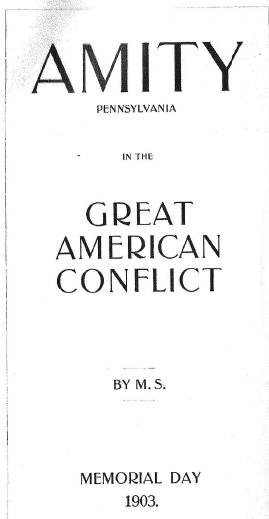
        The title of this article is from a pamphlet written in 1903 to celebrate Memorial Day in Amity, a small community in Washington County, Pennsylvania. While doing research for my book, "Such Severe and Hard Service: The 85th Pennsylvania in the Civil War," I came across an online reference to this booklet. Margaret Farrabee of Amity generously emailed me a copy, and I was able to use several citations for my book.

      The booklet was written early in the 20th century by 66-year old Manaen Sharp, who had served im Company B of the 85th Pennsylvania regiment. Sharp spent a year with the 85th before receiving a medical discharge. After the war, Sharp became a successful business man who owned furniture stores in Amity, Beallsville, and Little Washington, all in Washington County. He also served for a time as county treasurer. He died in 1920 at the age of 82 and is buried in Little Washington. His 1903 booklet chronicled the Civil War service of residents from the Amity area.

       Sharp wrote a paragraph or two about 40 or so soldiers from Amity and the surrounding area, including several from his own Company B of the 85th. [Sharp also included soldiers from other regiments, including the 140th Pennsylvania, the 22nd Pennsylvania Cavalry, and the 1st West Virginia Cavalry]. In doing so, Sharp recounts a series of interesting stories about many of the soldiers. Undoubtedly, Sharp was present for at least some of the events he described. In other cases, he surely heard the stories as they were passed around the campfire. Some others he learned about after the war, perhaps at regimental reunions. Below, I have quoted Sharp [in italics] concerning several members of his company.

     I have included some of my own comments in red.

LOC

CHRISTOPHER ANDERSON: At the battle of Fair Oaks, while aiming his gun, it was hit between his hands and disabled. He reached for the gun of a dead comrade and used it to good purpose.

Anderson returned home from the war. He died in 1877 and is buried in the Lone Pine Cemetery in Amity. 

Burying the Dead at Seven Pines
Harper's Weekly 7-19-1862
WILLIAM BRADEN: When driven back at Fair Oaks [Seven Pines], Comrade Braden was helping to carry his wounded captain [George H. Hooker] to save him from capture. The comrade, J.F. Speer of Canonsburg who was assisting, heard the sickening thud of a minie ball strike Comrade Braden, who said, 'I am hit.' He staggered to the road side and that is all that is known. He is buried among the unknown, but where? 

This story is confirmed by Captain Hooker, who wrote a letter in the pension file for Braden's widow, Nancy. “I hereby certify that Wm. Braden, a private of Company B 85th Pa. Vols, was shot while assisting me from the field at the Battle of Fair Oaks [Seven Pines] Virginia on the 31st day of May, 1862. He fell severely wounded and is supposed to have died from the effects of his wound.” 


Camp on Morris Island
Frank Leslie's Illustrated Newspaper

CYRUS [JOSIAH] BRATTON: His grave is on Morris Island, S.C....The autumn of 1863, he was excused from duty on account of sickness, but stayed in his quarters; his discharge papers were signed and with high hopes he expected to start for home in the morning. His messmate got breakfast and went to awaken him and found him in the sleep that knows no waking.

Bratton died of chronic diarrhea at age 25. 

JOHN CLAYTON: He was mortally wounded at Deep Bottom and taken to the hospital at Fortress Monroe where he died and is buried in the cemetery at the fort. At the Battle of Kingston [Kinston, NC] in loading his piece, he spilled the powder but rammed the bullet. He sat down where he stood in the battle line, unbreeched his gun, took out the ball, put his piece together, reloaded, putting in both balls with the remark, 'I will try and ring two of them this time.'

Clayton died from a gunshot wound to the thigh. He is buried in Hampton National Cemetery.

Attack Route Upon Battery Gregg
Robert Knox Sneden  LOC
LEONARD HAMMERS: In his performance of duty he had many narrow escape[s]. Only once did he lose hope -- that was when with others he was ordered to Morris Island to spike the guns of Battery Gregg. this battery could be swept by every fort in the harbor defences of Charleston. When they tied a strip of white on the left arm of this detail, so as to distinguish them from the Confederates in the darkness, hope left him but courage never. When the rebel guard discovered them and gave the alarm, the marines manning the boats refused to land, so the attack was not made.

Hammers enlisted at age 17. His first child was born while he was away in the army. He and his wife, Charlotte, had five more children after the war. He died in 1904 and is buried in AmityI wrote about the attempts to take Battery Gregg here.


Wounded Soldiers at Savage Station
1862    LOC

ABRAHAM IAMS: This young man took my place in the center of Co. B when I was taken to the hospital. He was mortally wounded at Fair Oaks, shot through the right breast and lay on the battlefield from Saturday afternoon until Monday afternoon when he was taken back to Savage Station. At 2 a.m. the next morning, in a down pour of rain, Robert Bair [James Robison Bair] put him on a train for White House [Landing, VA] where he died and is buried.

Corporal Iams was killed at the age of 25. He was survived by his parents, William and Delila, and his sister, Rachel.


Unidentified Soldier    LOC
DANIEL MILLER: Was badly wounded at Deep Bottom and was sent to the rear for repairs, [then] turned up in the hospital in New York. An order came to the effect that all soldiers who could walk to the railroad train would get furloughed. A comrade, James F. Speer, made him a pair of crutches. On these he started for the train, but had to rest many times before reaching it; but when seated in a comfortable car, contentment was seen all over his jolly face.

  Miller died in 1914 at age 78 and is buried at Amwell, PA. 

Kinston Swamp
45th Massachusetts Reunion 1887

DAVID MILLER: Was slightly wounded on the first and also on the second day at Fair Oaks. At Kinston, while charging through a swamp [left] , he was badly hurt and was helped to solid ground by a comrade who, examining his wound found the ball had passed through a deck of playing cards and buried itself in his side. He died about 1898.

I wrote an article about Miller on this blog which can be found here. Sharp's observation about Miller being wounded on the second day at Seven Pines [Fair Oaks] is interesting because his regiment had been sent to the rear and had not been actively engaged in the fight that day.

Henry T. Reynolds
HENRY TAYLOR REYNOLDS: Was killed June 14, 1864 near Richmond, Va. His body fell into the hands of the Confederates and was not recovered. He had a presentiment that he would not live out his time. A short time before he was killed, he applied for and obtained leave of absence to visit his old parents, as he believed, for the last time.

This story is confirmed by Oscar Lyons of Company B. I have included Reynolds' story in Volume II of my regimental history. Lyons wrote, "The boys tried to cheer him (Taylor) up, but the thought in his mind that he was soon to be killed could not be removed. On the 17th of June, we were in the rifle pits near Petersburg, on the North side of the Appomattox River... Many times through the day, Comrade Reynolds said he felt that his time had come; that he would never again see home or friends, for something told him that he was going to be killed."


Bridge over Chickahominy River
LOC
JAMES SMITH: At the change of base by McClellan's army on the Peninsula it was necessary to destroy a bridge over the Chickahominy river. The engineers had failed to destroy it because of a hot fire from the rebel side. An appeal was made to men in the line. Comrade Smith was one to respond for this important but dangerous work. They destroyed the bridge, checking Stonewall Jackson's flank movement.

Smith attended the last reunion of the regiment in Brownsville, Fayette County in 1928. He died in 1930 at the age of 88. 


Moses Smith


MOSES SMITH: Served his full term but had the misfortune to serve the latter part of it in Andersonville prison. Comparatively few survived this prison life. He was wounded at Kinston Bridge, the ball first striking his gun glancing into his leg. At Bermuda Hundred, an old tobacco barns stood close to the rebel line and was used by the rebel sharpshooters. Comrade Smith and Dave Miller crawled to this barn and set it on fire, completely destroying it. 

Moses Smith was the cousin of James Smith. He was captured at Ware Bottom Church, Virginia on June 16, 1864 with two other members of the regiment while on picket duty. He survived Andersonville and lived until 1924.


Hewitt's Cemetery
Rices' Landing, PA

SAMUEL WALTON: At Wier's [Ware] Bottom Church, while on picket duty, he was approached by a large grizzly unkempt rebel. Sam supposed he was coming in to surrender, as many of them at that time were doing, and was learning against a tree waiting to receive him. Imagine his surprise when the Johnnie fired, the ball striking the bark of the tree near his head, pieces of the bark stinging his face and neck. Comrade Walton did his duty at once. The rebel tried to reload his gun at once. The rebel tried to reload his gun after he was down and fatally wounded. 

 Walton enlisted as a private before being promoted to commissary sergeant.  He spent most of his postwar life in Greene County. He was involved in the lumber business and was the proprietor of S.M. Walton and Sons. He died in 1914 and is buried in Rices Landing, Greene County.     


Sunday, February 21, 2021

John E. Michener and the Attempt to Capture Battery Gregg


Morris Island, Battery Wagner and Batter Gregg
Robert Knox Sneden    LOC

          In August of 1863, Lieutenant John E. Michener and his regiment, the 85th Pennsylvania, were stationed on Morris Island near Charleston, South Carolina. They were part of a Union effort to recapture Fort Sumter and subdue Charleston, the city considered the heart of the rebellion. The 85th Pennsylvania spent the month assigned to the arduous task of digging a series of parallels or trenches that the Union hoped would eventually lead to the capture of Battery Wagner, the key Confederate sand-walled fort. A bit farther towards the tip of the island at Cummings Point lay Battery Gregg

Lt. John E. Michener
New York Public Library

          The 85th Pennsylvania had arrived in South Carolina in late January of 1863 from New Bern, North Carolina. They first spend a few weeks at St. Helena Island. In early April, the invaded Folly Island and found it had been abandoned. The were stationed on Folly Island for several months until they crossed Light House Inlet to Morris Island, where they would spend about three months.

          In July  the 85th Pennsylvania did not participate in either of two assaults upon Battery Wagner, the key Confederate sand-walled fort that helped guard Charleston Harbor and Fort Sumter. During these two assaults, hundreds of Union soldiers fell trying to capture the structure. [Last month's blog entry was about Michener's command of the barge that ferried the famous African-American 54th Massachusetts from Folly Island to Morris Island for the second assault on Battery Wagner]. However, during the ensuing month-long work digging five parallels, the 85th Pennsylvania lost more men that any other federal regiment. Among the wounded was their leader, Colonel Joshua B. Howell who nearly died when the bombproof that he occupied had a direct hit from a Confederate shell on August 18. While Howell recovered from a severe concussion, the regiment was led by Lieutenant Colonel Henry A. Purviance. He was instantly killed by a friendly-fire incident a few days later on August 30 when a Union shell prematurely exploded directly over his head while he led his troops in a trench.

Storming Battery Wagner's Rifle Pits
Frank Leslie's Illustrated Newspaper       9-26-1863

       On August 26, with the parallels nearing completion, three hundred men from the 24th Massachusetts captured the Confederate rifle pits in front of Battery Wagner. With the distance to Battery Wagner vastly closer, for a third time, a third infantry  action to storm the walls of the structure was scheduled. Ahead of this third assault, a stealthy movement This was intended to be a stealthy up Vincent's Creek was planned to capture Battery Gregg and surround Wagner. About 150 men from four or five regiments were chosen for this assignment, including the 85th Pennsylvania, 100th New York, 3rd New Hampshire, and the 104th Pennsylvania. The mission, under the command of Major Oliver Sanford of the 7th Connecticut.

[AUTHOR NOTE: Sources differ about the number as well as which regiments participated in the assault. All agree that the 85th Pennsylvania and the 100th New York were involved. But the other regiments are varied.  Even though the commander of the assault, Oliver S. Sanford, was a member of the 7th Connecticut, the author could find no evidence that his regiment participated. Interestingly, in his 1905 "History of the Seventh Connecticut Volunteer Infantry," soldier and historian Stephen Walkley did not mention the Battery Gregg mission at all, including Sanford's role as leader.]


Path along Vincent's Creek to Battery Gregg
Map by Robert Know Sneden    LOC

       The mission against Battery Gregg was hampered by two unforeseen events. First, cloud cover evaporated and a bright moon revealed the Union boats on their way to Gregg. Second, when a Confederate boat with about 12 men aboard was spotting leaving the battery, Lieutenant Francis J. Higginson, in charge of the naval personnel and in control of the assault boats,  ordered his men to open fire. The boat was captured but the presence of Union  assaulters was revealed, and the mission was called off.

         The Union tried again the next night, but Battery Gregg, now on full alert,  immediately began shelling the Union boats before they reached the shore. Again, the mission was cancelled.

          Plans for a Union land assault upon Batteries Wagner and Gregg went forward anyway. But when the federals approached Battery Wagner on the morning of September 7, they found it had been abandoned. Battery Gregg was left unmanned as well. Confederate troops inside had escaped in the early morning hours. 

    Below is an excerpt from "Prison Life" by author T.J. Simpson, a short 1867 work about John E. Michener's war experiences, followed by a second version of the event from Lieutenant George Stowits of the 100th New York.

Carrying boats up Morris Island for the Assault
Harpers Weekly 10-3-1863
    "Two nights before the evacuation of Forts Wagner and Gregg," wrote Simpson, "a boat expedition had been planned by General [Alfred] Terry to proceed up Light-House creek to Charleston harbor, surprise Fort Gregg, capture and blow up the magazine and retire. Major [Oliver S.]  Sanford of the Sixth Connecticut was ordered to the command of the expedition. Details were made for the Eighty-fifth and One Hundred and Fourth Pennsylvania Volunteers and two other regiments, in all about two hundred men. Lieutenant Michener had charge of two boats of twenty men. Captain [Rolla] Phillips and [William] Kerr of the same [85th PA] regiment had charge also of three or four boats of the command. These small boats were manned by sailors and proceeded slowly and cautiously up the stream until they arrived in Charleston harbor, and between Forts Sumter and Gregg, the point to be assailed. As the boats arrived opposite Payne’s dock, they successfully formed on the right by filing into line and moved steadily forward for the intended assault. At the moment the boats struck the beach, the men were to rush for the fort without waiting to form in line of battle. A knowledge of their position by the enemy would have proved perilous in the extreme, for they were then directly in the center and in close range of a chain of regel forts and batteries that could have destroyed them in a moment. The moon, unfortunately for the expedition, began to rise at that moment and when they had arrived within less than a hundred yards of Fort Gregg, were discovered and repulsed.                    

          "The enemy at once sent up a signal and soon Forts Johnston and Moultrie and battery Beauregard had united in raising one continued shower of shot and shell upon them. Major Sanford, seeing the utter hopelessness of then making an attack, ordered the boats to rapidly withdraw. This order was, at first, but imperfectly understand on account of the great excitement; and hence, while some of the boats were beating a hasty retreat, others were pulling for the beach. The mistake, however, was soon rectified and all rushed to get beyond the range of the batteries, to add to the confusion, oars would get foul, boats run into each other, and some even goaground. In the midst of this dreadful dilemma a cannon ball went crashing through the side of Lieutenant Michener’s boat, and it was with the greatest difficulty kept from sinking. Astonishing as it may appear, but few lives were lost in this bold and daring adventure, and the boats returned in safety."

Approaching Battery Gregg
Harper's Weekly  10-3-1863
          Interestingly, Michener, through author Simpson, does not blame naval personnel for exposing the Union boats by firing upon the departing Confederate craft; but Michener did  state that moonlight gave away their location. Also, "Prison Life" makes no mention of the second assault upon Battery Gregg that was called off before any of the Union boats reached the shoreline.

        Perhaps the best  account of the mission against Battery Gregg came from Lieutenant Stowits of the 100th New York. Stowits was a member of the assault team, but was unimpressed by the planning and leadership prior to the assault. Many lives would have been lost in what he felt was a poorly-planned assault. 

Lt. George Stowits, 100th New York
History of the 100th Regiment   p,187
        "Five hundred men were detailed from four of the most reliable regiments, and the command of the expedition was entrusted to Maj. Sandford of the Seventh Connecticut...We remember the visit of the Chaplain to the tent of the writer to ascertain if we could swim. When assured we could, he responded that it was favorable. We knew not then of our detail for the expedition. Boats had been collected in one of the creeks, and the men assembled near the camp of the boat infantry, and awaited darkness, before embarking...Scanning the manner of Maj. Sandford [sic], and his apparent, to us, unfitness for so a responsible a work, we could not but feel that many brave men, if landed, would be destroyed.

      "Files for spiking the guns were put into the hands of men selected for that purpose. On inquiry as to what should be used for driving the files, the answer was given that anything that lay around the gun. To us, that was too uncertain. We obtained permission to leave the guns of the men selected, and ordered them to use the flat side of the bayonet, that no time should be lost in searching in the sand or battery for what might not be at hand. The orders were to head the boats for the beach, land, form, and rush for the fort, spike the guns, blow up the magazine and retire...We endeavored to impress our men with the danger, as well as the importance of the enterprise, that each man should act for himself and as though he was to do the work alone and unaided. In consequence of the limited number of boats a large number were left behind. The boats were filled with a quiet, thoughtful band. We glided along with the music of shell overhead, exploding and striking the water about. As we neared the bay a boat shot out from Gregg. She was hailed. No attention paid. We fired and brought her to. We captured a surgeon, major and ten men. The garrison was aroused, and we were ordered back. The next night a second attempt was made, with no better success. The enemy opened on the boat and drove them of. The loss was slight. Thus ended an ill-conceived and fruitless. enterprise."

Union camp on Morris Island    LOC