Showing posts with label Fort Monroe. Show all posts

Thursday, July 1, 2021

Stories from Company B


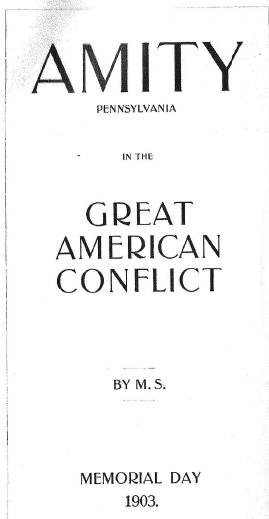
        The title of this article is from a pamphlet written in 1903 to celebrate Memorial Day in Amity, a small community in Washington County, Pennsylvania. While doing research for my book, "Such Severe and Hard Service: The 85th Pennsylvania in the Civil War," I came across an online reference to this booklet. Margaret Farrabee of Amity generously emailed me a copy, and I was able to use several citations for my book.

      The booklet was written early in the 20th century by 66-year old Manaen Sharp, who had served im Company B of the 85th Pennsylvania regiment. Sharp spent a year with the 85th before receiving a medical discharge. After the war, Sharp became a successful business man who owned furniture stores in Amity, Beallsville, and Little Washington, all in Washington County. He also served for a time as county treasurer. He died in 1920 at the age of 82 and is buried in Little Washington. His 1903 booklet chronicled the Civil War service of residents from the Amity area.

       Sharp wrote a paragraph or two about 40 or so soldiers from Amity and the surrounding area, including several from his own Company B of the 85th. [Sharp also included soldiers from other regiments, including the 140th Pennsylvania, the 22nd Pennsylvania Cavalry, and the 1st West Virginia Cavalry]. In doing so, Sharp recounts a series of interesting stories about many of the soldiers. Undoubtedly, Sharp was present for at least some of the events he described. In other cases, he surely heard the stories as they were passed around the campfire. Some others he learned about after the war, perhaps at regimental reunions. Below, I have quoted Sharp [in italics] concerning several members of his company.

     I have included some of my own comments in red.

LOC

CHRISTOPHER ANDERSON: At the battle of Fair Oaks, while aiming his gun, it was hit between his hands and disabled. He reached for the gun of a dead comrade and used it to good purpose.

Anderson returned home from the war. He died in 1877 and is buried in the Lone Pine Cemetery in Amity. 

Burying the Dead at Seven Pines
Harper's Weekly 7-19-1862
WILLIAM BRADEN: When driven back at Fair Oaks [Seven Pines], Comrade Braden was helping to carry his wounded captain [George H. Hooker] to save him from capture. The comrade, J.F. Speer of Canonsburg who was assisting, heard the sickening thud of a minie ball strike Comrade Braden, who said, 'I am hit.' He staggered to the road side and that is all that is known. He is buried among the unknown, but where? 

This story is confirmed by Captain Hooker, who wrote a letter in the pension file for Braden's widow, Nancy. “I hereby certify that Wm. Braden, a private of Company B 85th Pa. Vols, was shot while assisting me from the field at the Battle of Fair Oaks [Seven Pines] Virginia on the 31st day of May, 1862. He fell severely wounded and is supposed to have died from the effects of his wound.” 


Camp on Morris Island
Frank Leslie's Illustrated Newspaper

CYRUS [JOSIAH] BRATTON: His grave is on Morris Island, S.C....The autumn of 1863, he was excused from duty on account of sickness, but stayed in his quarters; his discharge papers were signed and with high hopes he expected to start for home in the morning. His messmate got breakfast and went to awaken him and found him in the sleep that knows no waking.

Bratton died of chronic diarrhea at age 25. 

JOHN CLAYTON: He was mortally wounded at Deep Bottom and taken to the hospital at Fortress Monroe where he died and is buried in the cemetery at the fort. At the Battle of Kingston [Kinston, NC] in loading his piece, he spilled the powder but rammed the bullet. He sat down where he stood in the battle line, unbreeched his gun, took out the ball, put his piece together, reloaded, putting in both balls with the remark, 'I will try and ring two of them this time.'

Clayton died from a gunshot wound to the thigh. He is buried in Hampton National Cemetery.

Attack Route Upon Battery Gregg
Robert Knox Sneden  LOC
LEONARD HAMMERS: In his performance of duty he had many narrow escape[s]. Only once did he lose hope -- that was when with others he was ordered to Morris Island to spike the guns of Battery Gregg. this battery could be swept by every fort in the harbor defences of Charleston. When they tied a strip of white on the left arm of this detail, so as to distinguish them from the Confederates in the darkness, hope left him but courage never. When the rebel guard discovered them and gave the alarm, the marines manning the boats refused to land, so the attack was not made.

Hammers enlisted at age 17. His first child was born while he was away in the army. He and his wife, Charlotte, had five more children after the war. He died in 1904 and is buried in AmityI wrote about the attempts to take Battery Gregg here.


Wounded Soldiers at Savage Station
1862    LOC

ABRAHAM IAMS: This young man took my place in the center of Co. B when I was taken to the hospital. He was mortally wounded at Fair Oaks, shot through the right breast and lay on the battlefield from Saturday afternoon until Monday afternoon when he was taken back to Savage Station. At 2 a.m. the next morning, in a down pour of rain, Robert Bair [James Robison Bair] put him on a train for White House [Landing, VA] where he died and is buried.

Corporal Iams was killed at the age of 25. He was survived by his parents, William and Delila, and his sister, Rachel.


Unidentified Soldier    LOC
DANIEL MILLER: Was badly wounded at Deep Bottom and was sent to the rear for repairs, [then] turned up in the hospital in New York. An order came to the effect that all soldiers who could walk to the railroad train would get furloughed. A comrade, James F. Speer, made him a pair of crutches. On these he started for the train, but had to rest many times before reaching it; but when seated in a comfortable car, contentment was seen all over his jolly face.

  Miller died in 1914 at age 78 and is buried at Amwell, PA. 

Kinston Swamp
45th Massachusetts Reunion 1887

DAVID MILLER: Was slightly wounded on the first and also on the second day at Fair Oaks. At Kinston, while charging through a swamp [left] , he was badly hurt and was helped to solid ground by a comrade who, examining his wound found the ball had passed through a deck of playing cards and buried itself in his side. He died about 1898.

I wrote an article about Miller on this blog which can be found here. Sharp's observation about Miller being wounded on the second day at Seven Pines [Fair Oaks] is interesting because his regiment had been sent to the rear and had not been actively engaged in the fight that day.

Henry T. Reynolds
HENRY TAYLOR REYNOLDS: Was killed June 14, 1864 near Richmond, Va. His body fell into the hands of the Confederates and was not recovered. He had a presentiment that he would not live out his time. A short time before he was killed, he applied for and obtained leave of absence to visit his old parents, as he believed, for the last time.

This story is confirmed by Oscar Lyons of Company B. I have included Reynolds' story in Volume II of my regimental history. Lyons wrote, "The boys tried to cheer him (Taylor) up, but the thought in his mind that he was soon to be killed could not be removed. On the 17th of June, we were in the rifle pits near Petersburg, on the North side of the Appomattox River... Many times through the day, Comrade Reynolds said he felt that his time had come; that he would never again see home or friends, for something told him that he was going to be killed."


Bridge over Chickahominy River
LOC
JAMES SMITH: At the change of base by McClellan's army on the Peninsula it was necessary to destroy a bridge over the Chickahominy river. The engineers had failed to destroy it because of a hot fire from the rebel side. An appeal was made to men in the line. Comrade Smith was one to respond for this important but dangerous work. They destroyed the bridge, checking Stonewall Jackson's flank movement.

Smith attended the last reunion of the regiment in Brownsville, Fayette County in 1928. He died in 1930 at the age of 88. 


Moses Smith


MOSES SMITH: Served his full term but had the misfortune to serve the latter part of it in Andersonville prison. Comparatively few survived this prison life. He was wounded at Kinston Bridge, the ball first striking his gun glancing into his leg. At Bermuda Hundred, an old tobacco barns stood close to the rebel line and was used by the rebel sharpshooters. Comrade Smith and Dave Miller crawled to this barn and set it on fire, completely destroying it. 

Moses Smith was the cousin of James Smith. He was captured at Ware Bottom Church, Virginia on June 16, 1864 with two other members of the regiment while on picket duty. He survived Andersonville and lived until 1924.


Hewitt's Cemetery
Rices' Landing, PA

SAMUEL WALTON: At Wier's [Ware] Bottom Church, while on picket duty, he was approached by a large grizzly unkempt rebel. Sam supposed he was coming in to surrender, as many of them at that time were doing, and was learning against a tree waiting to receive him. Imagine his surprise when the Johnnie fired, the ball striking the bark of the tree near his head, pieces of the bark stinging his face and neck. Comrade Walton did his duty at once. The rebel tried to reload his gun at once. The rebel tried to reload his gun after he was down and fatally wounded. 

 Walton enlisted as a private before being promoted to commissary sergeant.  He spent most of his postwar life in Greene County. He was involved in the lumber business and was the proprietor of S.M. Walton and Sons. He died in 1914 and is buried in Rices Landing, Greene County.     


Tuesday, January 5, 2021

John E. Michener Commands a Transport of Deserters and Stragglers


       Like  all officers, a part of Lieutenant John E. Michener's service in the Civil War had nothing to do with the battlefield. Time spent fighting accounts for a small fraction of a soldier's life. For an officer in camp, many logistical matters need to be addressed. In December of 1862, while his regiment was sent to North Carolina to participate in the Goldsboro Expedition, Michener was assigned to a precarious task of leading a transport of soldiers from Alexandria to Fort Monroe, Virginia. But these were not ordinary soldiers. They were stragglers and deserters who had been rounded up and were awaiting the return to their division. Along the trip, Michener kept a potentially volatile situation under control and completed the mission.

       An account of this event  is included in an 1867 brief biographical sketch of Michener's war service as written by author T.J. Simpson called "Prison Life." This two-paragraph narrative is quoted at the end of this post. Michener was tasked with picking up the ship load of deserters and stragglers from Alexandria and returning them to General John J. Peck's Division in southern Virginia.

        Stragglers were those who could not keep up with the rest of their compatriots on a march and dropped out of formation or fell far behind. The reasons for this action are varied. Some hesitant troops were trying to avoid a potential battle up ahead. Others could not withstand the physical demands of a long march. Eventually most rejoined their regiments. 

       Deserters, on the other hand, were those who were caught trying to permanently leave their regiment. Sometimes if caught, they would be subjected to humiliation, even execution. In late 1862, orders were issued to return both categories of soldiers from Camp Convalescent in Alexandria, Virginia to their regiments. Hence, Peck assigned Michener with the job to pick up up these men at the camp in northern Virginia who belonged to his division and bring them to Suffolk.

Execution of Five Union Deserters     LOC


         Camp Convalescent was the temporary home of three kinds of soldiers: the first were men who had recovered from illnesses or wounds at Washington, DC hospitals and were waiting to rejoin their regiment. A second camp was for stragglers and deserters commanded by Lieutenant Stephen H. Balk of the 6th U.S. Cavalry. The third camp was for recruits to the army.

Camp Convalescent
National Museum of Civil War Medicine

       The location of the Camp Convalsecent was described as being on Shuter's (or Shooter's) Hill near Fort Ellsworth. The camp was organized in August of 1862, after a series of battles around Richmond, and was under the command of Brigadier General John P. Slough, the military governor of Alexandria.

        Conditions at Camp Convalescent, also called Camp Misery,  probably had the men there is a surly mood before Michener and others arrived to take them back. One newspaper wrote, "Those not fit for duty are sent to the convalescent camp and placed in little diminutive tents six by seven on the ground. No floors nor straw to spread their blankets on, but the poor fellows just from comfortable quarter in the hospitals are turned into these pens, and compelled to sleep on the cold, damp ground, and this in a climate but little warmer than that of Massachusetts. In these miserable dog kennels the men are obliged to stay until called to to go to their respective regiments. Many of them are not cured, and the exposure here frequently brings on their old complaints and in this condition they are sent to their regiments. For rations they are fed on pork, fresh beef and bread, with occasionally a few potatoes and onions. These articles, together with sugar and coffee, are issued to the men raw, owing to the scarcity of wood. The men have to go out and pick up wood and faggots to cook their meat and boil their coffee. There is no wood to be had within a radius of two miles, and the men are obliged to go that distance for wood, or eat their rations raw. Many are without blankets and overcoats and suffer exceedingly from the inclement weather. Clothing is issued to those needing it when it can be obtained, which is but seldom. There are not less than 6,000 men in different divisions of this convalescent camp and with a few exceptions, all fare the same -- sleep on the ground, live on raw pork and bread, and in this manner eke out a miserable existence. It can hardly be called living -- it is merely staying here. No wonder the men are discouraged and dejected and desert, as they sometimes do." [The Burlington (VT) Free Press, December 11, 1862, p.2]

Camp Convalescent
Library of Congress

         Considering that they missed some of the fighting, stragglers had few defenders. One soldier however noted the life of a straggle could be perilous.

          "One of the saddest sights of the march was the great number of stragglers. We read in the newspapers of so many stragglers picked off by guerillas, or captured and missing, and one naturally supposes that these unlucky ones have willfully strayed from the command, and suffered the penalty for their carelessness and disobedience. But what is the reality? As the column goes hurrying by, you catch a glimpse of a pale face lying by the roadside, faint and weary; a few steps farther on, one with his shoes off, bathing his blistered feet; here is a poor fellow whose summer has been spent in hospital, sick of a fever, and whose little stock of strength is soon exhausted ; these are the stragglers who reach the camp long after the others have made themselves comfortable for the night, and, after a restless night, they start off the next morning with a like prospect before them, until human endurance can hold out no longer." [Charles Eustis Hubbard, The Campaign of the 45th Regiment, Massachusetts Volunteer Militia, 1882, p. 53-4]

          A journalist who was on the march to Goldsboro, NC and back with the 85th Pennsylvania in December of 1862 further explained, "I have spoken of stragglers upon the march. There are two or three distinct kinds of straggling. One is involuntary — the result of sickness or exhaustion. Another comes from laziness or the want of a spirited determination to bear up; and another from cowardice. Do not imagine that because a man enlists and goes to the wars that he necessarily does his whole duty as a soldier. There are no better opportunities for shirking than those afforded the soldier. It was noticeable upon our late march that whenever cannonading commenced at the head of the column, as it did day after day, scores of men commenced falling out and laying down by the side of the road." [Zenas T. Haines, Letters from the 44th Regiment M.V.M, 1863, p. 59]

         The deserters were who were on board the transport with Michener were a different matter. By definition their only goal was to escape military life. When things went badly on the voyage from Camp Convalescent, it would not take much imagination that these men would foment dissension or use any excuse to leave army life (again) if they had the chance.  

Map of Potomac River region showing Alexandria, Aquia Creek and Maryland Point      LOC

     The account, says Simpson was related by "J.E.C.," an assistant sutler with the 85th Pennsylvania. This is probably sutler James Clark.

          From "Prison Life:" "An instance illustrating Lieutenant Michener’s wonderful tact and skill in governing and controlling reckless and desperate men in times of peril and danger is related by J.E.C., assistant sutler of the Eighty-Fifth Pennsylvania Volunteers. In December, 1862, General [John J.] Peck, then in command of the troops at Suffolk, Virginia, detailed Lieutenant Michener to proceed to Alexandria, Virginia, and conduct from that point to Suffolk some two hundred deserters and stragglers belonging to his division. On the arrival of Lieutenant Michener at Alexandria, a number of the men refused to go and, being of a desperate character, much difficulty was apprehended. The assistance of a company of regulars was necessary to get them on board the steamer Thomas P. Swan. The officer in command at Alexandria, General Slough, offered Lieutenant Michener a guard of twenty men to accompany him to Suffolk with his reckless charge, but he declined the offer, stating that he thought he could take them without a guard. Nothing of importance occurred on the voyage until the steamer arrived off Maryland Point where she ran aground on the reefs, or kettle bottoms, as they are called. The men had only been furnished with one day’s rations, sufficient to take them to Fortress Monroe. These were now exhausted; the men became boisterous; a mutiny was threatened; they demanded the keys of the captain’s larder. In this critical moment Lieutenant Michener called the men upon the upper deck and in a brief and persuasive speech calmed their passions and prevailed upon them to wait patiently until relief should come.

Aquia Creek Landing, VA        LOC

        "A signal of distress was then thrown out and two hours later a gunboat came up and attaching a heavy hawser [large rope] to her bulkhead, parted it twice in vain attempts to pull her off. Seeing a schooner some two miles distant, Lieutenant Michener requested the captain of the steamer to send him off in a boat to the schooner, assuring the men that he would go to Aquia Creek, procure a tugboat and rations, and return at once. It was two o’clock P.M. when he left the steamer and did not arrive at Aquia Creek until after midnight. [General Ambrose] Burnside had just commenced his great but disastrous move against Fredericksburg and all was hurry and confusion at Aquia Creek. Lieutenant Michener succeeded, however, in procuring two tugboats and rations and reached the steamer at daybreak next morning. The combined efforts of the two tugboats, however, failed to get the steamer off, and Lieutenant Michener was compelled to return again to Aquia Creek for assistance. The men, however, became desperate, rage and passion burst forth, the lives of the captain and Lieutenant Michener were threatened. All seemed to be lost; it was a moment of dreadful suspense. Finding kind words and remonstrances in vain, Lieutenant Michener sprang to the deck and quickly armed ten of the most reliable and trusty soldiers and assuming a stern and commanding aspect, soon quelled the spirit of revolt. Appointing one of the ten as sergeant in command, with orders to shoot down the first man who should show feelings of revolt, he returned to Aquia Creek, procured a transport, transferred the men from the grounded steamer, started for Fortress Monroe, and arrived safely the next morning." 

       Simpson's account demonstrated Michener's strength as a leader. When the boat became stuck, he used words to calm the situation and took personal charge of trying to find a way to dislodge the Thomas P. Swan. When that attempt failed and the men became more rowdy, Michener resorted to the threat of physical harm and again returned to Aquia, this time for a replacement transport. The Simpson story stated that he had to quickly chose ten men from the group, most likely from among the stragglers who had fallen from the ranks of their regiments due to physical exhaustion and not avoidance of battle. Perhaps even sutler Clark was one of the armed men, since he could be trusted. All with the Union army in disarray following the disastrous battle of Fredericksburg just 15 miles away.

       Although not a heroic chapter from his life in battle, the story nonetheless displayed that Michener commendably pulled off his mission under dangerous circumstances without the loss of life. 

NEXT: John E. Michener's encounter with the Robert Gould Shaw and the famous 54th Massachusetts infantry just prior to their famous assault on Fort Wagner in South Carolina.


Monday, January 6, 2020

Captain Ross Rush Sanner

Captain Ross R. Sanner
Company H, 85th Pennsylvania Infantry

U.S. Army Education and Center
              Last week's post was about soldier and industrialist Norman Bruce Ream of Company H of the 85th Pennsylvania. That post mentions that Ream was saved from captivity and possibly death by his cousin, Lt. Ross R. Sanner. Ream was wounded during an assault upon Confederate forces on Whitemarsh Island, Georgia in 1864 and Sanner, also a member of Company H, assisted him back to the Union assault boats at the southwestern part of the island.

Whitemarsh Island (showing defenses) near Savannah, Georgia
LOC

        This week's post will focus on Sanner. Like Ream, Sanner taught school prior to the war as a teenager. Unlike Ream, Sanner continued his career as an educator following the war. In fact, his remarkable career as a principal and instructor spanned about 60 years. He began teaching as a teenager and  "Professor" Sanner was still teaching school at the age of 76.
    A news article five decades after the Civil War contrasted the postwar careers of the two cousins."[Ream] recovered from his wounds and became one of the greatest and richest money magnates of the United States, while Capt. Sanner elected to follow the humble though nonetheless honorable vocation of a pedagogue and in worldly goods and chattels is accounted a poor man in his old age, though rich in honor and respect shown him by the many pupils who have been under his guidance. The multi-millionaire, Norman B. Ream, remained his steadfast friends until his death, but did not remember him in his will...The writer (editor of the Republican) [William S. Livengood] had the privilege of being one of his primary pupils in 1868 and among the readers of the Republican are many who received their first instruction from this grand old pedagogue and who have ever since held him in grateful memory and high esteem." [Meyersdale Republican, February 17, 1916]
        Sanner enlisted into Company H as a 19-year old sergeant. On August 23, 1863, while stationed on Morris Island near Charleston, South Carolina, Sanner was shot in the neck by a Confederate sharpshooter. He recovered, rejoined his company and six months later saved Ream's life on Whitemarsh Island.

Sharpshooters near Fort Wagner on Morris Island, SC

         Four months after that, Sanner was wounded for the second time at Ware Bottom Church during the Bermuda Hundred Campaign and was sent to Chesapeake Hospital at Fortress Monroe. [Ream, his cousin, had also been wounded at Ware Bottom Church one day earlier]. Sanner returned to his regiment on the last day of July six weeks later, but was subsequently granted a medical discharge in September of 1864 after nearly three years of service.


Arrival of Wounded Soldiers at Fort Monroe
Frank Leslie's Illustrated Newspaper

        Sanner returned home to Somerset County but was plagued by paralysis in his arm and stiffness in his neck. He was nonetheless able to resume his teaching career, beginning in Grantsville, Maryland, just 17 miles from his birthplace.

.
        Among the various places at which he taught school were the Maryland cities of Cumberland, Frostburg, Oakland, Grantsville, Selbysport and Friendsville, as well as the Pennsylvania towns of Uniontown, Somerset and Confluence. For four years he was an instructor at the soldiers' orphan school in Jumonville, PA. He was still teaching until three weeks prior to his death.
        Sanner died in  1918. At his funeral, Dr. Walter S. Mountain, a life-long friend and fellow veteran of Company H, delivered the eulogy. Mountain said, "Capt. R.R. Sanner and I were schoolboys together and in the same company during the Civil War, hence I know something of his bravery and how well he did his duty as a soldiers...Our first fight was at Williamsburg, Va, and the captain [Sanner] was not found in the rear. He showed the same bravery at Yorktown, Fair Oaks and Malvern Hill. The next battle was at Newbern, NC, [Goldsboro Expedition] where Capt. Jackson was hiding behind a bank along a stream for fear he might be shot, and for which he was dismissed from the service for cowardice, and Capt. Sanner showed his bravery by staying on the bank where he was exposed and won his captaincy...[On Morris island]..the captain exposed his head above the ramparts and a confederate caught him in the neck with a bullet, and he was sent to the hospital. He was offered his discharge, but he said, 'No I am going back to my company to help lick the enemy.' A Confederate [at Ware Bottom Church] caught him in the arm and maimed him till the job was completed." [Meyeresdale (PA) Republican, April 11, 1918]
        Sanner is buried at Confluence, Somerset County in the Methodist Cemetery.
Sanner, age 74
Meyersdale Republican, 2-17-16