Showing posts with label Second Deep Bottom. Show all posts

Monday, July 27, 2020

George Fisher's Centennial Birthday

          The longest living member of the 85th Pennsylvania regiment was William Mahaney of Company C. Mahaney enlisted into the regiment as a 17-year old in 1861 and died in 1944 at the age of 99, several months shy of his 100th birthday.
       
Lincoln (NE) Star
1-26-1938
The second-longest living soldier in the regiment, the subject of this article, was Corporal George Fisher of Company E. Fisher was 23 when he joined the regiment and died at the age of 100 in Nebraska in 1938.
        About three months prior to his death, a local newspaper in Beatrice, Nebraska wrote an article in celebration of Fisher's 100th birthday. Although intended to be celebratory in nature, the article is a mixture of fact and fiction with somewhat dubious information relating to Fisher's service in the Civil War. Since he was likely the main source for the details of the story, Fisher seems to have misremembered or exaggerated some of the events. Colored by the passage of time, Fisher's remembrances and perhaps some information provided by his children and grandchildren resembled but did not accurately reflect past events.
       This is not meant to disparage a 100-year old man who honorably served his country for three years. It is meant as a warning that obituaries and articles such as this one are not always 100% accurate.
        The article states that Fisher, born in Germany, came to this country alone at the age of 15. After having what little money he had stolen from a hotel room in New York City, the article states that he "walked to Uniontown, PA and got a farm job which he kept 22 years except for time spent in the service of the Union army during the Civil War."
      As a reader, I would like to know what motivated Fisher to "walk" to Uniontown. The distance is over 300 miles and it seems that Fisher could have found work as a farm laborer much closer to New York City.
         The article continues on that, "He [Fisher] enrolled as a private in Co. 'E,' 85th Pennsylvania infantry in September, 1861. He was mustered into service on November 12, 1861 for a three-year enlistment and on August 27, 1863, was wounded by the explosion of an enemy shell."
     
Bombproof in Trench on Morris Island    LOC

          This account of Fisher's wounding is probably correct. In his comprehensive 1915 history of the regiment, historian Luther S. Dickey notes that Company E (Fisher's company) was in the trenches for digging duties near Fort Wagner on Morris Island on the night of August 27, 1863. Several members of Company E were killed by a shell explosion, including John H. Linn and Joseph Neely. Three other soldiers (William Marquis, Henry J. Ridgen and John I. White) later died of wounds suffered in this explosion.
        Although Fisher is not mentioned by name, Dickey writes that the explosion caused "more than a dozen casualties."
        The article continues "Fisher served with Generals Grant and McClellan and fought in the battles of Williamsburg, Charleston, Deep Bottom, Cold Harbor and others."
       There are several issues with this observation. The 85th Pennsylvania did not do much "fighting" at Williamsburg in May of 1862 during the Peninsula Campaign.  The divisions of Joseph Hooker and Phillip Kearney did  most of the fighting for the Union side. The 85th Pennsylvania formed a line and may have gotten off a volley or two into an unseen enemy beyond the tree line. And they were shelled by Confederate artillery. But for the most part they remained in formation and did not advance towards the battle. However, the 85th Pennsylvania did experience hard fighting at Charleston and (Second) Deep Bottom.
        The sentence also states that Fisher (and his regiment) served under Ulysses S. Grant and George B. McClellan. The 85th Pennsylvania assuredly served under McClellan's command during the Peninsula Campaign in Virginia in 1862. But they were never under Grant's direct command, either in the western theater or during the Overland Campaign of 1864. Technically, with Grant in command of the overall Union strategy beginning in March of 1864, every soldier in the Union army served under Grant. But in 1864, while Grant pushed towards Richmond with the Army of the Potomac, the 85th Pennsylvania was in the Army of the James under General Benjamin Butler and later under General Edward O.C. Ord.
        Grant did briefly accompany the Army of the James for part of the pursuit of the Army of Northern Virginia from the Petersburg front to Appomattox in April of 1865, a campaign that culminated with Robert E. Lee's surrender. 
       
LOC
The centennial article then states, "He [Fisher] helped construct the 'Swamp Angel,' a masked battery with which the Union army shelled Charleston...."
          This may have occurred. The regiment was stationed in the interior of Morris Island during the late summer of 1863 when the  Marsh Battery or Swamp Angel battery was under construction. It took much manpower to carry 13,000 sandbags to the site. The Swamp Angel was constructed between James and Morris Islands near Charleston, SC in July and August of 1863. The Swamp Angel floated on hundreds of sandbags (on top of 20 feet of mud), which soldiers carried over wooden planks to the marsh. On August 22, the Swamp Angel began an incendiary bombardment of Charleston, which continued until the 36th shot shattered its breech. 
         A problem here is that the 85th Pennsylvania was heavily involved in another Union effort at the time. Following the failed second assault on Fort Wagner on July 18 led by the black troops of the 54th Massachusetts, the next stage was unglamorous: the digging of a series of trenches or parallels to threaten the sand-walled battery. Along with the 100th New York and 3rd New Hampshire, the 85th Pennsylvania devoted almost all of their efforts in the month of August to this endeavor. Dickey's history of the regiment cites the diary of Commissary Sergeant John B. Bell for a day-to-day account of the regiment at this time. There are numerous references to "fatigue duty at the front," "completed seaward battery at third parallel," and the like, but no direct reference to constructing the Swamp Angel. 
           In his entry for August 17, Bell does state, "Regiment....moved to the front and during the day was engaged at fatigue duty filling gabions to strengthen the fortifications. Marsh Battery was completed ready for mounting guns."
           Next in the obituary,  the following reference is problematical. "...[Fisher] saw the battle of the
LOC
Monitor and the Merrimac.
"
          This could not have occurred. The battle of ironclads took place on March 8-9, 1862. The 85th Pennsylvania did not arrive at Hampton Roads for the Peninsula Campaign until three weeks later on April 1. Yes, several soldiers in the regiment wrote of seeing the Monitor in the waters around Fort Monroe as their ship came in for docking. At another time, the Merrimac was spotted when they were camped near Hampton, VA. But the ironclad battle itself was not witnessed by Fisher or anyone else in the regiment.


        The article concludes with the statement that, "A Republican, the aged man cast his first vote for president for a candidate with whom he shook hands several times, Abraham Lincoln."
         It is possible that Fisher met Lincoln face to face, but to have shaken hands with the president more that once seems to be a stretch. First of all, several soldiers from the regiment claim to have encountered  Lincoln when they were posted near Washington, DC during the winter of 1861-62. When they had free time, the men would often tour the capital city and several wrote that they talked to the president while walking the streets of Washington. 
         Lincoln then crossed paths with the regiment when Lincoln reviewed the entire Army of Northern Virginia in early July of 1862 at Harrison's Landing,VA. Finally, Lincoln was present at City Point,VA on March 25, 1865 and reviewed Union troops, including what may have included some in the 85th Pennsylvania. But Fisher had completed his three-year enlistment and had gone home the previous November.
           Fisher and his wife, Martha Rockwell Fisher from Uniontown, spent the last six decades of his life in York County, Nebraska. He passed away on January 23, 1938, three months after his one-hundredth birthday.     

Monday, April 13, 2020

Profile of Surgeon Samuel Longacre Kurtz

       
Dr. Kurtz and wife Sarah   1861
Courtesy of Eleanor Hancock
             The above photo shows Army Surgeon Samuel L. Kurtz and his wife, Sarah Morgan Kurtz. The photo was taken in late 1861 when Sarah visited her husband at training camp in Philadelphia. At the time, the 28-year old Kurtz was an assistant surgeon with the 11th Pennsylvania Reserves, also known as the 40th Volunteer Regiment. On June 3, 1862, just days after the Battle of Seven Pines, Kurtz was transferred to the 85th Pennsylvania and was promoted to head surgeon. He held this position for the next 32 months until he completed his service and returned home to Reading, Pennsylvania.
         Kurtz replaced Surgeon John B. Laidley of Carmichaels, Greene County, who was medically discharged from the 85th Pennsylvania in May of 1862.
        In the photo, Kurtz is proudly dressed in his uniform including his officer's sword. Years later,
LOC
Kurtz' granddaughter, Georgeine, asked him about the sword that he wore in the photograph. Kurtz replied, "The Rebels sank it in the James River." He state that the sword was on a baggage raft that was sunk by the enemy, probably in August of 1864 when the regiment was returning to their base in the Bermuda Hundred area of Virginia after a bloody fight at Second Deep Bottom.
        Kurtz lost a prized sword, but later, acquired an even more precious possession. When the men in the 85th Pennsylvania were winding down their three-year enlistment in the fall of 1864, they pooled their money and bought a complete surgeon kit in an engraved chest for Dr. Kurtz. It was one of his proudest possessions for the remainder of his life. It was a striking gesture for the man who cared for them when they were wounded, sick and for many, on their deathbeds. It was somewhat ironic because Kurtz was from eastern Pennsylvania, unlike most of the regiment than hailed from the southwestern corner of the state.

Reading Times   1-2-1865


       The presentation of the gift was chronicled in a Reading, PA newspaper shortly after Kurtz returned home from the war in early 1865. 


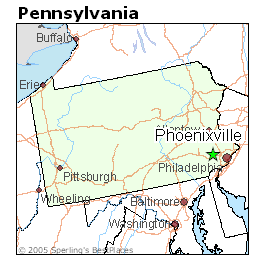
       Kurtz was born on September 27, 1832 in Chester County, PA. He graduated from Jefferson Medical College in Philadelphia in 1854. Prior to the war he practiced medicine in Phoenixville (Chester County) and Oakland Mills (Juniata County). He settled in Reading  (Berks County) and practiced medicine there for 40 years. In 1891, he was elected as the president of the Pennsylvania State Medical Society. 

Gift Medical Chest of Dr. Samuel L. Kurtz
On the right is Kurtz' granddaughter Georgeine Gruver
Reading Eagle   2-19-1967   p.44


        During the Civil War, Kurtz was involved in a bizarre battlefield incident that resulted the the death of musician Lemuel Thomas. It occurred on the first day of the regiment's six-day mission near Richmond in which they fought at Second Deep Bottom. 
        Musicians often served as doctor's assistants during a fight. As described by 85th Pennsylvania historian Luther S, Dickey, “Musician Lemuel Thomas of Company C, was on duty with Surgeon Kurtz of the Regiment assisting in caring for the wounded. Surgeon Kurtz was standing with an arm resting against a tree when a cannon ball from a battery of the enemy ricocheted, striking the heel of his shoe and then bounded to the head of Musician Thomas, fracturing his skull from which he died the following day. Although painfully wounded by the enemy's missile Surgeon Kurtz remained on duty.” [Dickey, History of the 85th Regiment Pennsylvania Volunteer Infantry,  p. 377]
      The 24-year old Thomas was from Fayette City, Fayette County. He is buried in the Hampton (VA) National Cemetery. 
       Kurtz was later involved in helping the wounded at the Battle of Darbytown Road near Richmond on October 13, 1864. By this point in the war, according to the following account by Dr. Charles Clark of the 39th Illinois, Kurtz and other surgeons of their brigade were moved close to the battlefield to provide more immediate care to the wounded. Both the 85th Pennsylvania and the 39th Illinois were part of the First Brigade of Colonel Francis B. Pond during the battle. The 85th Pennsylvania suffered only a few wounded at Darbytown Road but losses by the rest of their brigade were in the hundreds.
       Dr. Clark wrote, "The writer’s experiences at this battle [Darbytown Road] were unusually disagreeable…On the morning of the 13th [of October], he with other surgeons of the First Division of the Tenth Corps were ordered by the Medical Director to take the field and follow the command with strict orders to keep within 300 yards of the line of battle. When the First Brigade were preparing and forming to assault the rebel redoubt, he took the position behind a corn-crib in the yard of the Gerault house. As the Brigade advanced, there was a painful hush, like that of an audience awaiting some terrible denouement. Then came the roar and rattle of guns and a rain of shell and grapeshot in a most careless manner, shattering the old crib and scattering splinters and debris in all directions. One ambulance horse was killed and the driver wounded, and much other damage done. The wounded soon came back in numbers…Finding our position untenable, we felt justified in transgressing orders and removed to the left and rear inside an old earthwork where at last we could give our undivided attention to our work without fear of being either killed or wounded. The wounded…were sent back to the corps hospital some three miles distant." [Clark, Yates Phalanx, p. 179]
     
     After the war, upon reestablishing his practice in Reading, Kurtz won the trust of local residents when he treated a group of children involved in an accidental explosion. A group of boys were playing with gunpowder at a canal near his office when the explosion occurred. Kurtz treated their injuries effectively and the new doctor won the trust of his neighbors. 
        Kurtz married Sarah Morgan in 1854. Together they had two sons and a daughter. His two sons, Julius and Clarence, also became doctors. (Morton Montgomery, Biographies from Historical and Biographical Annals, p.399)
        Kurtz died on April 21, 1921 at the age of 88. He had practiced medicine for 60 years. At the time of his death, he was the oldest practicing physician in Reading. He is buried in the Charles Evans Cemetery in Reading. 
   

Monday, April 6, 2020

Home on Furlough 1864


Harper's Weekly
February, 1864

        After a hard campaign around Charleston, SC that resulted in the capture of Morris Island (but not the fall of Fort Sumter and Charleston) the 85th Pennsylvania spent the first few months of 1864 in relaxed duty on Hilton Head Island.
        While stationed there, the Union hierarchy made a concerted effort to have as many regiments as possible reenlist beyond their original 3-year commitments. If a certain percentage of men in a regiment re-enlisted, they earned the designation of being called "veteran volunteers."
      The other three regiments in the brigade of the 85th Pennsylvania all earned this distinction. They were the 62nd Ohio, 67th Ohio and 39th Illinois. Although a number of 85th Pennsylvanians re-enlisted, not enough extended their service to earn the distinction of being called a veteran volunteer regiment.
Waynesburg (PA) Messenger     3-16-1864,    p.3
       In my book, Such Hard and Severe Service: The 85th Pennsylvania in the Civil War, I detail the efforts of their officers to encourage their men to re-enlist and explore the reason more men did not sign on for extended service.
       Those that did re-enlist earned an immediate 30-day furlough to go back home to visit family and friends; also some states used the furloughed men to recruit new men from their home areas. Another inducement may have been cash payments in the hundreds of dollars from their local and/or county government. This helped fill a quota of men the locality was expected to furnish towards the war effort.
       Only about a hundred or so men re-enlisted from the 85th Pennsylvania. The article at the right is from a Greene County newspaper of the time, the Waynesburg Messenger. It lists a number of Greene Countians, mostly from Companies F and G, who returned home on leave in early 1864 under the command of Lieutenant Levi Rogers.
       Unfortunately, when they returned to army duty, less than half of the men in this group made it unscathed through the rest of the war. The article mentions 23 men from the 85th Pennsylvania who visited Waynesburg. When their month was over and they returned to the war, three were killed, seven were wounded, two died from disease and one was captured. The rest returned to the war and survived without dying or being wounded.
    It should also be noted that none of the men who were killed or hurt died as a result of extending their service. All fell during the period of their original enlistment, which ended in November of 1864.

           Below is the list of the men in the same order they are named in the news article, as well as what happened to them during and after the war.


Soldiers Home on Furlough
Harper's Weekly
January 23, 1864
Lieutenant Levi Muncy Rogers was severely wounded in the hip at the Battle of Second Deep Bottom outside of Richmond in August of 1864. He died three weeks later at a hospital at Fort Monroe, VA. He is buried in the Hampton (VA) National Cemetery.
Sergeant Elmore A. Russell was wounded four times during the war. His most severe wound was suffered at Second Deep Bottom where he was shot in the arm. Russell survived the war and settled in Texas for the last four decades of his life. His occupations included teacher, farmer, fruit-grower, postmaster and city councilman. He died in 1912 at Lamar, TX at the age of 70.
Sergeant Alonzo Lightner was killed at the Second Battle of Deep Bottom. He was about 24 years of age.
Corporal Thomas J. White survived the war and settled in Nebraska where he worked as a printer. He was one of eight members of the regiment who earned a "Gillmore" Medal for meritorious service during operations on Morris Island, SC in 1863. White died in 1896 and is buried in Arlington National Cemetery in Virginia. 
Corporal John N. Durbin was wounded in the leg at Darbytown Road near Richmond on October 13, 1864. He died in 1897 and is buried in Greene County.
Corporal Thomas M. Sellers was wounded at the Battle of Second Deep Bottom but survived. He became a farmer in Kansas and a horticulturalist in Texas after the war. He died at the age of 86 in 1932 and is buried in Houston.
Civil War Song Sheet  LOC
Corporal John D. Haveley was wounded at Second Deep Bottom but stayed in the army until the end of 1865. He died around 1880.
Private William E. Leonard was awarded a Medal of Honor for the capture of an enemy flag at Second Deep Bottom, where he also suffered a head wound.
Private Lisbon Scott was captured in May of 1864 during the Bermuda Hundred Campaign. After nearly a year, he was released from Andersonville Prison in Georgia. He went home to Greene County and served as a county commissioner. Scott died in 1917.
Private John Rizor was born in Marshall County, VA (later West Virginia) and served until 1865. He died in 1919 and is buried in Belmont County, Ohio.
Private Isaac Gray was wounded twice prior to his furlough. He served until 1865 and then returned to his life as a farmer in Greene County. He died in 1906.
Private George Pettit suffered a facial wound at Second Deep Bottom. He returned home and worked as a farmer in West Virginia. He patented a self-closing farm gate in 1897. Pettit died in 1917.
Private Jackson Kimble had his right arm amputated after being wounded at Second Deep Bottom. He died in 1913 and is buried in Greene County.
Private James Huffman returned to Greene County and his life as a farmer after the war. He died in 1911.
Private Jacob Huffman was wounded at Darbytown Road in October of 1864. He died in 1927 at the age of 86 and is buried in Illinois.
Private David Fry served in the regiment for four years and three months. Returning after the war to Greene County, he had a wife, Mary, and four children. He died in 1907.
Private Henry Fry was shot and killed while on picket duty at Ware Bottom Church on June 17, 1864. He was survived by his wife and three children.
Private Andrew J. Morris returned from his furlough and soon died from smallpox in April of 1864. He is buried in the Beaufort National Cemetery in South Carolina.
Private Alfred McDonald returned from his furlough and contracted jaundice. He died in October of 1864 at the age of 44. He is buried in the Hampton (VA) National Cemetery. McDonald was survived by his wife, Christina, and four children.
LOC


Private John Rush was one of three men named John Rush in the regiment, all from Greene County. This is probably John J. Rush, who returned to Greene County after the war. He died in 1914.
Private William Seabold survived the war and moved to Ohio. He died in 1918 and is buried in West Jefferson, Ohio.
Private Thomas Rinehart returned home to Greene County after four years of service. He died in 1922 at the age of 86.
Private Andrew Frakes lived in Ohio and West Virginia after the war before returning to Greene County. He died in 1922 at the age of 76.


Monday, February 24, 2020

Medal of Honor Recipients in the 85th PA

     
LOC
        For their actions during the Civil War, three members of the 85th Pennsylvania regiment were awarded Congressional Medals of Honor. They were John Shallenberger, William E. Leonard and Francis Morrison.
       Another member of the regiment, James Huff of Company E, stayed in the army following the war and was awarded a Medal of Honor in the 1870's during the army's campaign against the Apache Indians in America's southwest.
      Both Shallenberger of Company B and Leonard of Company F won their medals for capturing enemy flags during the Second Battle of Deep Bottom on August 16, 1864 near Richmond. Their medals were issued on April 6, 1865.
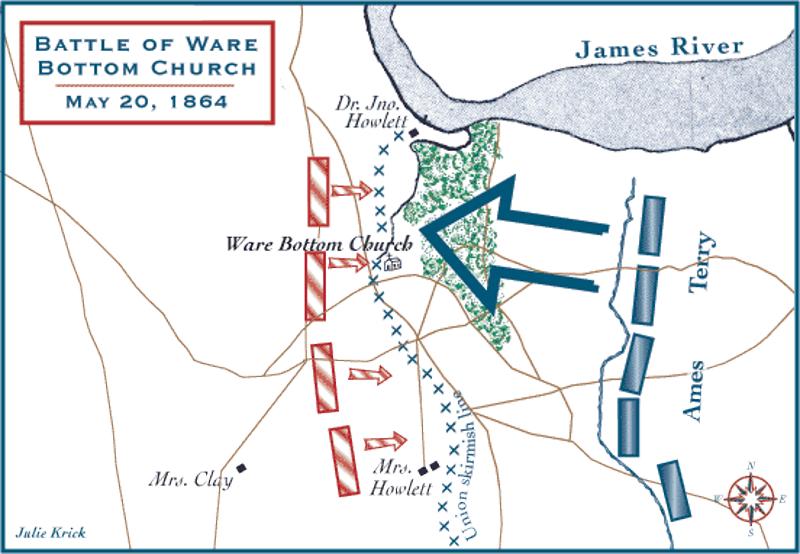
    Francis Morrison of Company H won his Medal of Honor for trying to save a fellow member of his company while under fire at Ware Bottom Church in Virginia on June 17, 1864.
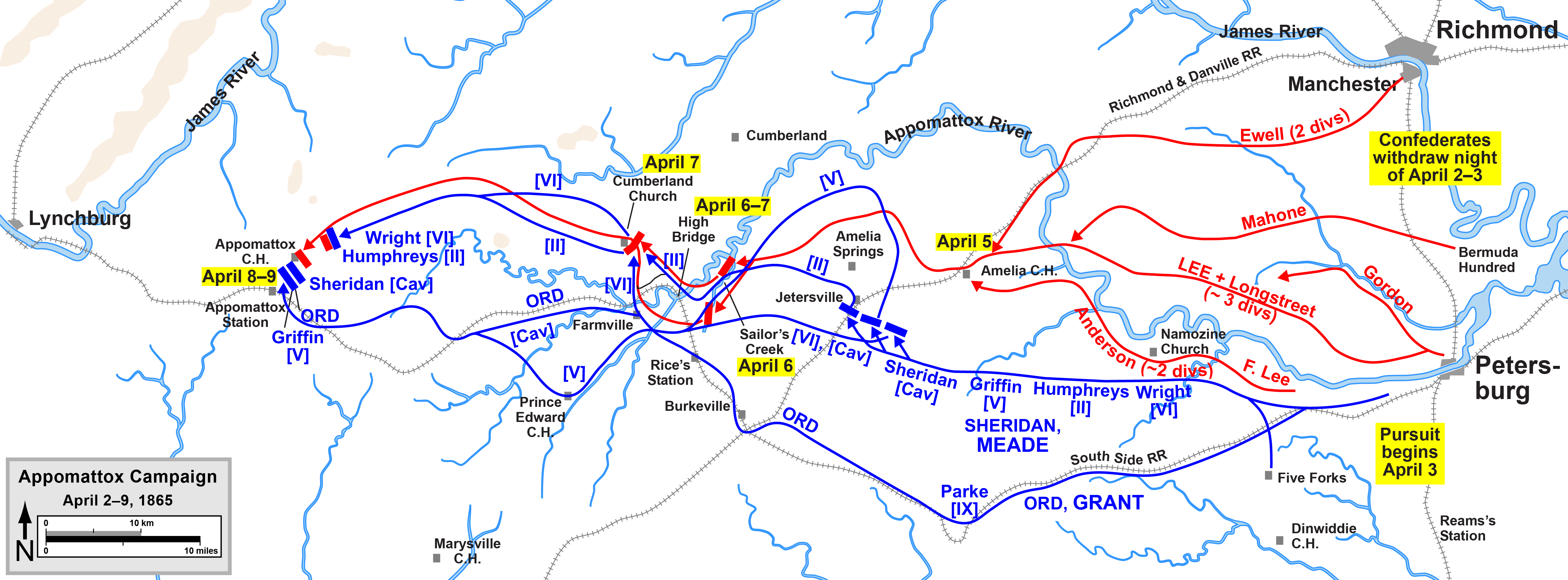
       Leonard and Shallenberger's heroic moment occurred during Grant's fourth offensive against the Richmond-to-Petersburg (Virginia) line in mid-August of 1864, a simultaneous two-pronged attack against both cities. The 85th Pennsylvania crossed the James River from the Bermuda Hundred to help pressure the Confederates' Richmond defenses and make the Confederates continue to stretch their defensive line covering both cities. The 85th Pennsylvania, as part of the brigade of Colonel Francis B. Pond, temporarily poked a hole in the Confederate line near Darbytown Road, but eventually Union forces gave way in the face of Confederate reinforcements. The Union had better success at the other end of the line near Petersburg, capturing the Weldon Railroad.
Pontoon Bridge at Deep Bottom,VA
Across the James River    LOC
      At Deep Bottom, the 85th Pennsylvania and the rest of the Pond's Brigade stormed and captured an enemy position. The brigade suffered heavy losses. One account said that an initial volley by the Confederates killed and wounded many of Pond's men in the assault, but that the rest of the brigade took the Confederate position before the rebels could reload their muskets and fire a second time. Colonel Edward C. Campbell of the 85th Pennsylvania noted it was the first time his men had engaged in hand-to-hand warfare in their nearly three years of fighting. During the final phase of capturing the enemy position, Shallenberger and Leonard snatched enemy colors from two regiments.
         Shallenberger (or Shellenberger), age 24 from Fayette County, worked as a farm laborer after the war He died in 1911 at the age of 71 in Granville, Licking County, Ohio where he spent the last 20 years of his life. Nearly eighty years later, in 1990, a new bronze marker was installed at his gravesite at the Welsh Hills Cemetery in Granville, Licking County. His original marble headstone mentioned only his service in the Civil War. The newer bronze marker recognized him for his Medal of Honor.
         In 2013, the Pennsylvania General Assembly designated a portion of the Mon Valley Expressway Interchange (Exit 18) in Fayette County as the John S. Shallenberger Interchange.
     Like Shallenberger, William E. Leonard captured an enemy flag at Second Deep Bottom. Leonard was wounded in the ear during the assault but survived. Leonard died in early 1891. A fellow soldier from Company F, wrote a tribute to Leonard that appeared in the Washington Observer newspaper (February 26, 1891, page 1). Sergeant James E. Sayers wrote a detailed recollection of Leonard's actions that day.
   
Second Deep Bottom Reenactment  2014
 "To him belongs the honor of capturing the only flag taken from the enemy on the field of battle by a Greene countian during the war...It was at the battle of Deep Bottom, Va., on August 16, 1964. In a charge by our brigade upon the enemy's works, the 85th lost the heaviest it ever did in a single dash.  Massed in 'close column by division at half distance,' which simply means a solid square, we made the outset through a thicket, and coming upon the enemy's rifle pits before we were scarcely aware of their proximity, received the fire of a double line of battle so close that the blaze from their muskets almost reached our faces. Men fell so thickly that I thought they all had laid down. But in an instant, those not hit recovered from the blinding,crashing musketry and with a 'hurrah,' leaped the rifle pits. Many of the Confederates fled, but a large proportion were captured. Ed Leonard went over the works a few rods to my left, and with others, pursed the enemy until recalled or rather forced back by the enemy reinforced...It was a day or two after the charge before Ed reported the capture of the flag. He first told some of his comrades and showed them the flag, and by then it was reported to headquarters. Ed's story is that after he crossed the works, he saw the flag and went for it. The man who carried it was shot...the dead man grasped the staff so firmly that in the haste and confusion of the fight, Ed stripped the flag from its staff and stuffed it in his haversack and it remained there until the hurly burly and anxiety of the fight was over." 

Francis Morrison's Chest Wound
Courtesy of Vallorie Brady
      Francis Morrison enlisted into of Company H as  a 16-year old  from Ohiopyle, Fayette County and was the last of the 85th Pennsylvania soldiers to receive a Medal of Honor for a brave act during the Civil War. On June 17, 1864, at the Battle of Ware Bottom Church during the Bermuda Hundred Campaign, Morrison risked his life in an attempt to carry comrade Jesse Dial from the field to safety. Dial died of his wounds, but this did not lessen Morrison's bravery.
      Morrison's citation stated,  "Private Jesse Dial was struck by a bullet and left behind. Private Morrison saw his comrade fall and, with utter disregard of a hail of bullets, advanced towards the enemy and was soon at the side of his friends. As he tenderly raised him from the ground to discover to his dismay that Dial wad dead. He then carried the corpse back to his regiment."
    Morrison's act of bravery was observed by Captain Ross Sanner, who submitted a recommendation for the Medal of Honor.
      Two months later, Morrison was shot through the chest at the Second Battle of Deep Bottom. The gunshot wound through his lung was described as fatal at the time. Morrison recovered, however (he had an open exit wound in his back for the remainder of his life), and went on to live for 49 more years. Morrison had also been earlier wounded at Seven Pines, Virginia in 1862 and on Morris Island, South Carolina in 1863.
Instructor Francis Morrison
Courtesy of Vallorie Brady
       Morrison began receiving a pension for his back wound in 1867. By 1883, he was receiving $18 a month, demonstrating the seriousness of his injury (amputees received $24).
    The postwar life of Morrison, who returned to Ohiopyle, included teaching, farming, serving as as justice of the peace and school board member. He died in 1913 and is buried in the Sugar Grove Cemetery in Ohiopyle. (Laurel Messenger, August, 1968, p.8)
          Morrison received his Medal of Honor 33 years after his valorous act, probably with the intercession of Inspector General Robert P. Hughes, a former officer of the 85th Pennsylvania who helped lead the charge that day at Deep Bottom.
        James Huff of Company E  was from Washington, PA. Huff had the distinction of serving in the infantry, artillery and cavalry during the course of his career. Huff began his military service in the 85th Pennsylvania under sad circumstances. His brother, Andrew, was one of the first members of the regiment to die (from disease) early in the regiment's stay at Washington, DC in 1861.
      James Huff served for a year in the 85th Pennsylvania and then transferred to the 4th U.S. Artillery, Battery L. Unlike almost every other member of his original regiment, Huff decided to make the military his career. He reenlisted in 1867 and was sent to the western frontier.
       A biographical entry  from the turn of the century noted,“James W, Huff, a veteran of the Civil War, re-enlisted in the United
James W. Huff
States Army at Philadelphia in 1867, and was assigned to troop ‘L,’ 1st Cavalry. The troop, with others, was sent to Arizona in June, 1869. It remained at Fort Goodwin until 1870, and then went to Fort Apache, which it helped to establish. Huff was the first white man to construct a log-house in that region. The Apache Indians, those scourges of the southwestern frontier, went upon the war-path in the winter of 1872, and during the balance of the winter and spring of 1873 kept the available United States troops very busy. General George Crook, upon the commencement of hostilities, ordered into the field a part of the 1st Cavalry…The Indians were overtaken in the Dragoon Mountains, and defeated.

      "They were separated into small bands and scattered through the surrounding region. When about eight miles from the command, the Apaches were discovered. Notwithstanding that the scouting party was outnumbered five or six to one, the Apaches were without hesitation or delay vigorously attacked. Huff and his three companions during the fight, which was very fierce while it was in progress, succeeded in killing seventeen of the Apaches, when the remainder fled.” 
      After his army service, Huff lived in Georgia and in 1910 and was the overseer of a rifle range in Turkey Creek, Carroll County  Huff moved to Florida and died in New Port Richey in 1927 at the age of 87.