Showing posts with label Greene County. Show all posts

Monday, June 22, 2020

Profile of Isaac Newton Teagarden

       
Anti-Slavery Image
LOC


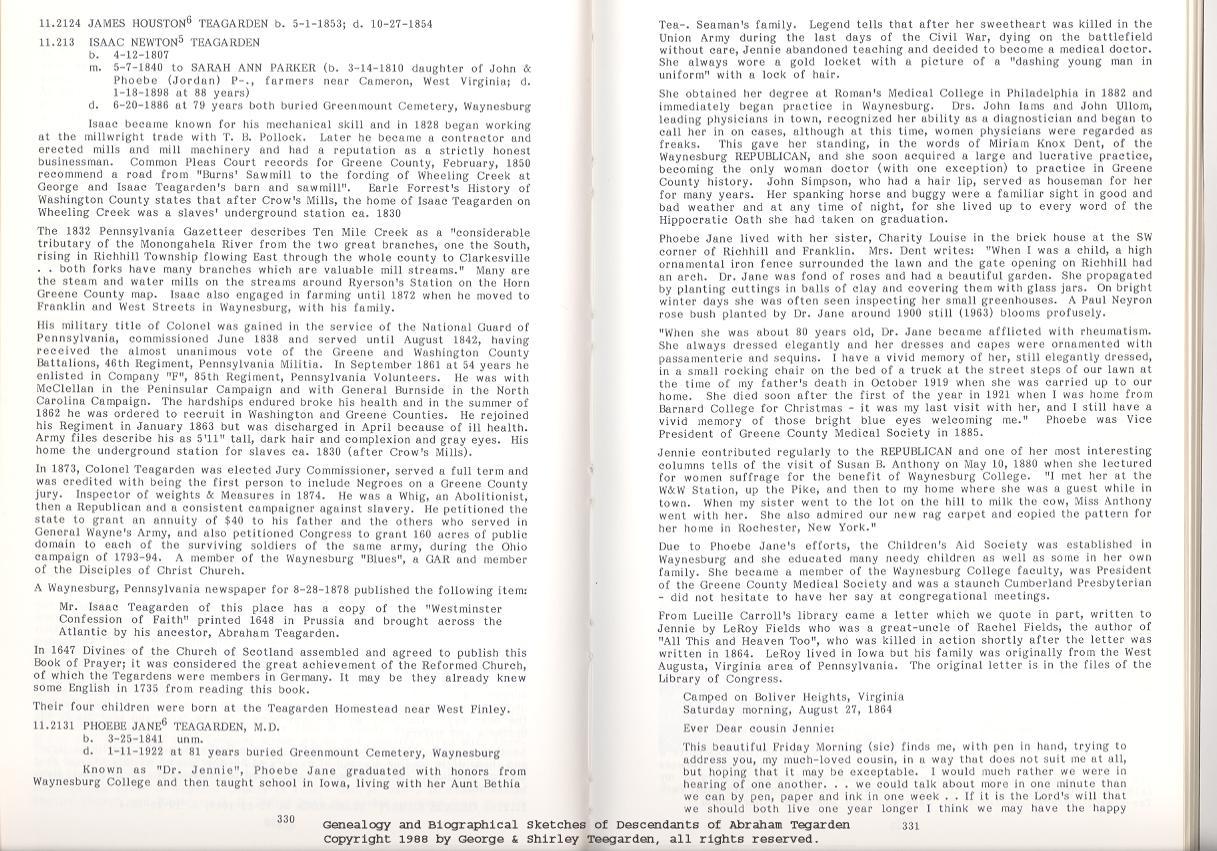
          The oldest private to enlist into the 85th Pennsylvania in the fall of 1861 appears to have been Isaac Newton Teagarden of Greene County. Teagarden was 54 years old when he volunteered to join Captain John Morris' Company F. Teagarden served in the regiment for 18 months before receiving a medical discharge on April 4, 1863 at New Bern, North Carolina.  Prior to his discharge, he had been sent home to western Pennsylvania on a recruiting mission. He returned to his regiment in early 1863 in North Carolina; but at his age, the rigors of army life proved to be too onerous, and he was discharged three months later. 
LOC

   
        Why would someone well into his sixth decade volunteer fight in the Civil War? For Teagarden, unlike most of the younger men who enlisted to preserve the Union,  the reason seems to be the cause of abolition. Even though the freeing of the slaves was not a direct cause of the war, Teagarden surely saw the conflict as an opportunity to permanently end the "peculiar institution."
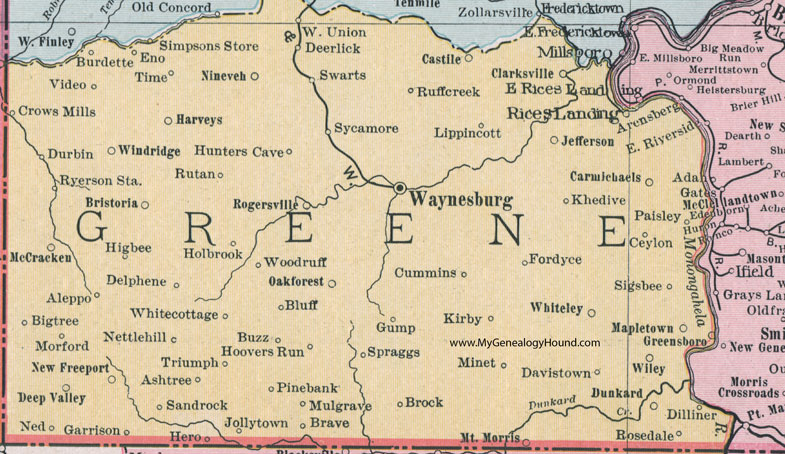
      Teargarden was a well-known citizen of Greene County in the decades prior to the war, although he was not necessarily a popular one. 


Waterwheel
Practical Hand Book for Millwrights 1910
      Teagarden was born in 1807 on the family homestead along Wheeling Creek in Richhill Township. He had eleven brothers and sisters. A brief biographical entry noted that Teagarden, "was educated in the public schools, and passed his early life on the home farm. In 1828, having reached his majority, he began working at the millwright trade under the instruction of T. P. Pollock, with whom he continued several years, becoming an expert workman. After leaving the employ of his instructor he began taking contracts for the erection of mills and mill machinery, and became one of the most noted of the early millwrights…His services were constantly in demand and many of the mills of those early days in Greene and Washington counties were monuments to his skill as a builder. Several years prior to the civil war he abandoned his trade and contracting business, returning to his boyhood vocation, farming, carrying on extensive operations until 1872, when he removed to Waynesburg, which was his residence until death.
        Teagarden was a member of the 46th Pennsylvania State Militia between 1837-1842. The men of this volunteer military unit hailed from Greene and Washington Counties. Teagarder was overwhelmingly elected  to serve as the unit's colonel for a period of time. Normally, someone with Teagarden's military background could have expected an offer to be an  officer on the level of lieutenant or even captain at the start of the Civil War. But due to Teagarden's political beliefs, he was probably shunned as an officer candidate and had to enter the service as a private. 
        In the 1840's, Teagarden helped found a local chapter of the Abolition Party. He must have realized that his views would be extremely suspect in his home county. With state borders to its south and west along the slave state of Virginia, there was fear than slave emancipation would cause an influx of cheap labor into Greene County that would have a negative impact on the white residents there. 
        But Teagarden was more than just an early spokesman for emancipation. His  home was
American Anti-Slavery Almanac 1838
reportedly a stopover for the Underground Railroad. He later joined the Republican Party in 1856; a main plank of the new party was opposition to the spread of slavery into western territories. The biographical entry stated that, "Prior to the formation of the Republican party, Colonel Teagarden was a Whig and strongly opposed to slavery, ranking among the then despised Abolitionists. He voted the Abolition ticket, when there were but three others in Greene county to do so. Newspapers and periodicals were then fewer in number and this deficiency was supplied by the local debating schools. In the schoolhouses and some of the churches in western Greene and southwestern Washington counties he met the champions of slavery, both preachers and laymen in debate, and while not eloquent, he was a most forceful convincing debater, and through these debates did much to create, build up and strengthen anti-slavery sentiment" 
      Following the war, with the Republican Party in ascendancy in Pennsylvania (if not Greene County, a Democrat Party stronghold), Teagarden was appointed Sealer of Weights and Measures and held this office from 1874-1883.
 

     Significantly, Teagarden was elected to be Jury Commissioner for Greene County in 1873; Teagarden saw to it that African-Americans in the county could serve on juries for the first time.
         "In all official positions, whether military or civil Colonel Teagarden was strict and fearless in the performance of duty, never swerving to gain the applause of men. The censure and odium he incurred when he placed the names of colored men in the jury wheel, but served to render him more zealous of their rights and privileges in the future. His comrades of John F. McCullough Post, Grand Army of the Republic, bore him to his last resting place, the military company, Waynesburg Blues, acting as escort.” 
            Teagarden and his wife, Sarah Ann Parker Teagarden, had three children: Phoebe Jane, Charity Louise, a teacher and John, a lawyer). Dr. Jane Teagarden was the first female doctor in Waynesburg, and for many years, the only female physician in Greene County. Captain John Parker Teagarden continued the family tradition of military service by serving in the 28th Pennsylvania Volunteers during the Spanish-American War.
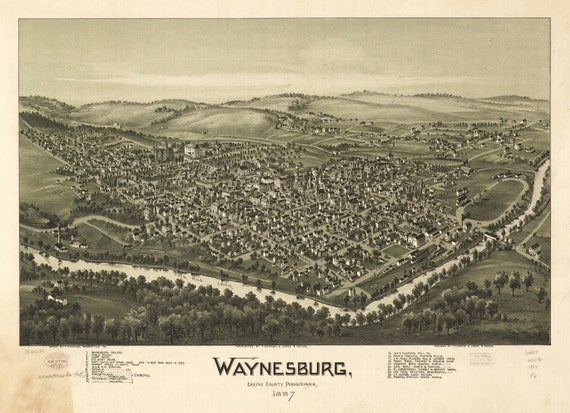
       Isaac Newton Teagarden died on June 20, 1886 at the age of 79 and is buried in the Green Mount Cemetery in Waynesburg, Greene County. 

Monday, June 15, 2020

"If I Never Get Home, I Hope to Meet You in Heaven."

  •          
  • Clarksville, Greene County
    from J.A. Caldwell Greene County 1876
    (Pryor household may be in pink section of map)


            One of the saddest stories in the history of the 85th Pennsylvania was that of Wilson and Robert Pryor. They were father and son, both members of Company D from Clarksville, Greene County. The remaining members of their family, particularly Wilson's wife, Catherine, were dealt a cruel fate during the course of the war.

          Wilson and Robert enlisted together into Company D of the 85th Pennsylvania in September of 1861. Wilson was 49 years of age; his son was 18. They served in the regiment together from training camp  in Uniontown, PA,  to fort construction in Washington, DC and  through the Peninsula Campaign in Virginia.

      There are hints that young Robert was the male figurehead of the family for his mother and younger siblings even before the pair went off to war. Wilson Pryor seems to have had an alcohol problem for many years before his enlistment. Robert may have wanted his father in Company D with him to perhaps help him cope with life; their service would also provide a steady income in order to send money home to Clarksville to support the rest of the family.

        Wilson Pryor apparently was ailing during the Peninsula Campaign. Robert wrote home to his mother sometime in the summer of 1862 that, "Pap [Wilson] wants you to try and stay where you are till he gets home if you can. That is if he ever gets home. I hope to God we may both get home safe again. If I ever get home safe you shall never want for anything, but if I never get home I hope to meet you in heaven."

        After 14 months in the regiment, Wilson Pryor was sent home on a medical discharge in early 1863. Mr. Pryor was in poor health when he died a few months later on June 4, 1863. The cause of death was an apparent suicide by hanging in his hometown. He was buried in the Burson Cemetery in Clarksville, Greene County.

         A local newspaper recorded Pryor's death in this blunt manner.  Wilson Prior of Clarksville, in this [Greene] County, committed suicide in an old, unoccupied dwelling of that village on Thursday last. It is supposed he was laboring under mental aberration. His body was not found till Monday morning, when an inquest was held. The deceased was a returned volunteer, and left a large family of children.”'

        In the months between is father's discharge and his death, Mrs. Pryor had to go to efforts to conceal the money sent home by her son. Catherine later stated in an affidavit that Wilson Pryor "...was of intemperate habits [drinking] and that in order to prevent him from squandering the money sent by Robert Pryor, her said son, it was necessary for her to conceal the fact of having received said money from her husband."


Harper's Weekly  February 28,  1863

           The affidavit also stated that Robert was supporting his family even before joining the 85th Pennsylvania regiment. "[he contributed]...two hundred dollars...by laboring at home for his parents." During his nearly three years in the service, he sent $115 home to Catherine as well. The strain to provide for his mother and siblings only increased in the months following his father's death. Plus Robert had to deal with the harsh conditions of the war itself.


           In the late summer of 1863, with his regiment stationed on Morris Island, SC, Robert and his regiment were digging trenches to prepare for a third assault on Fort Wagner. Robert wrote home that, "We are now in sight of Charleston and its defenses. we go within 100 yards of their forts every night and are very much exposed to their shell and canister. One day there was a shell come over and blowed one man all to pieces and wounded 5 men."


LOC


         Writing from Folly Island, SC in the spring of 1863, Robert discussed with his mother the death of his father. Robert wrote, "You said it was reported around Greene County that Pap tryed to hang himself [while he was] in the army. There is nothing of it. It is a lie...Let me know if you can get a house and a lot of about 3 or 4 acres. I don't want you to go back to the old place."

         Several months later, Robert wrote, "You told me Pap was in his right mind when he killed himself. I don't believe he was or he would not have done it."

         Robert, however, added a warning for his younger brother, David. "Tell David to never touch whiskey, Mother. I want you to raise them children wright. I know you can do it and keep on good terms with all the neighbors...Let's quit talking about Pap."

         Robert Pryor remained with the regiment through the Siege of Charleston, South Carolina, and then the  Bermuda Hundred Campaign in Virginia in 1864. 

        At the Second Battle of Deep Bottom, Robert was captured. He may have been a part of a contingent of troops who, after capturing a Confederate earthwork, became overzealous and pursued the retreating enemy into Confederate lines where they were taken prisoner.

         Robert died in captivity from exposure and malnutrition at the infamous


Andersonville prison camp in Georgia. 

        Along with fellow Company D comrade James Meeks, it was assumed the pair had been killed at Second Deep Bottom. But another captured member of Company D, Joseph Burson, lived long enough upon his release to disclose the fates of Meeks and Pryor to his father.


LOC


        Just prior to his capture, Pryor wrote home to his mother that, "I expect to be home in two months. my time is out the 15 of September, that is when my inlistment runs out."

         Corporal Burson of Company D was exchanged but died on the way back to western Pennsylvania. Catherine Pryor received a letter from Burson's uncle informing him of Robert's death in Andersonville. It said, "I received a letter from my brother last night [Joseph] is lying in bed in Annapolis [hospital]. He tells me your son Robert Pryor is dead. My brother said he died of starvation."  

The fate of Catherine Pryor and her family is unknown.                                                                   


Monday, April 27, 2020

Captain John A. Gordon of Greene County

Lt. John Adam Gordon
from M.L.Gordon's Experiences in the Civil War

         In 1861, Greene County, Pennsylvania School Superintendent John Adam Gordon was committed to developing news schools and helping to establish a teacher's college when the Civil War broke out. As a pro-Union member of the Democrat party, he resigned from his school position and went organizing a company of soldiers that included
John A. Gordon
his son, Marquis Lafayette Gordon. His troop paraded through the streets of Waynesburg before marching on to the training camp of the 85th Pennsylvania, established at Camp Lafayette in nearby Uniontown, Fayette County. 
     Gordon and his son probably assumed that, as long as they were not wounded or killed, that they would serve together throughout the Civil War. But although both survived the conflict, they actually spent little time together due to shifting responsibilities.
      When Captain Gordon's company arrived at Uniontown to enlist and train, it turned out his unit of about 50 men was too small to sustain a full company, so they were combined with another small company from Fayette County. In this new grouping, Isaac M. Abraham would be the captain and Gordon would serve as his lieutenant.
        After a few months of being stationed at Fort Good Hope near Washington, DC, Lieutenant Gordon was sent back home for recruiting duty at Brownsville, Fayette County in the spring of 1862.


M.L. Gordon
Experiences in the Civil War
         While Lieutenant Gordon was away, his son Sergeant Marquis "Mark" Gordon explained in his postwar memoir, the young man became ill in early May on the Virginia peninsula, spent time in a New York City hospital and did not rejoin his regiment until July. By that time, his father had been transferred out of the 85th Pennsylvania on a semi-permanent basis.
         Wrote Mark, "[My father] returned to the regiment about the end of May, expecting to see me, as he had heard nothing of my sickness. Colonel [Joshua B.] Howell met him with his usual smile, telling him what a splendid soldier I was proving myself to be. When my father told him I was not with the regiment, the colonel was somewhat taken aback. My father was with the regiment at the battle of Fair Oaks [Seven Pines] and through the Seven Days Battles [and] on the retreat to Harrison's Landing. A part of this time he was command of Company I. He knew nothing of me until he saw my name in the list of soldiers taken to New York, and the people of Waynesburg heard nothing either, so some thought I was dead, and I made quite a sensation when I got home."

       Lieutenant Gordon had returned to the regiment in time to participate in the Battle of Seven Pines near Richmond, which Mark Gordon had missed due to his illness. The division leader of the 85th Pennsylvania, General Silas Casey, was unfairly blamed for his men's retreat on the first day of the battle. He was replaced as division commander by General John J. Peck. 
     Mark Gordon continued, "A few days after I got back to the regiment, my father was placed in charge of the Ambulance Corps of General J. J. Peck's division. This made him a staff officer, his designation being 'Acting Assistant Adjutant General of the Ambulance Corps.' The position was a good one, giving him a horse and easier duties but was not quite so much as the high-sounding name would imply. As he did not really return to duty with my company until the last few months of the expiration of our term of service [in November, 1864], it will be seen that, although we were in the same company and regiment we really served together for only a very short time. He was often near us for quite a long while at a time, so I had many pleasant rides on his horse."
LOC
        A clerical error  nearly caused John A. Gordon to be sent to prison as a deserter in early 1863. With then 85th Pennsylvania stationed on Folly Island and Morris Island near Charleston, South Carolina, Lieutenant Gordon had remained at Suffolk with Peck's division. Colonel Howell of the 85th Pennsylvania made a strong request that Gordon be returned to his regiment.
        While Howell's request was being processed by the War Department, Confederate General James Longstreet made several movements towards Suffolk. General Peck's medical director requested that Gordon remain in Suffolk for the time being.
    When Gordon did return to the 85th Pennsylvania a few weeks late, he found that he had been mistakenly listed as
Civil War Ambulance Wagon
National Tribune  3-5-1903  
"absent without leave."  He was set to be court martialed and tried for desertion. But the court martial was overturned by General Quincy Gillmore and President Lincoln, and Gordon quietly returned to the 85th Pennsylvania.
      Later in 1863, Gordon was commissioned to captain.
       John A. Gordon performed one more voluntary service before returning home. As most of the regiment went home in November of 1864 at the end of their three-year enlistments, Captain Gordon was one of 55 men who took part in a special two-month duty. They served as guards for a large-scale prisoner exchange between Point Lookout, Maryland and Savannah, Georgia. Most of the Union prisoners with whom they sailed to the North were in extremely poor physical condition. Gordon may have volunteered because of his familiarity with sick soldiers from his duties in Peck's ambulance corps.

        Prior to the war, Gordon was elected the first Greene County school superintendent in 1854. His first order of business was to take an inventory of schools throughout the county, He determined that Greene County had 154 public schools, almost all one-room school houses, then called common schools. The schools included 167 teachers, ninety percent of whom were males.
     
Early Pennsylvania School House     LOC
          During John A.Gordon's first three-year term, 30 more schools were built that would provide education for "several hundred" more students than in 1854. His four goals were obtaining state funds to defray costs, more visitations to the schools, higher cooperation of parents, and higher quality teachers. Gordon set as a goal keeping the schools open for four months per year.
     Gordon served from 1854-57 and then ran for the office again in 1860. After winning that election, one of his main goals was the establishment of a normal school in the county to train teachers, but this endeavor was interrupted by the outbreak of the Civil War. The war also produced a shortage of teachers, as many of the young men, including Gordon's son, left the classroom to enlist into military service. Instead, Waynesburg College became the main local training ground for local teachers. [Samuel P. Bates, History of Greene County, Pennsylvania, 1888]
       Gordon died in 1898 at the age of 82 and is buried in the Green Mount Cemetery in Waynesburg.

Monday, April 6, 2020

Home on Furlough 1864


Harper's Weekly
February, 1864

        After a hard campaign around Charleston, SC that resulted in the capture of Morris Island (but not the fall of Fort Sumter and Charleston) the 85th Pennsylvania spent the first few months of 1864 in relaxed duty on Hilton Head Island.
        While stationed there, the Union hierarchy made a concerted effort to have as many regiments as possible reenlist beyond their original 3-year commitments. If a certain percentage of men in a regiment re-enlisted, they earned the designation of being called "veteran volunteers."
      The other three regiments in the brigade of the 85th Pennsylvania all earned this distinction. They were the 62nd Ohio, 67th Ohio and 39th Illinois. Although a number of 85th Pennsylvanians re-enlisted, not enough extended their service to earn the distinction of being called a veteran volunteer regiment.
Waynesburg (PA) Messenger     3-16-1864,    p.3
       In my book, Such Hard and Severe Service: The 85th Pennsylvania in the Civil War, I detail the efforts of their officers to encourage their men to re-enlist and explore the reason more men did not sign on for extended service.
       Those that did re-enlist earned an immediate 30-day furlough to go back home to visit family and friends; also some states used the furloughed men to recruit new men from their home areas. Another inducement may have been cash payments in the hundreds of dollars from their local and/or county government. This helped fill a quota of men the locality was expected to furnish towards the war effort.
       Only about a hundred or so men re-enlisted from the 85th Pennsylvania. The article at the right is from a Greene County newspaper of the time, the Waynesburg Messenger. It lists a number of Greene Countians, mostly from Companies F and G, who returned home on leave in early 1864 under the command of Lieutenant Levi Rogers.
       Unfortunately, when they returned to army duty, less than half of the men in this group made it unscathed through the rest of the war. The article mentions 23 men from the 85th Pennsylvania who visited Waynesburg. When their month was over and they returned to the war, three were killed, seven were wounded, two died from disease and one was captured. The rest returned to the war and survived without dying or being wounded.
    It should also be noted that none of the men who were killed or hurt died as a result of extending their service. All fell during the period of their original enlistment, which ended in November of 1864.

           Below is the list of the men in the same order they are named in the news article, as well as what happened to them during and after the war.


Soldiers Home on Furlough
Harper's Weekly
January 23, 1864
Lieutenant Levi Muncy Rogers was severely wounded in the hip at the Battle of Second Deep Bottom outside of Richmond in August of 1864. He died three weeks later at a hospital at Fort Monroe, VA. He is buried in the Hampton (VA) National Cemetery.
Sergeant Elmore A. Russell was wounded four times during the war. His most severe wound was suffered at Second Deep Bottom where he was shot in the arm. Russell survived the war and settled in Texas for the last four decades of his life. His occupations included teacher, farmer, fruit-grower, postmaster and city councilman. He died in 1912 at Lamar, TX at the age of 70.
Sergeant Alonzo Lightner was killed at the Second Battle of Deep Bottom. He was about 24 years of age.
Corporal Thomas J. White survived the war and settled in Nebraska where he worked as a printer. He was one of eight members of the regiment who earned a "Gillmore" Medal for meritorious service during operations on Morris Island, SC in 1863. White died in 1896 and is buried in Arlington National Cemetery in Virginia. 
Corporal John N. Durbin was wounded in the leg at Darbytown Road near Richmond on October 13, 1864. He died in 1897 and is buried in Greene County.
Corporal Thomas M. Sellers was wounded at the Battle of Second Deep Bottom but survived. He became a farmer in Kansas and a horticulturalist in Texas after the war. He died at the age of 86 in 1932 and is buried in Houston.
Civil War Song Sheet  LOC
Corporal John D. Haveley was wounded at Second Deep Bottom but stayed in the army until the end of 1865. He died around 1880.
Private William E. Leonard was awarded a Medal of Honor for the capture of an enemy flag at Second Deep Bottom, where he also suffered a head wound.
Private Lisbon Scott was captured in May of 1864 during the Bermuda Hundred Campaign. After nearly a year, he was released from Andersonville Prison in Georgia. He went home to Greene County and served as a county commissioner. Scott died in 1917.
Private John Rizor was born in Marshall County, VA (later West Virginia) and served until 1865. He died in 1919 and is buried in Belmont County, Ohio.
Private Isaac Gray was wounded twice prior to his furlough. He served until 1865 and then returned to his life as a farmer in Greene County. He died in 1906.
Private George Pettit suffered a facial wound at Second Deep Bottom. He returned home and worked as a farmer in West Virginia. He patented a self-closing farm gate in 1897. Pettit died in 1917.
Private Jackson Kimble had his right arm amputated after being wounded at Second Deep Bottom. He died in 1913 and is buried in Greene County.
Private James Huffman returned to Greene County and his life as a farmer after the war. He died in 1911.
Private Jacob Huffman was wounded at Darbytown Road in October of 1864. He died in 1927 at the age of 86 and is buried in Illinois.
Private David Fry served in the regiment for four years and three months. Returning after the war to Greene County, he had a wife, Mary, and four children. He died in 1907.
Private Henry Fry was shot and killed while on picket duty at Ware Bottom Church on June 17, 1864. He was survived by his wife and three children.
Private Andrew J. Morris returned from his furlough and soon died from smallpox in April of 1864. He is buried in the Beaufort National Cemetery in South Carolina.
Private Alfred McDonald returned from his furlough and contracted jaundice. He died in October of 1864 at the age of 44. He is buried in the Hampton (VA) National Cemetery. McDonald was survived by his wife, Christina, and four children.
LOC


Private John Rush was one of three men named John Rush in the regiment, all from Greene County. This is probably John J. Rush, who returned to Greene County after the war. He died in 1914.
Private William Seabold survived the war and moved to Ohio. He died in 1918 and is buried in West Jefferson, Ohio.
Private Thomas Rinehart returned home to Greene County after four years of service. He died in 1922 at the age of 86.
Private Andrew Frakes lived in Ohio and West Virginia after the war before returning to Greene County. He died in 1922 at the age of 76.


Monday, December 9, 2019

SW Pennsylvania Invasion Threats Part 6 John Hunt Morgan

           
John Hunt Morgan
LOC
                  Once the Confederate invasion threat from Confederate General William "Grumble" Jones subsided in May of 1863, the attention of Greene County and Washington County soon turned from the south to the west and to another prominent Confederate raider, John Hunt Morgan. Reports were that Morgan and his band of 2,500 rebels intended to attack Pittsburgh by marauding their way from Kentucky through Indiana, Ohio and West Virginia. From there, they had only to travel through the Pennsylvania counties of Greene and/or Washington in order to threaten Pittsburgh.


Joseph Markle
History of the County of
Westmoreland, PA
  p.653


FOOTNOTE: The town of West Newton in nearby Westmoreland County, east of Pittsburgh, responded to the Morgan’s threat by forming a company led by Joseph Markle. The 86-year old Markle was born during the Revolutionary War, had served in the War of 1812 and was a former general of the Pennsylvania militia. When Markle was 17 years old in 1794, Major General Daniel Morgan used the Markle family farm as a stopover as he led his wing on the Federal army against the Whiskey Rebellion. [Robert Van Atta, Pittsburgh Tribune-Review, April 9, 2000] 


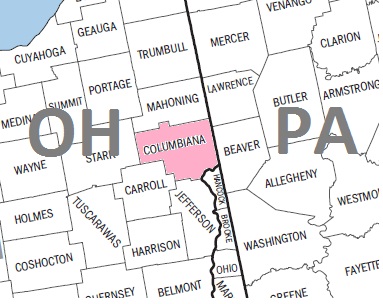
               Morgan’s raid began in June of 1863 in Tennessee and moved in a northern direction. From southern Indiana, Morgan’s Raiders headed due east until they reached Buffington Island, West Virginia. From here, Morgan took a northerly path once more and passed through Steubenville, Ohio. He was captured in late July near West Point in Columbiana County, Ohio, not far from Beaver County, Pennsylvania and just 60 miles northeast of Pittsburgh. 
       
Route of Morgan's Raid
Scott Mingus for Wikipedia
           Morgan began his raid upon the orders of General Braxton Bragg in Kentucky to create a diversion for Robert E. Lee's Army of the Potomac as Lee was marching towards central Pennsylvania and the epic confrontation at Gettysburg. Morgan was under orders from Bragg not to cross the Ohio River into northern territory, an order that Morgan ultimately ignored.

           On his 1000-mile trek, Morgan captured and paroled 6000 Union soldiers, destroyed 34 bridges, disrupted railroad traffic and generally put fear into the populace of several states, including Pennsylvania. Although Morgan never entered Pennsylvania, it was thought that the foundries, factories and federal arsenal in Pittsburgh might be a target.
         

Frank Leslie's Illustrated, 8-8-1863
Looting in Indiana by Morgan's Raiders


              In June, prior to Morgan’s capture, a small meeting of civic leaders was held at the Washington, Pennsylvania courthouse to prepare a defense of the city. Included in the four-man committee were two former officers of the 85th PA, Lieutenant Colonel Norton McGiffin and Harvey Vankirk. Like Vankirk, McGiffin had been medically discharged from the 85th PA in 1862. [Earle R. Forest, History of Washington County, Forest, 1926, p.1029] 

           A warning came from political leader James S. Jennings on June 17 for Greene and Fayette Counties to assemble local militias to meet this potential threat. “An invasion of this State by a large rebel force would be a great public calamity. It would be especially unfortunate for the farmers, who would be robbed of their stocks and produce, or paid in worthless Confederate shin-plaster [paper money]. I incline to the opinion that the Rebels will strike at Pittsburgh. The Cannon Foundries here, the Arsenal, and other establishments render this an important point just now, and it should be held at any expense or sacrifice.” [Waynesburg Messenger, June 17, 1863, p.3] 
             
John Hunt Morgan raid on Washington, Ohio
Harper's Weekly, August 15, 1863

             Local patrols began riding through both Greene and Washington counties. On one evening, some mounted men from Washington County rode into in Greene County. Fearful that they had spotted a Confederate raiding party, they burst through Waynesburg in the style of Paul Revere warning the townspeople that Morgan was on his way. The Confederate raiding party turned out to be simply a Greene County scouting party headed home from their mission to Waynesburg. [Forest, History of Washington County, 1026]


Pittsburgh Daily Post
7-28-1863


Coupled with the Confederate defeat at Gettysburg, PA in early July, the capture of Morgan's men and his imprisonment in Pittsburgh led one newspaper in that city to boast in the article at left:


Sunday, November 24, 2019

SW Pennsylvania Invasion Threats Part 4 Greene County

Greene County PA with the city of Waynesburg
Mongolia County, WV with city of Morgantown
LOC
During the Jones-Imboden Raid by Confederates into western Virginia in the spring of 1863, southwestern Pennsylvania began preparing for the possibility of invasion. Greene County residents were extremely concerned that their horses and cattle would  be confiscated by the raiders, and that the Confederates might move on to Waynesburg to steal bank funds. The Waynesburg
Waitman T. Willey
Photo by Matthew Brady   LOC
Messenger
reported that a courier sent from Morgantown by Waitman T. Willey, newly elected senator-elect from West Virginia, warned Greene Countians of events in Morgantown. Willey, the newspaper said, had escaped capture by fleeing to the Greene County community of Carmichaels. A Committee of Safety of seven prominent Waynesburg citizens was quickly organized with the goal of raising a local militia. After Confederate General Jones occupied Morgantown, the Waynesburg Messenger reported, “In view of this raid and of the fact that we are exposed here on the border to similar rebel incursions, we suggest that measures be immediately set on foot to organize the militia in the several townships.” [Waynesburg Messenger, April 29, 1863, p.3]
Among the community leaders of Waynesburg who were selected to form the Committee of Safety  was James B. Lindsay. Lindsay had been the sergeant major of the 85th Pennsylvania before returning home in early 1862 on permanent medical leave.
Lindsay in fact went on a scouting mission to Morgantown while that community was being occupied. With him was Rufus K. Campbell and Samuel A. Porter, both Union veterans.  Upon returning to Waynesburg, Lindsay reported that his small party had been chased home by Confederate raiders. Lindsay also reported that the Confederates numbers around 1,500 and were presently camped two miles from Morgantown.
Pittsburgh Gazette    April 29, 1863
         It will remembered that after confronting and defeating Jones’ force at Rowlesburg, (West) Virginia, Union Colonel John Showalter decided to withdraw his force to Uniontown and then to Wheeling. Both Waynesburg and Washington (PA) had organized local militias to support Showalter but called off the march to Morgantown when word was received that Showalter had left.
Pennsylvania Governor Andrew Curtin notified Washington, DC in late April of the potential
PA Governor Andrew Gregg Curtin
for raids progressing into Pennsylvania. However, President Lincoln astutely surmised that southwestern Pennsylvania was in no real danger. Lincoln wrote, “I do not think the people of Pennsylvania should be uneasy about an invasion. Doubtless a small force of the enemy is flourishing about in the northern part of Virginia on the ‘screwhorn principle’ on purpose to divert us in another quarter. I believe it is nothing more.” [Baylor, 142]
Word had reached the men in the regiment that some farmers back home tried to use the hilly topography to their advantage by hiding their livestock in deep ravines, while some businessmen hid their merchandise in barns and coal mines. [Robert Van Atta, Pittsburgh Tribune Review, April 9, 2000]
This part of the panic was mocked by some in the regiment, which was stationed on Folly Island near Charleston (SC) Harbor. One soldier who did not take the threat very seriously was Company G’s Mark Gordon of Greene County. In his letters
Marquis Lafayette Gordon
Experiences in the Civil War
home, Gordon had sometimes complained that his and other Union regiments were doing the dirty work for the government while many able-bodied men back home chose to sit out the war for as long as possible, if not permanently. In Gordon’s view, it was fitting that citizens back home were getting a taste of the war that he and his regiment had been attending to for the last 17 months. Gordon wrote, “Our boys had a great time after the arrival of the last mail, laughing over the scare of the people in Greene Co. had at the time of the threatened invasion by the Rebels…Some men…should have shown more pluck than to run off with their horses and cattle and leave their wives and children in the hands of a merciless vagabond band of guerillas.” [M.L. Gordon’s Experiences in the Civil War, p. 34]
Gordon was referring to the panicky atmosphere in Morgantown, just 26 miles from his hometown of Waynesburg. In a letter written by Anne Mathiot Dorsey from her farm a few miles south of Morgantown to her brother several days after the occupation, she wrote that while the raiders helped themselves to all the horses they could find in the town, most of the men had fled, leaving their wives and children to fend for themselves. [Source: Anne Mathiot Dorsey, letter to Jacob D. Mathiot, May 8, 1863, Myron B. Sharp, ed.  “The Confederate Raid at Morgantown,” Historical Society of Western Pennsylvania]
       A correspondent for a Philadelphia newspaper in Uniontown wrote, "Another person came in [from Morgantown] named FIELD and told a thrilling story, but on cross questioning, it appears he had deserted his wife and children to save one horse." (Philadelphia Inquirer, May 1, 1863)
Confederates with Confiscated Livestock
       In any event, by May 6, the Waynesburg Messenger reported that, “all imminent danger of a Rebel incursion having passed away, the Washington [PA] lads returned to their homes and our own people resumed their usual business occupations. At present, all is quiet, and all alarm allayed.


                                                NEXT: Washington County


Sunday, November 10, 2019

SW Pennsylvania Invasion Threats Part 2 Western Virginia


My last post presented an overview of Confederate invasion threats into southwestern Pennsylvania in the spring of 1863. For visual references, please refer to the map of the previous post. This post also included an overview of the Jones-Imboden Raid through western Virginia to the threshold of the Pennsylvania border. Today’s post will focus on the Jones-Imboden Raid in western Virginia and the Confederate occupation of Morgantown a few miles from the border with Greene County, Pennsylania. Future posts will focus on reactions in the Pennsylvania ounties of Washington, Greene and Fayette.
General John Imboden
The Photographic History of the Civil War
Volume 10
On April 20, Brigadier General John D. Imboden departed from the Shenandoah Valley towards western Virginia. His force numbered about 3,500, of whom four-fifths were infantrymen; the rest were cavalry and a six-gun battery. After a two-hour fight at Beverly in Randolph County against a small Union force, Imboden seized that town as well as nearby Buckhannon several miles to the west.  Imboden was now about 75 miles from the Pennsylvania border.
Imboden’s move was meant to preoccupy Union attention while General William “Grumble” Jones and his 3,000 men began a push to the north towards Mongolia County, which shares a border with both Greene and Fayette Counties in Pennsylvania. Jones’ main mission was to destroy Baltimore and Ohio Railroad bridge on the CheatRiver at Rowlesburg, (West) Virginia, as well as to wreck 45 miles of railroad track from Grafton to Oakland, Maryland.
Jones had set out from the Shenandoah Valley one day after Imboden began his march. Jones’ troops were soon contested by a hundred Union soldiers at Greenland Gap for over four hours before Jones seized the area. Jones proceeded to divide his force into thirds when he was 30 miles from Pennsylvania. While Jones himself headed to Rowlesburg, his two other detachments destroyed railroad bridges at the Maryland towns of Oakland and Altamont.
Historical Marker of Rowlesburg Battle
 Jones reached the key Baltimore and Ohio Railroad bridge at Rowlesburg on the Cheat River on April 26. The destruction of this span was the paramount goal of the raid. But the bridge was defended by 300 men of the 6th (West) Virginia under the command of Major John H. Showalter, along with townspeople and railroad workers. Showalter’s force blocked both ends of the bridge with stacks of railroad ties. He also had several well-placed artillery pieces to cover the area.
Significantly, Jones could not counter with his own artillery because he had sent it back to the Shenandoah Valley a few days earlier when its passage could not be secured across the rain-swollen Potomac River at Moorefield.
General William E. "Grumble" Jones
The Photographic History of the Civil War
Volume 10
After assaulting the bridge at Rowlesburg, Jones’ men withdrew. This was his only setback during the campaign. Jones proceeded to Morgantown, which he occupied the next day. He was now only five miles from the Pennsylvania border. In Morgantown, the invaders captured supplies and horses. On April 29, Jones and his men rode on to Fairmont about 35 miles away to the southwest, signaling the end of the threat to invade Pennsylvania. The largest battle of the raid ensued at Fairmont as Jones prevailed and his men blew up a bridge and train equipment.
Jones’ men also tore up miles of track and captured more horses and cattle before laying waste to thousands of barrels of oil at Burning Springs near the Ohio border.
The two commands of Jones and Imboden united in mid-May and returned to the Shenandoah Valley.  The cattle that both commands had seized helped to feed their own men as well as Lee’s army. Jones and Imboden also spirited away 1,500 horses, but many of these steeds had to replace their own mounts which had given out during the raid; many other of the other captured horses were unfit by the time they returned to the Shenandoah Valley. Most of the railroad track and bridges destroyed on the raid were quickly repaired. 
Jones and Imboden did acquire some recruits to the Confederate cause, but Imboden also lost 200 men to desertion when he tried to curb their thirst for looting and stealing. The raid also had the reverse effect of pushing more western Virginia residents towards the Union and impending statehood by the looting of their livestock. Homer Plimpton of the 39th Illinois, part of the brigade that included the 85th Pennsylvania, wrote from South Carolina, “According to the latest accounts that we have received the rebels are making some very active demonstrations in Maryland and on the border of Pa. Such raids will do us more good than harm. Let the enemy once get on to northern soil and our doubtful brethren will begin to realize what war is, and have something of an idea of the magnitude of the present war.” [The Civil War Journals of Col. Homer A. Plimpton by John L. Dodson]

"Confederate raiders attempt the capture of Union generals, Memphis, Tennessee, August 21, 1864, artist's impression,"
 House Divided: The Civil War Research Engine at Dickinson College
http://hd.housedivided.dickinson.edu/node/43065.
                    
                     ALARM ACROSS THE PENNSYLVANIA BORDER

The most alarming event for the residents of southwestern Pennsylvania was the brief occupation of Morgantown, just a few miles from the state border. This caused panic to reach a fever pitch on the northern side of the Mason-Dixon Line.  Some Morgantown residents drove their livestock into Greene County for protection. There was also a false report that Stonewall Jackson was leading 20,000 cavalrymen into Pennsylvania. This “Jackson” was actually Colonel William T. Jackson who was under Imboden’s command.
Gray Days in Morgantown
             by Clyde Cale, Jr. 
When Grumble Jones’ force left Morgantown, it was strongly feared that southwestern Pennsylvania would be his next target for cattle, horses and supplies. Even though entering Pennsylvania was never a goal of the Jones-Imboden Raid, the Confederates seemed to be on a path towards the home counties of the 85th Pennsylvania. Jones briefly headed in their direction when he crossed the Monongahela River from Morgantown, but then veered to the southwest towards Fairmont.
Small parties of Confederate cavalry did probe across the state line into Pennsylvania both during and after the brief occupation of Morgantown. Wild rumors and news accounts said the raiders had moved into Uniontown, which did not occur.  However, it was not out of the question that Jones’ men may have ridden into the southern part of Greene County or Fayette County in search of horses or to determine if any Union troops were in the area. When no Union troops were found, these Confederate bands returned to Morgantown and Jones headed to Fairmont.
                                   Next: Fayette County Reacts