Showing posts with label swamp. Show all posts

Monday, June 15, 2020

"If I Never Get Home, I Hope to Meet You in Heaven."

  •          
  • Clarksville, Greene County
    from J.A. Caldwell Greene County 1876
    (Pryor household may be in pink section of map)


            One of the saddest stories in the history of the 85th Pennsylvania was that of Wilson and Robert Pryor. They were father and son, both members of Company D from Clarksville, Greene County. The remaining members of their family, particularly Wilson's wife, Catherine, were dealt a cruel fate during the course of the war.

          Wilson and Robert enlisted together into Company D of the 85th Pennsylvania in September of 1861. Wilson was 49 years of age; his son was 18. They served in the regiment together from training camp  in Uniontown, PA,  to fort construction in Washington, DC and  through the Peninsula Campaign in Virginia.

      There are hints that young Robert was the male figurehead of the family for his mother and younger siblings even before the pair went off to war. Wilson Pryor seems to have had an alcohol problem for many years before his enlistment. Robert may have wanted his father in Company D with him to perhaps help him cope with life; their service would also provide a steady income in order to send money home to Clarksville to support the rest of the family.

        Wilson Pryor apparently was ailing during the Peninsula Campaign. Robert wrote home to his mother sometime in the summer of 1862 that, "Pap [Wilson] wants you to try and stay where you are till he gets home if you can. That is if he ever gets home. I hope to God we may both get home safe again. If I ever get home safe you shall never want for anything, but if I never get home I hope to meet you in heaven."

        After 14 months in the regiment, Wilson Pryor was sent home on a medical discharge in early 1863. Mr. Pryor was in poor health when he died a few months later on June 4, 1863. The cause of death was an apparent suicide by hanging in his hometown. He was buried in the Burson Cemetery in Clarksville, Greene County.

         A local newspaper recorded Pryor's death in this blunt manner.  Wilson Prior of Clarksville, in this [Greene] County, committed suicide in an old, unoccupied dwelling of that village on Thursday last. It is supposed he was laboring under mental aberration. His body was not found till Monday morning, when an inquest was held. The deceased was a returned volunteer, and left a large family of children.”'

        In the months between is father's discharge and his death, Mrs. Pryor had to go to efforts to conceal the money sent home by her son. Catherine later stated in an affidavit that Wilson Pryor "...was of intemperate habits [drinking] and that in order to prevent him from squandering the money sent by Robert Pryor, her said son, it was necessary for her to conceal the fact of having received said money from her husband."


Harper's Weekly  February 28,  1863

           The affidavit also stated that Robert was supporting his family even before joining the 85th Pennsylvania regiment. "[he contributed]...two hundred dollars...by laboring at home for his parents." During his nearly three years in the service, he sent $115 home to Catherine as well. The strain to provide for his mother and siblings only increased in the months following his father's death. Plus Robert had to deal with the harsh conditions of the war itself.


           In the late summer of 1863, with his regiment stationed on Morris Island, SC, Robert and his regiment were digging trenches to prepare for a third assault on Fort Wagner. Robert wrote home that, "We are now in sight of Charleston and its defenses. we go within 100 yards of their forts every night and are very much exposed to their shell and canister. One day there was a shell come over and blowed one man all to pieces and wounded 5 men."


LOC


         Writing from Folly Island, SC in the spring of 1863, Robert discussed with his mother the death of his father. Robert wrote, "You said it was reported around Greene County that Pap tryed to hang himself [while he was] in the army. There is nothing of it. It is a lie...Let me know if you can get a house and a lot of about 3 or 4 acres. I don't want you to go back to the old place."

         Several months later, Robert wrote, "You told me Pap was in his right mind when he killed himself. I don't believe he was or he would not have done it."

         Robert, however, added a warning for his younger brother, David. "Tell David to never touch whiskey, Mother. I want you to raise them children wright. I know you can do it and keep on good terms with all the neighbors...Let's quit talking about Pap."

         Robert Pryor remained with the regiment through the Siege of Charleston, South Carolina, and then the  Bermuda Hundred Campaign in Virginia in 1864. 

        At the Second Battle of Deep Bottom, Robert was captured. He may have been a part of a contingent of troops who, after capturing a Confederate earthwork, became overzealous and pursued the retreating enemy into Confederate lines where they were taken prisoner.

         Robert died in captivity from exposure and malnutrition at the infamous


Andersonville prison camp in Georgia. 

        Along with fellow Company D comrade James Meeks, it was assumed the pair had been killed at Second Deep Bottom. But another captured member of Company D, Joseph Burson, lived long enough upon his release to disclose the fates of Meeks and Pryor to his father.


LOC


        Just prior to his capture, Pryor wrote home to his mother that, "I expect to be home in two months. my time is out the 15 of September, that is when my inlistment runs out."

         Corporal Burson of Company D was exchanged but died on the way back to western Pennsylvania. Catherine Pryor received a letter from Burson's uncle informing him of Robert's death in Andersonville. It said, "I received a letter from my brother last night [Joseph] is lying in bed in Annapolis [hospital]. He tells me your son Robert Pryor is dead. My brother said he died of starvation."  

The fate of Catherine Pryor and her family is unknown.                                                                   


Monday, February 17, 2020

The Lucky Card Player

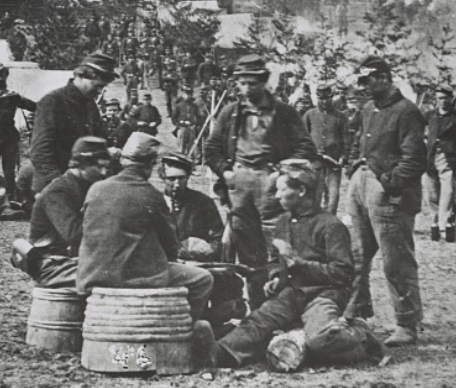
Playing Cards in Camp
LOC


       It was common for Civil War soldiers to toss away certain items just before going into battle. Dice, playing cards and pipes were often flipped away along the road or the brush while marching towards a fray. If a soldier were killed in battle, his personal belongings would be sent home to his family; many soldiers did not want their mothers to know that they had engaged in such habits as gambling or smoking.
       Corporal David Miller of Company B of the 85th Pennsylvania apparently did not hold such assumptions about his deck of cards. Perhaps he did use them to gamble. Maybe he thought he would be spared from injury or death. It could have been that his mother was no longer living. Or perhaps he just did not care. In any event, his decision to keep his cards may have saved his life.
      The 34-year old Miller, at the time a resident of Washington County, had already been wounded once, in the side and in the hand, at the Battle of Seven Pines in Virginia on May 31, 1862 when his deck of cards became a lifesaver. During this battle, about 75 men of his regiment suffered wounds, and about 25 died. Miller recovered and continued his service with his regiment.
     Six months later, in December of 1862, the 85th Pennsylvania was sent to New Bern, North Carolina to become part of the Goldsboro Expedition. This two-week mission, led by General John G. Foster, was tasked with disrupting the Confederate railroad center at Goldsboro sixty miles to the west and to interrupt the supply line for Robert E. Lee's Army of Northern Virginia.
Twenty-Fifth Anniversary of the Battle of Kinston
Reunion of the 45th Massachusetts Regiment
December 14, 1887
Post by Jason Tomberlin
     Foster's 10,000-man force was on their way to Goldsboro when they received word of the disastrous Union loss at Fredericksburg, Virginia.
    It is unclear whether or not Foster's goal was to simply stop supplies from reaching Lee (which did not matter now that the Fredericksburg battle had been fought) or whether he was to capture and occupy Goldsboro. With the federal army already badly defeated at Fredericksburg, the threat loomed of Confederate reinforcements being sent from northern Virginia to assist General Nathan "Shanks" Evans and his undermanned troops in North Carolina against Foster's command,
       Foster altered his plan. Staying in Goldsboro, he determined, was now out of the question. He decided he had time to march on to Goldsboro, destroy a railroad bridge and safely return to New Bern before Confederate reinforcements could arrive.
        On their way to Goldsboro, the 85th Pennsylvania was involved in two engagements in and around Kinston, At Southwest Creek, four miles south of the city, Companies B (including Miller) and D of the 85th Pennsylvania were sent, along with the 9th New Jersey, to force an opening through a thin Confederate artillery position. Both Union regiments made it across the creek at separate locations, gaining a pathway for Foster's force to continue on to Kinston.
     The next day, the 85th Pennsylvania as part of Henry Wessells' Brigade, slogged through a thinly  guarded swamp southeast of city towards the Kinston Bridge that spanned the Neuse River. This is where Miller's deck of cards came into play.
From a Kinston, NC Historical Marker
The yellow circle shows the position of  the 85th PA

       While part of Foster's force marched up the road towards the bridge from the south (the left of the picture below), the 85th Pennsylvania advanced towards the bridge from the southwest through the swamp (top left of the picture).
Kinston Bridge across the Neuse River
Harper's Weekly
      In this part of the assault, the 85th Pennsylvania and their brigade were slowed by the chest-deep waters. Confederate sniper fire also made the passage difficult. The Union troops were slowed by trying to advance through the water. On the other hand, as one member of the 85th Pennsylvania later commented, with the lower two-thirds of their bodies in water, the Confederates had less of a target to shoot at.
      During this advance, Sergeant Miller was struck. Nearly four decades later 85th veteran Manaen Sharp wrote a brief tract about veterans in the area around Amity, PA in Washington County.
      Of Miller, Corporal Sharp wrote,  "At Kingston [sic] while charging through a swamp he [MIller] was badly hurt and helped to solid ground by a comrade, who, examining his wound, found the ball had passed through a deck of playing cards and buried itself in his side." [Sharp, Amity in the Great American Conflict, p. 24]
         How badly was Miller wounded? Records are inconclusive.  Historian Luther Dickey, in his 1915 history of the 85th Pennsylvania, listed the names of the three soldiers from the regiment killed on the expedition but not the names of  five more who were wounded along the way. Miller may or may not have been one of these five. A later biographical sketch noted that Miller was treated for his wound in a field hospital. [Presidents, Soldiers and Statesmen, 1894, p. 1263]
        Miller either marched or rode the sixty miles back to the Union base at New Bern. The regiment stayed there for six weeks through the end of January before being transported to St. Helena Island, South Carolina. Their next military movement was not until April of 1863 when they launched an invasion of Folly Island, South Carolina.  This gave Corporal Miller four months to recover and rejoin his regiment.
        Miller stayed with his regiment for the next 18 months, finishing his three-year enlistment in November of 1864. 
       Later, in the 1890 Veteran Schedule, a special census of Union Civil War veterans which detailed their service and physical conditions, no mention was made of Miller having suffered from a permanent wound at Kinston.
        Miller lived in Jefferson, PA in Greene County at the time of the Veteran Schedule. No record of his burial could be found in either Greene or Washington Counties. Was Miller a gambler and/or did he continue his card-playing habit following the war? Suffice to say, he may have made his best gamble of his by keeping his cards close at hand at Kinston in 1862.