Showing posts with label Company B. Show all posts

Monday, May 18, 2020

Musician William Barker of Company B

 
Waynesburg (PA) Messenger     July 17, 1867
          The subject of the unfortunate accident mentioned in the news article above is a former member of the 85th Pennsylvania regiment, William J. Barker. The accident highlights several ironies in Barker's life.
         Barker enlisted into Company B of the 85th Pennsylvania as a 16-year old drummer boy in the fall of 1861, He was a musician in the company along with 18-year old fife player Eli Crumrine.
Unidentified Civil War Drummer   LOC
Although a great majority of the soldiers from Company B came from Washington County, Barker was one of a handful of men in the unit from the town of Brownsville in Fayette County.
       Barker's date of enlistment is October 11, 1861. This relatively late date may be the reason he had not joined the already established Company C of Captain John C. Wilkinson, which was composed of boys and men mostly from Brownsville and the surrounding area.
      Barker survived the war and returned home to Brownsville three years later while still in his teens at the end of 1864.
         Barker had been born in Chester County, PA in 1845 to parent Matthew and Jane. At some point prior the outbreak of the war, the family moved across the state to Brownsville. Following the war, Barker returned to Brownsville and worked as a glass blower but soon headed to Pittsburgh where he spent most of his life. He was engaged in various artistic professions for the next several decades, including work in glass art and editing an art publication. In the last few decades of his life, he found work as a machinist.
        Barker died in 1910 and is buried in the Homewood Cemetery in Pittsburgh.
   

Mexican War six-pound cannon     LOC
The first irony surrounding the Fourth of July accident in 1867 shortly after the war had to do with the cannon itself. It had been brought back to Brownsville as a war prize confiscated during the Mexican War (1846-1848).
    Another news article of the accident, this from a Pittsburgh newspaper, offers more information about Barker's mishap.
Pittsburgh Daily Commercial      July 15, 1867

         Although this article states that Barker's injuries were potential fatal, he survived the event and lived another 53 years. Also, his partner in the event, William Norcross, is mistakenly mentioned as a former member of the 85th Pennsylvania. Norcross was 50 years old at the time of the accident and may have been a Mexican War veteran,but he was not a former member of Barker's regiment. 
       The end of this article mentions that a similar explosion occurred 18 years earlier on the same spot of ground. That accident killed Samuel Austin, a Mexican War veteran and a former member of the Second Pennsylvania Volunteers. 
         James Hadden offered more information about Austin's war record and this first accident in his history of his hometown entitled A History of Uniontown (1913).  It is not stated, although perhaps probable, that the same cannon was involved in both accidents.

          This article mentions the site of the accident as Brubaker Hill. At this location was a tavern that was a stopover for travelers along Route 40. It is located near the present site of a Dairy Queen and Dollar General store. It is also close to the Redstone Cemetery, where several veterans of the 85th Pennsylvania are buried. 
        The second irony involves the manner of Barker's death in Pittsburgh in 1910. After surviving the war and the cannon accident, Barker died as the result of another accident at the age of 65. The manner of his death is recounted in the following obituary.

Pittsburgh Daily Post   2-10-1910


Monday, February 17, 2020

The Lucky Card Player

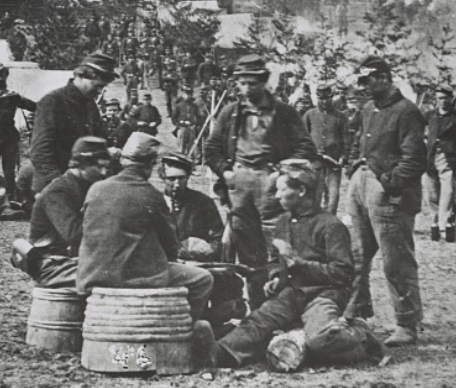
Playing Cards in Camp
LOC


       It was common for Civil War soldiers to toss away certain items just before going into battle. Dice, playing cards and pipes were often flipped away along the road or the brush while marching towards a fray. If a soldier were killed in battle, his personal belongings would be sent home to his family; many soldiers did not want their mothers to know that they had engaged in such habits as gambling or smoking.
       Corporal David Miller of Company B of the 85th Pennsylvania apparently did not hold such assumptions about his deck of cards. Perhaps he did use them to gamble. Maybe he thought he would be spared from injury or death. It could have been that his mother was no longer living. Or perhaps he just did not care. In any event, his decision to keep his cards may have saved his life.
      The 34-year old Miller, at the time a resident of Washington County, had already been wounded once, in the side and in the hand, at the Battle of Seven Pines in Virginia on May 31, 1862 when his deck of cards became a lifesaver. During this battle, about 75 men of his regiment suffered wounds, and about 25 died. Miller recovered and continued his service with his regiment.
     Six months later, in December of 1862, the 85th Pennsylvania was sent to New Bern, North Carolina to become part of the Goldsboro Expedition. This two-week mission, led by General John G. Foster, was tasked with disrupting the Confederate railroad center at Goldsboro sixty miles to the west and to interrupt the supply line for Robert E. Lee's Army of Northern Virginia.
Twenty-Fifth Anniversary of the Battle of Kinston
Reunion of the 45th Massachusetts Regiment
December 14, 1887
Post by Jason Tomberlin
     Foster's 10,000-man force was on their way to Goldsboro when they received word of the disastrous Union loss at Fredericksburg, Virginia.
    It is unclear whether or not Foster's goal was to simply stop supplies from reaching Lee (which did not matter now that the Fredericksburg battle had been fought) or whether he was to capture and occupy Goldsboro. With the federal army already badly defeated at Fredericksburg, the threat loomed of Confederate reinforcements being sent from northern Virginia to assist General Nathan "Shanks" Evans and his undermanned troops in North Carolina against Foster's command,
       Foster altered his plan. Staying in Goldsboro, he determined, was now out of the question. He decided he had time to march on to Goldsboro, destroy a railroad bridge and safely return to New Bern before Confederate reinforcements could arrive.
        On their way to Goldsboro, the 85th Pennsylvania was involved in two engagements in and around Kinston, At Southwest Creek, four miles south of the city, Companies B (including Miller) and D of the 85th Pennsylvania were sent, along with the 9th New Jersey, to force an opening through a thin Confederate artillery position. Both Union regiments made it across the creek at separate locations, gaining a pathway for Foster's force to continue on to Kinston.
     The next day, the 85th Pennsylvania as part of Henry Wessells' Brigade, slogged through a thinly  guarded swamp southeast of city towards the Kinston Bridge that spanned the Neuse River. This is where Miller's deck of cards came into play.
From a Kinston, NC Historical Marker
The yellow circle shows the position of  the 85th PA

       While part of Foster's force marched up the road towards the bridge from the south (the left of the picture below), the 85th Pennsylvania advanced towards the bridge from the southwest through the swamp (top left of the picture).
Kinston Bridge across the Neuse River
Harper's Weekly
      In this part of the assault, the 85th Pennsylvania and their brigade were slowed by the chest-deep waters. Confederate sniper fire also made the passage difficult. The Union troops were slowed by trying to advance through the water. On the other hand, as one member of the 85th Pennsylvania later commented, with the lower two-thirds of their bodies in water, the Confederates had less of a target to shoot at.
      During this advance, Sergeant Miller was struck. Nearly four decades later 85th veteran Manaen Sharp wrote a brief tract about veterans in the area around Amity, PA in Washington County.
      Of Miller, Corporal Sharp wrote,  "At Kingston [sic] while charging through a swamp he [MIller] was badly hurt and helped to solid ground by a comrade, who, examining his wound, found the ball had passed through a deck of playing cards and buried itself in his side." [Sharp, Amity in the Great American Conflict, p. 24]
         How badly was Miller wounded? Records are inconclusive.  Historian Luther Dickey, in his 1915 history of the 85th Pennsylvania, listed the names of the three soldiers from the regiment killed on the expedition but not the names of  five more who were wounded along the way. Miller may or may not have been one of these five. A later biographical sketch noted that Miller was treated for his wound in a field hospital. [Presidents, Soldiers and Statesmen, 1894, p. 1263]
        Miller either marched or rode the sixty miles back to the Union base at New Bern. The regiment stayed there for six weeks through the end of January before being transported to St. Helena Island, South Carolina. Their next military movement was not until April of 1863 when they launched an invasion of Folly Island, South Carolina.  This gave Corporal Miller four months to recover and rejoin his regiment.
        Miller stayed with his regiment for the next 18 months, finishing his three-year enlistment in November of 1864. 
       Later, in the 1890 Veteran Schedule, a special census of Union Civil War veterans which detailed their service and physical conditions, no mention was made of Miller having suffered from a permanent wound at Kinston.
        Miller lived in Jefferson, PA in Greene County at the time of the Veteran Schedule. No record of his burial could be found in either Greene or Washington Counties. Was Miller a gambler and/or did he continue his card-playing habit following the war? Suffice to say, he may have made his best gamble of his by keeping his cards close at hand at Kinston in 1862.


Sunday, October 20, 2019

Profile of Robert Patterson Hughes

        One of the most prominent postwar members of the 85th Pennsylvania regiment was Robert Patterson "Pat" Hughes of Washington, PA. [I have no photo of Hughes to share, but this link to the Wyoming State Archives had a picture of Private Hughes] Hughes enlisted as a private in the 12th Pennsylvania infantry for three months before joining Company B of the 85th Pennsylvania as a lieutenant. By the end of the war, Hughes was the lieutenant colonel of the 199th Pennsylvania regiment. And by the time he retired from the army in the early 1900's, he was a major general. He is the only member of the regiment who served in both the Civil War and the Spanish American War.
Removing Confederate Torpedoes on James River, 1864  
  LOC

         Hughes was born in 1839 in Washington County. During the war, he became one of the most reliable field commanders in the regiment. He led a small unit to destroy a torpedo station on the James River in Virginia. He later led charges during the Second Battle of Deep Bottom in 1864 in Virginia, and then at Fort Gregg near Petersburg, Virginia (as a member of the 199th PA) in the closing week of the war.
Hughes' map of Little Big Horn 
   LOC
        He married Clara Terry, who was the sister of General Alfred Terry, and was a member of Terry's staff during the campaign against the Sioux Indians in 1876. Terry and Hughes came upon the Little Bighorn Battlefield shortly after George Custer's command was wiped out. Hughes drew a map of the field which is now housed in the Library of Congress. Hughes also wrote a brief but spirited tract on the battle in which he placed blame on Custer and absolved Terry, his brother-in-law.
    He continued to advance his army career, becoming Inspector General. In this position, he helped Francis Morrison of the 85th Pennsylvania earn a Medal of Honor for trying to save a comrade's life at Ware Bottom Church (VA) in 1864 during the Civil War. 
    Hughes was sent to the Philippines during the Spanish American War as an aide to General Elwell Stephen Otis. Hughes spent four years in the Philippines, serving at one point as Provost Marshal of the Manila.
    In 1901, after the killing of nearly 50 American soldiers of the U.S. 9th Infantry on the island of Balangiga, Hughes instituted a severe search-and-destroy policy against insurrectionists that resulted in the deaths of thousands of Filipinos. He told a congressional committee that burning villages was not civilized warfare, but that the Filipinos were not a civilized people.
From the Inter Ocean
 Chicago
 February 26, 1902
      Hughes retired from the army in 1904 at age 64 and a 43-year military career. He died in 1909.

Sunday, September 29, 2019

Map of Southwest Creek near Kinston, NC


         The Historical Preservation Group of Kinston, North Carolina, has kindly allowed me to post this battle map of Southwest Creek. A fight occurred here on December 13, 1862 in which the 85th Pennsylvania played a key role.
          Two days earlier, the 85th Pennsylvania had marched out of New Bern as part of General John G. Foster's combined strike force of 12,000 troops. Their goal was to march from the North Carolina coast to Goldsboro, a key Confederate railroad hub, destroy a railroad bridge and possibly occupy the city. Their intention was to disrupt the supply line from Wilmington, NC to Robert E. Lee's Army of Northern Virginia on the eve of the battle of Fredericksburg, VA. A chapter in my history of the 85th Pennsylvania, "Such Hard and Severe Service" (published by Monongahela Books) is dedicated to this two-week, 180-mile expedition.
          The 85th Pennsylvania was still smarting from the Battle of Seven Pines (VA) six months
General John G. Foster   LOC
earlier. They had fought hard, and delayed a large attacking Confederate force before retreating, only to learn that General George B. McClellan had publicly disparaged them for their eventual retreat in the face of an overwhelming enemy.
         Anxious to restore their battered reputation, companies B and D of the 85th Pennsylvania along with the 9th New Jersey were responsible for defeating a Confederate battery guarding Southwest Creek a few miles south of Kinston, which was on the way to Goldsboro.
        As can be seen in the map, the 85th Pennsylvania advanced through a swampy area across the creek from the right flank south of the creek while the 9th New Jersey scurried across the creek over an unguarded milldam to the left. This victory set the stage the next day for the First Battle of Kinston. In this engagement, the 85th Pennsylvania swept through an unguarded swamp, distracting the thin Confederate defensive line and allowing other Union regiments to capture the bridge.
        Foster's force continued to Goldsboro and destroyed the railroad bridge, but beat a hasty retreat back to New Bern when word came of the Union's disastrous defeat at Fredericksburg.
       Nonetheless, the 85th Pennsylvania, due to their roles at Southwest Creek and Kinston, felt their honor had been restored by their performance. Their losses were three men killed --Pvt. Thomas Cox (Company C) was killed instantly, while  Corp. Charles Pullin (H), and Pvt. Samuel Daniels (H) died the next month while hospitalized.

Monday, September 23, 2019

Boyd Crumrine Profile

Boyd Crumrine
Commemorative and Biographical Record 

of Washington County, PA (1889)


   "Why is a love for local history to be justified and encouraged? First, for the reason that it is so absorbing, in the leisure hours when other subjects may have lost their interest; and second, and the better reason perhaps, because when one of the present had brought before him the honest, strenuous life and bravery of his pioneer ancestors, he is most likely himself impelled to courage and endurance"

                     Boyd Crumrine
                     The Daily Notes
                     Canonsburg, PA
                     December 24, 1903


     I found this quotation by Boyd Crumrine of the 85th Pennsylvania to coincide with my own motivations for writing "Such Severe and Hard Service" published by Monongahela Books. After the war, Crumrine had a distinguished career as an attorney and local historian in Washington County.
    Crumrine (1838-1916) had just been admitted to the bar of Washington County, PA in 1861 when he decided to enlist into Company B of the 85th Pennsylvania as quartermaster-sergeant. He spent the winter of 1861-2 with his regiment in Washington, DC. Crumrine then transferred to another unit that was soon disbanded; he consequently was discharged and went home in 1862 to began his career as an attorney. In this capacity, he represented many veterans' widows and mothers who were seeking survivor benefits. Their husbands or sons were men from his former regiment who had lost their lives in battle or from disease.
     Crumrine wrote a comprehensive history of Washington County in 1882 as well as several other books and articles on western Pennsylvania history. At one time he was the president of the Washington County Historical Society. He also wrote and edited several law books during his career as a writer.
Boyd Crumrine 1910
The Centennial Celebration....of Washington, PA