Showing posts with label Fort Gregg. Show all posts

Monday, September 14, 2020

The 199th Pennsylvania Joins the Brigade

          
Regimental Colors of the 199th PA
PA Capitol Preservation Committee
Room 630 Main Capitol Building
Harrisburg, PA

             In October of 1864, about three-quarters of the men in the 85th Pennsylvania completed their three-year enlistment and prepared to return home to western Pennsylvania. They were removed from the front lines near the James River in Virginia and sent to Portsmouth, Virginia  for a month of relaxed duty before leaving the service.
            About 150 of their comrades from their regiment remained on the front lines, either because they had re-enlisted or because they had joined the regiment after 1861 and still owed the government a year or so of service. These remaining men would play prominent roles in the Battle of Fort Gregg and the Appomattox Campaign in April of 1865.


-
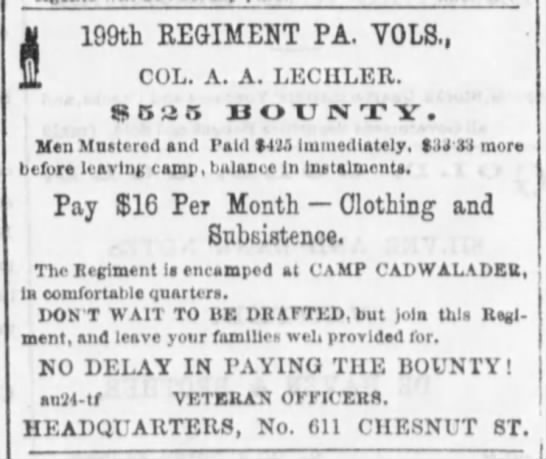
The Evening Telegraph, Philadelphia, PA, September 3, 1864


          The other three regiments in the brigade of the 85th PA had a more substantial number of men in remain in the service. In early 1864, many of these men from the 39th Illinois, 62nd Ohio and 67th Ohio had reenlisted. This brigade was designated as the First Brigade, First Division of the Army of the James.

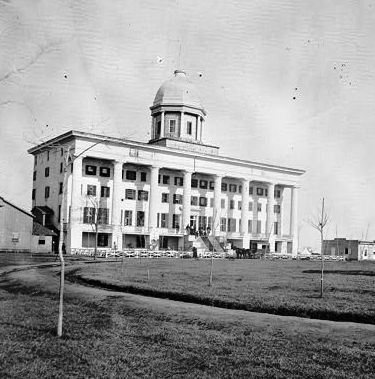
Wetherill House, Samson St.
Philadelphia where the 
199th PA was organized


        Because of the departure of the men from the 85th PA, the brigade, temporarily led by Colonel Francis B. Pond of the 62nd Ohio,  was low in numbers. Therefore a new regiment, the 199th Pennsylvania, joined their ranks in Virginia. The 199th PA was composed of nearly 1,500 troops from around the state, including the counties of Philadelphia, Montgomery, Lancaster, Crawford, Allegheny, Lycoming, Wilkes-Barre, Dauphin and Lackawanna. They had enlisted for one year of military service in the fall of 1864.


Camp Cadwalader
Philadelphia
Where the 199th PA Trained

            The 199th PA was led by Colonel James (later Joseph) C. Briscoe, He born in Ireland and had served as a staff officer for Generals Phillip Kearney and David Birney.  Meanwhile, several  members of the 85th PA became officers in the 199th PA: Robert P. Hughes (Lieutenant Colonel), Oliver Sproul (First Lieutenant, Company H), Charles Eckels (Captain, Company K) and Walter Cravin (Captain, Company E).
        On April 2, 1865, Union forces made a breakthrough against Confederate lines near Petersburg. In their first battle at Fort Gregg later that day, the 199th PA suffered 18 killed and 91 wounded. Colonel Briscoe was shot in the leg during the charge but continued towards Fort Gregg. 


        Briscoe's official report of the charge at Fort Gregg stated,  "About noon we received orders to attack and
James C. Briscoe
Am. Civil War Research Database

carry the fort, and the whole line advanced, in good style. The ground in front of the southeast salient of the work forms a perfect natural glaces for about 300 yards; passing over this space my regiment suffered its severest loss-canister, shot, and minie bullets tore through the ranks, yet not a man faltered. I was struck down by a flanking ball about seventy-five yards from the work, and although I lost but a moment in recovering myself, the men were already in the moat and clambering up the exterior slope; were fighting hand to hand across the parapet, the enemy refusing to surrender, though surrounded on all sides. This sort of thing lasted nearly twenty minutes, when we finally burst over the parapet and the fort was ours."
         Lieutenant Oliver Sproul, the former 85th Pennsylvanian, planted the colors of the 39th Illinois on the wall of the fort. William Chick of the 85th PA claimed that this was the first of many Union flags planted on the parapet as the fort fell to the Union. Wrote Chick, "The first flag to reach the fort was the flag of the 39th Ill. The Color Bearer fell as he reached the ditch and First Lieut Oliver Sproul of the 199th Pa. grabbed the colors, mounted the parapet, and planted the flag." [National Tribune, Washington, DC, June 12, 1902]
       Another account of Fort Gregg came from Private Jacob Etter of Company H. Etter wrote this tribute to his captain, John G. Bippus of Butler County, who like Briscoe was wounded in the charge upon the fort. "[You were] leading your command into action – that terrible charge on Fort Gregg, the key to the stronghold, Petersburg. I shall never forget it, nor my feelings as I picked you up and placed you in the ambulance [after a gunshot wound to the head], with the impression that you were mortally wounded…How any of us escaped to tell the tale of that day may only be attributed to Him who governs the universe and rules the stars, and who also directed the flying missiles. " (Butler Citizen,  August 7, 1878)


Charge of Fort Gregg    LOC


            After Fort Gregg fell, General Robert E. Lee abandoned Richmond and Petersburg and headed west to escape pursuing Union armies. At Rice's Station, on the way to Appomattox, a brief fight left four men dead and eight wounded from the new regiment. In total during their brief service, the 199th PA lost 32 men to the battlefield and 52 to diseases.
        Following the surrender at Appomattox, the 199th PA was encamped near Richmond and the men were mustered out two months later. [Frank H. Taylor, Philadelphia in the Civil War, 1913]
        Because they were from counties from throughout the state, the 199th PA often held company reunions rather than trying to bring the entire regiment together. One such reunion was held in 1912 by Company K. For this get-together, Captain Charles E. Eckels, formerly of the 85th PA, traveled from West Brownsville in Washington County to meet his former soldiers in Lancaster County.
       In his remarks to the company, Eckels said that, after the surrender at Appomattox, Company K was given the honor of guarding Union headquarters by General John Gibbon (Commander of the 24th Corps in the Army of the James) because of the company's strong appearance, discipline and training. [Williamsport [PA] Sun-Gazette, September 12, 1912]
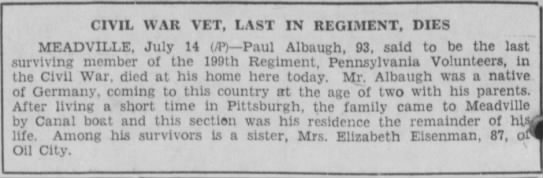
      The last surviving member of the 199th PA was Paul Albaugh from Meadville, Crawford County. He died in 1935.

-
The Mercury, Pottstown, PA, July 15, 1935


Monday, February 3, 2020

The Last Man Killed

   
Frank Leslie's Illustrated
       In last week's post, I  wrote about James C. Davis, who was the last member of the regiment to be wounded in battle. Davis was hurt on April 2, 1865 at Fort Gregg near Petersburg, VA.
       Davis survived his wound and went on to a prominent career in education. He died in 1914 at the age of 63 and is buried in Kansas.
      The next question to answer is: Who was the last member of the 85th Pennsylvania to die in battle? The answer is not as cut-and-dried as one would imagine. My interpretation of the question is: Who was the last to die AS A RESULT of being wounded in battle. Based on this view, several men who were wounded at Second Deep Bottom could be that last victim. And what about those who WERE members of the 85th Pennsylvania but had transferred to another regiment to meet their permanent fate?
        Following the  2nd Battle of Deep Bottom in August of 1864. the 85th Pennsylvania was involved in the fighting at Darbytown Road, VA (October 13, 1864), Fort Gregg (April 2, 1865) and Appomattox Court House (April 9, 1865) before the war finally ended.

New York Daily Herald
August 17, 1864
    In these final three engagements, several men from the 85th Pennsylvania were wounded but there were no fatalities.
     That means that the last engagement in which men from the regiment were killed was at 2nd Deep
2DP Reenactment  2014
Bottom. In that engagement 21 men were killed and another 73 were wounded.
      In this one-week operation near Richmond, most men died on the day of the most substantial part of the fight on August 18,1864.         


      The 85th Pennsylvania, as a member of Francis Pond's Brigade, stormed and captured a Confederate earthwork.
       Captain Lewis Watkins of Company E was severely wounded in the arm and  leg while helping to lead the charge at 2nd Deep Bottom. Watkins died six weeks later at Chesapeake Hospital at Fort Monroe (VA).
        Of the men who suffered fatal wounds, Sergeant Myers P. Titus of Company G lingered until November 2, 1864 before dying in a Hampton (VA) hospital. Corporal James Sturgis, also of Company G, hung on from his wound until he expired on November 6, 1864 in a hospital in Beverly, NJ.
        Next is Corporal James C. Bailey of Company C. Bailey was captured on Whitemarsh Island near Savannah, Georgia on February 22, 1864. The exact cause of his demise is unclear. Bailey was eventually released during a large-scale prisoner exchange but died on the voyage home on December 12, 1864. He may have been wounded on Whitemarsh Island. How much this contributed to his death is unknown. On the other hand, his death may have been due to harsh treatment at Andersonville and other Confederate prison camps. If he were wounded on Whitemarsh Island, was this a a contributory factor to his death?
        Next is Private David Baldwin of Company D. Baldwin  who died in Salisbury (NC) POW camp in North Carolina on December 19, 1864. Baldwin was listed as missing-in-action at 2nd Deep Bottom. Like Bailey, it is unknown if Baldwin were wounded, causing him to be captured. If he were wounded, it is also not known if this contributed to his death. He may have died of starvation or caught a disease in camp and expired.

Captain Richard Dawson
James Hadden, History of the Old Flag
 

      Captain Richard Dawson of Company I was wounded at the second (and successful) Union assault on Fort Fisher near Wilmington, North Carolina in January of 1865. Dawson was wounded in the arm, which was amputated, but he passed away a few weeks later from the wound on February 1, 1865.
    But Dawson was not a member of the 85th Pennsylvania at the time. Two months earlier, he had been promoted and was an aide to General Adelbert Ames when he was wounded during the storming of Fort Fisher.


Corporal Joseph W. Burson
Courtesy of Sharon Zbinovec

      Finally there is my choice for the last fatality in the regiment, Corporal Joseph W. Burson of Company D. Burson was wounded and captured at Second Deep Bottom in August. He was released from prison camp near the end of the war, but died on March 17, 1865, three weeks before the war ended. He died at home in Fredericktown, Washington County, just after being accompanied home by his father, Edward, from a hospital in Annapolis, Maryland.
    Therefore, although it is possible Burson's death was caused by his stay in prison camp, his wound does appear to be a contributing factor in his demise.

https://www.findagrave.com/memorial/46342950/joseph-w_-burson

Walton Cemetery
Clarksville, GreeneCounty, PA

Monday, January 27, 2020

The Last Wounded Man

f
The Daily Courier
Connellsville, PA
September 18, 1911, p.1

    Next week I am going to speculate about which soldier from the 85th Pennsylvania was the last to die in battle or due to a battlefield wound. This week I will focus on the last man to be wounded who survived the war. That man appears to be Private James C. Davis of Company E. 
    The article at the right from 1911 mentions four veterans of the 85th Pennsylvania and has a revealing mention about Davis as the war was closing.
   The four soldiers from the 85th Pennsylvania in the article are, Davis, Eli F. Huston, (Company E), Henry J. Molleston (I) and Joshua Torrance (B). Huston, Molleston and Torrance were all living in Dawson, Fayette County at the time.
   The story is about a dinner party for Davis, who lived in Oklahoma. Davis had come back home for a regimental reunion that year that was held at Brownsville, Fayette County in mid-September. About 75 elderly members of the regiment were in attendance. 
   Eli F. Huston was 76 years old at this time. He was born in Fayette County. He enlisted as a wagoner but spent the war in the ranks as a private. Huston was wounded in the thigh on Morris Island, SC in 1863 when his regiment was digging a series of trenches that resulted in the capture of Fort Wagner. He was a coal miner following the war, working his was up to superintendent of one of the mines near Connellsville.
    Six years later in 1917, Huston attended the regimental reunion in Uniontown and died the next day of pneumonia at age 82.
   Henry J. Molleston, age 74, was given a medical discharge after 30 months of service. After the war, he attended California Normal School (now California University of Pennsylvania, the school from which the author graduated). Besides finding work as a farmer and blacksmith, Molleston worked as an engineer for a coal company . He also became a preacher in the Methodist Church.
          Joshua Torrance. age 67, was captured at Ware
Andersonville Prison   LOC
Bottom Church (VA) on June 16, 1864 while on picket duty. He spent two months at Libby Prison in Richmond and then another 11 months at Andersonville Prison in Georgia. He was released on April 1, 1865, just eight days before the end of the war. He later served as school director, tax collector and auditor for Lower Tyrone Township in Fayette County following the war. 
       James C. Davis, 65 years of age, had enlisted as a 15-year old in 1861. After the war, he served as a school principal in Pennsylvania, Ohio and Indiana. He moved to Kansas in 1880 where he served three terms as school superintendent for Chase County. He later purchased land in Oklahoma and became an oil prospector. 
       The article about the dinner party states that Davis was "the last member of the 85th wounded, the date being April 2, 1865."
         This happened during an assault upon Fort Gregg on the last line of inner line of defenses around Petersburg, VA. Earlier in the day, after a ten month siege, Union forces had pierced the Confederates' outer defensive line, forcing Lee out of his trenches. Lee headed west in a futile attempt to link with Joseph E. Johnston's army in North Carolina. Lee surrendered at Appomattox one week later to end the war. 
 
Storming Fort Gregg    LOC
        Fort Gregg was extremely bloody. Every Confederate  in the fort, numbering about 330 men, was killed, wounded or taken prisoner as the rebels fought to the end to give Lee time to evacuate the Richmond-Petersburg front.
   
Colonel Thomas O. Osborn
Yates Phalanx
        The 85th Pennsylvania was in the first of four waves to rush the fort. They were commanded by Colonel Thomas O. Osborn of the 39th Illinois. Osborn's Brigade made it into the moat surrounded the earthen fort, which saved many lives until several more waves of Union troops breached the parapet and  forced the fort to surrender. The Union suffered over 700 casualties in the assault. *
        Davis was one of 163 remaining members of the 85th Pennsylvania  after 1864  (these remaining men had reenlisted or had joined the regiment after 1861 and were yet to complete their three years). The majority of the regiment had gone home four months earlier.
        The last battle in which the full regiment was engaged was at Darbytown Road near Richmond on October 13, 1864. Seven men were wounded in this affair, none fatally.
       The seven men wounded at Darbytown Road were: Sgt. Charles Eckels (Company E), Corp. Nicholas Derbins (F), Pvts. David Baker (B), Milton F. Bradley (I), Jacob Huffman (F), Samuel E. Johnson (I), and George Rodeback (C). 
         The reduced 85th Pennsylvania was involved in two more fights during the last week of the war, at Rice's Station and Appomattox (see map below), but the author could find no documentation that any member of the regiment was killed or wounded in either fight. So Davis does indeed appear to be the last man in the regiment to suffer a wound or death on the battlefield.


Last 3 Days of Lee's Retreat to Appomattox, VA
85th PA was part of  the Army of the James [ORD] 

Map by Hal Jespersen
www.cwmaps.com
            *NOTE: It has always puzzled the author why the 85th Pennsylvania did not suffer more casualties at Fort Gregg. The 199th Pennsylvania from Philadelphia, engaging in their first battle since joining Osborn's Brigade, suffered ten deaths. The 39th Illinois, also in the brigade, suffered 12 men killed and 31 wounded. Davis was the only soldier in the 85th PA to be killed or wounded while being in the thick of the fight.
           Granted, these regiment were larger that the 85th Pennsylvania at the time. Nonetheless, considering that all of these regiments (along with the 62nd Ohio and 67th Ohio) made the first charge upon Fort Gregg simultaneously, wouldn't one expect to find more losses in the 85th Pennsylvania? 


Sunday, October 20, 2019

Profile of Robert Patterson Hughes

        One of the most prominent postwar members of the 85th Pennsylvania regiment was Robert Patterson "Pat" Hughes of Washington, PA. [I have no photo of Hughes to share, but this link to the Wyoming State Archives had a picture of Private Hughes] Hughes enlisted as a private in the 12th Pennsylvania infantry for three months before joining Company B of the 85th Pennsylvania as a lieutenant. By the end of the war, Hughes was the lieutenant colonel of the 199th Pennsylvania regiment. And by the time he retired from the army in the early 1900's, he was a major general. He is the only member of the regiment who served in both the Civil War and the Spanish American War.
Removing Confederate Torpedoes on James River, 1864  
  LOC

         Hughes was born in 1839 in Washington County. During the war, he became one of the most reliable field commanders in the regiment. He led a small unit to destroy a torpedo station on the James River in Virginia. He later led charges during the Second Battle of Deep Bottom in 1864 in Virginia, and then at Fort Gregg near Petersburg, Virginia (as a member of the 199th PA) in the closing week of the war.
Hughes' map of Little Big Horn 
   LOC
        He married Clara Terry, who was the sister of General Alfred Terry, and was a member of Terry's staff during the campaign against the Sioux Indians in 1876. Terry and Hughes came upon the Little Bighorn Battlefield shortly after George Custer's command was wiped out. Hughes drew a map of the field which is now housed in the Library of Congress. Hughes also wrote a brief but spirited tract on the battle in which he placed blame on Custer and absolved Terry, his brother-in-law.
    He continued to advance his army career, becoming Inspector General. In this position, he helped Francis Morrison of the 85th Pennsylvania earn a Medal of Honor for trying to save a comrade's life at Ware Bottom Church (VA) in 1864 during the Civil War. 
    Hughes was sent to the Philippines during the Spanish American War as an aide to General Elwell Stephen Otis. Hughes spent four years in the Philippines, serving at one point as Provost Marshal of the Manila.
    In 1901, after the killing of nearly 50 American soldiers of the U.S. 9th Infantry on the island of Balangiga, Hughes instituted a severe search-and-destroy policy against insurrectionists that resulted in the deaths of thousands of Filipinos. He told a congressional committee that burning villages was not civilized warfare, but that the Filipinos were not a civilized people.
From the Inter Ocean
 Chicago
 February 26, 1902
      Hughes retired from the army in 1904 at age 64 and a 43-year military career. He died in 1909.

Sunday, September 1, 2019

1910 Regimental Reunion


1910 Reunion of the 85th PA
Rogersville, Greene County, PA
     Here is a link to a group photograph taken at the 1910 reunion of the 85th Pennsylvania regiment held at Rogersville, Greene County, PA. The link includes the names of all the veterans in attendance. I identified the names of many of the veterans, based on previous photographs taken during the Civil War and afterwards.

Charles Eckels c. 1862
US Army Heritage and Information Ctr.
       To the right are two photos of Charles Eckels of Company E taken nearly 50 years apart. Using his Civil War photo and knowing that he attended the 1910 reunion, It was established that he attended the reunion; then all the faces in this photo were checked  to find a match for the youthful Eckels.
       Eckels was just a 16-year old from West Brownsville, Washington County, PA when he enlisted in 1861. He re-enlisted in 1864. In October of 1864, he was wounded at Darbytown Road near Richmond. In November of 1864, most of the regiment went home following their three-year hitch. Eckels was one of about 125 members of the regiment who stayed in the army. He became a captain of Company K in the 199th PA, but was still brigaded with his old mates in the 85th PA.
     Besides attending the reunions of the 85th PA, Eckels would also travel across the state to meet with his old troops in the 199th (see article below). After the war, he served as Justice of the Peace and School Director in West Brownsville. He was the last president of the regimental veterans association.  He died at the age
Charles Eckels from the 1910 reunion photo
of 90 in 1935 and is buried in the Bridgeport Cemetery in Brownsville, PA.
    Below is an article from the Harrisburg Daily 
Independent (September 12, 1912) about a reunion
of his company in the 199th PA in Lancaster County.
     Eckels led this company at Fort Gregg (VA) and Appomattox Court House in the last week of the war.