Showing posts with label Appomattox. Show all posts

Monday, September 14, 2020

The 199th Pennsylvania Joins the Brigade

          
Regimental Colors of the 199th PA
PA Capitol Preservation Committee
Room 630 Main Capitol Building
Harrisburg, PA

             In October of 1864, about three-quarters of the men in the 85th Pennsylvania completed their three-year enlistment and prepared to return home to western Pennsylvania. They were removed from the front lines near the James River in Virginia and sent to Portsmouth, Virginia  for a month of relaxed duty before leaving the service.
            About 150 of their comrades from their regiment remained on the front lines, either because they had re-enlisted or because they had joined the regiment after 1861 and still owed the government a year or so of service. These remaining men would play prominent roles in the Battle of Fort Gregg and the Appomattox Campaign in April of 1865.


-
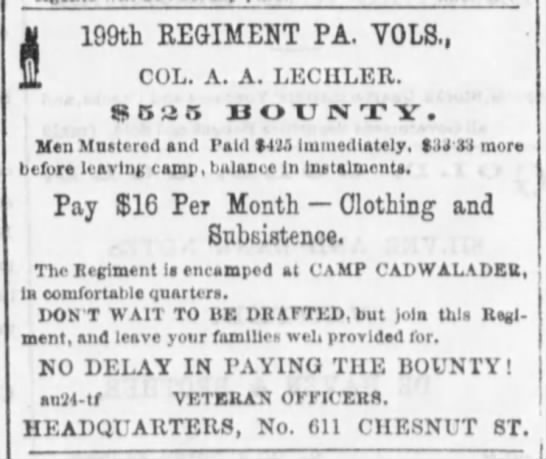
The Evening Telegraph, Philadelphia, PA, September 3, 1864


          The other three regiments in the brigade of the 85th PA had a more substantial number of men in remain in the service. In early 1864, many of these men from the 39th Illinois, 62nd Ohio and 67th Ohio had reenlisted. This brigade was designated as the First Brigade, First Division of the Army of the James.

Wetherill House, Samson St.
Philadelphia where the 
199th PA was organized


        Because of the departure of the men from the 85th PA, the brigade, temporarily led by Colonel Francis B. Pond of the 62nd Ohio,  was low in numbers. Therefore a new regiment, the 199th Pennsylvania, joined their ranks in Virginia. The 199th PA was composed of nearly 1,500 troops from around the state, including the counties of Philadelphia, Montgomery, Lancaster, Crawford, Allegheny, Lycoming, Wilkes-Barre, Dauphin and Lackawanna. They had enlisted for one year of military service in the fall of 1864.


Camp Cadwalader
Philadelphia
Where the 199th PA Trained

            The 199th PA was led by Colonel James (later Joseph) C. Briscoe, He born in Ireland and had served as a staff officer for Generals Phillip Kearney and David Birney.  Meanwhile, several  members of the 85th PA became officers in the 199th PA: Robert P. Hughes (Lieutenant Colonel), Oliver Sproul (First Lieutenant, Company H), Charles Eckels (Captain, Company K) and Walter Cravin (Captain, Company E).
        On April 2, 1865, Union forces made a breakthrough against Confederate lines near Petersburg. In their first battle at Fort Gregg later that day, the 199th PA suffered 18 killed and 91 wounded. Colonel Briscoe was shot in the leg during the charge but continued towards Fort Gregg. 


        Briscoe's official report of the charge at Fort Gregg stated,  "About noon we received orders to attack and
James C. Briscoe
Am. Civil War Research Database

carry the fort, and the whole line advanced, in good style. The ground in front of the southeast salient of the work forms a perfect natural glaces for about 300 yards; passing over this space my regiment suffered its severest loss-canister, shot, and minie bullets tore through the ranks, yet not a man faltered. I was struck down by a flanking ball about seventy-five yards from the work, and although I lost but a moment in recovering myself, the men were already in the moat and clambering up the exterior slope; were fighting hand to hand across the parapet, the enemy refusing to surrender, though surrounded on all sides. This sort of thing lasted nearly twenty minutes, when we finally burst over the parapet and the fort was ours."
         Lieutenant Oliver Sproul, the former 85th Pennsylvanian, planted the colors of the 39th Illinois on the wall of the fort. William Chick of the 85th PA claimed that this was the first of many Union flags planted on the parapet as the fort fell to the Union. Wrote Chick, "The first flag to reach the fort was the flag of the 39th Ill. The Color Bearer fell as he reached the ditch and First Lieut Oliver Sproul of the 199th Pa. grabbed the colors, mounted the parapet, and planted the flag." [National Tribune, Washington, DC, June 12, 1902]
       Another account of Fort Gregg came from Private Jacob Etter of Company H. Etter wrote this tribute to his captain, John G. Bippus of Butler County, who like Briscoe was wounded in the charge upon the fort. "[You were] leading your command into action – that terrible charge on Fort Gregg, the key to the stronghold, Petersburg. I shall never forget it, nor my feelings as I picked you up and placed you in the ambulance [after a gunshot wound to the head], with the impression that you were mortally wounded…How any of us escaped to tell the tale of that day may only be attributed to Him who governs the universe and rules the stars, and who also directed the flying missiles. " (Butler Citizen,  August 7, 1878)


Charge of Fort Gregg    LOC


            After Fort Gregg fell, General Robert E. Lee abandoned Richmond and Petersburg and headed west to escape pursuing Union armies. At Rice's Station, on the way to Appomattox, a brief fight left four men dead and eight wounded from the new regiment. In total during their brief service, the 199th PA lost 32 men to the battlefield and 52 to diseases.
        Following the surrender at Appomattox, the 199th PA was encamped near Richmond and the men were mustered out two months later. [Frank H. Taylor, Philadelphia in the Civil War, 1913]
        Because they were from counties from throughout the state, the 199th PA often held company reunions rather than trying to bring the entire regiment together. One such reunion was held in 1912 by Company K. For this get-together, Captain Charles E. Eckels, formerly of the 85th PA, traveled from West Brownsville in Washington County to meet his former soldiers in Lancaster County.
       In his remarks to the company, Eckels said that, after the surrender at Appomattox, Company K was given the honor of guarding Union headquarters by General John Gibbon (Commander of the 24th Corps in the Army of the James) because of the company's strong appearance, discipline and training. [Williamsport [PA] Sun-Gazette, September 12, 1912]
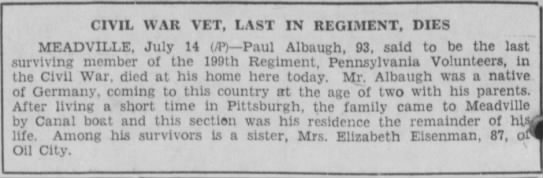
      The last surviving member of the 199th PA was Paul Albaugh from Meadville, Crawford County. He died in 1935.

-
The Mercury, Pottstown, PA, July 15, 1935


Monday, July 27, 2020

George Fisher's Centennial Birthday

          The longest living member of the 85th Pennsylvania regiment was William Mahaney of Company C. Mahaney enlisted into the regiment as a 17-year old in 1861 and died in 1944 at the age of 99, several months shy of his 100th birthday.
       
Lincoln (NE) Star
1-26-1938
The second-longest living soldier in the regiment, the subject of this article, was Corporal George Fisher of Company E. Fisher was 23 when he joined the regiment and died at the age of 100 in Nebraska in 1938.
        About three months prior to his death, a local newspaper in Beatrice, Nebraska wrote an article in celebration of Fisher's 100th birthday. Although intended to be celebratory in nature, the article is a mixture of fact and fiction with somewhat dubious information relating to Fisher's service in the Civil War. Since he was likely the main source for the details of the story, Fisher seems to have misremembered or exaggerated some of the events. Colored by the passage of time, Fisher's remembrances and perhaps some information provided by his children and grandchildren resembled but did not accurately reflect past events.
       This is not meant to disparage a 100-year old man who honorably served his country for three years. It is meant as a warning that obituaries and articles such as this one are not always 100% accurate.
        The article states that Fisher, born in Germany, came to this country alone at the age of 15. After having what little money he had stolen from a hotel room in New York City, the article states that he "walked to Uniontown, PA and got a farm job which he kept 22 years except for time spent in the service of the Union army during the Civil War."
      As a reader, I would like to know what motivated Fisher to "walk" to Uniontown. The distance is over 300 miles and it seems that Fisher could have found work as a farm laborer much closer to New York City.
         The article continues on that, "He [Fisher] enrolled as a private in Co. 'E,' 85th Pennsylvania infantry in September, 1861. He was mustered into service on November 12, 1861 for a three-year enlistment and on August 27, 1863, was wounded by the explosion of an enemy shell."
     
Bombproof in Trench on Morris Island    LOC

          This account of Fisher's wounding is probably correct. In his comprehensive 1915 history of the regiment, historian Luther S. Dickey notes that Company E (Fisher's company) was in the trenches for digging duties near Fort Wagner on Morris Island on the night of August 27, 1863. Several members of Company E were killed by a shell explosion, including John H. Linn and Joseph Neely. Three other soldiers (William Marquis, Henry J. Ridgen and John I. White) later died of wounds suffered in this explosion.
        Although Fisher is not mentioned by name, Dickey writes that the explosion caused "more than a dozen casualties."
        The article continues "Fisher served with Generals Grant and McClellan and fought in the battles of Williamsburg, Charleston, Deep Bottom, Cold Harbor and others."
       There are several issues with this observation. The 85th Pennsylvania did not do much "fighting" at Williamsburg in May of 1862 during the Peninsula Campaign.  The divisions of Joseph Hooker and Phillip Kearney did  most of the fighting for the Union side. The 85th Pennsylvania formed a line and may have gotten off a volley or two into an unseen enemy beyond the tree line. And they were shelled by Confederate artillery. But for the most part they remained in formation and did not advance towards the battle. However, the 85th Pennsylvania did experience hard fighting at Charleston and (Second) Deep Bottom.
        The sentence also states that Fisher (and his regiment) served under Ulysses S. Grant and George B. McClellan. The 85th Pennsylvania assuredly served under McClellan's command during the Peninsula Campaign in Virginia in 1862. But they were never under Grant's direct command, either in the western theater or during the Overland Campaign of 1864. Technically, with Grant in command of the overall Union strategy beginning in March of 1864, every soldier in the Union army served under Grant. But in 1864, while Grant pushed towards Richmond with the Army of the Potomac, the 85th Pennsylvania was in the Army of the James under General Benjamin Butler and later under General Edward O.C. Ord.
        Grant did briefly accompany the Army of the James for part of the pursuit of the Army of Northern Virginia from the Petersburg front to Appomattox in April of 1865, a campaign that culminated with Robert E. Lee's surrender. 
       
LOC
The centennial article then states, "He [Fisher] helped construct the 'Swamp Angel,' a masked battery with which the Union army shelled Charleston...."
          This may have occurred. The regiment was stationed in the interior of Morris Island during the late summer of 1863 when the  Marsh Battery or Swamp Angel battery was under construction. It took much manpower to carry 13,000 sandbags to the site. The Swamp Angel was constructed between James and Morris Islands near Charleston, SC in July and August of 1863. The Swamp Angel floated on hundreds of sandbags (on top of 20 feet of mud), which soldiers carried over wooden planks to the marsh. On August 22, the Swamp Angel began an incendiary bombardment of Charleston, which continued until the 36th shot shattered its breech. 
         A problem here is that the 85th Pennsylvania was heavily involved in another Union effort at the time. Following the failed second assault on Fort Wagner on July 18 led by the black troops of the 54th Massachusetts, the next stage was unglamorous: the digging of a series of trenches or parallels to threaten the sand-walled battery. Along with the 100th New York and 3rd New Hampshire, the 85th Pennsylvania devoted almost all of their efforts in the month of August to this endeavor. Dickey's history of the regiment cites the diary of Commissary Sergeant John B. Bell for a day-to-day account of the regiment at this time. There are numerous references to "fatigue duty at the front," "completed seaward battery at third parallel," and the like, but no direct reference to constructing the Swamp Angel. 
           In his entry for August 17, Bell does state, "Regiment....moved to the front and during the day was engaged at fatigue duty filling gabions to strengthen the fortifications. Marsh Battery was completed ready for mounting guns."
           Next in the obituary,  the following reference is problematical. "...[Fisher] saw the battle of the
LOC
Monitor and the Merrimac.
"
          This could not have occurred. The battle of ironclads took place on March 8-9, 1862. The 85th Pennsylvania did not arrive at Hampton Roads for the Peninsula Campaign until three weeks later on April 1. Yes, several soldiers in the regiment wrote of seeing the Monitor in the waters around Fort Monroe as their ship came in for docking. At another time, the Merrimac was spotted when they were camped near Hampton, VA. But the ironclad battle itself was not witnessed by Fisher or anyone else in the regiment.


        The article concludes with the statement that, "A Republican, the aged man cast his first vote for president for a candidate with whom he shook hands several times, Abraham Lincoln."
         It is possible that Fisher met Lincoln face to face, but to have shaken hands with the president more that once seems to be a stretch. First of all, several soldiers from the regiment claim to have encountered  Lincoln when they were posted near Washington, DC during the winter of 1861-62. When they had free time, the men would often tour the capital city and several wrote that they talked to the president while walking the streets of Washington. 
         Lincoln then crossed paths with the regiment when Lincoln reviewed the entire Army of Northern Virginia in early July of 1862 at Harrison's Landing,VA. Finally, Lincoln was present at City Point,VA on March 25, 1865 and reviewed Union troops, including what may have included some in the 85th Pennsylvania. But Fisher had completed his three-year enlistment and had gone home the previous November.
           Fisher and his wife, Martha Rockwell Fisher from Uniontown, spent the last six decades of his life in York County, Nebraska. He passed away on January 23, 1938, three months after his one-hundredth birthday.     

Monday, January 27, 2020

The Last Wounded Man

f
The Daily Courier
Connellsville, PA
September 18, 1911, p.1

    Next week I am going to speculate about which soldier from the 85th Pennsylvania was the last to die in battle or due to a battlefield wound. This week I will focus on the last man to be wounded who survived the war. That man appears to be Private James C. Davis of Company E. 
    The article at the right from 1911 mentions four veterans of the 85th Pennsylvania and has a revealing mention about Davis as the war was closing.
   The four soldiers from the 85th Pennsylvania in the article are, Davis, Eli F. Huston, (Company E), Henry J. Molleston (I) and Joshua Torrance (B). Huston, Molleston and Torrance were all living in Dawson, Fayette County at the time.
   The story is about a dinner party for Davis, who lived in Oklahoma. Davis had come back home for a regimental reunion that year that was held at Brownsville, Fayette County in mid-September. About 75 elderly members of the regiment were in attendance. 
   Eli F. Huston was 76 years old at this time. He was born in Fayette County. He enlisted as a wagoner but spent the war in the ranks as a private. Huston was wounded in the thigh on Morris Island, SC in 1863 when his regiment was digging a series of trenches that resulted in the capture of Fort Wagner. He was a coal miner following the war, working his was up to superintendent of one of the mines near Connellsville.
    Six years later in 1917, Huston attended the regimental reunion in Uniontown and died the next day of pneumonia at age 82.
   Henry J. Molleston, age 74, was given a medical discharge after 30 months of service. After the war, he attended California Normal School (now California University of Pennsylvania, the school from which the author graduated). Besides finding work as a farmer and blacksmith, Molleston worked as an engineer for a coal company . He also became a preacher in the Methodist Church.
          Joshua Torrance. age 67, was captured at Ware
Andersonville Prison   LOC
Bottom Church (VA) on June 16, 1864 while on picket duty. He spent two months at Libby Prison in Richmond and then another 11 months at Andersonville Prison in Georgia. He was released on April 1, 1865, just eight days before the end of the war. He later served as school director, tax collector and auditor for Lower Tyrone Township in Fayette County following the war. 
       James C. Davis, 65 years of age, had enlisted as a 15-year old in 1861. After the war, he served as a school principal in Pennsylvania, Ohio and Indiana. He moved to Kansas in 1880 where he served three terms as school superintendent for Chase County. He later purchased land in Oklahoma and became an oil prospector. 
       The article about the dinner party states that Davis was "the last member of the 85th wounded, the date being April 2, 1865."
         This happened during an assault upon Fort Gregg on the last line of inner line of defenses around Petersburg, VA. Earlier in the day, after a ten month siege, Union forces had pierced the Confederates' outer defensive line, forcing Lee out of his trenches. Lee headed west in a futile attempt to link with Joseph E. Johnston's army in North Carolina. Lee surrendered at Appomattox one week later to end the war. 
 
Storming Fort Gregg    LOC
        Fort Gregg was extremely bloody. Every Confederate  in the fort, numbering about 330 men, was killed, wounded or taken prisoner as the rebels fought to the end to give Lee time to evacuate the Richmond-Petersburg front.
   
Colonel Thomas O. Osborn
Yates Phalanx
        The 85th Pennsylvania was in the first of four waves to rush the fort. They were commanded by Colonel Thomas O. Osborn of the 39th Illinois. Osborn's Brigade made it into the moat surrounded the earthen fort, which saved many lives until several more waves of Union troops breached the parapet and  forced the fort to surrender. The Union suffered over 700 casualties in the assault. *
        Davis was one of 163 remaining members of the 85th Pennsylvania  after 1864  (these remaining men had reenlisted or had joined the regiment after 1861 and were yet to complete their three years). The majority of the regiment had gone home four months earlier.
        The last battle in which the full regiment was engaged was at Darbytown Road near Richmond on October 13, 1864. Seven men were wounded in this affair, none fatally.
       The seven men wounded at Darbytown Road were: Sgt. Charles Eckels (Company E), Corp. Nicholas Derbins (F), Pvts. David Baker (B), Milton F. Bradley (I), Jacob Huffman (F), Samuel E. Johnson (I), and George Rodeback (C). 
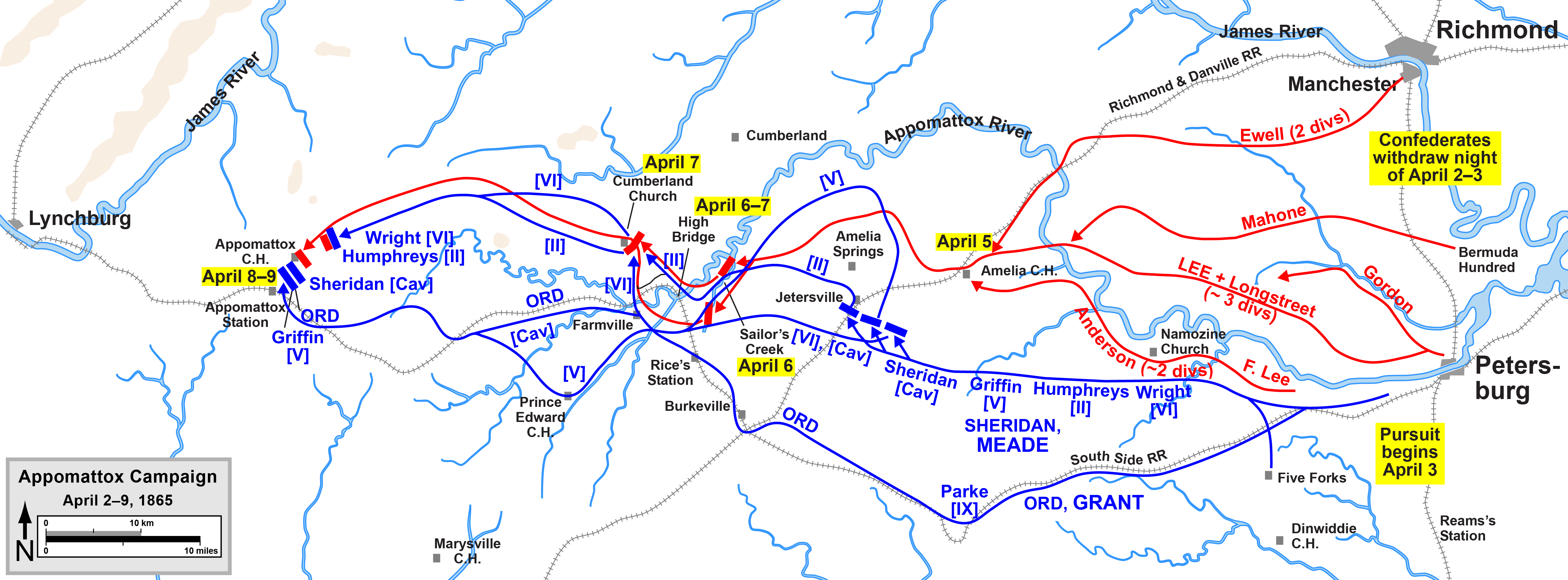
         The reduced 85th Pennsylvania was involved in two more fights during the last week of the war, at Rice's Station and Appomattox (see map below), but the author could find no documentation that any member of the regiment was killed or wounded in either fight. So Davis does indeed appear to be the last man in the regiment to suffer a wound or death on the battlefield.


Last 3 Days of Lee's Retreat to Appomattox, VA
85th PA was part of  the Army of the James [ORD] 

Map by Hal Jespersen
www.cwmaps.com
            *NOTE: It has always puzzled the author why the 85th Pennsylvania did not suffer more casualties at Fort Gregg. The 199th Pennsylvania from Philadelphia, engaging in their first battle since joining Osborn's Brigade, suffered ten deaths. The 39th Illinois, also in the brigade, suffered 12 men killed and 31 wounded. Davis was the only soldier in the 85th PA to be killed or wounded while being in the thick of the fight.
           Granted, these regiment were larger that the 85th Pennsylvania at the time. Nonetheless, considering that all of these regiments (along with the 62nd Ohio and 67th Ohio) made the first charge upon Fort Gregg simultaneously, wouldn't one expect to find more losses in the 85th Pennsylvania? 


Monday, December 23, 2019

Civil War "Doughboys"


Library of Congress
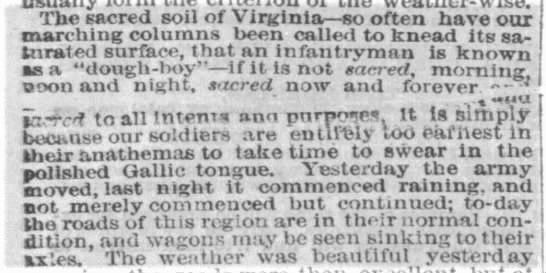
       Most people associate the term "doughboys" is with American soldiers in the First World War. However, there are indications that the term was used in America as a reference to soldiers at least as far back as the Mexican War (1846-48).
     This link provides excellent information for the term as well as various references to "doughboys" in the 19th century.
      In late 1918, in the final month of World War I, James E. Sayers of Waynesburg, a veteran of the 85th Pennsylvania regiment,  wrote the following letter to the Pittsburgh Post-Gazette. Sayers was 73 years old at the time and was a prominent attorney in Greene County, PA. 
      Sayers had enlisted into the 85th Pennsylvania as an 18-year old and was with the regiment through the end of the war at Appomattox Court House. [The author used Sayers' diary as a source in his book about the regiment called, "Such Hard and Severe Service: The 85th Pennsylvania in the Civil War," published by Monongahela Books] 
       In his letter, Sayers notes that the term "doughboys" was used during the Civil War and explains the origin of the term.

Pittsburgh Post Gazette
October 23, 1918


                       Sayers' reference to the soil "kneaded into mud ('dough') by the infantry" undoubtedly was a reference to the "Mud March" in late January of 1863. This followed Burnside's disastrous loss at Fredericksburg, Virginia the previous month, [NOTE: The 85th Pennsylvania did not take part in the Battle of Fredericksburg. They were in North Carolina on the Goldsboro Expedition trying to created a diversion for the attack on Fredericksburg.] Burnside planned a winter offensive towards Richmond. But a heavy rainstorm quickly turned Burnside's planned river crossing of men and wagons into a muddy quagmire. The offensive was abandoned. 

Harper's Weekly
December 13, 1864

James E. Sayers
Greene Connections


    The following article from 1865, which appeared in a Philadelphia newspaper near the close of the war, confirms Sayers' version of "doughboys."


Philadelphia Inquirer
April 3, 1865

.     The article below from 1863 during the Civil War uses the term in the same way it was used in World War I as a reference to all infantrymen.

Buffalo Courier
May 23, 1863

 
           In any event, Sayers' premise is confirmed by the Civil War era newspapers that the term '"doughboys," although not used as extensively as it was later used in the First World War, was used to refer to soldiers during the Civil War more than 50 years earlier.

Sunday, September 1, 2019

1910 Regimental Reunion


1910 Reunion of the 85th PA
Rogersville, Greene County, PA
     Here is a link to a group photograph taken at the 1910 reunion of the 85th Pennsylvania regiment held at Rogersville, Greene County, PA. The link includes the names of all the veterans in attendance. I identified the names of many of the veterans, based on previous photographs taken during the Civil War and afterwards.

Charles Eckels c. 1862
US Army Heritage and Information Ctr.
       To the right are two photos of Charles Eckels of Company E taken nearly 50 years apart. Using his Civil War photo and knowing that he attended the 1910 reunion, It was established that he attended the reunion; then all the faces in this photo were checked  to find a match for the youthful Eckels.
       Eckels was just a 16-year old from West Brownsville, Washington County, PA when he enlisted in 1861. He re-enlisted in 1864. In October of 1864, he was wounded at Darbytown Road near Richmond. In November of 1864, most of the regiment went home following their three-year hitch. Eckels was one of about 125 members of the regiment who stayed in the army. He became a captain of Company K in the 199th PA, but was still brigaded with his old mates in the 85th PA.
     Besides attending the reunions of the 85th PA, Eckels would also travel across the state to meet with his old troops in the 199th (see article below). After the war, he served as Justice of the Peace and School Director in West Brownsville. He was the last president of the regimental veterans association.  He died at the age
Charles Eckels from the 1910 reunion photo
of 90 in 1935 and is buried in the Bridgeport Cemetery in Brownsville, PA.
    Below is an article from the Harrisburg Daily 
Independent (September 12, 1912) about a reunion
of his company in the 199th PA in Lancaster County.
     Eckels led this company at Fort Gregg (VA) and Appomattox Court House in the last week of the war.