Showing posts with label McClellan. Show all posts

Thursday, December 17, 2020

John E. Michener and the Peninsula Campaign


Captain John E. Michener
Miriam and Ira D. Wallach Division of Art, Prints and Photographs
New York Public Library


       The brief, 40-page chapter in "Prison Life" (1867) about Captain John E. Michener of the 85th Pennsylvania, mentioned in my previous post, offers some heretofore little known details about his three years in the Union army, beginning with information about the Peninsula Campaign. 
        Michener, from Fredericktown, Washington County, PA, first joined the 85th Pennsylvania regiment as a lieutenant in Company D. He was 23 years of age with a wife and newborn daughter. His brother, Ezra, served as an assistant sutler attached to the regiment. Later in the war, in early 1864, Michener would be promoted to captain of Company K. 

        After a brief stay in Washington, DC during the winter of 1861-62, the 85th Pennsylvania was transported to Fort Monroe, Virginia to be part of General George B. McClellan's massive movement to capture Richmond, the Confederate capital, by advancing up the peninsula between the James and York Rivers. This effort, known as the Peninsula Campaign, would prove to be a massive Union failure and starkly shattered the expectation of many northerners that victory would in a short amount of time. 

Position of Casey's Division At Williamsburg in support of Hooker and Kearney

         The first pitched battle of the of the Peninsula Campaign, was fought at Williamsburg on May 5, 1864. Union forces caught up to the rear guard of the Confederate army that was retreating from Yorktown. The battle involved over 70,000 troops and resulted in about 4,000 total casualties, but ended without a decisive winner The Union pursuit continued up the Virginia Peninsula towards Richmond. 

      The 85th Pennsylvania played a supporting role during the engagement. They were called into a line of battle line during the night of May 5, but did not fire their rifles. The men were very excited to be placed in a position to be under fire from artillery for the first time. Although shelled, the regiment suffered just two casualties, their first of the war. Also memorable was the bone-chilling weather, as they stood shivering in formation all night long during a rain storm. More information about the Battle of Williamsburg can be found here.

      What "Prison Life" adds to the story: Because of the minor role played by the 85th Pennsylvania at Williamsburg, "Prison Life" adds little to what is already known. Author T.J. Simpson exalts Michener for parading in front of his men and exhorting them to stand in readiness for an order to advance that never came. Michener deserved credit for encouraging his men, but not on the level described below by Simpson. Although placed under fire for the first time, the Confederate shells directed at them mostly fell behind the men, not upon them or in front of them. Michener displayed plenty of bravery during the war; however, it was a stretch for Simpson to highlight this incident in such sonorous language.

From "Prison Life:" [Standing in formation at Williamsburg] "Here Lieutenant Michener’s coolness and intrepidity was fearlessly displayed and won for him the admiration and confidence of all his comrades. Seizing a musket, he rushed to the front and as if wholly unconscious of danger, continued to encourage and animate his men, both by word and example, in the midst of a most deadly fire, until the close of the battle."

         The Confederate army following the battle continued their withdrawal up the peninsula towards Richmond under the command of General Joseph Johnston with McClellan in pursuit. Nearly a month after Williamsburg, the 85th Pennsylvania was in the front lines for the Battle of Seven Pines. This fight involved 73,000 troops and ended with nearly 14,000 casualties. This three-day fight, the closest ever to Richmond, ended in a draw. Confederates held off the invasion of Richmond, while the Union rallied after nearly being overwhelmed on the first day of the battle. 

        The 85th Pennsylvania, as part of Silas Casey's Division of Erasmus Keyes' Fourth Corps, was in the front lines on the first day of the battle. This inexperienced division, greatly reduced by sickness, fought extremely well, holding off a much larger Confederate strike force until re-enforcements arrived hours later from across the Chickahominy River. For more information about the Battle of Seven Pines as well as an excellent detailed map of the opening of the fight, click here.

        Michener, then a lieutenant in Company D, was on picket duty with the fight commenced along with his captain, William Horn, and a handful of men. Facing overwhelming numbers of Confederates, he and his men struggled to return to their regiment. Several of were captured. While some in others regiments panicked and fled to the rear, Michener was able to coolly lead the rest of the men back to their regiment.

    What "Prison Life" adds to the story: Specific details about Michener's role are provided. Michener, it turned out, was given charge of a group of Confederate prisoners during his return from the picket line by a colonel of another regiment. Michener through Simpson also disclosed the route of his return. 

History of the 103rd Regiment
PA Veteran Volunteer Infantry p.174
Union picket line on the far left; 85th PA to the right of the redoubt along the stage road


  From "Prison Life:"
"Lieutenant Michener was cut off from his division, with the rebels in front and rear, while he and his men were exposed to a galling fire from both friends and foes. With thirteen men belonging to his own company and four of the ninety-sixth New York, he moved through the slashing of newly-fallen timber to the York River railroad, deployed his little squad as skirmishers, and captured three prisoners with the loss of one of the New York boys, who was shot in the head while gallantly fighting at his post. Moving then to the right of the railroad, he succeeded in escaping from his dreadful dilemma and hastened to the point where [General John] Sedgwick fiercely contesting every inch of ground, finally changed defeat into victory and triumphantly closed one of the bloodiest battles of the war."

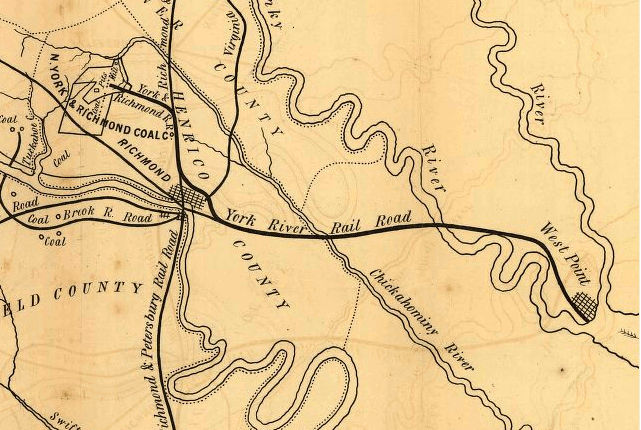
Michener's route from the picket line along the RR line to Sedgwick's position at the Battle of Seven Pines
History of the 103rd PA by L.S. Dickey, p. 166

Colonel Oliver H. Rippey
61st PA Infantry
Killed at Seven Pines
   

    "Here Lieutenant Michener was directed by Colonel [Oliver H.] Rippey, [61st PA, killed at Seven Pines] a brave and gallant officer, to take charge of some forty-five prisoners and guard them securely until they could be removed to the rear."


         The 85th Pennsylvania and Silas Casey's entire division, after a severe public rebuke from McClellan, was sent to rear during the ensuing Seven Days' Battles. In late June of 1862, McClellan gave up his plan to capture Richmond. After the final fight at Malvern Hill, the 85th Pennsylvania as part of the division of General John J. Peck (who replaced the scapegoated Casey) guarded the Union retreat. McClellan's huge army set up a defensive position at Harrison's Landing on the James River and sat for six weeks. In mid-August, McClellan's army began loading onto ships and left the peninsula. McClellan called the massive retreat a "change of base." 

       It took several days for the army to be removed aboard transport and barges from Harrison's Landing. The mood of many in the Union army as well as in the North was disappointment and confusion that the Union offensive to end the war had stalled. A Pittsburgh newspaper wrote, "Without a struggle, without even the loss of a single man, the immense Army of the Potomac, officers and men, bag and baggage, stores, tents, horses, ammunition and contrabands, are now far away from Harrison's Landing...steamer after steamer and vessel after vessel passed us steaming or sailing in the direction of Fortress Monroe heavily laden with horses and stores." [Pittsburgh Gazette, August 21, 1862, p.1]

Harrison's Landing
Harper's Weekly


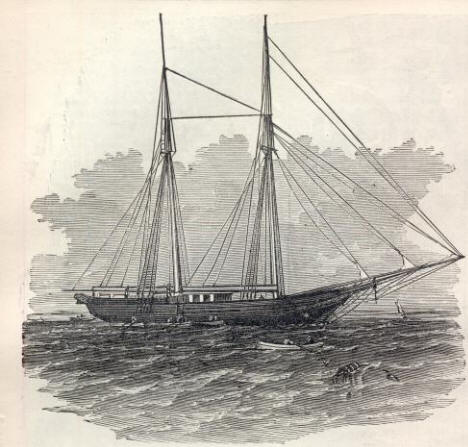
  From "Prison Life:" This vignette displayed Michener's organizational and management skills. [McClellan’s retreat] "At the evacuation of Harrison’s Landing, Lieutenant Michener was detailed to take charge of all the baggage belonging to General Peck’s division. The baggage consisted of trunks, boxes, knapsacks, etc. They had been hastily and carelessly tumbled into crazy old canal hulks by a careless and reckless quartermaster and consequently the boats rapidly filled with water and sunk at the wharf where they had been loaded. To remove this baggage out of these sunken boats to others was a slow and difficult task. In less than eighteen hours, however, Lieutenant Michener with a squad of soldiers and one hundred contrabands [former slave laborers], succeeded in transferring the whole of the baggage from the sunken boats to the schooner W. A. Ellis. After this was accomplished, he was ordered by General Peck to proceed with the schooner to Hampton Creek, Virginia, near Fortress Monroe and land the baggage."

Yellow - water route of baggage barge on the James River
Blue - land route of 85th Pennsylvania
Joel Dorman Steele, 
A Brief History of the United States 


          Most of the Army of the Potomac sailed to Fortress Monroe, Virginia and then on towards Washington, DC. They would soon fight at Second Bull Run, Virginia in August and at Antietam, Maryland in September. The 85th Pennsylvania did not board transports but instead marched back down the peninsula to Fortress Monroe where they stayed while their future assignment was being debated by McClellan and the War Department. The 85th Pennsylvania was eventually sent to Suffolk, Virginia where they spent the next three months.

 Next: John E Michener is in charge of a dangerous mission transporting deserters and stragglers.


Tuesday, August 4, 2020

Capture of Lt. James B. Washington

           
Casey's Division is circled. The line is the position of Casey's pickets.
The "X" is the approximate location of J.B. Washington's capture.
From Battles and Leaders of the Civil War, II; 1887, p.227


           In reviewing obituary records for the men of the 85th Pennsylvania infantry regiment from the Civil War, I came across this brief notation for Private George Washington Anderson of Company H. It pertains to an event that precluded the Battle of Seven Pines (Fair Oaks) near Richmond, VA that began on May 31, 1862.
        "During one of the Virginia campaigns, while doing picket duty, he [Anderson] captured Major J.B. Washington of the Confederate army, now and for a number of years past secretary of the Pittsburg and Connellsville branch of the B&O R.R. Major Anderson and Mr. Washington met in Somerset a few years since, when their recognition was mutual and they spent a pleasant hour talking over their war experience." (Somerset (PA) Herald,  October 20, 1897, p.3)
           If true, the capture of Washington by Anderson would be a notable occurrence from the battle by
Picket Duty    LOC
a member of the 85th Pennsylvania.  Many accounts of the Battle of Seven Pines mention Washington's capture, but Anderson's obituary is the only one I have come across that states the identity of the  soldier who captured him. [If any reader has further information about Washington's capture, I would appreciate a response.]
          It is confirmed that members of the 85th Pennsylvania were on picket duty that day. Lieutenant John E. Michener wrote, "There on Saturday of May 31st, without any support, our little Division was attacked by an overwhelming force of the enemy's best men, and after suffering a heavy loss, was repulsed...I was on picket duty in front of the swamp, and had instructions to hold my ground till the last." [Michener letter courtesy of Margaret Thompson]
          Private Milton McJunkin also wrote, "...our Company was on picket at the time so you see I saw the whole performance. About 1 o’clock the rebs fired three shots into our camp to give Casey warning. At the same time we, that is us pickets, were attacked by 5 brigades and nearly surrounded. Our Company was in the centre of the line and was cut in two so you see we had to retreat as it was useless for 200 pickets to try to check 5,000 of the best troops Jeff [Jefferson Davis] had so we scattered and got to camp the best way we could..." [The Bloody 85th: The Letters of Milton McJunkin, a Western Pennsylvania Soldier in the Civil War, by Palm, Sauers and Schroeder, p. 39]
           The capture of Washington, who was apparently performing a reconnaissance just prior to the Confederate attack, was significant. The Confederate attack in the early afternoon of May 31 nearly overwhelmed the division of Silas Casey, which was outnumbered 2-to-1 or 3-to-1. The 85th Pennsylvania was in the thick of the early fighting that day, in the brigade of General Henry Wessells, stationed near a battery during the early part of the battle. Pushed back to a line of trees, Colonel Joshua B. Howell rallied his 85th Pennsylvania regiment and parts of others to boldly advance towards a rifle pit and temporarily regain control of the position. Howell's men had to fall back once again, but not before buying precious time for Union reinforcements from across the Chickahominy River to arrive later in the afternoon and stop the Confederate advance.
          Despite their efforts, Army of the Potomac commander George B. McClellan (based on the questionable account of General Samuel Heintzelman of the Third Corps) chose not to praise Casey's Division for their stand but to disparage them publicly for their retreat after two or three hours of fighting.
         Casualties in the 85th Pennsylvania numbered around 30 dead and another 50 or so wounded.
        One of the charges made against General Casey was that he was unprepared for a Confederate attack. But in truth, Casey knew the precariousness of his position and was furiously trying to reinforce in anticipation of a rebel attack.
        The capture of Washington several hours prior to the battle only served to intensify the Union belief that an attack was imminent.
         Many accounts of the Battle of Seven Pines mention Washington's capture, but Anderson's obituary is the only one I have come across that says who captured him.
       Luther S. Dickey wrote the official history of the regiment in 1915, about 18 years after Anderson's death. He mentioned Washington's capture on that day but did not mention Anderson's role.
          "During the forenoon of May 31, the enemy appeared in force in front of the pickets immediately north of the Williamsburg Road. Shortly after 10 'clock A.M., Lieut. J.B. Washington , an aide-de-camp on the staff of General Joseph E. Johnston, was captured by Casey's pickets on the Nine-mile road and taken to Gen. [Silas] Casey's headquarters, and thence to Gen. [Erasmus] Keyes' headquarters..." [Dickey, p.71]
          Keyes immediately notified McClellan's staff of Washington's capture. "This young gentleman [Washington] was handsomely captured by our pickets on the right...In connection with the appearance with this young officer, on our right near our lines, I will state that the general officer of the day, Col. Hunt of Casey's division, heard the cars running through the night continually. Yesterday there was much stir among the enemy, and everything on his part indicates an attack on our position, which is only tolerably strong, and my forces too weak to defend it properly." [Dickey, p.72]
       
         Anderson died on October 14, 1897 in Ursina, Somerset County, Pennsylvania at the age of 65. He served three full years in Company H, comprised of men from Somerset County and led at the start of the war by young Captain James B. Tredwell. After the war, Anderson held a variety of positions in Ursina, including constable, justice of the peace, town council member and judge. 
       Incidentally, Anderson's obituary mentions that he and Washington met after the war in Somerset to discuss their meeting at Seven Pines. This is entirely plausible, since Washington for a time managed the Somerset branch of the B&O Railroad.
         During the summer of 1863, the 85th Pennsylvania was stationed on Morris Island, South Carolina. After two failed assaults on Battery Wagner at the northern end of the island, the 85th Pennsylvania was tasked with the arduous duty of digging a series of parallels or trenches that approached Battery Wagner. Many were killed and wounded during the digging operation, falling victim to enemy sharpshooters and shelling from five Confederate forts.
           After the end of the operation, which resulted in the Confederate abandonment of Battery Wagner,
Gillmore Medal
History of the Negro Troops in the War of the Rebellion, 1888
several soldiers in each regiment were nominated by their officers for special Fort Sumter Medals, also called "Gillmore Medals" for valorous service. Anderson was one of eight men from his regiment who were awarded this honor.
         James Barroll Washington, meanwhile,  was born in 1839 and was 23 years old at the time of his capture. He was born in Baltimore and was a graduate of West Point where he was a classmate of future General George Armstrong Custer At Seven Pines, after being captured, Washington posed with Custer, then a captain in the 5th Cavalry, for several photos, including the one below.
   
Matthew Brady photo of Washington and Custer
at Seven Pines on the day of Washington's capture    LOC

          Washington was part of a prisoner of exchange four months after his capture in September of 1862 at Aiken's Landing, Virginia. He then served the Confederacy in Alabama. He became a corporate executive of the Baltimore & Ohio Railroad and died in Pittsburgh, Pennsylvania in 1900. He is buried in his hometown of Baltimore.
          Interestingly, Washington's father, Lewis Washington, also has a prominent place in history. Lewis Washington, a great grandnephew of President George Washington, was one of the hostages taken by radical abolitionist John Brown in 1859 during his infamous raid on the arsenal at Harper's Ferry, Virginia. After Brown and his men holed up in the town's fire house with the hostages, it was Washington who pointed out Brown after U.S. Marines broke down the engine house doors and end the standoff.
John Brown' provisional army with hostages on the left in Harper's Ferry engine house
Lewis Washington is depicted as the second man from the left    LOC


Monday, July 27, 2020

George Fisher's Centennial Birthday

          The longest living member of the 85th Pennsylvania regiment was William Mahaney of Company C. Mahaney enlisted into the regiment as a 17-year old in 1861 and died in 1944 at the age of 99, several months shy of his 100th birthday.
       
Lincoln (NE) Star
1-26-1938
The second-longest living soldier in the regiment, the subject of this article, was Corporal George Fisher of Company E. Fisher was 23 when he joined the regiment and died at the age of 100 in Nebraska in 1938.
        About three months prior to his death, a local newspaper in Beatrice, Nebraska wrote an article in celebration of Fisher's 100th birthday. Although intended to be celebratory in nature, the article is a mixture of fact and fiction with somewhat dubious information relating to Fisher's service in the Civil War. Since he was likely the main source for the details of the story, Fisher seems to have misremembered or exaggerated some of the events. Colored by the passage of time, Fisher's remembrances and perhaps some information provided by his children and grandchildren resembled but did not accurately reflect past events.
       This is not meant to disparage a 100-year old man who honorably served his country for three years. It is meant as a warning that obituaries and articles such as this one are not always 100% accurate.
        The article states that Fisher, born in Germany, came to this country alone at the age of 15. After having what little money he had stolen from a hotel room in New York City, the article states that he "walked to Uniontown, PA and got a farm job which he kept 22 years except for time spent in the service of the Union army during the Civil War."
      As a reader, I would like to know what motivated Fisher to "walk" to Uniontown. The distance is over 300 miles and it seems that Fisher could have found work as a farm laborer much closer to New York City.
         The article continues on that, "He [Fisher] enrolled as a private in Co. 'E,' 85th Pennsylvania infantry in September, 1861. He was mustered into service on November 12, 1861 for a three-year enlistment and on August 27, 1863, was wounded by the explosion of an enemy shell."
     
Bombproof in Trench on Morris Island    LOC

          This account of Fisher's wounding is probably correct. In his comprehensive 1915 history of the regiment, historian Luther S. Dickey notes that Company E (Fisher's company) was in the trenches for digging duties near Fort Wagner on Morris Island on the night of August 27, 1863. Several members of Company E were killed by a shell explosion, including John H. Linn and Joseph Neely. Three other soldiers (William Marquis, Henry J. Ridgen and John I. White) later died of wounds suffered in this explosion.
        Although Fisher is not mentioned by name, Dickey writes that the explosion caused "more than a dozen casualties."
        The article continues "Fisher served with Generals Grant and McClellan and fought in the battles of Williamsburg, Charleston, Deep Bottom, Cold Harbor and others."
       There are several issues with this observation. The 85th Pennsylvania did not do much "fighting" at Williamsburg in May of 1862 during the Peninsula Campaign.  The divisions of Joseph Hooker and Phillip Kearney did  most of the fighting for the Union side. The 85th Pennsylvania formed a line and may have gotten off a volley or two into an unseen enemy beyond the tree line. And they were shelled by Confederate artillery. But for the most part they remained in formation and did not advance towards the battle. However, the 85th Pennsylvania did experience hard fighting at Charleston and (Second) Deep Bottom.
        The sentence also states that Fisher (and his regiment) served under Ulysses S. Grant and George B. McClellan. The 85th Pennsylvania assuredly served under McClellan's command during the Peninsula Campaign in Virginia in 1862. But they were never under Grant's direct command, either in the western theater or during the Overland Campaign of 1864. Technically, with Grant in command of the overall Union strategy beginning in March of 1864, every soldier in the Union army served under Grant. But in 1864, while Grant pushed towards Richmond with the Army of the Potomac, the 85th Pennsylvania was in the Army of the James under General Benjamin Butler and later under General Edward O.C. Ord.
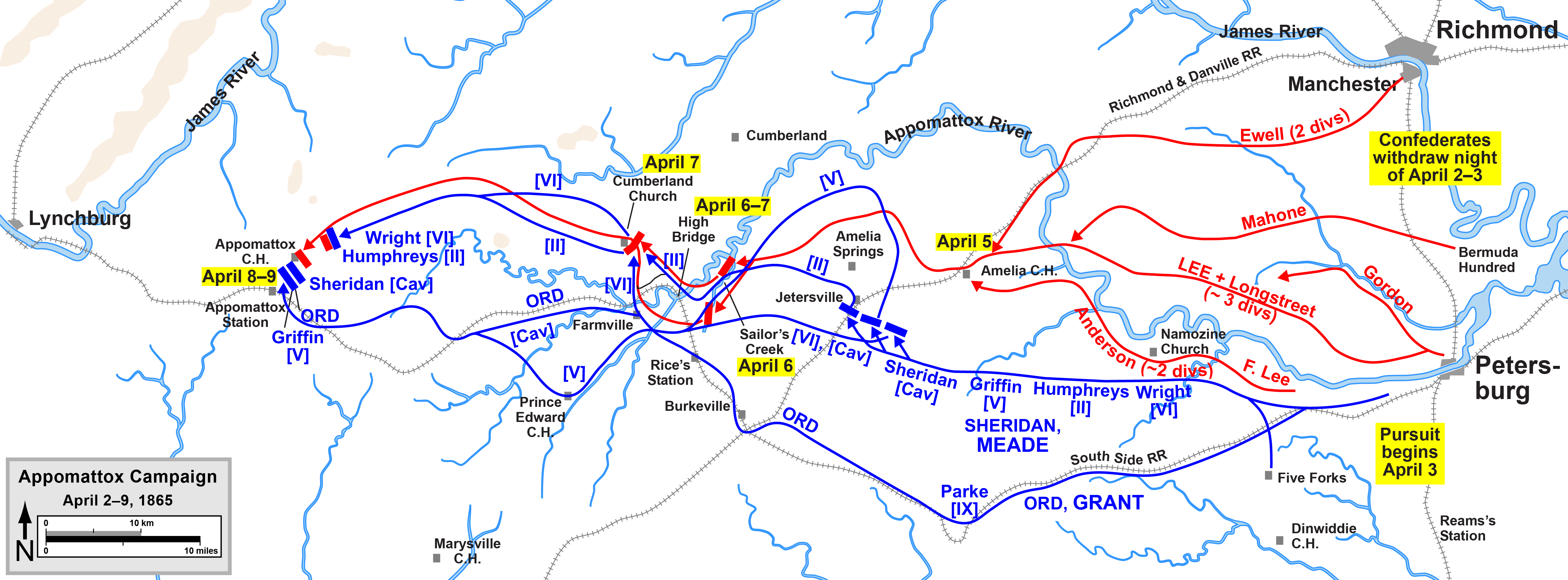
        Grant did briefly accompany the Army of the James for part of the pursuit of the Army of Northern Virginia from the Petersburg front to Appomattox in April of 1865, a campaign that culminated with Robert E. Lee's surrender. 
       
LOC
The centennial article then states, "He [Fisher] helped construct the 'Swamp Angel,' a masked battery with which the Union army shelled Charleston...."
          This may have occurred. The regiment was stationed in the interior of Morris Island during the late summer of 1863 when the  Marsh Battery or Swamp Angel battery was under construction. It took much manpower to carry 13,000 sandbags to the site. The Swamp Angel was constructed between James and Morris Islands near Charleston, SC in July and August of 1863. The Swamp Angel floated on hundreds of sandbags (on top of 20 feet of mud), which soldiers carried over wooden planks to the marsh. On August 22, the Swamp Angel began an incendiary bombardment of Charleston, which continued until the 36th shot shattered its breech. 
         A problem here is that the 85th Pennsylvania was heavily involved in another Union effort at the time. Following the failed second assault on Fort Wagner on July 18 led by the black troops of the 54th Massachusetts, the next stage was unglamorous: the digging of a series of trenches or parallels to threaten the sand-walled battery. Along with the 100th New York and 3rd New Hampshire, the 85th Pennsylvania devoted almost all of their efforts in the month of August to this endeavor. Dickey's history of the regiment cites the diary of Commissary Sergeant John B. Bell for a day-to-day account of the regiment at this time. There are numerous references to "fatigue duty at the front," "completed seaward battery at third parallel," and the like, but no direct reference to constructing the Swamp Angel. 
           In his entry for August 17, Bell does state, "Regiment....moved to the front and during the day was engaged at fatigue duty filling gabions to strengthen the fortifications. Marsh Battery was completed ready for mounting guns."
           Next in the obituary,  the following reference is problematical. "...[Fisher] saw the battle of the
LOC
Monitor and the Merrimac.
"
          This could not have occurred. The battle of ironclads took place on March 8-9, 1862. The 85th Pennsylvania did not arrive at Hampton Roads for the Peninsula Campaign until three weeks later on April 1. Yes, several soldiers in the regiment wrote of seeing the Monitor in the waters around Fort Monroe as their ship came in for docking. At another time, the Merrimac was spotted when they were camped near Hampton, VA. But the ironclad battle itself was not witnessed by Fisher or anyone else in the regiment.


        The article concludes with the statement that, "A Republican, the aged man cast his first vote for president for a candidate with whom he shook hands several times, Abraham Lincoln."
         It is possible that Fisher met Lincoln face to face, but to have shaken hands with the president more that once seems to be a stretch. First of all, several soldiers from the regiment claim to have encountered  Lincoln when they were posted near Washington, DC during the winter of 1861-62. When they had free time, the men would often tour the capital city and several wrote that they talked to the president while walking the streets of Washington. 
         Lincoln then crossed paths with the regiment when Lincoln reviewed the entire Army of Northern Virginia in early July of 1862 at Harrison's Landing,VA. Finally, Lincoln was present at City Point,VA on March 25, 1865 and reviewed Union troops, including what may have included some in the 85th Pennsylvania. But Fisher had completed his three-year enlistment and had gone home the previous November.
           Fisher and his wife, Martha Rockwell Fisher from Uniontown, spent the last six decades of his life in York County, Nebraska. He passed away on January 23, 1938, three months after his one-hundredth birthday.     

Monday, June 8, 2020

The 85th PA in the Battle of Williamsburg


   [NOTE: A more detailed account of the 85th Pennsylvania at the Battle of Williamsburg, with numerous primary source accounts, is found in my book, Such Hard and Severe Service: The 85th Pennsylvania in the Civil War published by Monongahela Books of Morgantown.] 

          Williamsburg in Virginia is of course well known for a 300-acre living-history 18th century colonial village that is a top tourism attraction in the commonwealth. The former Virginia capital is lesser known as the site of a significant Civil War battle in 1862.
        Perhaps because of the popularity of Williamsburg as a colonial tourist destination, the city's Civil War significance has often been overlooked.


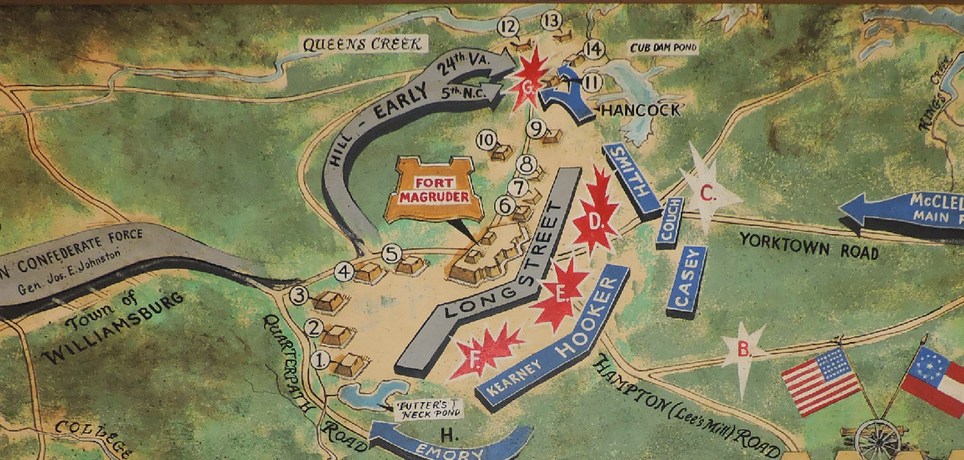
85th PA (green) approaches Fort Magruder
Modern Map Overlay of Williamsburg Battle
Courtesy of
  Williamsburg Battlefield Association
        But that appears to be changing. The American Battlefield Trust website notes that 69 acres of the Civil War battle site have been preserved. The website states, "Much of the battlefield has been lost to development along U.S. Route 60, but historic markers along the side of the highway tell the story of the battle. Fort Magruder, one of the Confederate defensive positions, remains today on Penniman Road east of town  and is marked by a stone monument and some interpretive waysides."
        The Williamsburg Battlefield Association is currently involved in efforts to preserve 29 additional acres of the battlefield with a long-term goal of saving 400 acres of undeveloped land.  
       Williamsburg was the site of the first pitched battle of the the Peninsula Campaign that involved over 70,000 troops. It was also the first engagement for the 85th Pennsylvania, 
        The battle was fought on May 5, 1862. Major General George B. McClellan had spent a month placing siege guns around Confederate forces at Yorktown. He anticipated bombarding the position into submission and ending the Civil War at the same site where George Washington's Continental Army along with significant French land and sea forces had accomplished a victory over the British 81 years earlier to effectively win the American Revolution.
       But when McClellan opened up a barrage upon Yorktown on May 4, it was discovered that General Joseph Johnston's Confederate command had abandoned the fort, retreating up the Virginia peninsula between the York and James Rivers towards Richmond.
   
Robert Know Sneden 1862 Map of Fort Magruder         LOC
              Confederate General James Longstreet was tasked with delaying McClellan's Army of the Potomac which was in pursuit to allow time for Johnston's supply wagons to clear the area. The battle of Williamsburg, mainly involving the Union divisions of Joseph Hooker and Phillip Kearney, focused around the Confederate position at Fort Magruder, and ended with no decisive winner. Casualties totaled about 4,000 soldiers, about 56% on the Union side.
       The role of the 85th Pennsylvania was minimal. As the battle raged, their regiment was called up in a reserve capacity. They forged ahead to within sight of Fort Magruder and were halted. They fired a musket round at an unseen target through the trees. They were shelled, but most of the Confederate projectiles landed harmlessly behind them.
       The 85th Pennsylvania suffered two casualties. Captain John Morris of Company F suffered a minor injury as he was grazed by a shell fragment in the cheek. However, Sergeant Daniel Miller of Company K lost his legs when hit by another shell. He spent three agonizing weeks in a hospital before finally dying in early June.
       Although they did not play a consequential role, Williamsburg was important to the 85th Pennsylvania for several reasons. First, it was their initial taste of being fired upon and witnessing dead and wounded soldiers.
       Corporal William Elliott Finley described the role of his his regiment.

Corporal William Elliott Finley
from A Soldier's Life (1867)


"Just in front of it [the regiment] lay an open space which must be crossed to gain the woods beyond where the rebels were concealed. Sweeping across this, it caught the enemy's fire. A shell from Fort Magruder went hissing through its ranks and exploding, a fragment struck Captain [John] Morris upon the cheek. He only grew a little whiter and marched sternly on while the blood spurted from the wound. A little farther on, a rifle shot struck a Company 'K' man [Sergeant Daniel Miller] and uttering a cry threw up his hands, staggered and fell. Many a heart beat faster;many a cheek grew paler. They had seen the first man fall in battle."


Colonel Joshua B. Howell

          Secondly, the regiment remembered their colonel, Joshua B. Howell, boldly volunteering his regiment when a superior officer asked for a regiment to rush to the battle site.
         Private Milton McJunkin of Company D wrote home that, “Well we moved off double quick until we got on an open field joining the woods…While standing there, Genr’l Sumner rode up in great haste and hollowed Col. have you a regt you can rely upon. The old col without takeing time to give him an answer yelled out forward 85th. So we started off double quick down the road to the scene of action. The old Col was rideing back and forth along the line with a smile on his face, saying now me boys give them the bayonet.” [Ron Palm, Richards Sauers and Patrick Schroeder, The Bloody 85th: The Letters of Milton McJunkin, a Western Pennsylvania Soldier in the Civil War, [page 59]

           Third, the men remembered the frigid cold that they experienced the night of May 5 when they stood in formation. 
          Private John Neill of Company A remembered, 

A Halt in Line of Battle
copper plate edging, Edwin Forbes, 1876
"I have been cold many a time before and since, but never to the same extent. We dared not break ranks or we could not have re-formed in the blackness of the darkness; and between midnight and morning I could hear the teeth rattle to the upper end of our Company, and to me it seemed that my insides shook about and that I could tell where every bone joined to every other all over my body... I forgot to state that we were yet without food, and remained so till the evening of the next day, and guess my digestive apparatus had upset in the shaking of the night before."

          Lieutenant John E. Michener of Company D summarized the 85th Pennsylvania's experience in a letter to a western Pennsylvania newspaper.


Waynesburg (PA) Messenger  5-28-1862

Wednesday, May 20, 2020

Two Views of McClellan from Soldiers in the 85th PA

     
General George Brinton McClellan
Frank Leslie's Illustrated Newspaper
  
      The standard view of Union General George B. McClellan is that he had good organizational skills but was a poor field general. For the first six months or so when he was in charge of the Union army in 1861-62, McClellan was very popular with his troops, including the 85th Pennsylvania regiment. As they trekked up the Virginia peninsula in the spring of 1862, morale was high and a quick victory was anticipated. The prevailing view was not IF Richmond fell but WHEN. McClellan's leadership was thought to be a key component of an impending Union victory in the war.
      This positive view of "Little Mac" was shared by most of the men of the 85th Pennsylvania until McClellan unfairly shamed them (and the rest of their division led by General Silas Casey) for allegedly retreating like cowards at Seven Pines (VA) on May 31, 1862. Of course Casey's outnumbered troops had held off a substantial Confederate attack for several hours until help arrived, but this information never got to McClellan, who made his rash statement mainly based on the report of III Corps General Samuel Heintzelman.
      Heintzelman, who was in charge of McClellan's two corps on the south side of the Chickahominy River that day when the Confederates attacked, apparently needed a scapegoat for being unprepared for the rebel offensive. General Casey became a convenient patsy. 
      The 85th Pennsylvania, in Casey's division (of Erasmus Keyes' IV Corps) was stationed far in front of the rest of Heintzelman's command,  with flanks exposed. Casey's Division was McClellan's least experienced division, decimated by disease. Why McClellan would place them at the front of his 120,000 may army, just three miles from his goal of Richmond, the Confederate capital, is a mystery. Casey's men became an inviting target for General Joseph Johnston and his Confederate troops. 
Headstone of Private Joseph Wilgus
Company B     85th PA
Seven Pines National Cemetery
       On the day of the attack, Casey's men were outnumbered at least 2-to-1, maybe 3-to-1. Yes, Casey's men eventually did retreat, but only after holding off the rebels for several hours in time for Union reinforcements to arrive. They actually helped save McClellan from a disastrous defeat. Had Johnston's plan worked, he would have had 3-2 numerical advantage over McClellan on the south side of the Chickahominy River. Plus a heavy downpour the night before the attack had swelled the Chickahominy River, making it doubtful McClellan would be able to have more troops cross the river to reinforce his two corps under Heintzelman's command. McClellan was fortunate not to have suffered a devastating loss.  
       On the second day of the two-day battle, which ended with no decisive winner, McClellan informed Secretary of War Edwin Stanton that all of his troops had fought hard, with the exception of Casey's Division. Relying on Heintzelman's cover-my-rear-end assessment, McClellan said Casey's men "had given way unaccountably and discreditably." As if to emphasize his words, McClellan later stated in the same report, "With the exception of Casey's division, our men behaved splendidly." 
         McClellan's report, which went public on June 2 was based on Heintzelman's input. Besides Casey and Keyes who immediately voiced strenuous objections to the report, the press began to be seriously question McClellan's unjust claims. This prompted McClellan to backtrack two weeks after the battle, stating, "My dispatch...was based upon official statements made to me before I arrived on the battle-field...From statements made to me subsequently...I am induced to believe that portions of the division behaved well and made a most gallant stand against superior numbers..." 
          For the regiments involved like the 85th Pennsylvania, it was a case of too little, too late. Casey was soon sacked and spent the rest of the war in Washington, DC.
         Coupled with McClellan's retreat from the Virginia peninsula a month later following the Seven Days' Battles, McClellan's reputation within the ranks of the 85th Pennsylvania took a severe hit.
        Lieutenant John E. Michener of Company D, once a staunch supporter, of Little Mac, had this to say in a letter written home several months after the battle. Michener wrote the following to his brother and sister back home in Fredericktown, Washington County in August of 1862.
Lieutenant John E. Michener

           "Madam rumor says that Burnside is likely to relieve McClellan of his command. Altho' I have ever been a friend of McClellan's, vindicating him whenever assailed, I have now lost confidence in him, believing him to be unequal for the great task before him. My ardent attachment to him had blinded my eyes to all his blundering errors of the past. Ye Gods! What has he done? Visit the rude cabins from Newport News to the Chickahominy Swamp and there view innumerable mounds --the unmarked spots, where rest the remains of patriotic soldiers! Then go to the battlefields of Fair Oaks [Seven Pines], Mechanicsville, White Oak Swamp and Malvern Hill, and as you gave upon the bleaching bones of the brave men that gave their lives to their County, you will have an answer! I am in favor of a man who is for a vigorous prosecution of this war. Pope and Burnside have both proven themselves active generals, and I would prefer being under either of them."


          On the other hand, one man in the 85th Pennsylvania who stayed loyal to McClellan was Sergeant Marquis Lafayette Gordon of Company H. Gordon penned the following brief story several decades after the war.
          Part of Gordon's allegiance was political. Gordon's family back home in Greene County, PA, were loyal Democrats. Gordon's father, John, had run for county school superintendent several times as a Democrat. McClellan eventually ran against Abraham Lincoln as the candidate of the Democrat Party in the election of 1864 and lost, although he carried Gordon's home county of Greene County.
          Part of Gordon's fealty may also have been that he missed the Battle of Seven Pines while recovering from a disease in a New York City hospital.
           Nonetheless, here is a vignette  imparted by Gordon as to McClellan's affection for the common soldier. The article was published about seven months after McClellan's death in October of 1885. It ironically was also published within a few days of the 25th anniversary of the Battle of Seven Pines.
         The article was entitled, "McClellan's Kindness." Gordon rejoined his regiment at the beginning of August. The 85th regiment crossed the Chickahominy River on August 16, and General McClellan and his staff passed by on August 19.


Sergeant M.L. Gordon

          "Reference is frequently made to the peculiar personal attachment which General McClellan’s troops had for him. The following incident may be worthy of record as illustrating one of the causes of this attachment:
         “In August, 1862, during the march of the Army of the Potomac, from Harrison’s Landing to Fort Monroe. The 85th Regiment Pennsylvania Volunteers was halted midday just before crossing the pontoon bridge across the Chickahominy. It was extremely hot, and the road very dusty. A group of tired soldiers flung themselves on the ground to rest, not knowing they were on the leeward side of the road.
         "Presently the clanking of sabers told of the approach of a body of mounted men. Just as they reached us the leader drew up and said quietly: “Better cross to the other side lads, or you will be covered with dust.”
         "It was a slight act, but it showed that the commander of the army – for such we recognized him to be, just as he and his staff moved on – was not indifferent to the comfort of the humblest soldier.”


Monday, May 4, 2020

The 85th Pennsylvania and the Peninsula Campaign


Map by Hal Jespersen       www.cwmaps.com
 
     [NOTE: The participation of the 85th Pennsylvania is described in more detailed fashion in a Chapter 4 of my book, "Such Hard and Severe Service: The 85th Pennsylvania in the Civil War."
          I am also currently chronicling the 85th Pennsylvania during the Peninsula Campaign on my Facebook blog called "85th Pennsylvania Civil War Page." That blog  follows the regiment on a day to day basis.]

          The Peninsula Campaign was the costliest military campaign in which the 85th Pennsylvania was ever involved. Seventy-eight men died during the approximately four-month operation from April to early July of 1862. Two thirds of the deaths resulted from diseases. Another seventy-two men were medically discharged and sent home.
General George B. McClellan   LOC
          After initially being stationed in Washington, DC in 1861-62, the 85th Pennsylvania sailed away from the nation's capital in the spring of 1862 to participate in the Peninsula Campaign. This was General George B. McClellan's grand effort to capture the Confederate capital city of Richmond, VA by executing an amphibious landing at Fort Monroe and marching up the Virginia peninsula between the James and York rivers towards their objective seventy miles away.
        Due to McClellan's delays, misjudgment of the enemy strength and the emergence of Robert E. Lee as the leader of the Army of Northern Virginia, the Union campaign ended in failure. McClellan withdrew his army from the peninsula in July of 1862. It took two years for the Union to once again threaten the capital city of the Confederacy.
       The Peninsula Campaign had long-term repercussions, mainly the cold realization for the Union that the war would not end quickly. President Lincoln called for a draft in which the states would provide 300,000 additional troops to subdue the rebellion.
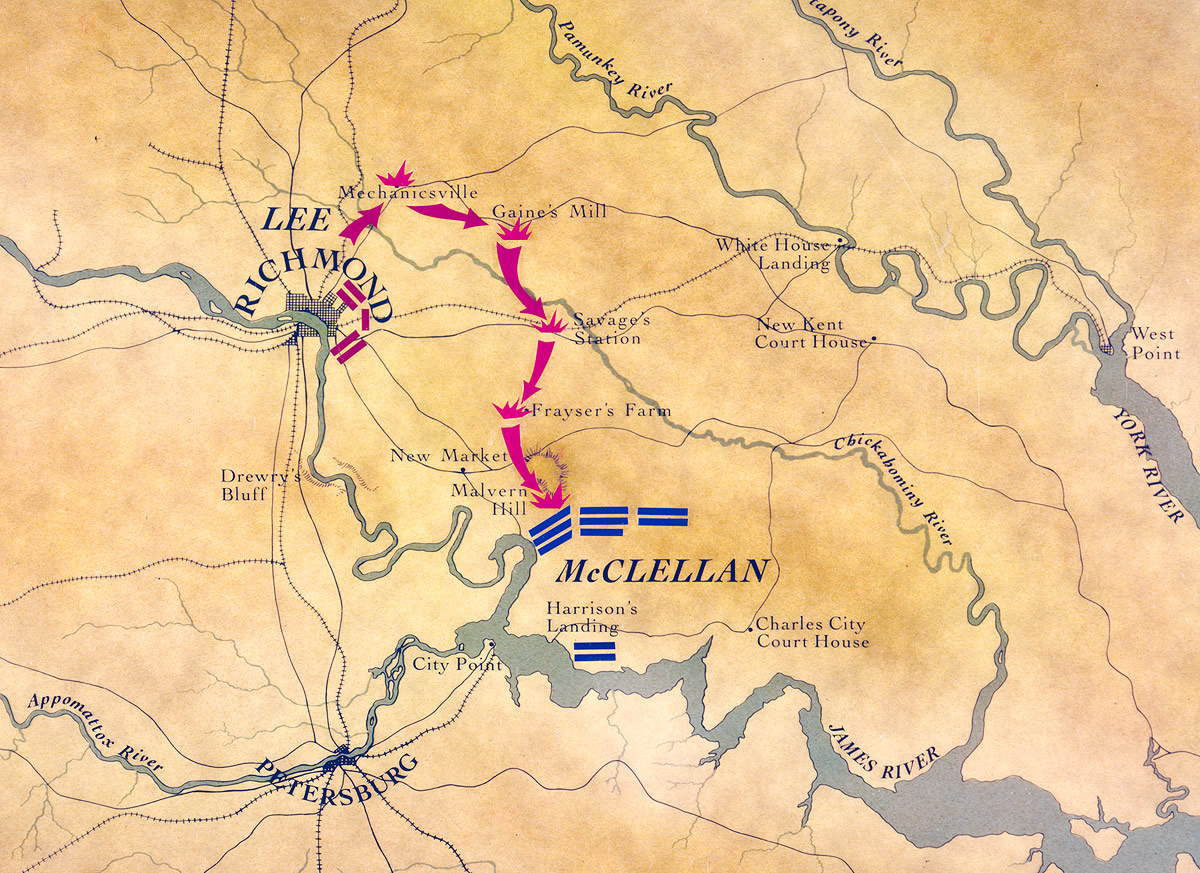
       The Peninsula Campaign would comprise a series of battles beginning with the Yorktown siege and Battle of Williamsburg in early May, at Seven Pines and then the Seven Days Battles. The 85th Pennsylvania was heavily involved in the first-day fighting at Seven Pines but sent to the rear for the ensuing Seven Days Battles. Finally, the 85th Pennsylvania was among the Union regiment which were tasked with helping guard McClellan's retreat to Harrison's Landing in July.
       At the outset, the march up the peninsula took its toll on McClellan's army. This was especially true for the regiments (including the 85th) of General Silas Casey's Division of Erasmus Keyes' IV Corps. Casey's Division was the most inexperienced in McCellan's army, not yet fully trained when they left Washington, DC. Casey's men lacked basic supplies for weeks and often had to haul supplies over rain-soaked and muddy roads.
       The 85th regiment marched out of Newport News at the bottom of the peninsula on April 16 and
Soldiers Assisting with Lowe's Balloon    LOC
were soon encamped at Camp Winfield Scott near Warwick Court House. They were stationed here for two weeks on McClellan's left flank while Union forces prepared for a siege of Yorktown, famous of being the site of the British defeat at the hands of George Washington's Continental Army in 1781 that effectively ended the Revolutionary War. Immediately upon arriving at Warwick Court House, Company A of the 85th Pennsylvania was detailed to help Professor Thaddeus Lowe launch his observation balloon on April 17.
         McClellan finally struck at Yorktown on May 4, only to find the much smaller Confederate force had abandoned the fortification the previous night. As the Confederates were marching away from Yorktown,  Union forces caught up to their rearguard. The Battle of Williamsburg ensued on May 5. During this battle, casualties numbered 4000 (2300 on the Union side).With Colonel Joshua B. Howell of the 85th Pennsylvania replacing the severely ill brigade leader General William Keim, the regiment was called into a line of attack in a reserve role. Although they stayed aligned in formation during a cold night of freezing rain and were targeted by Confederate artillery, the regiment was not called upon to enter the battle. Two of their men were wounded by shells; one (Sergeant Daniel Miller of Company K, the regiment's first man to fall in battle) fatally.
         The IV Corps of General Erasmus Keyes, which included the divisions of Casey and Darius Couch, continued towards Richmond and crossed the Chickahominy River in late May. The III Corps of Samuel Heintzelman soon followed. While the III Corps stayed close to the Chickahominy, Keyes' Corps advanced. Couch's Division established a camp at Seven Pines; Casey's Division advance another 3/4 of a mile and set up a camp at Fair Oaks. Why McClellan would place his smallest and least-experienced division at the vanguard of his army just three miles from Richmond in an exposed position remains a mystery.
      Noting the vulnerable position of McClellan's split army, Confederate General Joseph Johnston decided to attack the two Union corps on the last day of May following a torrential rainstorm that swelled the Chickahominy. This would make it difficult or perhaps impossible for McClellan to reinforce Keyes and Heintzelman across the suddenly fast-moving waters of the  Chickahominy.
Map by Hal Jespersen           www.cwmaps.com
     Despite being severely reduced by disease and being outnumbered 2-to-1 or 3-to-1, Casey's Division valiantly held off the Confederates for 2-3 hours before being enveloped on three sides and retreating. For this they were severely rebuked by McClellan, who was far behind the fight hobbled by an attack of malaria. But because of the effort of Casey's men, the Union had time to get additional men into the fight from across the Chickahominy that stabilized the field for the Union and kept the Confederates from swallowing up nearly half of McClellan's army.   
        The two-day battle of Seven Pines ended with no decisive winner. It did result in 11,000 casualties, mostly on the Confederate side. It was the largest battle in the East up until that time and the closest ever fought near Richmond.
        Casey's Division, which took more casualties than any other Union division on the first day of the fight,was sent to the rear for the next month. Silas Casey, erroneously scapegoated for retreating on the first day, was replaced by John J. Peck.
       For three weeks, the 85th Pennsylvania was stationed on McClellan's extreme left near White Oak Swamp. The had no tents or knapsacks, which were left behind at Seven Pines. Scores of men got sick in this environment and many died. Camp hospitals were filled; their doctors were called away to help with the wounded from the Seven Days Battles. The 85th Pennsylvania did no fighting during the Seven Days Battles; instead they were tasked with several reconnaissance missions and with digging entrenchments, They were in a reserve role for the final encounter Malvern Hill.
       When McClellan decided to abandon the peninsula, his army was ordered to march from Malvern Hill to Harrison's Landing for the withdrawal. Peck's division was tasked with guarding the withdrawal. The irony did not escape the 85th Pennsylvania and other regiments from Casey's former command. Once shamed for retreating from Seven Pines,  it was now their task to monitor the retreat of the rest of McClellan's huge army.
    The 85th Pennsylvania, now part of a brigade led by General Henry Wessells who was named Keim's permanent replacement, marched back down the peninsula to Hampton, VA. While the rest of McClellan's army was shipped to northern Virginia for the Battle of Second Bull Run, Wessells' Brigade was sent to Suffolk, VA where they spent the next four months.
Union Retreat from Harrison's Landing, VA
Frank Leslie's Illustrated


Monday, March 16, 2020

Casualties at the Battle of Seven Pines

 
From Dickey's History of the 85th Regiment Pennsylvania Volunteer Infantry
     The first major battle fought by the 85th Pennsylvania was also the largest in which they ever participated. It was at the Battle of Seven Pines near Richmond on May 31, 1862, the first day of the two-day battle during George B. McClellan's Peninsular Campaign.
     The 85th Pennsylvania had more casualties in this battle than in any other in which they fought. It should be noted that at Second Deep Bottom in August of 1864, the regiment, which was down from its original thousand members to around 400, suffered a higher percentage of losses at that time.
    At Seven Pines, the 85th Pennsylvania was in Henry Wessells' Brigade, part of Silas Casey's Division of Erasmus Keyes' Fourth Corps. McClellan had inexplicably sent Casey's Division across the Chickahominy River, far in advance of the rest of his army. Three of McClellan's five corps did not cross the river. Only Keyes' Fourth Corps and Samuel Heintzelman's Third Corps advanced across the river to probe the enemy and to set up an encampment just three miles from Richmond.
     Casey's Division, the least experienced of McClellan's five divisions and the one most depleted by illness, was thus put in the vanguard of McClellan's army with both flanks exposed.
    Confederate General Joseph Johnston saw an inviting target for an attack, especially after a heavy spring rainstorm on May 30 had swelled the Chickahominy River into a rushing, almost impassable torrent. With most of McClellan's army on the opposite side of the river, and perhaps being unable to engage, Johnson devised a plan to throw his whole army of 60,000 against Casey's and Keyes' 33,000 men.
 
Picket Line and Casey's Division at Seven Pines
From Dickey's History of the 85th Regiment Pennsylvania Volunteer Infantry
        In the early afternoon of May 31, Confederates began the battle with a head-on charge towards Casey''s Division. Some of the 85th Pennsylvania were on picket duty, the rest were back in camp by two battlefield landmarks -- the Twin Houses and a large wood pile.
    Casey's heavily outnumbered division held off the charging rebels for 2-3 hours, giving part of McClellan's force time to cross the Chickahominy River via the rickety Grapevine Bridge and stabilize the battlefield. The fight ended in a draw with heavy losses on both sides.
    The 85th Pennsylvania suffered about 25 killed (including those who succumbed to wounds) and about 50 more who survived their wounds. Several others were captures. A few who were wounded who were captured and died in Confederate prisons. Several others were exchanged and rejoined the regiment several weeks later.
    The tally below gives the casualties by Company, along with a brief biographical mention of each soldier's service. The list was culled from period newspapers, pension records, the 1860 fedearl census, the 1890 Veteran Schedule and obituaries.


                          Field and Staff

Wounded        Lt. Col. Henry A. Purviance    [killed in action in 1863]
 Hosp. Stwd. Robinson Elder   [father of 7 children]

                Company A

Killed              Collin W. Barr                        [died at age 25]
 Robert Byers                          [died in Annapolis hospital at age 21]          
 John Low                               [died the next month in Annapolis hospital]
 John A. McMillen                   [died 10 days later in Washington, DC hospital]

Wounded      Corp. R. W. Criswell              [finished 3-year enlistment]
John Patterson                      [refused to allow arm to be amputated]
William Scott                         [recovered in New York City hospital]
Lt. John W. Acheson             [wounded again in 1864]
Joseph Schell                        [finished 3-year enlistment]

                 Company B

Killed             Lt. Julius A. Smith                  [captured; died 1 month later in Libby Prison]
William Howard                      [died at age 32]
John Reily                              [died at age 49]
Jacob Younkin                        [survived by wife and infant son]
William Braden                       [killed carrying Capt. Hooker to safety]
John B. Hayden                      [captured, exchanged, and died 3 months later]
Corp.Abraham Iams               [died at White House Landing, VA]

Wounded       Capt. George H. Hooker         [life saved by Wiliam Braden]
 Owen Turner                           [transferred to Veterans Reserve Corps]
 Joshua Torrence                      [captured in 1864; survived Andersonvile]
 James Speer                           [wounded again in 1864]
 David Miller                             [later wounded in North Carolina, 1863]
 Amos Bane                             [discharged 5 months later]

                  Company C

Wounded       Corp. John Woodward              [killed in action in 1864]
John B. Thompson                    [discharged 8 months later]
James Day                                [wounded again in 1864]
   
Captured        James Beatty                            [exchanged; rejoined regiment]

                   Company D

Killed              Corp. Alexander Morgan        [first listed as MIA; body never identified]
 Sgt. John N. Donagho             [died from wound in Salisbury POW Camp]

Captured        Hezekiah Horn                         [exchanged, finished 3-year enlistment]

                     Company E

Killed             Lt. Thompson Purviance           [cousin of Lt. Col. Henry Purviance]
Lindsay Hartman                       [brother William served in Company E]

Wounded      Sgt. Robert G. Taylor, leg          [discharged 5 months later, paralysis]
Sgt. Moses McKeag, arm          [discharged 1 month later]
Sgt. John Heckard, shoulder     [discharged 11 months later]
Corp. Charles E Eckels             [served 3-year enlistment]
Corp. Martin Pope, hand           [finished 3-year enlistment]
Musc. Samuel Wood, finger      [finished 3-year enlistment]
Rudolph Smith, thigh                 [discharged, date unknown]
Henry J. McAllister, temple        [age 16 at the time of his wounding]

                    Company F

Killed             Richard F. Lewis                        [served in company with brother George]
Cornelius Estrep                        [died 2 months after wounding]
Meeker Rinehart                        [died in Annapolis 5 weeks after wounding]

Wounded       Corp. Morgan Rinehart, neck     [finished 3-year enlistment]
Isaac DeHavely, side                  [wounded again, 1864]
Charles Chapman, cheek           [finished 3-year enlistment]
Jacob West, thigh                       [recovered after 7 months in DC hospital]
Lisbon Scott, hand                      [captured 1864 and survived Andersonville]
Jesse Cheney, hand and thigh   [discharged 1 month later]
Isaac Gray, hand                        [recovered at home; wounded again, 1863]
Samuel Thompson, hand           [lost a finger; served regt. band for 3 years]
Jacob Weaver, hand                  [spent 6 weeks recovering in Annapolis hospital]
Thomas M. Sellers                     [wounded again in 1864]

                     Company G

Killed              Asberry Phillips                         [died 2 days after wounding at Fort Monroe]
                      Corp. Harrison Hoge, knee        [died 10 weeks later]

Wounded        Sergeant James R. Core         [discharged 9 months later]
                       John Cline                                [wounded again in 1863; finished 3-year enlistment]


                    Company H

Killed               Lt. James Hamilton                 [buried on the battlefield]
  John Conn                               [married farmer with 7 children]
  William Hare, chest                 [died by wood pile on battlefield]

Wounded         Corp. George Colburn            [died on disease, 1864]
  James Bird                              [later died of disease with 4th PA Artilllery]
   Andrew J. Burgess                 [finished 3-year enlistment]
   Reason B. Daniels                  [discharged 10 months later]
   William Dennison                   [died of disease 6 months later]
   Francis D. Morrison                [father of MOH winner Francis Morrison]
   William Muhlenberg               [killed in action in 1864]
   Harrison Younkin                    [discharge 13 months later]
   Thomas J. McClintock            [discharged 6 months later]
   Ross Sterner                           [again wounded in 1863 and 1864]
   James Nichlow                        [finished 3-year enlistment]
   Jesse Peck                              [finished 3-year enlistment]
   Frederick Yurgason                 [killed in action in 1864]

                    Company I

Killed                Corp. James S. Hackney            [died at age 21]

Wounded          Sgt. Lucius Bunting                   [discharged 3 months later]
    Corp.Richard Lincoln, hand      [discharged 7 months later]
    William E. Finley, leg                 [finished 3-year enlistment]
    Cornelius Hennessy, hand        [finished 3-year enlistment]
    Warren Kilgore hand                 [killed at Spotsylvania in 1864]

                     Company K

Wounded           Sgt. Samuel Grim                    [killed in service in 1863]
     Matthew Campbell                  [discharged 19 months later in 1864]