Showing posts with label John E. Michener. Show all posts

Tuesday, August 4, 2020

Capture of Lt. James B. Washington

           
Casey's Division is circled. The line is the position of Casey's pickets.
The "X" is the approximate location of J.B. Washington's capture.
From Battles and Leaders of the Civil War, II; 1887, p.227


           In reviewing obituary records for the men of the 85th Pennsylvania infantry regiment from the Civil War, I came across this brief notation for Private George Washington Anderson of Company H. It pertains to an event that precluded the Battle of Seven Pines (Fair Oaks) near Richmond, VA that began on May 31, 1862.
        "During one of the Virginia campaigns, while doing picket duty, he [Anderson] captured Major J.B. Washington of the Confederate army, now and for a number of years past secretary of the Pittsburg and Connellsville branch of the B&O R.R. Major Anderson and Mr. Washington met in Somerset a few years since, when their recognition was mutual and they spent a pleasant hour talking over their war experience." (Somerset (PA) Herald,  October 20, 1897, p.3)
           If true, the capture of Washington by Anderson would be a notable occurrence from the battle by
Picket Duty    LOC
a member of the 85th Pennsylvania.  Many accounts of the Battle of Seven Pines mention Washington's capture, but Anderson's obituary is the only one I have come across that states the identity of the  soldier who captured him. [If any reader has further information about Washington's capture, I would appreciate a response.]
          It is confirmed that members of the 85th Pennsylvania were on picket duty that day. Lieutenant John E. Michener wrote, "There on Saturday of May 31st, without any support, our little Division was attacked by an overwhelming force of the enemy's best men, and after suffering a heavy loss, was repulsed...I was on picket duty in front of the swamp, and had instructions to hold my ground till the last." [Michener letter courtesy of Margaret Thompson]
          Private Milton McJunkin also wrote, "...our Company was on picket at the time so you see I saw the whole performance. About 1 o’clock the rebs fired three shots into our camp to give Casey warning. At the same time we, that is us pickets, were attacked by 5 brigades and nearly surrounded. Our Company was in the centre of the line and was cut in two so you see we had to retreat as it was useless for 200 pickets to try to check 5,000 of the best troops Jeff [Jefferson Davis] had so we scattered and got to camp the best way we could..." [The Bloody 85th: The Letters of Milton McJunkin, a Western Pennsylvania Soldier in the Civil War, by Palm, Sauers and Schroeder, p. 39]
           The capture of Washington, who was apparently performing a reconnaissance just prior to the Confederate attack, was significant. The Confederate attack in the early afternoon of May 31 nearly overwhelmed the division of Silas Casey, which was outnumbered 2-to-1 or 3-to-1. The 85th Pennsylvania was in the thick of the early fighting that day, in the brigade of General Henry Wessells, stationed near a battery during the early part of the battle. Pushed back to a line of trees, Colonel Joshua B. Howell rallied his 85th Pennsylvania regiment and parts of others to boldly advance towards a rifle pit and temporarily regain control of the position. Howell's men had to fall back once again, but not before buying precious time for Union reinforcements from across the Chickahominy River to arrive later in the afternoon and stop the Confederate advance.
          Despite their efforts, Army of the Potomac commander George B. McClellan (based on the questionable account of General Samuel Heintzelman of the Third Corps) chose not to praise Casey's Division for their stand but to disparage them publicly for their retreat after two or three hours of fighting.
         Casualties in the 85th Pennsylvania numbered around 30 dead and another 50 or so wounded.
        One of the charges made against General Casey was that he was unprepared for a Confederate attack. But in truth, Casey knew the precariousness of his position and was furiously trying to reinforce in anticipation of a rebel attack.
        The capture of Washington several hours prior to the battle only served to intensify the Union belief that an attack was imminent.
         Many accounts of the Battle of Seven Pines mention Washington's capture, but Anderson's obituary is the only one I have come across that says who captured him.
       Luther S. Dickey wrote the official history of the regiment in 1915, about 18 years after Anderson's death. He mentioned Washington's capture on that day but did not mention Anderson's role.
          "During the forenoon of May 31, the enemy appeared in force in front of the pickets immediately north of the Williamsburg Road. Shortly after 10 'clock A.M., Lieut. J.B. Washington , an aide-de-camp on the staff of General Joseph E. Johnston, was captured by Casey's pickets on the Nine-mile road and taken to Gen. [Silas] Casey's headquarters, and thence to Gen. [Erasmus] Keyes' headquarters..." [Dickey, p.71]
          Keyes immediately notified McClellan's staff of Washington's capture. "This young gentleman [Washington] was handsomely captured by our pickets on the right...In connection with the appearance with this young officer, on our right near our lines, I will state that the general officer of the day, Col. Hunt of Casey's division, heard the cars running through the night continually. Yesterday there was much stir among the enemy, and everything on his part indicates an attack on our position, which is only tolerably strong, and my forces too weak to defend it properly." [Dickey, p.72]
       
         Anderson died on October 14, 1897 in Ursina, Somerset County, Pennsylvania at the age of 65. He served three full years in Company H, comprised of men from Somerset County and led at the start of the war by young Captain James B. Tredwell. After the war, Anderson held a variety of positions in Ursina, including constable, justice of the peace, town council member and judge. 
       Incidentally, Anderson's obituary mentions that he and Washington met after the war in Somerset to discuss their meeting at Seven Pines. This is entirely plausible, since Washington for a time managed the Somerset branch of the B&O Railroad.
         During the summer of 1863, the 85th Pennsylvania was stationed on Morris Island, South Carolina. After two failed assaults on Battery Wagner at the northern end of the island, the 85th Pennsylvania was tasked with the arduous duty of digging a series of parallels or trenches that approached Battery Wagner. Many were killed and wounded during the digging operation, falling victim to enemy sharpshooters and shelling from five Confederate forts.
           After the end of the operation, which resulted in the Confederate abandonment of Battery Wagner,
Gillmore Medal
History of the Negro Troops in the War of the Rebellion, 1888
several soldiers in each regiment were nominated by their officers for special Fort Sumter Medals, also called "Gillmore Medals" for valorous service. Anderson was one of eight men from his regiment who were awarded this honor.
         James Barroll Washington, meanwhile,  was born in 1839 and was 23 years old at the time of his capture. He was born in Baltimore and was a graduate of West Point where he was a classmate of future General George Armstrong Custer At Seven Pines, after being captured, Washington posed with Custer, then a captain in the 5th Cavalry, for several photos, including the one below.
   
Matthew Brady photo of Washington and Custer
at Seven Pines on the day of Washington's capture    LOC

          Washington was part of a prisoner of exchange four months after his capture in September of 1862 at Aiken's Landing, Virginia. He then served the Confederacy in Alabama. He became a corporate executive of the Baltimore & Ohio Railroad and died in Pittsburgh, Pennsylvania in 1900. He is buried in his hometown of Baltimore.
          Interestingly, Washington's father, Lewis Washington, also has a prominent place in history. Lewis Washington, a great grandnephew of President George Washington, was one of the hostages taken by radical abolitionist John Brown in 1859 during his infamous raid on the arsenal at Harper's Ferry, Virginia. After Brown and his men holed up in the town's fire house with the hostages, it was Washington who pointed out Brown after U.S. Marines broke down the engine house doors and end the standoff.
John Brown' provisional army with hostages on the left in Harper's Ferry engine house
Lewis Washington is depicted as the second man from the left    LOC


Monday, June 8, 2020

The 85th PA in the Battle of Williamsburg


   [NOTE: A more detailed account of the 85th Pennsylvania at the Battle of Williamsburg, with numerous primary source accounts, is found in my book, Such Hard and Severe Service: The 85th Pennsylvania in the Civil War published by Monongahela Books of Morgantown.] 

          Williamsburg in Virginia is of course well known for a 300-acre living-history 18th century colonial village that is a top tourism attraction in the commonwealth. The former Virginia capital is lesser known as the site of a significant Civil War battle in 1862.
        Perhaps because of the popularity of Williamsburg as a colonial tourist destination, the city's Civil War significance has often been overlooked.


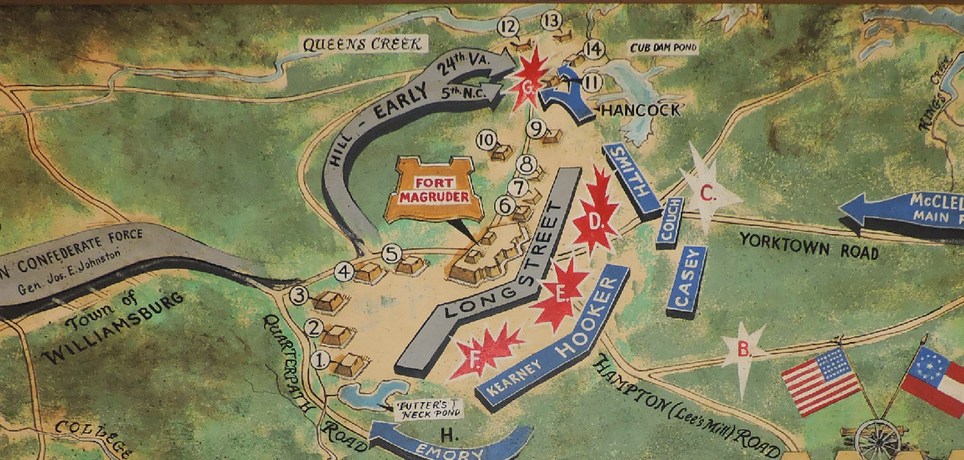
85th PA (green) approaches Fort Magruder
Modern Map Overlay of Williamsburg Battle
Courtesy of
  Williamsburg Battlefield Association
        But that appears to be changing. The American Battlefield Trust website notes that 69 acres of the Civil War battle site have been preserved. The website states, "Much of the battlefield has been lost to development along U.S. Route 60, but historic markers along the side of the highway tell the story of the battle. Fort Magruder, one of the Confederate defensive positions, remains today on Penniman Road east of town  and is marked by a stone monument and some interpretive waysides."
        The Williamsburg Battlefield Association is currently involved in efforts to preserve 29 additional acres of the battlefield with a long-term goal of saving 400 acres of undeveloped land.  
       Williamsburg was the site of the first pitched battle of the the Peninsula Campaign that involved over 70,000 troops. It was also the first engagement for the 85th Pennsylvania, 
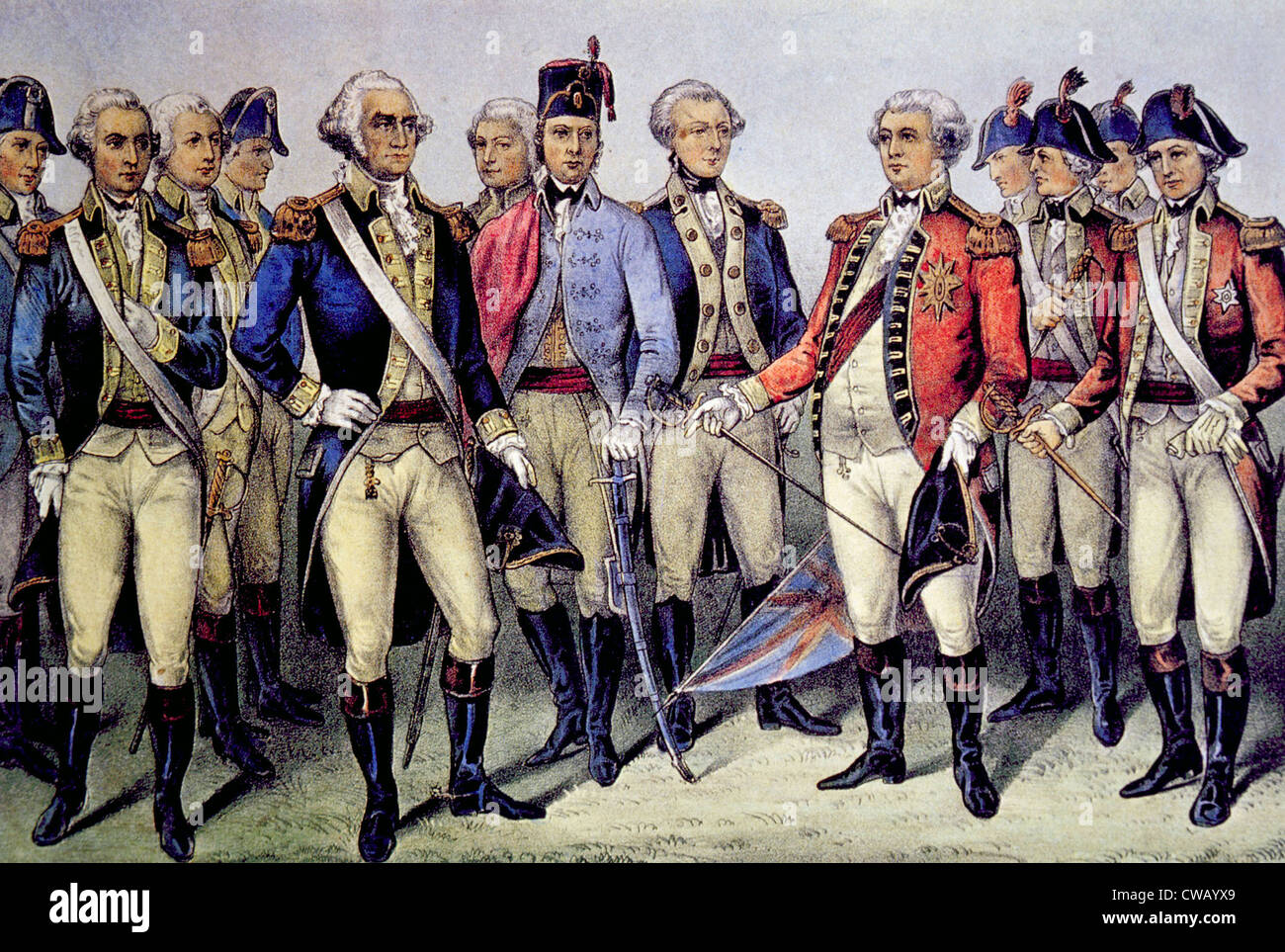
        The battle was fought on May 5, 1862. Major General George B. McClellan had spent a month placing siege guns around Confederate forces at Yorktown. He anticipated bombarding the position into submission and ending the Civil War at the same site where George Washington's Continental Army along with significant French land and sea forces had accomplished a victory over the British 81 years earlier to effectively win the American Revolution.
       But when McClellan opened up a barrage upon Yorktown on May 4, it was discovered that General Joseph Johnston's Confederate command had abandoned the fort, retreating up the Virginia peninsula between the York and James Rivers towards Richmond.
   
Robert Know Sneden 1862 Map of Fort Magruder         LOC
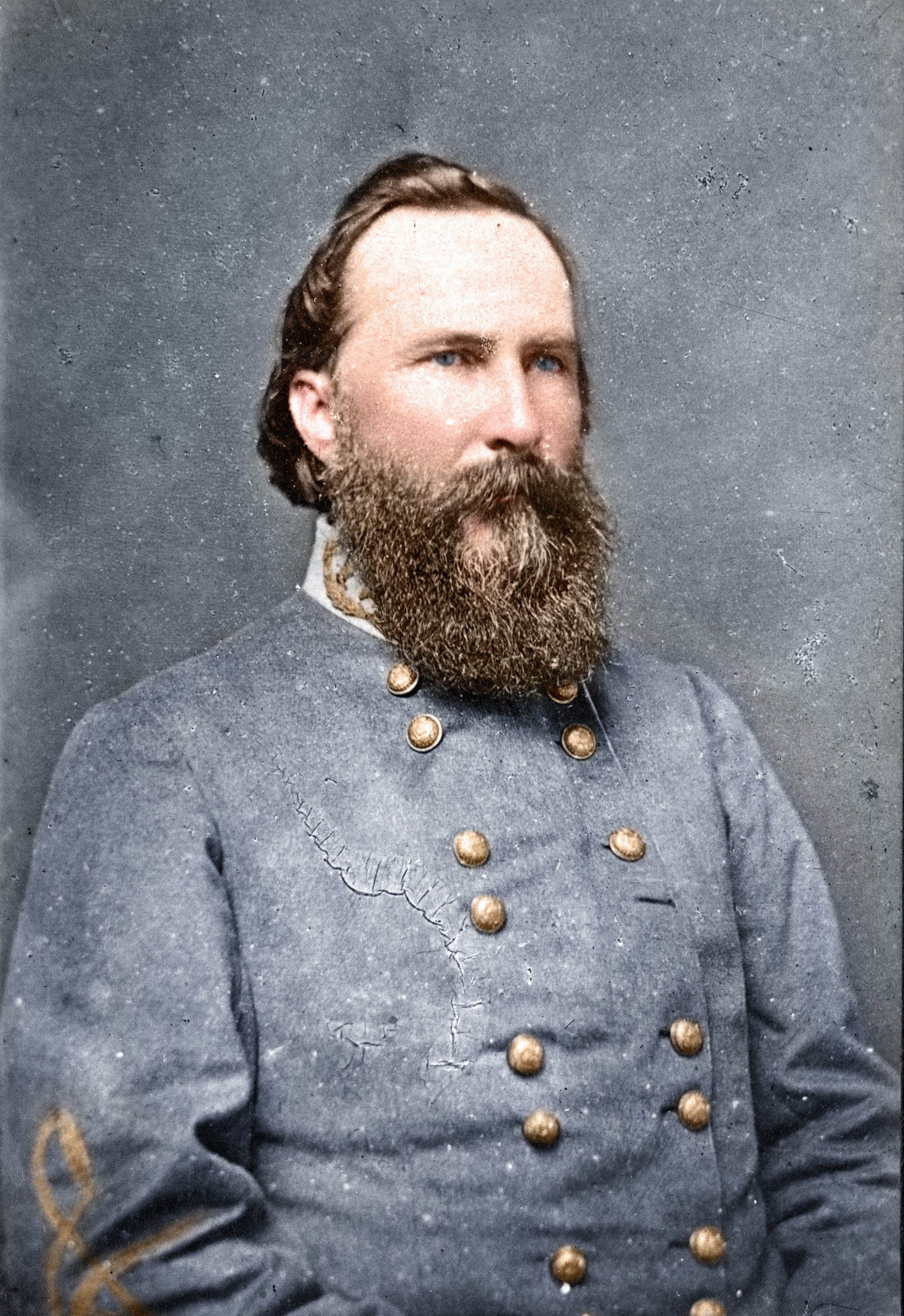
              Confederate General James Longstreet was tasked with delaying McClellan's Army of the Potomac which was in pursuit to allow time for Johnston's supply wagons to clear the area. The battle of Williamsburg, mainly involving the Union divisions of Joseph Hooker and Phillip Kearney, focused around the Confederate position at Fort Magruder, and ended with no decisive winner. Casualties totaled about 4,000 soldiers, about 56% on the Union side.
       The role of the 85th Pennsylvania was minimal. As the battle raged, their regiment was called up in a reserve capacity. They forged ahead to within sight of Fort Magruder and were halted. They fired a musket round at an unseen target through the trees. They were shelled, but most of the Confederate projectiles landed harmlessly behind them.
       The 85th Pennsylvania suffered two casualties. Captain John Morris of Company F suffered a minor injury as he was grazed by a shell fragment in the cheek. However, Sergeant Daniel Miller of Company K lost his legs when hit by another shell. He spent three agonizing weeks in a hospital before finally dying in early June.
       Although they did not play a consequential role, Williamsburg was important to the 85th Pennsylvania for several reasons. First, it was their initial taste of being fired upon and witnessing dead and wounded soldiers.
       Corporal William Elliott Finley described the role of his his regiment.

Corporal William Elliott Finley
from A Soldier's Life (1867)


"Just in front of it [the regiment] lay an open space which must be crossed to gain the woods beyond where the rebels were concealed. Sweeping across this, it caught the enemy's fire. A shell from Fort Magruder went hissing through its ranks and exploding, a fragment struck Captain [John] Morris upon the cheek. He only grew a little whiter and marched sternly on while the blood spurted from the wound. A little farther on, a rifle shot struck a Company 'K' man [Sergeant Daniel Miller] and uttering a cry threw up his hands, staggered and fell. Many a heart beat faster;many a cheek grew paler. They had seen the first man fall in battle."


Colonel Joshua B. Howell

          Secondly, the regiment remembered their colonel, Joshua B. Howell, boldly volunteering his regiment when a superior officer asked for a regiment to rush to the battle site.
         Private Milton McJunkin of Company D wrote home that, “Well we moved off double quick until we got on an open field joining the woods…While standing there, Genr’l Sumner rode up in great haste and hollowed Col. have you a regt you can rely upon. The old col without takeing time to give him an answer yelled out forward 85th. So we started off double quick down the road to the scene of action. The old Col was rideing back and forth along the line with a smile on his face, saying now me boys give them the bayonet.” [Ron Palm, Richards Sauers and Patrick Schroeder, The Bloody 85th: The Letters of Milton McJunkin, a Western Pennsylvania Soldier in the Civil War, [page 59]

           Third, the men remembered the frigid cold that they experienced the night of May 5 when they stood in formation. 
          Private John Neill of Company A remembered, 

A Halt in Line of Battle
copper plate edging, Edwin Forbes, 1876
"I have been cold many a time before and since, but never to the same extent. We dared not break ranks or we could not have re-formed in the blackness of the darkness; and between midnight and morning I could hear the teeth rattle to the upper end of our Company, and to me it seemed that my insides shook about and that I could tell where every bone joined to every other all over my body... I forgot to state that we were yet without food, and remained so till the evening of the next day, and guess my digestive apparatus had upset in the shaking of the night before."

          Lieutenant John E. Michener of Company D summarized the 85th Pennsylvania's experience in a letter to a western Pennsylvania newspaper.


Waynesburg (PA) Messenger  5-28-1862

Monday, January 13, 2020

Disgruntlement on Folly Island


              The following letter was written from Folly Island, South Carolina in the spring of 1863 by a member of the 85th Pennsylvania. The regiment spent a year in the area around Charleston Harbor in a fruitless Union attempt to re-capture Fort Sumter and subdue the city of Charleston. His anonymous letter, signed only as "A High Private,"  reflects dissatisfaction with the treatment of the men and the lack of support from their officers. With the direction of the war shifting from restoration of the Union to also freeing slaves, the writer, like many Unionists, balks at the concept of fighting the war for the benefit of enslaved blacks.
       
Map of Charleston Harbor
Charleston is to the top middle of the map; Folly Island is circled     LOC
    The soldier is from Company D, which was composed of men from Washington County and Greene County. My two ancestors (John and Stephen Clendaniel) were members of this company. But neither one penned this letter. My family has a few of their Civil War letters and they did not have the level of education to write the following. The author remains a mystery. 
     The article appeared originally in the Washington (PA) Examiner (exact date unknown) and was reprinted in The Democratic Watchman from Bellefonte, PA in the center of the state. Both of these newspapers supported positions of the Democrat Party. The date of publication in the Watchman was June 12, 1863. 
     The letter is italicized below. My comments are interspersed throughout the letter in red.


                              “Soldier Sentiment – A Very Interesting Soldier Letter”


Camp Peck
Folly Island, South Carolina
May 20, 1863

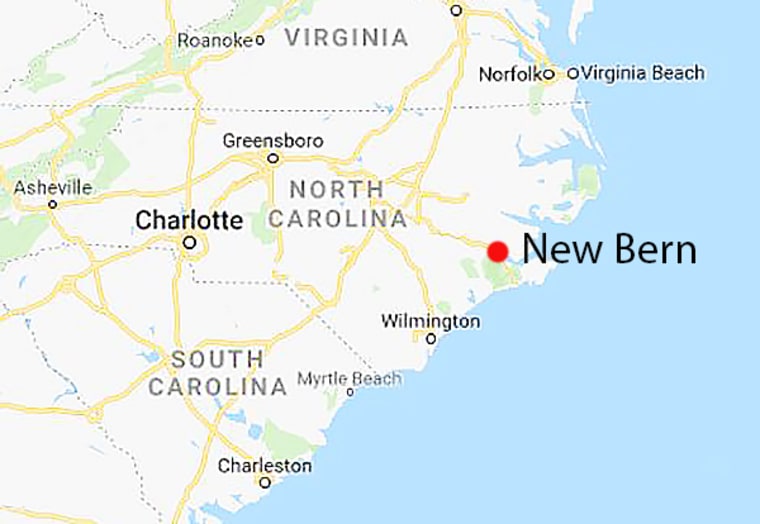
     Perhaps a line from the 85th Pennsylvania Regiment might interest you, especially as nearly half our number hail from Washington county. The 85th Pennsylvania consisted of ten companies. Companies A and B, as well as large parts of Companies D and E hailed from Washington County. I would put the percentage from Washington County at around 35-40%, more than the other three counties from which the men came (Fayette, Greene, Somerset).  We have now put in here for four months in this department. The regiment left New Bern, North Carolina in January and landed on the coast of South Carolina for a year-long siege. We came and took possession of this inhospitable island on the 5th of April, preparatory to making an advance on Charleston. They crossed an inlet from Cole Island and landed on Folly Island with no opposition, as the Confederates withdrew just before Union forces arrived. But since the naval attack on Fort Sumpter on the 7th [of April] ult., there has been little said in regard to capturing the city. This failed Union naval attack, consisting mostly of ironclads, was bombarded by Confederate shore batteries, as well guns from Fort Sumter, and withdrew. The Union naval blockade of Charleston was still intact, but Charleston didn't fall until February of 1865 when Sherman's Army caused the Confederate army to abandon the city. The most we hear is from the New York papers. They frequently speak of things which should have happened even in our own camps – things that none of us ever heard of before. Apparently "Fake News" existed during the Civil War.
     About five thousand troops are left here, and the Island is well fortified. Union forces first fortified the
Union camp on Folly Island  LOC
southern end of the island. We have been building forts and breastworks ever since we came.
When Union General Quincy Gillmore arrived in June to take command of the Department of the South, he was puzzled as to why the southern end of Folly Island was fortified instead of the northern end closer to Morris Island. He asked if Union forces planned to swing the island around in order to attack Fort Wagner, Fort Sumter and Charleston.. He soon began fortifying the northern end of Folly Island as a platform to eventually invade Morris Island. We are in view of Sumpter and a portion of the city, and the rebel camps on James Island can be seen, but not reached without a heavy force from all appearances. The rebel pickets come up to within talking distance of us every night, but keep their distance through the day.  Soldiers from the two sides soon began trading with each other (newspapers, coffee, tobacco, sugar, etc.) when the officers were not around. Sometimes they even swam together. The weather is extremely warm – equal to the month of August in Pennsylvania. We get provisions plenty, such as the army rations. All does well enough, except the hard tacks we would willing exchange for bread of some other kind. "Hardtacks" were rather tasteless biscuits made of flour and water. They were rock-hard (until softened in water or coffee) but remained edible for months, even years. The paymaster has visited us twice since we came south, though his presence the
Payday
A Soldier in the Civil War, 1886
last time failed to render satisfaction as on former occasions. Our lost clothing had to be paid for. I shall not attempt to give the causes from which our clothing was lost, as it has already been published; but during our campaign last summer and fall all who were not in hospital lost their suits of clothing and had to draw others on requisition. The run up our clothing bill far above our allowance. The government allows us forty-two dollars a year for clothing and our bills overrun our allowance from twenty to fifth dollars to each man.
The 85th PA first left their supplies behind at Seven Pines when they were overrun by Confederates. Their next set of supplies were on a transport that sank while they were on their way to South Carolina. While in North Carolina during December, 1862, the were mocked by Union troops stationed there for the ragged appearance of their often ill-fitting replacement uniforms.
     Our officers admit that they had attended in [illegible] time this money could have been saved us. Yes, had they devoted the time they spent in drafting their resolutions March last, to our affairs, our money would not have been extracted from us. The implementation of the Emancipation Proclamation at the beginning of 1863 caused controversy in the North, as many supported the war to preserve the Union, not for the freedom of slaves. The 85th PA made national news for holding meetings in support of Lincoln’s policies and administration, with some holdouts, such as the writer of this letter. Had they [our officers] devoted the time they spent in drafting their resolutions in March last to our affairs, our money would not have been extracted from us. I see in the papers from the North many patriotic letters and most of resolutions adopted they the officers of the different regiments in this department. Their main object seems to be to denounce the whole Democratic party in general – threatening every loyal heart with the rope and bayonet who mentions conciliation and peace. Western Pennsylvania was strong Democrat Party territory. But unlike the Copperheads who favored a peace settlement to stop the fighting, most Democrats in the regiment wanted to continue the war until victory. They say the soldiers don’t want peace but are eager to fight. Allow me to say this eagerness rests wholly among those who live better than they ever did at home we are willing to fight to the bitter end for the Constitution and the old flag, but we have thus far seen the fruitless efforts to overwhelm the millions arrayed in battle. Still the encrimsoned waters of this civil war is not subsiding. Now the truth of the matter is there is not a man amongst us but would rejoice at the end of this struggle and an honorable peace. A peace satisfactory to the whole American nation is the ardent desire of every soldier in this army. Please say to those noble peace men of our country that the soldiers of the 85th will vote for any man who will bring it about.

                                                                        Truly yours, 
                                                                        A HIGH PRIVATE
                                                                        Co. D   85th P.V.

New York Times
March 21, 1863
      Interestingly, the writer kept his identity secret. Soon afterwards, Lieutenant John E. Michener of Company D sent a pro-war letter to a Republican Party newspaper in Washington (PA) signed by every man in Company D. This implies that the writer of the above letter also signed the pro-war Michener letter. This suggests that the author of the pro-peace letter was either pressured into signing Michener's pro-war resolution, he had changed his mind (unlikely), or decided to join the majority while keeping his pro-peace sentiments to himself.

     
Shore of Folly Island
The Union blockading fleet is to the right.   LOC

      The 85th Pennsylvania was soon to observe the bravery of the 54th Massachusetts who led an assault on Fort Wagner (Morris Island) with heavy losses. My book, "Such Hard and Severe Service: The 85th Pennsylvania in the Civil War," published by Monongahela Books, has several first-person accounts  of how this event changed the minds of many white troops about the bravery and discipline of black troops.