|
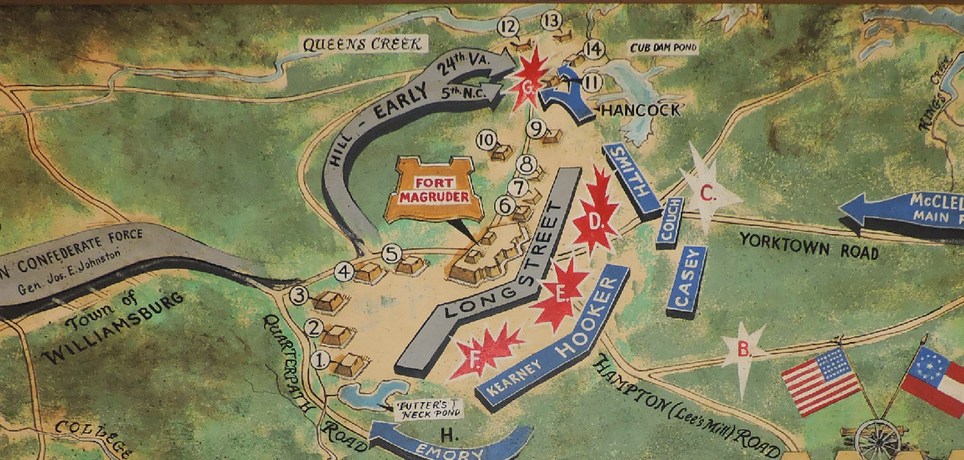
| Casey's Division is circled. The line is the position of Casey's pickets. The "X" is the approximate location of J.B. Washington's capture. From Battles and Leaders of the Civil War, II; 1887, p.227 |
"During one of the Virginia campaigns, while doing picket duty, he [Anderson] captured Major J.B. Washington of the Confederate army, now and for a number of years past secretary of the Pittsburg and Connellsville branch of the B&O R.R. Major Anderson and Mr. Washington met in Somerset a few years since, when their recognition was mutual and they spent a pleasant hour talking over their war experience." (Somerset (PA) Herald, October 20, 1897, p.3)
If true, the capture of Washington by Anderson would be a notable occurrence from the battle by
 |
| Picket Duty LOC |
It is confirmed that members of the 85th Pennsylvania were on picket duty that day. Lieutenant John E. Michener wrote, "There on Saturday of May 31st, without any support, our little Division was attacked by an overwhelming force of the enemy's best men, and after suffering a heavy loss, was repulsed...I was on picket duty in front of the swamp, and had instructions to hold my ground till the last." [Michener letter courtesy of Margaret Thompson]
Private Milton McJunkin also wrote, "...our Company was on picket at the time so you see I saw the whole performance.
About 1 o’clock the rebs fired three shots into our camp to give Casey warning. At
the same time we, that is us pickets, were attacked by 5 brigades and nearly
surrounded. Our Company was in the centre of the line and was cut in two so you
see we had to retreat as it was useless for 200 pickets to try to check 5,000 of the
best troops Jeff [Jefferson Davis] had so we scattered and got to camp the best
way we could..." [The Bloody 85th: The Letters of Milton McJunkin, a Western Pennsylvania Soldier in the Civil War, by Palm, Sauers and Schroeder, p. 39]
The capture of Washington, who was apparently performing a reconnaissance just prior to the Confederate attack, was significant. The Confederate attack in the early afternoon of May 31 nearly overwhelmed the division of Silas Casey, which was outnumbered 2-to-1 or 3-to-1. The 85th Pennsylvania was in the thick of the early fighting that day, in the brigade of General Henry Wessells, stationed near a battery during the early part of the battle. Pushed back to a line of trees, Colonel Joshua B. Howell rallied his 85th Pennsylvania regiment and parts of others to boldly advance towards a rifle pit and temporarily regain control of the position. Howell's men had to fall back once again, but not before buying precious time for Union reinforcements from across the Chickahominy River to arrive later in the afternoon and stop the Confederate advance.
Despite their efforts, Army of the Potomac commander George B. McClellan (based on the questionable account of General Samuel Heintzelman of the Third Corps) chose not to praise Casey's Division for their stand but to disparage them publicly for their retreat after two or three hours of fighting.
Casualties in the 85th Pennsylvania numbered around 30 dead and another 50 or so wounded.
One of the charges made against General Casey was that he was unprepared for a Confederate attack. But in truth, Casey knew the precariousness of his position and was furiously trying to reinforce in anticipation of a rebel attack.
The capture of Washington several hours prior to the battle only served to intensify the Union belief that an attack was imminent.
Many accounts of the Battle of Seven Pines mention Washington's capture, but Anderson's obituary is the only one I have come across that says who captured him.
Despite their efforts, Army of the Potomac commander George B. McClellan (based on the questionable account of General Samuel Heintzelman of the Third Corps) chose not to praise Casey's Division for their stand but to disparage them publicly for their retreat after two or three hours of fighting.
Casualties in the 85th Pennsylvania numbered around 30 dead and another 50 or so wounded.
One of the charges made against General Casey was that he was unprepared for a Confederate attack. But in truth, Casey knew the precariousness of his position and was furiously trying to reinforce in anticipation of a rebel attack.
The capture of Washington several hours prior to the battle only served to intensify the Union belief that an attack was imminent.
Many accounts of the Battle of Seven Pines mention Washington's capture, but Anderson's obituary is the only one I have come across that says who captured him.
Luther S. Dickey wrote the official history of the regiment in 1915, about 18 years after Anderson's death. He mentioned Washington's capture on that day but did not mention Anderson's role.
"During the forenoon of May 31, the enemy appeared in force in front of the pickets immediately north of the Williamsburg Road. Shortly after 10 'clock A.M., Lieut. J.B. Washington , an aide-de-camp on the staff of General Joseph E. Johnston, was captured by Casey's pickets on the Nine-mile road and taken to Gen. [Silas] Casey's headquarters, and thence to Gen. [Erasmus] Keyes' headquarters..." [Dickey, p.71]
Keyes immediately notified McClellan's staff of Washington's capture. "This young gentleman [Washington] was handsomely captured by our pickets on the right...In connection with the appearance with this young officer, on our right near our lines, I will state that the general officer of the day, Col. Hunt of Casey's division, heard the cars running through the night continually. Yesterday there was much stir among the enemy, and everything on his part indicates an attack on our position, which is only tolerably strong, and my forces too weak to defend it properly." [Dickey, p.72]
 Anderson died on October 14, 1897 in Ursina, Somerset County, Pennsylvania at the age of 65. He served three full years in Company H, comprised of men from Somerset County and led at the start of the war by young Captain James B. Tredwell. After the war, Anderson held a variety of positions in Ursina, including constable, justice of the peace, town council member and judge.

Incidentally, Anderson's obituary mentions that he and Washington met after the war in Somerset to discuss their meeting at Seven Pines. This is entirely plausible, since Washington for a time managed the Somerset branch of the B&O Railroad.
During the summer of 1863, the 85th Pennsylvania was stationed on Morris Island, South Carolina. After two failed assaults on Battery Wagner at the northern end of the island, the 85th Pennsylvania was tasked with the arduous duty of digging a series of parallels or trenches that approached Battery Wagner. Many were killed and wounded during the digging operation, falling victim to enemy sharpshooters and shelling from five Confederate forts.
After the end of the operation, which resulted in the Confederate abandonment of Battery Wagner,
several soldiers in each regiment were nominated by their officers for special Fort Sumter Medals, also called "Gillmore Medals" for valorous service. Anderson was one of eight men from his regiment who were awarded this honor.
James Barroll Washington, meanwhile, was born in 1839 and was 23 years old at the time of his capture. He was born in Baltimore and was a graduate of West Point where he was a classmate of future General George Armstrong Custer At Seven Pines, after being captured, Washington posed with Custer, then a captain in the 5th Cavalry, for several photos, including the one below.
Washington was part of a prisoner of exchange four months after his capture in September of 1862 at Aiken's Landing, Virginia. He then served the Confederacy in Alabama. He became a corporate executive of the Baltimore & Ohio Railroad and died in Pittsburgh, Pennsylvania in 1900. He is buried in his hometown of Baltimore.
Interestingly, Washington's father, Lewis Washington, also has a prominent place in history. Lewis Washington, a great grandnephew of President George Washington, was one of the hostages taken by radical abolitionist John Brown in 1859 during his infamous raid on the arsenal at Harper's Ferry, Virginia. After Brown and his men holed up in the town's fire house with the hostages, it was Washington who pointed out Brown after U.S. Marines broke down the engine house doors and end the standoff.
During the summer of 1863, the 85th Pennsylvania was stationed on Morris Island, South Carolina. After two failed assaults on Battery Wagner at the northern end of the island, the 85th Pennsylvania was tasked with the arduous duty of digging a series of parallels or trenches that approached Battery Wagner. Many were killed and wounded during the digging operation, falling victim to enemy sharpshooters and shelling from five Confederate forts.
After the end of the operation, which resulted in the Confederate abandonment of Battery Wagner,
 |
| Gillmore Medal History of the Negro Troops in the War of the Rebellion, 1888 |
James Barroll Washington, meanwhile, was born in 1839 and was 23 years old at the time of his capture. He was born in Baltimore and was a graduate of West Point where he was a classmate of future General George Armstrong Custer At Seven Pines, after being captured, Washington posed with Custer, then a captain in the 5th Cavalry, for several photos, including the one below.
 |
| Matthew Brady photo of Washington and Custer at Seven Pines on the day of Washington's capture LOC |
Interestingly, Washington's father, Lewis Washington, also has a prominent place in history. Lewis Washington, a great grandnephew of President George Washington, was one of the hostages taken by radical abolitionist John Brown in 1859 during his infamous raid on the arsenal at Harper's Ferry, Virginia. After Brown and his men holed up in the town's fire house with the hostages, it was Washington who pointed out Brown after U.S. Marines broke down the engine house doors and end the standoff.
 |
| John Brown' provisional army with hostages on the left in Harper's Ferry engine house Lewis Washington is depicted as the second man from the left LOC |