Showing posts with label Harrison's Landing. Show all posts

Thursday, December 17, 2020

John E. Michener and the Peninsula Campaign


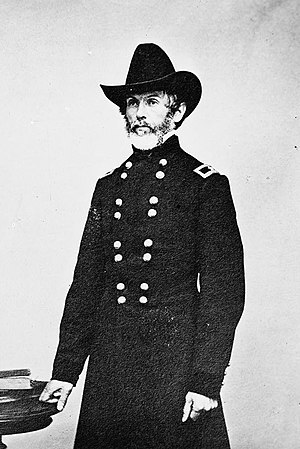
Captain John E. Michener
Miriam and Ira D. Wallach Division of Art, Prints and Photographs
New York Public Library


       The brief, 40-page chapter in "Prison Life" (1867) about Captain John E. Michener of the 85th Pennsylvania, mentioned in my previous post, offers some heretofore little known details about his three years in the Union army, beginning with information about the Peninsula Campaign. 
        Michener, from Fredericktown, Washington County, PA, first joined the 85th Pennsylvania regiment as a lieutenant in Company D. He was 23 years of age with a wife and newborn daughter. His brother, Ezra, served as an assistant sutler attached to the regiment. Later in the war, in early 1864, Michener would be promoted to captain of Company K. 

        After a brief stay in Washington, DC during the winter of 1861-62, the 85th Pennsylvania was transported to Fort Monroe, Virginia to be part of General George B. McClellan's massive movement to capture Richmond, the Confederate capital, by advancing up the peninsula between the James and York Rivers. This effort, known as the Peninsula Campaign, would prove to be a massive Union failure and starkly shattered the expectation of many northerners that victory would in a short amount of time. 

Position of Casey's Division At Williamsburg in support of Hooker and Kearney

         The first pitched battle of the of the Peninsula Campaign, was fought at Williamsburg on May 5, 1864. Union forces caught up to the rear guard of the Confederate army that was retreating from Yorktown. The battle involved over 70,000 troops and resulted in about 4,000 total casualties, but ended without a decisive winner The Union pursuit continued up the Virginia Peninsula towards Richmond. 

      The 85th Pennsylvania played a supporting role during the engagement. They were called into a line of battle line during the night of May 5, but did not fire their rifles. The men were very excited to be placed in a position to be under fire from artillery for the first time. Although shelled, the regiment suffered just two casualties, their first of the war. Also memorable was the bone-chilling weather, as they stood shivering in formation all night long during a rain storm. More information about the Battle of Williamsburg can be found here.

      What "Prison Life" adds to the story: Because of the minor role played by the 85th Pennsylvania at Williamsburg, "Prison Life" adds little to what is already known. Author T.J. Simpson exalts Michener for parading in front of his men and exhorting them to stand in readiness for an order to advance that never came. Michener deserved credit for encouraging his men, but not on the level described below by Simpson. Although placed under fire for the first time, the Confederate shells directed at them mostly fell behind the men, not upon them or in front of them. Michener displayed plenty of bravery during the war; however, it was a stretch for Simpson to highlight this incident in such sonorous language.

From "Prison Life:" [Standing in formation at Williamsburg] "Here Lieutenant Michener’s coolness and intrepidity was fearlessly displayed and won for him the admiration and confidence of all his comrades. Seizing a musket, he rushed to the front and as if wholly unconscious of danger, continued to encourage and animate his men, both by word and example, in the midst of a most deadly fire, until the close of the battle."

         The Confederate army following the battle continued their withdrawal up the peninsula towards Richmond under the command of General Joseph Johnston with McClellan in pursuit. Nearly a month after Williamsburg, the 85th Pennsylvania was in the front lines for the Battle of Seven Pines. This fight involved 73,000 troops and ended with nearly 14,000 casualties. This three-day fight, the closest ever to Richmond, ended in a draw. Confederates held off the invasion of Richmond, while the Union rallied after nearly being overwhelmed on the first day of the battle. 

        The 85th Pennsylvania, as part of Silas Casey's Division of Erasmus Keyes' Fourth Corps, was in the front lines on the first day of the battle. This inexperienced division, greatly reduced by sickness, fought extremely well, holding off a much larger Confederate strike force until re-enforcements arrived hours later from across the Chickahominy River. For more information about the Battle of Seven Pines as well as an excellent detailed map of the opening of the fight, click here.

        Michener, then a lieutenant in Company D, was on picket duty with the fight commenced along with his captain, William Horn, and a handful of men. Facing overwhelming numbers of Confederates, he and his men struggled to return to their regiment. Several of were captured. While some in others regiments panicked and fled to the rear, Michener was able to coolly lead the rest of the men back to their regiment.

    What "Prison Life" adds to the story: Specific details about Michener's role are provided. Michener, it turned out, was given charge of a group of Confederate prisoners during his return from the picket line by a colonel of another regiment. Michener through Simpson also disclosed the route of his return. 

History of the 103rd Regiment
PA Veteran Volunteer Infantry p.174
Union picket line on the far left; 85th PA to the right of the redoubt along the stage road


  From "Prison Life:"
"Lieutenant Michener was cut off from his division, with the rebels in front and rear, while he and his men were exposed to a galling fire from both friends and foes. With thirteen men belonging to his own company and four of the ninety-sixth New York, he moved through the slashing of newly-fallen timber to the York River railroad, deployed his little squad as skirmishers, and captured three prisoners with the loss of one of the New York boys, who was shot in the head while gallantly fighting at his post. Moving then to the right of the railroad, he succeeded in escaping from his dreadful dilemma and hastened to the point where [General John] Sedgwick fiercely contesting every inch of ground, finally changed defeat into victory and triumphantly closed one of the bloodiest battles of the war."

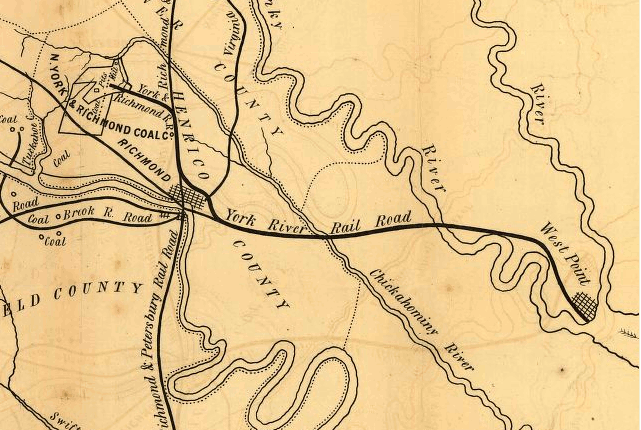
Michener's route from the picket line along the RR line to Sedgwick's position at the Battle of Seven Pines
History of the 103rd PA by L.S. Dickey, p. 166

Colonel Oliver H. Rippey
61st PA Infantry
Killed at Seven Pines
   

    "Here Lieutenant Michener was directed by Colonel [Oliver H.] Rippey, [61st PA, killed at Seven Pines] a brave and gallant officer, to take charge of some forty-five prisoners and guard them securely until they could be removed to the rear."


         The 85th Pennsylvania and Silas Casey's entire division, after a severe public rebuke from McClellan, was sent to rear during the ensuing Seven Days' Battles. In late June of 1862, McClellan gave up his plan to capture Richmond. After the final fight at Malvern Hill, the 85th Pennsylvania as part of the division of General John J. Peck (who replaced the scapegoated Casey) guarded the Union retreat. McClellan's huge army set up a defensive position at Harrison's Landing on the James River and sat for six weeks. In mid-August, McClellan's army began loading onto ships and left the peninsula. McClellan called the massive retreat a "change of base." 

       It took several days for the army to be removed aboard transport and barges from Harrison's Landing. The mood of many in the Union army as well as in the North was disappointment and confusion that the Union offensive to end the war had stalled. A Pittsburgh newspaper wrote, "Without a struggle, without even the loss of a single man, the immense Army of the Potomac, officers and men, bag and baggage, stores, tents, horses, ammunition and contrabands, are now far away from Harrison's Landing...steamer after steamer and vessel after vessel passed us steaming or sailing in the direction of Fortress Monroe heavily laden with horses and stores." [Pittsburgh Gazette, August 21, 1862, p.1]

Harrison's Landing
Harper's Weekly


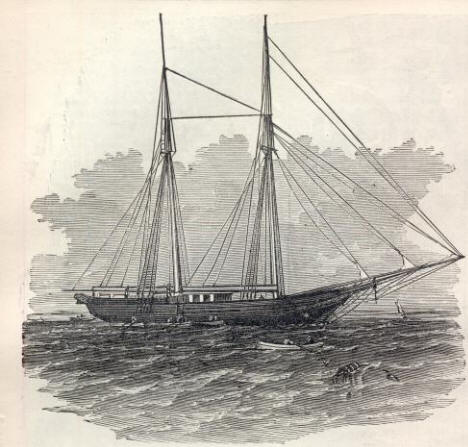
  From "Prison Life:" This vignette displayed Michener's organizational and management skills. [McClellan’s retreat] "At the evacuation of Harrison’s Landing, Lieutenant Michener was detailed to take charge of all the baggage belonging to General Peck’s division. The baggage consisted of trunks, boxes, knapsacks, etc. They had been hastily and carelessly tumbled into crazy old canal hulks by a careless and reckless quartermaster and consequently the boats rapidly filled with water and sunk at the wharf where they had been loaded. To remove this baggage out of these sunken boats to others was a slow and difficult task. In less than eighteen hours, however, Lieutenant Michener with a squad of soldiers and one hundred contrabands [former slave laborers], succeeded in transferring the whole of the baggage from the sunken boats to the schooner W. A. Ellis. After this was accomplished, he was ordered by General Peck to proceed with the schooner to Hampton Creek, Virginia, near Fortress Monroe and land the baggage."

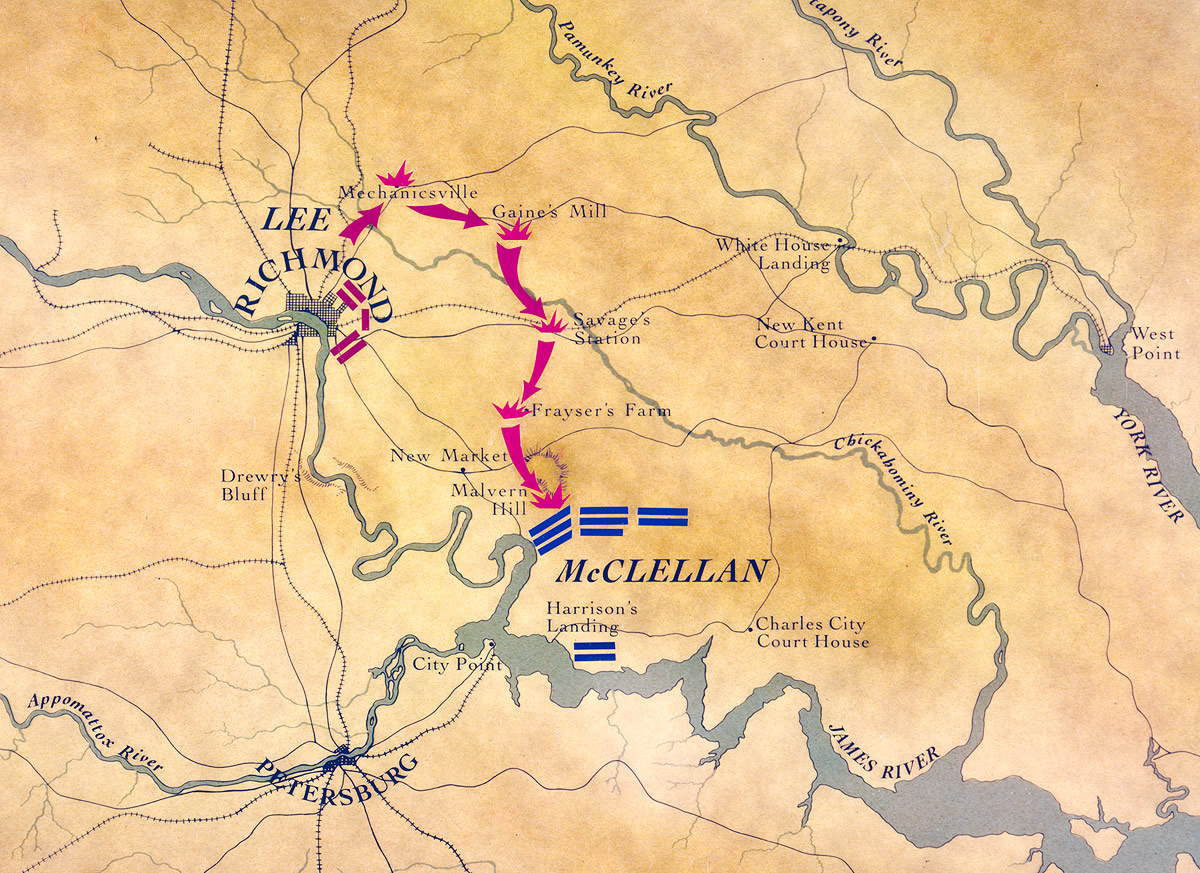
Yellow - water route of baggage barge on the James River
Blue - land route of 85th Pennsylvania
Joel Dorman Steele, 
A Brief History of the United States 


          Most of the Army of the Potomac sailed to Fortress Monroe, Virginia and then on towards Washington, DC. They would soon fight at Second Bull Run, Virginia in August and at Antietam, Maryland in September. The 85th Pennsylvania did not board transports but instead marched back down the peninsula to Fortress Monroe where they stayed while their future assignment was being debated by McClellan and the War Department. The 85th Pennsylvania was eventually sent to Suffolk, Virginia where they spent the next three months.

 Next: John E Michener is in charge of a dangerous mission transporting deserters and stragglers.


Monday, May 4, 2020

The 85th Pennsylvania and the Peninsula Campaign


Map by Hal Jespersen       www.cwmaps.com
 
     [NOTE: The participation of the 85th Pennsylvania is described in more detailed fashion in a Chapter 4 of my book, "Such Hard and Severe Service: The 85th Pennsylvania in the Civil War."
          I am also currently chronicling the 85th Pennsylvania during the Peninsula Campaign on my Facebook blog called "85th Pennsylvania Civil War Page." That blog  follows the regiment on a day to day basis.]

          The Peninsula Campaign was the costliest military campaign in which the 85th Pennsylvania was ever involved. Seventy-eight men died during the approximately four-month operation from April to early July of 1862. Two thirds of the deaths resulted from diseases. Another seventy-two men were medically discharged and sent home.
General George B. McClellan   LOC
          After initially being stationed in Washington, DC in 1861-62, the 85th Pennsylvania sailed away from the nation's capital in the spring of 1862 to participate in the Peninsula Campaign. This was General George B. McClellan's grand effort to capture the Confederate capital city of Richmond, VA by executing an amphibious landing at Fort Monroe and marching up the Virginia peninsula between the James and York rivers towards their objective seventy miles away.
        Due to McClellan's delays, misjudgment of the enemy strength and the emergence of Robert E. Lee as the leader of the Army of Northern Virginia, the Union campaign ended in failure. McClellan withdrew his army from the peninsula in July of 1862. It took two years for the Union to once again threaten the capital city of the Confederacy.
       The Peninsula Campaign had long-term repercussions, mainly the cold realization for the Union that the war would not end quickly. President Lincoln called for a draft in which the states would provide 300,000 additional troops to subdue the rebellion.
       The Peninsula Campaign would comprise a series of battles beginning with the Yorktown siege and Battle of Williamsburg in early May, at Seven Pines and then the Seven Days Battles. The 85th Pennsylvania was heavily involved in the first-day fighting at Seven Pines but sent to the rear for the ensuing Seven Days Battles. Finally, the 85th Pennsylvania was among the Union regiment which were tasked with helping guard McClellan's retreat to Harrison's Landing in July.
       At the outset, the march up the peninsula took its toll on McClellan's army. This was especially true for the regiments (including the 85th) of General Silas Casey's Division of Erasmus Keyes' IV Corps. Casey's Division was the most inexperienced in McCellan's army, not yet fully trained when they left Washington, DC. Casey's men lacked basic supplies for weeks and often had to haul supplies over rain-soaked and muddy roads.
       The 85th regiment marched out of Newport News at the bottom of the peninsula on April 16 and
Soldiers Assisting with Lowe's Balloon    LOC
were soon encamped at Camp Winfield Scott near Warwick Court House. They were stationed here for two weeks on McClellan's left flank while Union forces prepared for a siege of Yorktown, famous of being the site of the British defeat at the hands of George Washington's Continental Army in 1781 that effectively ended the Revolutionary War. Immediately upon arriving at Warwick Court House, Company A of the 85th Pennsylvania was detailed to help Professor Thaddeus Lowe launch his observation balloon on April 17.
         McClellan finally struck at Yorktown on May 4, only to find the much smaller Confederate force had abandoned the fortification the previous night. As the Confederates were marching away from Yorktown,  Union forces caught up to their rearguard. The Battle of Williamsburg ensued on May 5. During this battle, casualties numbered 4000 (2300 on the Union side).With Colonel Joshua B. Howell of the 85th Pennsylvania replacing the severely ill brigade leader General William Keim, the regiment was called into a line of attack in a reserve role. Although they stayed aligned in formation during a cold night of freezing rain and were targeted by Confederate artillery, the regiment was not called upon to enter the battle. Two of their men were wounded by shells; one (Sergeant Daniel Miller of Company K, the regiment's first man to fall in battle) fatally.
         The IV Corps of General Erasmus Keyes, which included the divisions of Casey and Darius Couch, continued towards Richmond and crossed the Chickahominy River in late May. The III Corps of Samuel Heintzelman soon followed. While the III Corps stayed close to the Chickahominy, Keyes' Corps advanced. Couch's Division established a camp at Seven Pines; Casey's Division advance another 3/4 of a mile and set up a camp at Fair Oaks. Why McClellan would place his smallest and least-experienced division at the vanguard of his army just three miles from Richmond in an exposed position remains a mystery.
      Noting the vulnerable position of McClellan's split army, Confederate General Joseph Johnston decided to attack the two Union corps on the last day of May following a torrential rainstorm that swelled the Chickahominy. This would make it difficult or perhaps impossible for McClellan to reinforce Keyes and Heintzelman across the suddenly fast-moving waters of the  Chickahominy.
Map by Hal Jespersen           www.cwmaps.com
     Despite being severely reduced by disease and being outnumbered 2-to-1 or 3-to-1, Casey's Division valiantly held off the Confederates for 2-3 hours before being enveloped on three sides and retreating. For this they were severely rebuked by McClellan, who was far behind the fight hobbled by an attack of malaria. But because of the effort of Casey's men, the Union had time to get additional men into the fight from across the Chickahominy that stabilized the field for the Union and kept the Confederates from swallowing up nearly half of McClellan's army.   
        The two-day battle of Seven Pines ended with no decisive winner. It did result in 11,000 casualties, mostly on the Confederate side. It was the largest battle in the East up until that time and the closest ever fought near Richmond.
        Casey's Division, which took more casualties than any other Union division on the first day of the fight,was sent to the rear for the next month. Silas Casey, erroneously scapegoated for retreating on the first day, was replaced by John J. Peck.
       For three weeks, the 85th Pennsylvania was stationed on McClellan's extreme left near White Oak Swamp. The had no tents or knapsacks, which were left behind at Seven Pines. Scores of men got sick in this environment and many died. Camp hospitals were filled; their doctors were called away to help with the wounded from the Seven Days Battles. The 85th Pennsylvania did no fighting during the Seven Days Battles; instead they were tasked with several reconnaissance missions and with digging entrenchments, They were in a reserve role for the final encounter Malvern Hill.
       When McClellan decided to abandon the peninsula, his army was ordered to march from Malvern Hill to Harrison's Landing for the withdrawal. Peck's division was tasked with guarding the withdrawal. The irony did not escape the 85th Pennsylvania and other regiments from Casey's former command. Once shamed for retreating from Seven Pines,  it was now their task to monitor the retreat of the rest of McClellan's huge army.
    The 85th Pennsylvania, now part of a brigade led by General Henry Wessells who was named Keim's permanent replacement, marched back down the peninsula to Hampton, VA. While the rest of McClellan's army was shipped to northern Virginia for the Battle of Second Bull Run, Wessells' Brigade was sent to Suffolk, VA where they spent the next four months.
Union Retreat from Harrison's Landing, VA
Frank Leslie's Illustrated