 |
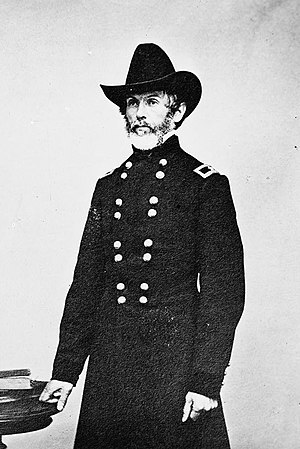
Henry A. Purviance
Photo taken in Pittsburgh |
Among the hundred or so soldier in the 85th Pennsylvania who died as the result of the battlefield during
the Civil War, the most senior officer to fall was Lieutenant Colonel Henry A. Purviance. He was killed as the result of friendly fire on Morris Island, South Carolina on August 30, 1863. Temporarily in command of the regiment after Colonel Joshua B. Howell suffered a concussion a few days earlier, Purviance was in the trenches with his men when a Union shell fired from behind his position prematurely exploded over his head. He was instantly killed. Purviance was 32 years of age.
At the time the Civil War began in 1861, Purviance was the co-publisher of the Washington (PA) Reporter and Tribune newspaper. Every few months, Purviance would write a detailed summary of the activities of the 85th Pennsylvania which was published back home in his newspaper.
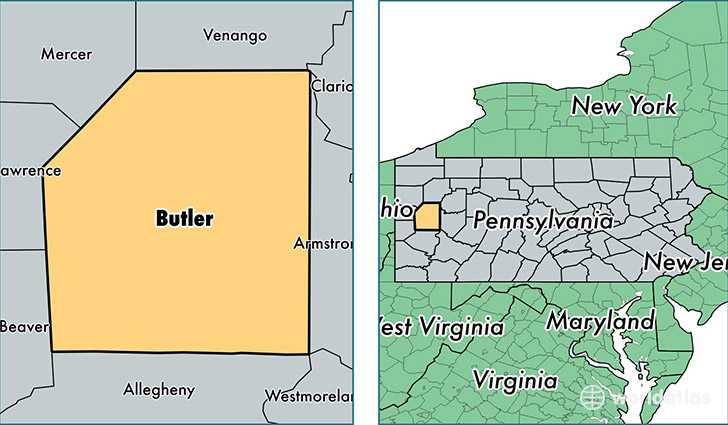
Although born in Butler County, PA, Purviance had deep roots in Washington County. His maternal grandfather, John Hamilton (1754-1837), had been appointed sheriff of Washington County in 1793. This was the time of the Whiskey Rebellion in western Pennsylvania; the nexus of the uprising was in Washington County. Farmers protested a new excise tax on whiskey, their main source of income and barter, to defray the federal government's debt left over from the Revolutionary War. Sheriff Hamilton was involved in the early peaceful protests of the tax, but unsuccessfully tried to steer the movement away from violence. Incident included the tarring-and-feathering of tax collectors, attempted destruction of tax records and a gun fight at the home of tax collector John Neville.
Hamilton was nevertheless charged with aiding and abetting the insurrection. After President George Washington authorized troops to quell the rebellion, Hamilton was arrested and taken to Philadelphia. However, Hamilton was exonerated and went home. In the ensuing decades, he held a variety of public offices for the next 20 years. These included a position in the Pennsylvania State Senate and in the United States House of Representatives. (Boyd Crumrine, History of Washington County, Pennsylvania, 1882, pp.305-6)
 |
| Tarring-and-Feathering of a Tax Collector LOC |
Several decades following Hamilton's death, just after the Civil War had begun at Fort Sumter, SC in April of 1861, his grandson, Henry Purviance, enlisted into the 12th Pennsylvania infantry for three months. This regiment did not take part in the Battle of Bull Run in July of 1861 and the regiment was soon disbanded.
But after the Union lost at Bull Run and it became obvious that the war was going to last longer than a battle or two. Eager to fight for the Union cause, Purviance organized his own company of Washington County men and took it to Pittsburgh to train.
After some negotiation, Purviance took his company to Camp Lafayette in Uniontown, PA to join Colonel Joshua B. Howell's new regiment, the 85th Pennsylvania. Purviance would serve as captain of Company E.
The 85th Pennsylvania was stationed for five months in Washington, DC and then was sent via transport ships to the Virginia Peninsula for George B. McClellan's campaign to capture the Confederate capital of Richmond and end the war. During this time in 1862, Purviance was elected as the regiment's lieutenant colonel, replacing Norton McGiffin, who had gone home on a medical discharge.
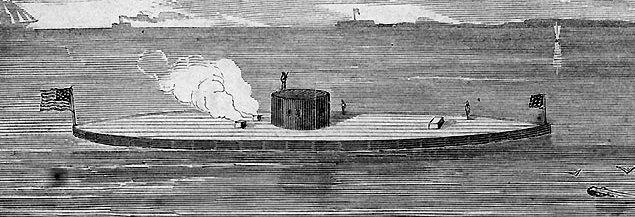
At this time, Purviance wrote one of his first letters that was published in his newspaper. Aboard the steamship Daniel Webster near Portsmouth, VA when the regiment was on its way to the Virginia Peninsula, Purviance wrote about scanning the waters around Fort Monroe, VA to look for the ironclad Monitor, which had neutralized the Confederate ironclad Virginia (Merrimac) two weeks earlier:
 |
Hampton Roads, VA 1862
The Gazette, Cedar Rapids Iowa
3-4-1962 |
“…after a very refreshing sleep, I found that our vessel was anchored out in Chesapeake Bay off Fortress Monroe. The Bay was dotted in every direction with ships of war, merchants ships and vessels of every size and description…I cared little for any of them, for my curious eyes were seeking out the famous ‘Yankee Cheese Box,’ [the ironclad Monitor] which bewildered and startled rebeldom and especially the…insolent Merrimac a few weeks ago. I could not believe the most contemptible looking whelp of a vessel in all the Bay, lying scarcely a quarter of a mile away, with nothing of her visible except the rim of the hull, her deck and revolving turret, was the Monitor. She is a wonderful contrivance and is doubtless the most formidable battery afloat…The arrival of the Monitor in Hampton Roads was so opportune as to seem providential. Not only would the vast shipping around Fortress Monroe have been at the mercy of the iron clad Merrimac…but the fort itself [might] have succumbed to the maritime monster.” (Washington Reporter and Tribune, April 17, 1862)
At the battle of Seven Pines, on May 31, 1862, as part of Henry Wessells' Brigade in Silas Casey's Division, the 85th Pennsylvania was in the front lines near Richmond when Confederates launched an attack against their exposed position. Casey's Division, outnumbered at least 2-to-1, held off the enemy for several hours before withdrawing. Their effort gave Union forces in the rear time to enter the fight and stall the Confederate charge.
The 85th Pennsylvania had about 75 casualties in the battle, including Purviance, who was shot in the leg. He was sent to a Philadelphia hospital to recover.
From his hospital bed, two weeks after the battle, Purviance wrote, "I am shot by a musket ball through the left leg, in the thick part below the knee. The doctors think the ball passed behind the bone and around it without fracturing...Even worse than my wound, though, does it pain me to observe misrepresentations of Casey's division in connection to the battle...Our own regiment...was absolutely the last to retire." (Luther S. Dickey, History of the 85th Regiment Pennsylvania Volunteer Infantry, p.171)
Purviance recovered and returned to his regiment. In December, 1862, they were sent to North Carolina for the Goldsboro Expedition, a Union effort to seize a key rail hub and to prevent enemy supplies from reaching Robert E. Lee's army near Fredericksburg, VA. The North Carolina expedition was a success, as the Union force under John G. Foster won four small battles. Unfortunately for the Union, the Goldsboro Expedition did nothing to prevent the Confederate victory at Fredericksburg.
 |
Advance of 85th PA toward Kinston (NC) Bridge
December 14, 862
Harper's Weekly, January 10, 1863 |
One member of the 85th Regiment, Private John F. McCoy of Washington County, remembered Purviance's leadership as their brigade about to charge through a waist-deep swamp on their way to help capture the town of Kinston.
McCoy wrote, "Our Lieut. Colonel, H. A. Purviance, was running from one end of the line to the other encouraging the men. One thing I heard him say, 'Remember, boys, there is no falling back with the 85th.' With such commanders as him and Colonel Howell, we knew we could fight, at least we were willing to try." (Wheeling Intelligencer, January 9, 1863)
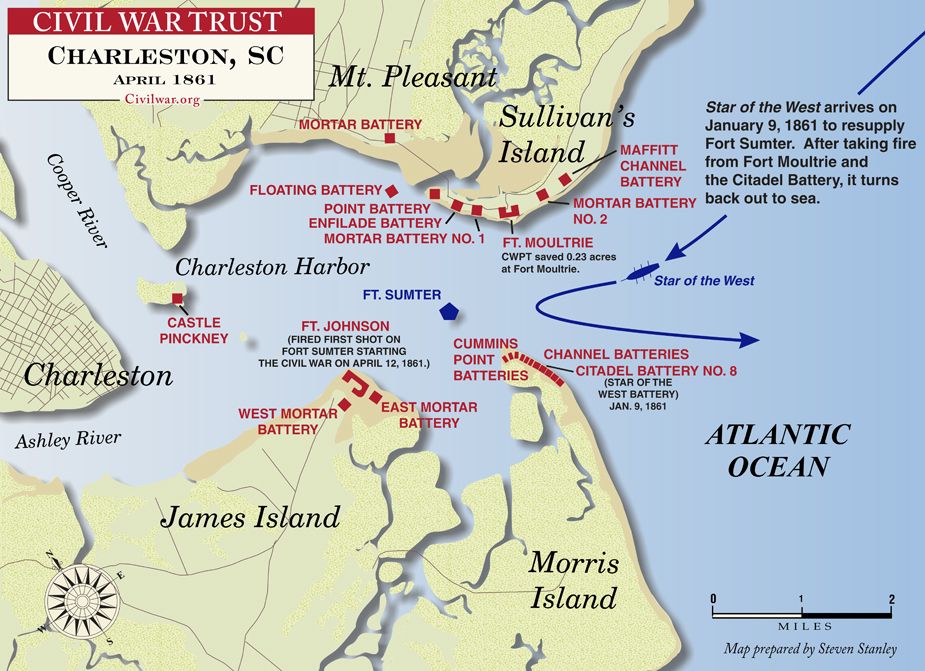
A few months later, the 85th Pennsylvania was transferred to South Carolina as part of the Union effort to try to recapture Fort Sumter and subdue the city of Charleston.
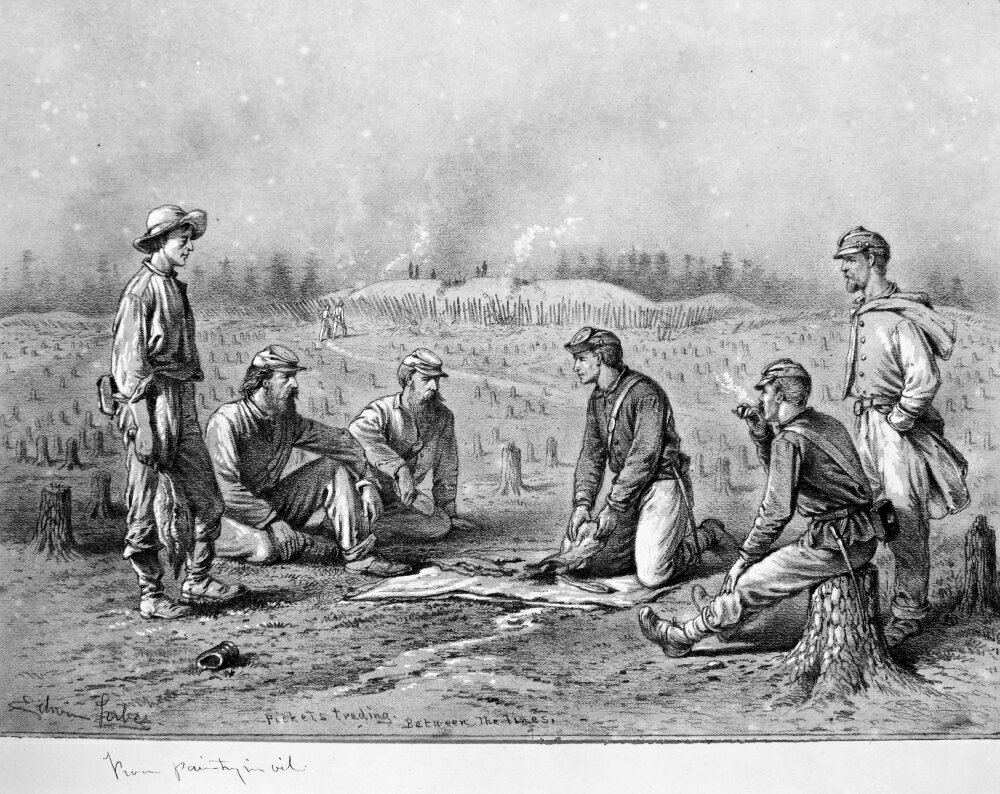
While stationed on Folly Island, Union soldiers would sometimes trade items with Confederate soldiers, usually coffee and sugar in exchange for Confederate tobacco. Many Union officers discouraged such transactions. But as one of his letter demonstrates, Purviance allowed the following exchange to occur between Folly Island and Morris Island across Light House Inlet, perhaps because it was not face-to-face.

|
Light House Inlet between Folly and Morris Islands
Henry F. W. Little
The Seventh Regiment, New Hampshire Volunteers\1896, p.190 |
"By and by…a nautical machine popularly called a 'dug out,' a miniature craft with a tiny sail, was seen to be freighted (across Lighthouse Inlet) and launched from the other side. The wind filled the little sail, and the clumsy vessel, which was very much like a sugar trough, came tumbling over to our shore where it was at once secured and subjected to my inspection. It contained a huge cake of chewing tobacco…Our boys promptly acknowledged the courtesy. A vessel was gracefully proportioned and elegantly fashioned, conforming in its exterior appearance to the Monitor model, the turret of which was filled with coffee, was set afloat and soon made its way to the hostile shore (on Morris Island)...This sort of intercourse had been going on for weeks. (Washington Reporter and Tribune, May 20, 1863, p.2)
Helping to guard Fort Sumter and Charleston for the Confederates on Morris Island were Batteries Wagner and Gregg. Two Union assaults in July of 1863 upon Battery Wagner resulted in massive Union casualties.The 85th Pennsylvania was to follow up the initial assaults on both occasions, but each time the secondary assault was cancelled due to heavy Union losses.
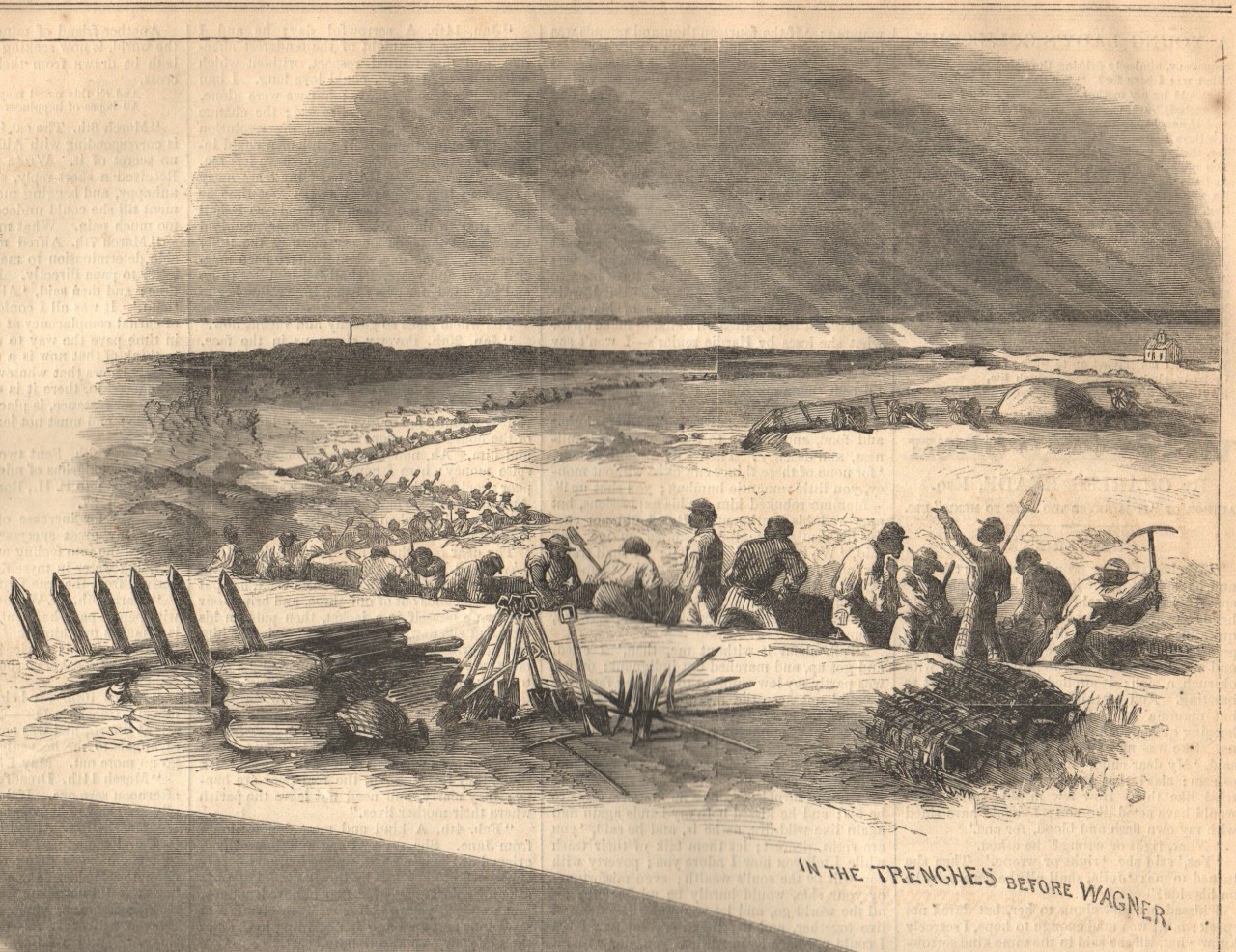
In late July, a new strategy was instituted. Union forces would dig a series of entrenchments or parallels to close the gap between themselves and Battery Wagner. Once Wagner's rifle pits were taken, another assault would be attempts. However, as the Union diggers closed upon them, the Confederates decided to abandon both Wagner and Gregg. Union forces were able to quietly occupy the structures.
During the digging part of the campaign, the 85th Pennsylvania played a key role. From late July to early September, the 85th Pennsylvania suffered more casualties than any other Union regiment. These included Colonel Howell and Lieutenant Colonel Purviance.
During their twelve-hour shift on August 21, at work on the fourth (of five) trench or parallel, the position of the regiment was under intense firing from Confederate sharpshooters and batteries. Twenty-five men were wounded, five of whom died.
On August 29, Purviance formally protested to his superiors about the mounting losses in his regiment. Nonetheless, he led his men into the forward trench line at sunset. A bright moonlight presented Confederate artillery positions with a clear target. Soon a single shell killed or wounded six men.
After midnight, in the early morning hours of August 30, two more men were killed. They were William Grover of Company D and George Grover of Company I.
 |
Morris Island
Parallels, Wagner and Gregg
LOC |
The long shift was not over. Only a week earlier, the colonel of a regiment that was in the process of relieving the 85th Pennsylvania asked Purviance where he could find the relative safety of the command position. Purviance bluntly told the colonel, "My headquarters are with my men." (Dickey, p.278)
In the morning hours of August 30, Purviance joined the list of those mortally wounded. He was the highest ranking officer to perish in the overall siege of Battery Wagner.
The most detailed account of Purviance's death came from Lieutenant John E. Michener of Company D.
"About
daylight on the morning of the 30th of August Lieutenant Colonel
Purviance was instantly killed by the premature explosion of a shell from one
of [Union General Quincy] Gillmore’s guns, which was being fired rapidly at Fort Wagner over the heads
of the Union troops. The previous night had been one of extreme trial and
excitement; the enemy desperately employing all the guns and mortars that could
be brought to bear upon the persistent and determined besiegers. This noble
officer, soldier, and patriot had entered the trenches that night with one hundred
and seventy-five men of his regiment. Discovering indications of an assault by
the enemy, he sent Lieutenant Michener, acting temporarily as adjutant, back to
headquarters for additional troops. Colonel [Louis] Bell of the Fourth New Hampshire
sent up, with Lieutenant Michener, two companies of the Ninth Maine, which
were all that could be used to advantage. Morning dawned, however, without any
attack by the enemy, yet the continued fire of the rebels upon this little
devoted band, during the night, had told fearfully upon their ranks. The brave
Colonel Purviance, weary and almost exhausted sat down by a small bomb-proof
and generously inviting Captains R.P. Hughes and Lieutenant Michener to his
side, divided some rations of boiled ham and biscuit among them. The repast
being ended, Lieutenant Michener handed the colonel an overcoat and requested
him to lie down and take some rest, at the same time remarking that if anything
of importance occurred, he would quickly report to him. Lieutenant Michener had
just turned to leave him when he [Purviance] was struck by the fatal shell and killed
instantly. Thus fell one of the bravest and noblest spirits of the war, lamented
by all who knew him, and mourned as a father by the brave men whom he had so
often led to battle." (Washington Reporter and Tribune, October 9, 1867, page 3)
Another tribute to Purviance appeared several months after his death, written by an anonymous member of the regiment. This soldier lamented the loss of Purviance, whom he gave full credit for the regiment's cohesiveness up to that time. "When the command of the
85th was entrusted to Col. Purviance, it was destitute of
discipline, without prestige from former victories – in fact, a raw, untrained
body of men, but containing the finest material in the world for soldiers. To
mould these men into soldiers, invincible in action and distinguished for their
courage and fidelity, was his constant aim and the object of his ceaseless and
untiring exertions. For whatever services the 85th has rendered the
nation in its struggle for self preservation and for whatever success it has
achieved during the last two years of its existence, let the glory be
attributed to him to whom along it is justly due – Lt. C. Purviance." (Washington Reporter and Tribune, February 17, 1864, p.2)
About a month after his death, his own newspaper published a lengthy obituary.
"The Reporter and Tribune contains the sad
announcement that Col. H. A. Purviance, one of the editors and proprietors, had
fallen at his post on Morris Island while operating at the head of his regiment
against the rebel stronghold, Fort Wagner.
The
circumstances attending his death are, in brief, about these: On the 30th
of August, while our forces were operating against the rebel fortress which may
fairly be denominated the Sebastopol of America, it was the fortune of Colonel
Purviance to occupy the extreme advance, and as our batteries were at the time
engaged in what is no uncommon mode of operation – firing at the enemy
 |
| Exterior of Batteries Wagner and Gregg LOC |
over the
heads of our own men – he was killed by a shell from one of our own guns. He
was in the extreme front, watching the movements of the enemy, when a shell
from our own batteries exploded immediately above him, carrying away the whole
back part of his head, sending one of the fragments through the body in the
immediate region of the heart, and lacerating the right arm in the most
horrible manner. Of course he was killed instantly. The melancholy mishap is
ascribed to the fact that the powder with which the shell was filled was
somewhat damp, on account of which the fuse was cut short, and, as might
naturally be effected, a wrong calculation seems to have been made either in
respect to the length of the fuse or the state of the powder with the untoward
result we have indicated.
Colonel
Purviance was the son of Parker C. Purviance, Esq., now of Kittanning, Pa, a
native of our town, and a namesake of the celebrated Parker Campbell, one of
the most distinguished lawyers of Western Pennsylvania in the early part of the
present century. The subject of our brief sketch was born in Butler, Pa.,
in the month of May, 1831, and was, consequently, in the 32nd year of his age
at the time of his decease. At an early age he developed those traits of
character which later life marked him out as the man of exquisite taste and of
high literary attainments. Unlike most men, he may be said to have had no
childhood, so soon did he manifest a disposition to prefer the society of his
books and pen to the childish sports and amusements of his youthful companions.
By the time he had attained his eighth year he had accustomed himself to write
short articles for the village paper, one of which – a poem on the death of a
youthful friend and companion – attracted considerable interest and excited no
little astonishment that a youth of such tender years should exhibit
extraordinary command of language and vigor of thought. The only education which
he received was such as the village school and the academy of his native place
could furnish. As might be expected, he eagerly availed himself of the
advantages afforded by these, and of course made most rapid progress in his
studies. His father being engaged in the publication of a paper at the time, he
entered the office at the age of thirteen, and with the most wonderful facility
acquiring a thorough knowledge of the art, rendering the most important and
valuable assistance in the various departments of the concern. His connection
with the office afforded him ample opportunity to indulge his taste for varied
and extensive reading, of which he did not fail to take advantage, thus storing
his mind with a copious fund of useful knowledge, upon which he was enable to
draw to good purpose in after life. He continued to follow his occupation as a
printer without much interruption until he attained the age of nineteen, at
which time the married, and soon after engaged for a brief period in the
Daguerreotype business, an occupation which afforded him the requisite leisure
to indulge his irrepressible taste for reading and study. During the few years
of his experience as an artist, he devoted himself with more than his ordinary
assiduity to literary pursuits, and his productions were sought after by such
noted journalists as George D. Prentice. From time to time his effusions graced
the columns of the most respectable journals of the country, all of which
readily gave place to his articles, and were glad to number him among their regular
contributors.
In the midst of these pursuits, he still found some time
to devote to public affairs. Having taken up his residence in the Allegheny
city, he took a prominent part in the political contests of the day, and was
actively engaged on the stump in Allegheny
County during the
presidential canvass of 1856. After the close of that struggle, with a
determination to connect himself with the press so soon as an opportunity
presented itself, and accordingly in June 1858, in connection with Col. [Samuel] Armstrong, he purchased the Tribune
of this pace, and from that time until there breaking out of the rebellion was
actively engaged in our midst in the performance of his editorial duties. In
response to the President’s call for troops, after the fall of Sumter, he enlisted in the first company that
left our county, and passed through the three months’ service as a private. On
his return home, he took the field and recruited a company of his own and
attached himself to the 85th Pa.
Regiment, under command of Col. [Joshua B.] Howell. Having trained himself to do thoroughly
whatever he undertook. he devoted himself entirely to the profession of arms,
and soon displayed those rare qualities which marked him for promotion. So
completely had he won the confidence of his companions in arms that upon the
resignation of Lieut. Col. [Norton] M’Giffin on account of ill health, he was chosen to
fill the place, thus leaping at a single bound from a captain’s place to the
second position of the regiment. He had command of the regiment for the last
year, Col. Howell having been acting in the capacity of Brigadier General
during the length of time. He had passed safely through sixteen battles and
skirmishes, with the exception of a severe wound which here received in the leg
in the memorable conflict at Fair Oaks [Seven Pines], and it seems melancholy that one who
had so often escaped the bullets of the enemy should at last have been taken
away by a deadly missile from our own ranks.
This
simple and imperfect sketch of his somewhat eventful career, has spun out to
such a length that we have little space left in which to dwell on those traits
of character that endeared him to so large a circle of friends. As a write and
speaker, Col. Purviance’s style, though somewhat diffuse, was vigorous and elegant,
the readers always being captivated by the brilliancy of his thought as well as
the mellifluous flow of his words. His intellect being strong imbued with the
poetic elements, his copious imagery imparting a freshness and luster even to
the most commonplace ideas, while the more grave and stately conceptions of his
mind were made to appear like 'apples of gold in the pictures of silver.'

As
a public journalist it is scarcely necessary to speak of him; the readers of
this paper who have so often enjoyed his weekly visits through our editorial
columns and who have so often been charmed with the letters he from time to
time contributed from the camp, know how to appreciate the loss they and we
have sustained by his fall. Whatever he undertook he did with his might; and
whatever cause he espoused, he labored for with all the earnestness of his
nature, regardless alike of threats or blandishments. As a patriot his record
is before us and the blood he has so freely poured out in defense of the Union
of our fathers tells, in more forcible language that any mere word of ours, how
well had loved and how faithfully he served the country that bore him. But
though he as been stricken down in the prime of his manhood and in the vigor of
his usefulness, he has left behind him a name to be remembered in after years
in connection with that of a [Nathaniel] Lyon, an [Elmer] Ellsworth, a [Edward] Baker, and the long
catalogue of worthies who have gladly yielded up their lives for the cause of
free government." (Washington Reporter and Tribune, reprinted in the Raftsman's Journal, Clearfield, Pennsylvania, October 14, 1863)
Purviance was a widower; his wife, Mary Jane Parker Purviance, had died in 1859. He was the father of three young daughters -- Margaretta, Belle and Ada. They were raised by Purviance's brother, William, and his wife. His body was shipped home. He is buried in the Washington Cemetery in Washington, PA.







![[Union General Quincy]](https://blogger.googleusercontent.com/img/b/R29vZ2xl/AVvXsEimjLcRu2V9KmuaGrJ0ojdquy9HkP862idmkHvDv_mMzOOEWKZbDDsyYPxjjh4eS_ZSejVVJhHTZU68H_KQ-FYD8zrbdXJe6Rdu9Y3cHlEHWdPQ3QsQv07g3My332JskYt_cpeRqhlQbkU/w1200-h630-p-nu/Gillmore-vignette_sm.jpg)