Showing posts with label Hughes. Show all posts

Friday, August 25, 2023

Eli Crumrine Makes His Move


Eli Crumrine
Photograph Subject Files
American Heritage Center, University of Wyoming
Annals of Wyoming, Vol. 58, p. 13, 1986

      One effect of the Civil War, an unbelievably bloody affair,  is that it gave soldiers the opportunity to experience lands and peoples with whom they would otherwise have been unfamiliar. The men in the 85th Pennsylvania, for example, traveled across the south from Virginia to Georgia and back. If they survived, they came home more worldly (and perhaps haunted) than they otherwise would have been because of this experience.

       This made it easier for many to move soon after the end of the war, often to the West to take advantage of settling on cheap farmland in states like Indiana or Nebraska. Many 85th veterans made the move to these and other states like Iowa, Missouri, Kansas. Some ventured to Oklahoma, Texas, the Dakotas and even farther away to the west coast. They were mainly young men in their 20's or early 30's in search of economic opportunity.

       Only one member of the regiment settled in Wyoming, and he relocated there more than 20 years after the war ended. [Two other 85th soldiers had connections to Wyoming, which will be explored later in this article.]  He was Eli Crumrine, a Civil War musician from East Bethlehem, Washington County, who enlisted at age 18 into Company B. His postwar journey for the far reaches of the United States came later in life when he was 43 years old. Crumrine was an established professional in banking for 20 years in western Pennsylvania with as a wife and three young children. However, his chose to head off for Laramie in Albany County, Wyoming where he spent the last 26 years of his life. 

Boyd Crumrine
Commemorative Biographical Record
of Washington County
(Chicago, 1893), p.209

         Eli was one of five Crumrines associated with the 85th PA.   All five  survived the war. The other four were his cousins; only Boyd and Bishop were brothers to each other. [Bishop was turned down trying to enlist into the 85th which was full at the time. He instead joined the 4th PA Artillery] The other cousins in the 85th were Jackson and Daniel Crumrine. Following the war, Boyd Crumrine became one of the most prominent attorneys and historians in Washington County. Bishop [Topeka] and Jackson [Alton] moved to different cities in Kansas. Daniel went home to Washington County and became a farmer. Daniel lived until 1929, one of the longest living men from the regiment.

      Eli enlisted as a fife player in Company B in 1861 and eventually became part of the regimental band. On the last day of 1863, while the 85th PA was stationed on Hilton Head Island in South Carolina, some new instruments arrived and the regimental band was reorganized. Historian Luther S. Dickey wrote, " Three silver fifes, eight tenor and one bass drum arrived today for the Regimental band; the re-organized band is as follows : Sergt. Samuel Woods, Company E, and Corp. Henry L. Regar, Company H, principal musicians; Robert B. Thompson, Company A, Eli Crumrine, Company B, and John Stuck, Company I, fifers; John W. Ingles, Company A, Isaiah Jordan, Company D, Daniel Swan and James McCuen, Company F, drummers." [p. 303] 

Civil War Fife Player  LOC
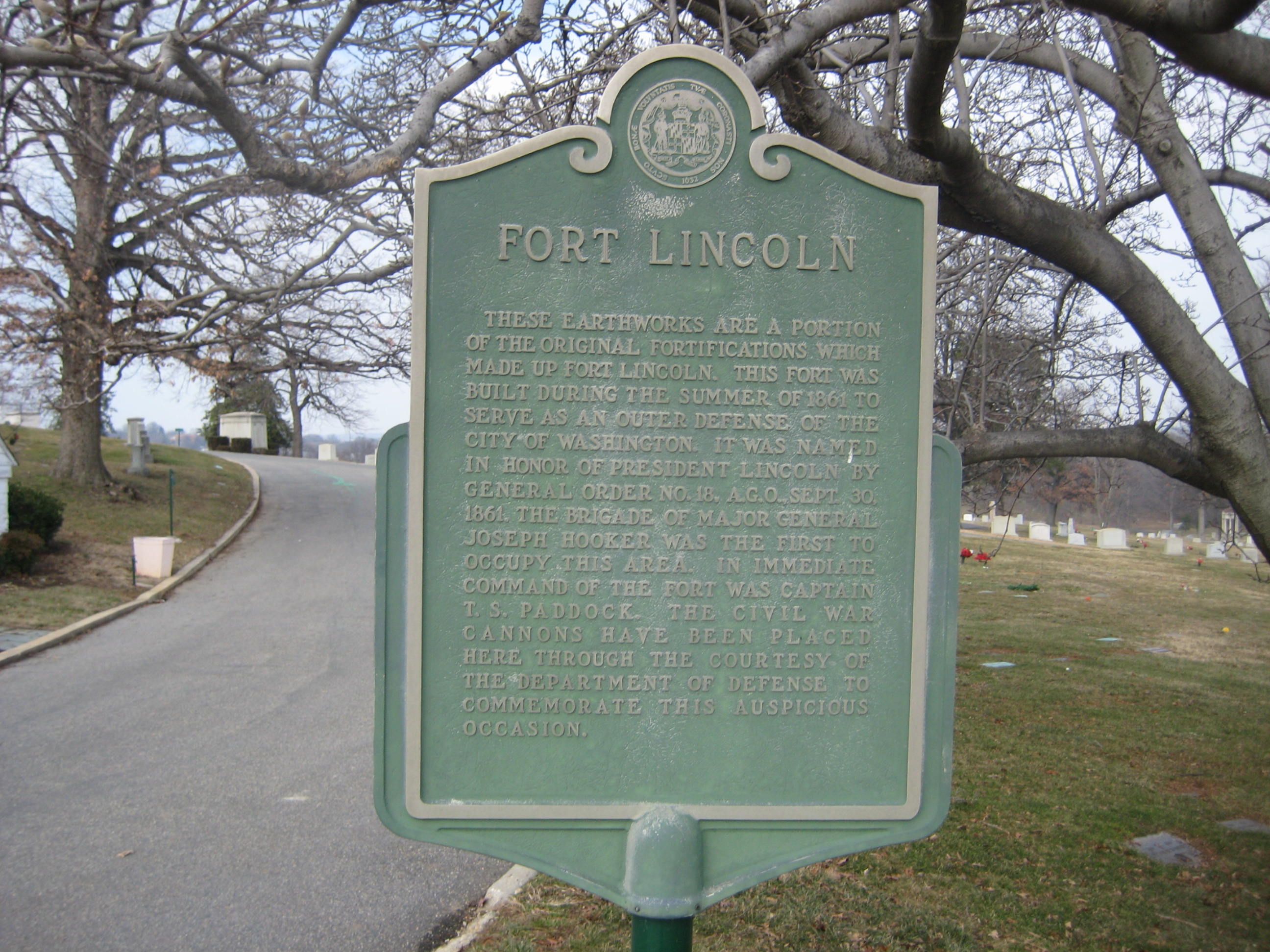
        Music was important in the daily life of most regiments. Any early contribution of the 85th musicians, however, was nearly catastrophic. It almost provoked a confrontation with fellow Union troops at Fort Lincoln near Washington, D.C., in late 1861. As described by Private Milton McJunkin of Company D, "“as we passed Fort Lincoln on our way to camp Casey we came very near being cut to pieces by our own men...right opposite Fort Lincoln was a very pretty place to rest and the officers [of the 85th] told the drummers to give the boys the long roll which is invariably to arms[.] it was not 2 seconds until we had 4 pieces of artillery leveled on us, and our colors was all that saved us from being tore all to smash[.] [The Bloody 85th by Patrick Schroeder, Ronn Palm and Richard Sauers, 2000, p.9]

      The soldiers in Fort Lincoln, hearing what they thought was an attack cadence, nearly mistook the 85th for Confederates. From then on, the music provided by the musicians of the 85th conformed to military standards. 

         Besides sounding out camp orders, musicians also performed impromptu concerts in camp. [A list of Civil War marching songs can be found here.] The Kennedy Center website states that Civil War musicians could be divided into two general categories: field musicians and members of regimental bands.

     "Field musicians included the fife-and-drum corps with the marching units and the buglers that accompanied both the cavalry and the infantry. These musicians marked the activities of daily wartime life, including wake up, lights-out, roll call, and drills. The music also helped organize the movement of the troops and even conveyed combat orders to soldiers, who were trained to recognize these commands..."

      "Larger [regimental] bands performed as commanding officers inspected and addressed the troops; they would also present regular concerts and entertain soldiers in camp. The bands helped maintain morale and reinforce spirit and resolve. Musicians also did whatever was needed--staffed ambulances, tended wounded, and even fought as the war raged on."

Lemuel Thomas headstone
Hampton (VA) National Cemetery
Contributed by Ron Stewart
findagrave.com

       For one 85th musician, 24-year old Lemuel Thomas of Company C, helping wounded soldiers during the Battle of Second Deep Bottom in Virginia in August of 1864 cost him his young life. Regimental historian Luther S. Dickey wrote, "Musician Lemuel Thomas of Company C, was on duty with Surgeon [Samuel] Kurtz of the Regiment assisting in caring for the wounded. Surgeon Kurtz was standing with an arm resting against a tree when a cannon ball from a battery of the enemy ricocheted, striking the heel of his shoe and then bounded to the head of Musician Thomas, fracturing his skull from which he died the following day. Although painfully wounded by the enemy's missile Surgeon Kurtz remained on duty." [p.355]

       Most aspiring soldiers like Eli from East Bethlehem joined Company D of the 85th PA. Eli, however, joined Company B, perhaps to be with his cousin, Boyd, who hailed from Washington City. Ironically, Boyd's time in the 85th PA was brief. After being promoted to quartermaster of the entire regiment, Boyd transferred to another regiment where he spent most of the remainder of his service posted at Fort Delaware, a prison-of-war camp for Confederates and northern lawbreakers.

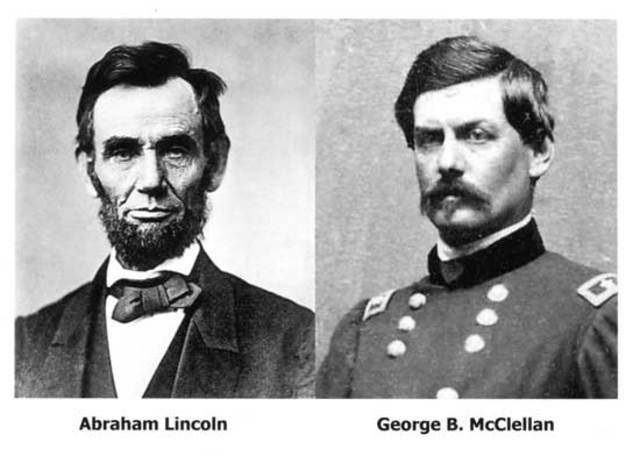
       The only wartime primary source we have from Eli is a letter he wrote home near the end of his three-year enlistment to a local newspaper describing camp polling numbers for the presidental election of 1864. It was the first time absentee voting was allowed. Some states like Pennsylvania allowed soldiers to vote in the field. Other states required the soldiers to return home in order to vote. Overall, the vote of soldiers was 4-1 in favor of Abraham Lincoln's re-election bid over George McClellan.

Pennsylvania soldiers voting in camp 1864
Harper's Weekly, 10-29-1864
       Eli wrote, "On yesterday, the 39th Regiment of Illinois volunteers held an election, also the 11th Maine held one and the results are a fair sample of the whole army. The 39th polled 150 votes in all; out of these 135 were for Lincoln...The 11th polled 362 votes in all; out of these 281 were for Lincoln. These results plainly show that Father Abraham will yet reside another four years at the White House. God grant that he may. The 85th will go for Old Abe." [Washington (PA) Observer and Reporter, October 26, 1864, p.2]

       So long after the war ended, why would an established middle-aged man pick up his family and move to a relatively remote part of the county? 

Albany County (Wyoming) National Bank in Laramie
Courtesy of Albany County Historical Society
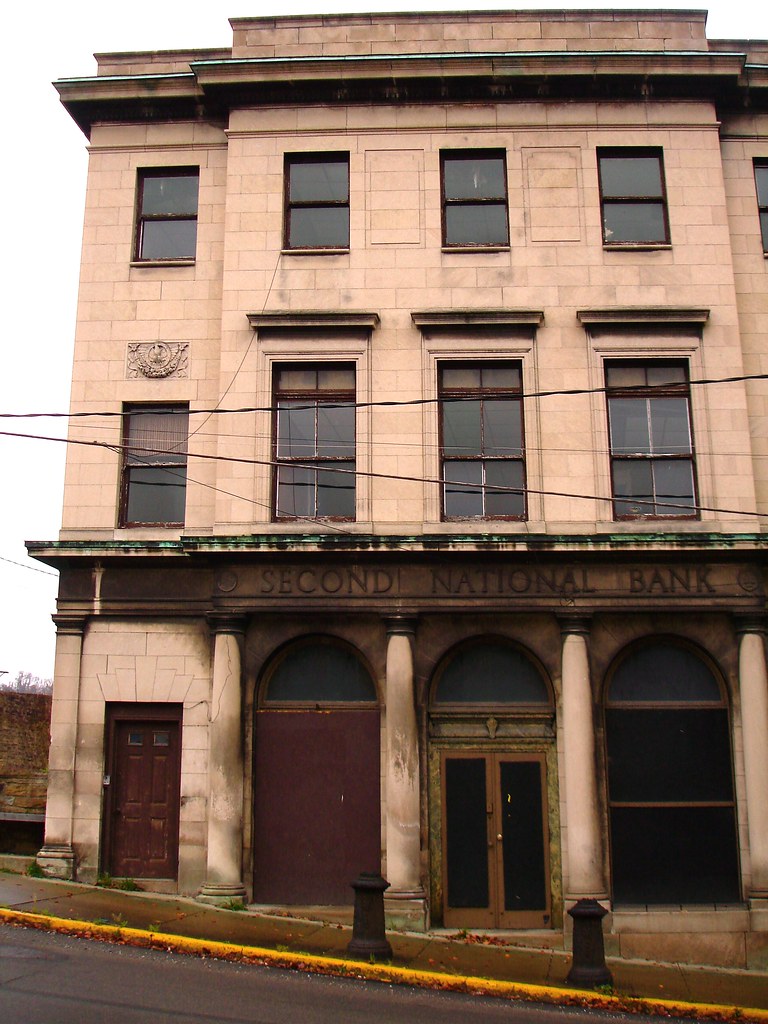
       First, however, the question arises as to how the new bank in Wyoming even became aware of a cashier in Brownsville, PA. A news story helped answer that question. "His [Eli's] first employment was with the First National Bank of Brownsville, later with the Second National Bank. The capital which organized the Albany County National bank in Wyoming included men behind the Scranton banks of Pennsylvania, and hence Mr. Crumrine was made cashier of the Laramie bank upon its organization...the appointment being the occasion for his coming to [that] state." [Wyoming Semi-Weekly Tribune, February 26, 1909, p.4]

         Eli took a trip to the West in 1885, the year before he made the move permanent, presumably to visit Laramie and get a feel for his future life. He discovered a remote yet growing community with beautiful vistas and plenty of opportunities to make money. Laramie, founded in 1868 as a boisterous railroad town, was undergoing significant growth at the time of Eli's arrival, from a population of 2,600 in 1880 to 6,400 ten years later. [Laramie has grown in every decade since then and today has a population today of over 30,000.]

Old Main,  U. of Wyoming      Built in 1886    LOC
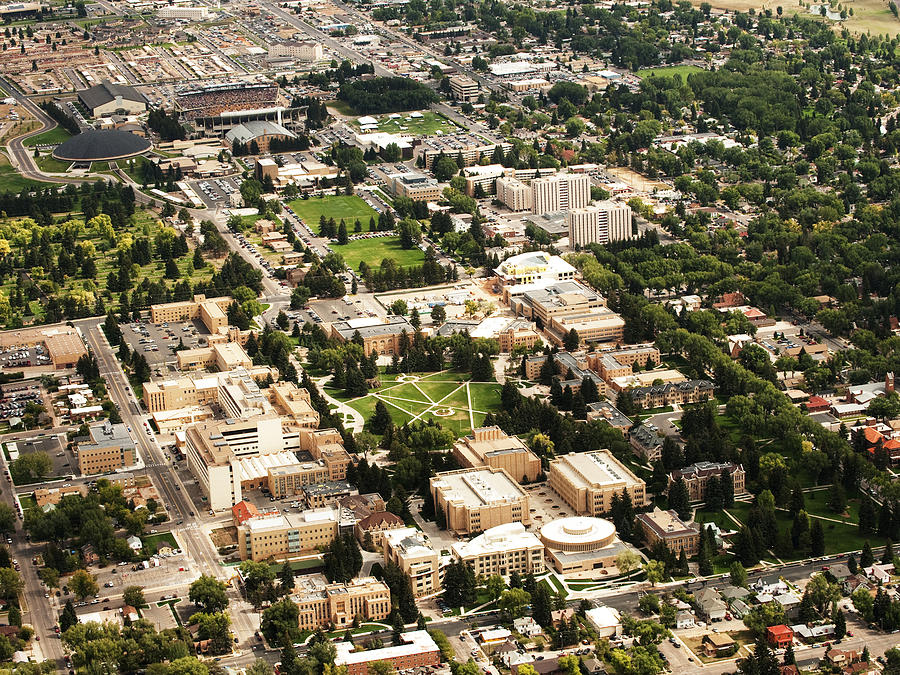
       Laramie's growth in the mid-1880's was due mainly to the completion of the Union Pacific Railroad in 1868. Prior to the railroad, Benjamin Holladay's Overland Trail for stage coaches and wagons passed through the Laramie Plains. In the late 1860's and early 1870's, Laramie was a raucous town, vexed by Native American raids, unpunished thievery and rowdy behavior. But by the time of Crumrine's arrival in Laramie in 1886,
      Jane Nelson, the president of the Albany County Historical Society, said, "Laramie was trying very hard to become a viable city. It had an opera house, three or four hotels, The Albany County Bank was its third bank and the first to have full electricity." She added that the University of Wyoming opened in 1886, further enhancing the reputation of the city.  Ms. Nelson also noted that Wyoming was forward-thinking in the area of womens' rights. Women were already allowed to serve on juries, and women's suffrage was enacted in 1869, fifty years before the passage of the 19th amendment on a national level.

        Prior to the arrival of the railroad, a former member of Company B of the 85th Pennsylvania, 28-year old Robert P. Hughes, (at that time a captain in the 18th U.S. Infantry) wrote a letter from Fort Laramie (located a hundred miles northest of the city of Laramie) in 1867 to a friend in his hometown of Canonsburg, PA. Firt Laramie was 188 miles northest of Laramie City and was founded in 1834 as a trading post. It soon became a well-known military post. Hughes enlisted in the Civil War as a private and retired in 1903 as a major general.

Robert P. Hughes
Wyoming State Archives
      "The Indians have not been able to operate much thus far since Spring, for the snow thawing in the Mountains has kept the streams so high that they have been unable to cross them without great difficulty. They have succeeded in catching a few [stage] coaches on the Overland Mail Route and also a few small parties of soldiers."

       "I am almost ashamed to be one of the actors in the scene. But our greatest battles now are with the mosquitoes and Buffalo Gnats. They come down on us at all hours and they do not use either Modern Tactics or maneuver or logistics but seem to me to move in the old Roman Style by Phalanxes and they make us scratch our heads quite seriously to determine how to flank them."

       "We have some peculiarities here. We have beautiful lightning every night, but we suffer for it in heat the next day. We have the most beautiful Sunsets I ever saw. The Sun will hide behind one of the Buttes and leave the whole western horizon a blace of fire." ["Loneliness, Sand and Sunsets: News from Ft. Laramie, August 13, 1867," Wyoming State Archives]

          After the railroad arrived, a letter from a Laramie visitor to a friend in Pennsylvania in 1878 was typical in spreading word on this up-and-coming city.

1882 Traveler's Railroad Guide

            "To my surprise, I found thousands of acres of land [in Wyoming] that are irrigated and good crops of wheat, oats and barley have been raised along this line of railroad. Left Cheyenne and soon looked down upon that vast grassy amphitheatre, the Laramie Plains...the hundreds of square miles of pasture lands and arable valleys lie in full view. 

         "In the midst of these plains and on the south side of the Laramie river is the city of the same name. It is distant from Omaha 572 miles, altitude 7,123 feet. It contains a population of 2,500 souls. The only rolling mills in operation between the Missouri River and the Pacific Coast are located here...the Union Pacific Company has also extensive machine shops and round houses here...A public school house is nearly completed...There are some very handsome buildings, blocks and private residences built of brick and some large wholesale and retail business houses. Water is conveyed to the town through iron pipes from a spring 3 miles north of town."

       "The Laramie Plains contain nearly 3,000,000 acres of winter and summer grazing lands....Over 40,000 head of stock are grazing this region...Most of the Ranchmen have from 640 to a couple thousand acres fenced...The ranch house that I am now writing from is genteel, nice and clean, three rooms carpeted and contains some nice walnut furniture. I merely state these facts for the reason that nearly all  Eastern persons that have not visited the Stock Ranches of the Laramie Plains naturally suppose that they all sleep with loaded seven-shooters under their heads, a double-barreled shotgun in each corner of the house, and are regular devils and cuthroats." [Valley Spirit, Chambersburg, PA, October 23, 1878, p.2]

        The writer of the above paragraph, Charles C. Clugston, moved to Wyoming within two years and with his business partner established a settlement near Laramie.

         Financially, the move to Wyoming in 1886 was a wise decision for Eli Crumrine. He was the Albany County Bank's cashier for eight years and was then promoted to vice-president. He was able to acquire a ranch on the outskirts of town and had other holdings. His estate was worth well over $50,000 when he passed away 24 years later.

        Crumine also played an active role in the growth of his new community. He helped arrange a donation from Andrew Carnegie 1902 to build a free county library in Albany (becoming a member of its board of trustees), was active the local Grand Army of the Republic of Union veterans and served for several terms in the Wyoming state senate. 

        Considering the 1,500 mile distance and arduous travel involved, it is noteworthy that Crumrine returned home to western Pennsylvania at least three times to attend regimental reunions, in 1890 and 1909, both in  Uniontown, and in 1910 at Rogersville, Greene County. 

1910 Reunion of the 85th PA
Rogersville, PA  Courtesy of Greene Connections

          Unfortunately, Crumrine became ill with pneumonia on his way home from the 1910 reunion and died one day after returning to Laramie. His wife, Mary, traveled to Denver and accompanied him home on the last leg of his journey. Eli was a long-time asthma sufferer, but his health had improved in the summer months, allowing him to return to Pennsylvania for the reunion. He was 67 years of age when he died. He was succeeded at the Albany County Bank by his son-in-law, Charles Spalding.

Crumrine Home
Courtesy of Albany County Historical Society
         Just a few months before his death in 1910, Crumrine received the endorsement of a newspaper back home in Washington County in case he decided to run for governor of his adopted state. "For a long time, we have heard the rumor that Hon. Eli Crumrine of this city might be one of the candidates for the nomination for governor of Wyoming before the next Republican state convention...Of course this newspaper wants the next governor of Wyoming to be a Democrat...but if there is to be a Republican, we are for the Laramie candidate first, last and all the time." [Washington (PA) Reporter, April 23, 1910, p.6]

Eli Crumrine Death Certificate

             The third member of the 85th PA regiment with a connection to Wyoming is Sergeant Marquis Lafayette "Mark" Gordon of Company G who hailed from Waynesburg in Greene County. The current governor of Wyoming is also named Mark Gordon. He is the great grandson of Marquis Lafayette Gordon.

    

Saturday, September 17, 2022

Milton Chase Writes a Letter Home

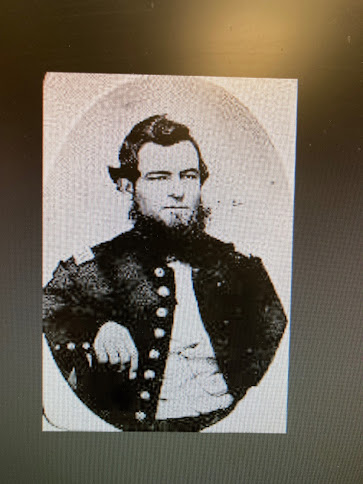
Milton B. Chase of Company E, 85th PA
Courtesy of Sherry (Chase) Reinhardt


   When the war began, the 85th had a number of reliable chroniclers whose writings became valuable primary source material in telling the story of their regiment. For example, Lieutenant Colonel Henry A. Purviance was part-owner of the Washington (PA) Tribune and Reporter and wrote half a dozen lengthy letters that were published in his own newspaper.

    Likewise, Private Robert Roddy was the brother of Edward Roddy, who owned the Genius of Liberty newspaper in Uniontown. Roddy's letters appeared every few months in his brother's newspaper.

   Most soldiers of course wrote letters home to family members, some of which have survived. Other soldiers in the regiment penned letters that were published in newspapers around western Pennsylvania and even Wheeling, West Virginia. These soldiers included  Lieutenant John Acheson, Private John F. McCoy, Captain John E. Michener, Corporal George W. Dales and others.

   But by the end of 1864, the number of potential sources in the 85th PA had dwindled. Purviance was killed by friendly fire, Roddy went home with a medical discharge, and Michener was captured by the enemy, Acheson transferred to another command, and McCoy and Dales went home when their three-year enlistment ended.

  Only about 150 men were left in the regiment by the end of 1864, those who had joined in 1862 or later or those who had re-enlisted. The pool of potential sources was limited.

   One newspaper from the Civil War era that survives is the Washington Reporter and Tribune, found online in the Google News Archives. Unlike some other online newspaper sources that require a fee, this archive is free. The catch is that there is also no reliable search button. One must look through each edition page by page in the hope of finding information.

   So I went to the newspaper and began in November of 1864, scanning each weekly edition for a potential letter from the front, or perhaps something written by a returned soldier.

    Low and behold, eventually a letter from an 85th PA soldier appeared. It was on page 1 of the Reporter and Tribune from February 8, 1865. It was written by a soldier still in the regiment who called himself 'M.B.C." His identify was easy to find. Of the remaining men in the regiment, only Private Milton B. Chase of Company E had that set of initials.

   Chase was 31 years of age at the time. A native of Washington County, PA, he was married and living in Iowa when the war broke out. After serving for three months in an Iowa regiment, he decided to go home to enlist for three more years, joining Company E of the 85th PA, which had many men from Washington County, PA. He enlisted into the regiment in April of 1862, which meant he still had a few months to serve when he wrote the following letter in 1865.  Chase worked as a teacher before and after the war, which indicates why his letter seems to be fairly well written.

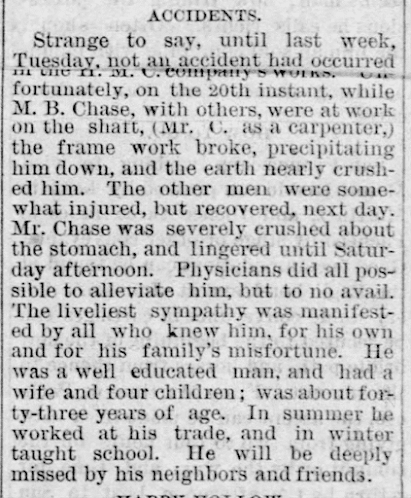
   Milton went home in December of 1865 from City Point, VA and was reunited with his wife, Margaret Franks Chase, whom he had married in Iowa in 1855. The growing family soon moved from one side of the Mississippi River to the other to live in  Hampton, Illinois. Unfortunately, Chase did not enjoy a long postwar life. On April 25, 1874, he ws killed in a coal mine cave-in. Chase was buried in the Old Rapid City Cemetery in Rapid City, Rock Island County, Illinois. He was survived by his wfie, Margaret, and four children. A fifth child, Margaret, was born two months after his death.

Moline [Illinois] Review-Dispatch  May 1, 1874, page 2

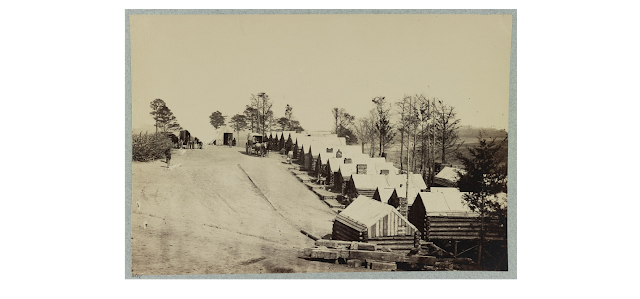
    His Civil War letter, written on January 25, 1865 from the camp of the 85th PA just below Richmond on the north side of the James River, first gives a review of the regiment's activities for the last nine months. These include the Bermuda Hundred Campaign, the Battle of Second Deep Bottom, the Battle of Chaffin's Farm, the Second Battle of Darbytown Road, and a description of the Battle of Trent's Reach the previous day on the James River. His letter appeared in the Reporter and Tribune on February 8, 1865.

Winter Quarters along the James River   LOC

   His letter answers a few questions that were previously unknown. The acting commander of this detachment of the 85th PA was Lieutenant James Nichlow. Lieutenant Absalom Dial of Company E was the nominal head of the detachment, but records indicate that Dial was away on a special detachment for a prisoner-of-war exchange. Chase reveals that Dial was actually on convalescent leave due to wounds received at Second Deep Bottom.

   Chase also explains that during their time as provost guards at division headquarters, the 85th PA was tasked with supervising Union prisoners, some of whom were awaiting execution for desertion. 

    Milton Chase includes a cryptic paragraph about 'Mat,' 'the young one,' turning in his gun for a drum. I could find no one with the name "Mat" or "Matthew" among the 150 who remained in the regiment in 1865. The closest was Matthew C. Axton of Brownsville, Fayette County. Like Chase, Axton was from Company E; but he is listed as having gone home two months earlier in December of 1864. 


Camp of the 85th Pa Vols.

Before Richmond, VA., January 15, 1865

Dear Reporter and Tribune:

   Knowing the interest felt by many of your readers, especially by the returned veterans of the Regiment, in the detachment of the noble old 85th still in the field, permit me through your columns to communicate to them some of the changes that have taken place since they left, as well as some other items that may prove interesting to our friends generally.

   The Detachment known as the 85th Pa. Volunteers, is now doing duty as Provost Guard at Headquarters, 1st Division, 24th Army Corps, Gen. A.H. Terry's old Division, now commanded by Gen. J. R. Rawley. The 85th is commanded by 1st Lieut. acting Col. James Nichlow, formerly Sergeant Co. H, Captain R.P. [Robert] Hughes having been promoted to Lieutenant Colonel of the 199th Pa. Vols. 1st Sergeant Charles E. Eckles, Co. E, has been promoted to Captain Co. K, 199th P.V. Sergeant W. C. [Walter] Cravin Co. C [to] Captain, Co. K 199th P.V. and Sergeant O. [Oliver] Sproul is Lieutenant Co. B 199th P.V. Lieutenant [Absalom]  Dial is abroad on sick leave occasioned by wounds received in action last August. Captain R.W. [Richard] Dawson, Assistant Inspector General on Gen. [Adelbert] Ames' staff, was so careless as to put himself in the way of a rebel ball at Fort Fisher, N.C. and consequently got shot in the right arm seriously.

    'Mat,' the 'young one,' desires his friends to know that he has got rid of his 'shoot stick' and has gone to playing the drum for a living. 

   The aggregate strength of the Regiment is about 150 men; there is 110 present for duty and the remaining 40 are absent on detached service  -- sick, wounded, etc.

   In order that you may know what part we have taken in the last campaign, I will give you a hasty and brief synopsis of our movements during that time.

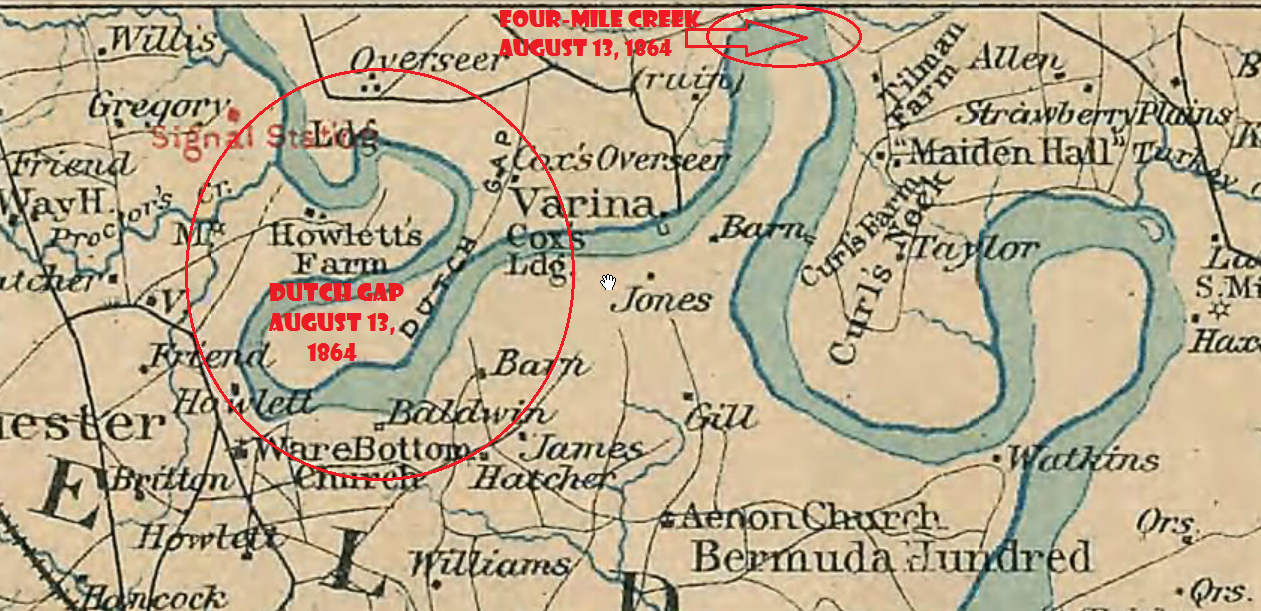
   Our regiment was withdrawn from the Department of the South last April and formed part of the force that accompanied the then popular, but now fallen, Gen. [Benjamin] Butler in his operation at Bermuda Hundred, VA. [above] where we landed May 5th, 1864 from which time until August our headquarters were on that front, we being almost constantly under fire duing picket duty, or working on the various defenses of that line. We participated in several engagements and many lively lttle skirmishes on that line, including the Battle of Ware Bottom Church, May 20th, battle near the same place, June 17th, and also on the same line June 18th, expedition to north side of James River, which resulted in establishing works there June 29th, second advance from Deep Bottom August 14. Severe engagement near Malvern Hill August 16th in which our brigade led the charging column led by intrepid soldier General [Alfred] Terry, then in command of our division, the 1st of the 10th Corps. The old 85th led by Captain R. P. Hughes under whose gallant leaderhip we hurled back the rebel horde from their strong works [at Second Deep Bottom], taking a number of prisoners almost equal to our number, and capturing two rebel battle flags. Near this place we quietly entrenched ourselves, having advanced as far in that direction as was thought to be either prudent or healthy, and awaited the Johnnys' assault, which they made with a considerable show of determination on the afternoon of the 18th: they found us there and promptly skedaddled. Soon after this object of the expedition being accomplished, we were ordered to the Petersburg front, where we remained in the trenches a month, constantly under fire, though the nature and completeness of our works there was such that we suffered but few casualties.

   While here we were called to part with our heroic and almost idolized Col. J.B. [Joshua] Howell, in whose loss we are depirived of a much esteemed officer and long to be remembered friend, in whom the country loses a patriot, gentleman and true soldier that it could illy spare these troublous times. Our next move was the grand advance toward Richmond on the north side of the James from Deep Bottom and Aikin's Landing, September 28, which after a bloody struggle resuled in pushing back the rebel lines almost to the suburbs of the Rebel Capitol, the capture of strong works on 'Chapin's Farm,' Fort Harrison now called Fort Burnham, and many other important Rebel works establishing our present line within seven miles of Richmond. On this line the rebels advance on our immediate front a heavy Rebel force [on] October 7th [at Darbytown Road]. A severe engagement ensued in which the rebels were repulsed with heavy loss and driven within their main works. Our next move was the reconnaisance in force [on] October 12th and 13th [also at Darbytown Road], resulting in a series of brisk little dashes on the rebel lines and extending as far as the old battle ground at Fair Oaks, the scene of McClellan's nearest approach to Richmond , in which the 85th participated under him 'in his wanderings on the Peninsula.' On the 14th of October, the time of the original organization of the old 85th having expired, all except the reenlisted Veterans and those whose time was not out were 'mustered to the rear' and in due time mustered out and permitted to return to their homes 'laden with laurel,' long may they wave, while we lonely enough but not weary in well-doing were left in the field. October 15th, we were temporarily attached to the 199th Pa. Vols., a splendid 'one year organization' raised in Philadelphia and second to none in the corps, owing to the untiring energy, strict discipline and efficient instructions of the able and energetic officers in command, for which to the skill and experience of their acqusitions from the 85th they are in a great measure indebted. The 199th already attracts the admiration and excites the envy of many other organizations. About the 1st of December, our old corps, the 10th, was consolidated with the 18th and called the 24th Army Corps; the colored troops of the 10th and 18th corps were formed into a separate organization and called the 25th Corps. On the 15th of December, we were detached from the 199th and ordered to report for duty as Provost Guard at Hd. Qrs., 1st Div. 24th A.C. and here we are in pretty snug winter quarters, enjoying ourselves as well as possible. We have charge of about one hundred prisoners, mostly in for minor offenses while a few are charged with desertion. Two courts martial are disposing of their cases as rapidly as possible. Some have already been shot and others will doubtless ere long share their hard fate. The weather is somewhat cold at present, though we have seen but little snow this winter. The Johnnies made a demonstration on the left of our line this morning with their gunboats and rams and a cooperating land force. Our monitors and batteries in the vicinity of Dutch Gap are said to have demolished two or three of their boats and the excitement over an anticipated attack has subsided. For fear that this may be disapproved, like our applications for Furlough, on account of its length I will for the present desist, promising that if our scribbling is acceptable, you shall hear from us again when anything happens worthy of note.

I am very respectfully yours, for three years or during the war,

M.B.C.

85th Regt. P.V.V.

    Chase promised to write again should future events prove newsworthy. Fort Gregg and Appomattox were certainly meaningful events in April of 1865, but I could find no more letters from Chase in the April or May editions of the Reporter and Tribune. Most of the news in late April concerned Lincoln's assassasination, so if Chase sent a letter, there simply may not, from the newspaper's point of view, have been as much space or interest in such events. 

Sunday, October 20, 2019

Profile of Robert Patterson Hughes

        One of the most prominent postwar members of the 85th Pennsylvania regiment was Robert Patterson "Pat" Hughes of Washington, PA. [I have no photo of Hughes to share, but this link to the Wyoming State Archives had a picture of Private Hughes] Hughes enlisted as a private in the 12th Pennsylvania infantry for three months before joining Company B of the 85th Pennsylvania as a lieutenant. By the end of the war, Hughes was the lieutenant colonel of the 199th Pennsylvania regiment. And by the time he retired from the army in the early 1900's, he was a major general. He is the only member of the regiment who served in both the Civil War and the Spanish American War.
Removing Confederate Torpedoes on James River, 1864  
  LOC

         Hughes was born in 1839 in Washington County. During the war, he became one of the most reliable field commanders in the regiment. He led a small unit to destroy a torpedo station on the James River in Virginia. He later led charges during the Second Battle of Deep Bottom in 1864 in Virginia, and then at Fort Gregg near Petersburg, Virginia (as a member of the 199th PA) in the closing week of the war.
Hughes' map of Little Big Horn 
   LOC
        He married Clara Terry, who was the sister of General Alfred Terry, and was a member of Terry's staff during the campaign against the Sioux Indians in 1876. Terry and Hughes came upon the Little Bighorn Battlefield shortly after George Custer's command was wiped out. Hughes drew a map of the field which is now housed in the Library of Congress. Hughes also wrote a brief but spirited tract on the battle in which he placed blame on Custer and absolved Terry, his brother-in-law.
    He continued to advance his army career, becoming Inspector General. In this position, he helped Francis Morrison of the 85th Pennsylvania earn a Medal of Honor for trying to save a comrade's life at Ware Bottom Church (VA) in 1864 during the Civil War. 
    Hughes was sent to the Philippines during the Spanish American War as an aide to General Elwell Stephen Otis. Hughes spent four years in the Philippines, serving at one point as Provost Marshal of the Manila.
    In 1901, after the killing of nearly 50 American soldiers of the U.S. 9th Infantry on the island of Balangiga, Hughes instituted a severe search-and-destroy policy against insurrectionists that resulted in the deaths of thousands of Filipinos. He told a congressional committee that burning villages was not civilized warfare, but that the Filipinos were not a civilized people.
From the Inter Ocean
 Chicago
 February 26, 1902
      Hughes retired from the army in 1904 at age 64 and a 43-year military career. He died in 1909.