Showing posts with label Pittsburgh. Show all posts

Monday, May 18, 2020

Musician William Barker of Company B

 
Waynesburg (PA) Messenger     July 17, 1867
          The subject of the unfortunate accident mentioned in the news article above is a former member of the 85th Pennsylvania regiment, William J. Barker. The accident highlights several ironies in Barker's life.
         Barker enlisted into Company B of the 85th Pennsylvania as a 16-year old drummer boy in the fall of 1861, He was a musician in the company along with 18-year old fife player Eli Crumrine.
Unidentified Civil War Drummer   LOC
Although a great majority of the soldiers from Company B came from Washington County, Barker was one of a handful of men in the unit from the town of Brownsville in Fayette County.
       Barker's date of enlistment is October 11, 1861. This relatively late date may be the reason he had not joined the already established Company C of Captain John C. Wilkinson, which was composed of boys and men mostly from Brownsville and the surrounding area.
      Barker survived the war and returned home to Brownsville three years later while still in his teens at the end of 1864.
         Barker had been born in Chester County, PA in 1845 to parent Matthew and Jane. At some point prior the outbreak of the war, the family moved across the state to Brownsville. Following the war, Barker returned to Brownsville and worked as a glass blower but soon headed to Pittsburgh where he spent most of his life. He was engaged in various artistic professions for the next several decades, including work in glass art and editing an art publication. In the last few decades of his life, he found work as a machinist.
        Barker died in 1910 and is buried in the Homewood Cemetery in Pittsburgh.
   

Mexican War six-pound cannon     LOC
The first irony surrounding the Fourth of July accident in 1867 shortly after the war had to do with the cannon itself. It had been brought back to Brownsville as a war prize confiscated during the Mexican War (1846-1848).
    Another news article of the accident, this from a Pittsburgh newspaper, offers more information about Barker's mishap.
Pittsburgh Daily Commercial      July 15, 1867

         Although this article states that Barker's injuries were potential fatal, he survived the event and lived another 53 years. Also, his partner in the event, William Norcross, is mistakenly mentioned as a former member of the 85th Pennsylvania. Norcross was 50 years old at the time of the accident and may have been a Mexican War veteran,but he was not a former member of Barker's regiment. 
       The end of this article mentions that a similar explosion occurred 18 years earlier on the same spot of ground. That accident killed Samuel Austin, a Mexican War veteran and a former member of the Second Pennsylvania Volunteers. 
         James Hadden offered more information about Austin's war record and this first accident in his history of his hometown entitled A History of Uniontown (1913).  It is not stated, although perhaps probable, that the same cannon was involved in both accidents.

          This article mentions the site of the accident as Brubaker Hill. At this location was a tavern that was a stopover for travelers along Route 40. It is located near the present site of a Dairy Queen and Dollar General store. It is also close to the Redstone Cemetery, where several veterans of the 85th Pennsylvania are buried. 
        The second irony involves the manner of Barker's death in Pittsburgh in 1910. After surviving the war and the cannon accident, Barker died as the result of another accident at the age of 65. The manner of his death is recounted in the following obituary.

Pittsburgh Daily Post   2-10-1910


Monday, December 9, 2019

SW Pennsylvania Invasion Threats Part 6 John Hunt Morgan

           
John Hunt Morgan
LOC
                  Once the Confederate invasion threat from Confederate General William "Grumble" Jones subsided in May of 1863, the attention of Greene County and Washington County soon turned from the south to the west and to another prominent Confederate raider, John Hunt Morgan. Reports were that Morgan and his band of 2,500 rebels intended to attack Pittsburgh by marauding their way from Kentucky through Indiana, Ohio and West Virginia. From there, they had only to travel through the Pennsylvania counties of Greene and/or Washington in order to threaten Pittsburgh.


Joseph Markle
History of the County of
Westmoreland, PA
  p.653


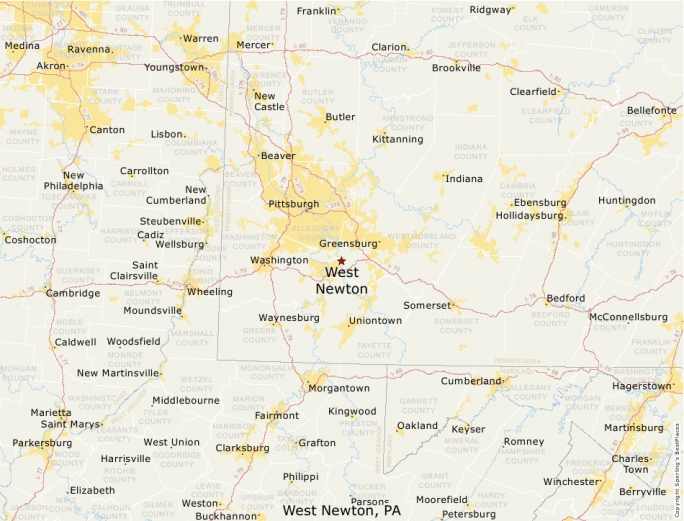
FOOTNOTE: The town of West Newton in nearby Westmoreland County, east of Pittsburgh, responded to the Morgan’s threat by forming a company led by Joseph Markle. The 86-year old Markle was born during the Revolutionary War, had served in the War of 1812 and was a former general of the Pennsylvania militia. When Markle was 17 years old in 1794, Major General Daniel Morgan used the Markle family farm as a stopover as he led his wing on the Federal army against the Whiskey Rebellion. [Robert Van Atta, Pittsburgh Tribune-Review, April 9, 2000] 


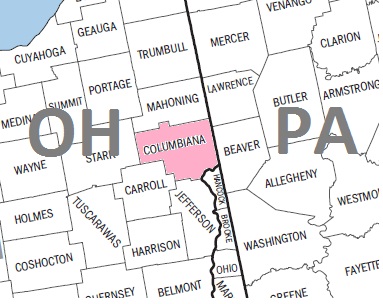
               Morgan’s raid began in June of 1863 in Tennessee and moved in a northern direction. From southern Indiana, Morgan’s Raiders headed due east until they reached Buffington Island, West Virginia. From here, Morgan took a northerly path once more and passed through Steubenville, Ohio. He was captured in late July near West Point in Columbiana County, Ohio, not far from Beaver County, Pennsylvania and just 60 miles northeast of Pittsburgh. 
       
Route of Morgan's Raid
Scott Mingus for Wikipedia
           Morgan began his raid upon the orders of General Braxton Bragg in Kentucky to create a diversion for Robert E. Lee's Army of the Potomac as Lee was marching towards central Pennsylvania and the epic confrontation at Gettysburg. Morgan was under orders from Bragg not to cross the Ohio River into northern territory, an order that Morgan ultimately ignored.

           On his 1000-mile trek, Morgan captured and paroled 6000 Union soldiers, destroyed 34 bridges, disrupted railroad traffic and generally put fear into the populace of several states, including Pennsylvania. Although Morgan never entered Pennsylvania, it was thought that the foundries, factories and federal arsenal in Pittsburgh might be a target.
         

Frank Leslie's Illustrated, 8-8-1863
Looting in Indiana by Morgan's Raiders


              In June, prior to Morgan’s capture, a small meeting of civic leaders was held at the Washington, Pennsylvania courthouse to prepare a defense of the city. Included in the four-man committee were two former officers of the 85th PA, Lieutenant Colonel Norton McGiffin and Harvey Vankirk. Like Vankirk, McGiffin had been medically discharged from the 85th PA in 1862. [Earle R. Forest, History of Washington County, Forest, 1926, p.1029] 

           A warning came from political leader James S. Jennings on June 17 for Greene and Fayette Counties to assemble local militias to meet this potential threat. “An invasion of this State by a large rebel force would be a great public calamity. It would be especially unfortunate for the farmers, who would be robbed of their stocks and produce, or paid in worthless Confederate shin-plaster [paper money]. I incline to the opinion that the Rebels will strike at Pittsburgh. The Cannon Foundries here, the Arsenal, and other establishments render this an important point just now, and it should be held at any expense or sacrifice.” [Waynesburg Messenger, June 17, 1863, p.3] 
             
John Hunt Morgan raid on Washington, Ohio
Harper's Weekly, August 15, 1863

             Local patrols began riding through both Greene and Washington counties. On one evening, some mounted men from Washington County rode into in Greene County. Fearful that they had spotted a Confederate raiding party, they burst through Waynesburg in the style of Paul Revere warning the townspeople that Morgan was on his way. The Confederate raiding party turned out to be simply a Greene County scouting party headed home from their mission to Waynesburg. [Forest, History of Washington County, 1026]


Pittsburgh Daily Post
7-28-1863


Coupled with the Confederate defeat at Gettysburg, PA in early July, the capture of Morgan's men and his imprisonment in Pittsburgh led one newspaper in that city to boast in the article at left:


Monday, December 2, 2019

SW Pennsylvania Invasion Threats Part 5 Washington County

False Rumor Report in Phila. Inquirer  4-30-1863

Postwar Story About Grumble Jones
          Bristol (VA) Herald Courier  11-7-1948
     In April of 1863, a Washington, Pennsylvania ("Little Washington") newspaper received news of the Confederate occupation of Morgantown from J. Edgar Boyers, West Virginia statehood (and Union) supporter who had fled Morgantown before he could be the apprehended by Confederate raiders. The article noted,

“The information [from Morgantown] was brought by a gentleman who resides two miles below Morgantown on the Monongahela River and who reached this place about Tuesday morning. Their [the Confederates] aim appeared to be the obtaining of supplies in the shape of horses, cattle, stores, etc. and the capture of such leading citizens as had rendered themselves conspicuous for their efforts in the Union cause. Our informant being one of this class…was compelled to flee when they were within a few yards of his house...On reaching the main road, he leaped upon one of the horses that was being brought away to avoid capture and came through Waynesburg, arriving here early on Tuesday morning as stated.” [Washington (PA) Reporter and Tribune, April 29, 1863]

While Confederate General William “Grumble” Jones was occupying Morgantown and rounding up Union supporters, another resident of the city escaped the dragnet and rode about 45 miles north to Washington, Pennsylvania to alert these citizens of transpiring events. A Pittsburgh newspaper published an alarming report of the events to their south: “The excitement in Washington, Waynesburg and Uniontown at last accounts was unabated...Messengers arrived here from Washington [PA] last evening and took out six thousand rounds of ammunition, which would be distributed to the militia there. They had five hundred men under arms, and ready to give the rebels and warm reception, but they had no ammunition.” [Pittsburgh Gazette, April 29, 1863]
 Little Washington wasted little time in responding. Late in the evening of April 28, as soon as news was received of Jones’ movement at Morgantown, the courthouse bell was sounded and a late-night meeting was held within minutes. Two couriers reported that Grumble Jones had captured Morgantown (which was true), and that Waynesburg and Washington were the next targets on the Confederates’ path to Pittsburgh (which was not true). Overnight preparations were made to form a militia company to march to Waynesburg, which had requested military assistance. The Little Washingtonians agreed with the request, choosing to confront the enemy in Waynesburg rather than wait for the raiders to appear in their own city. [AlexanderWishart, Letter to Isaac M. Wells, August 3, 1901, Courtesy of U. Grant Miller Library, Washington and Jefferson University]


Washington County Court House

The company of militiamen from Washington was hastily organized under the command of Captain Alexander Wishart and Lieutenant Harvey Vankirk. Wishart earlier had served in the 8th PA Reserves and was the current school superintendent of the city. He was wounded during the Seven Days’ Battles at Gaines Mill, Virginia in 1862 and was medically discharged several months later. Vankirk, an attorney, was also given a medical discharge from the 85th Pennsylvania in 1862.


Captain Wishart later remembered that,

“…farmers and others who had teams were asked to convey the troops to Waynesburgh. When I [asked] where the arms and ammunition was to come from, Major [John] Ewing cried out, ‘Dang it all, we’ll fight them with pitchforks!’ But a wagon was sent to the Allegheny Arsenal [in Pittsburgh] at once and arms and ammunition procured, and after their arrival the company proceeded to Waynesburgh in the wagons which had been tendered.” [Wishart letter]

Obituary for Alexander Wishart
Pittsburgh Daily Post  8-3-1906
Wishart and Vankirk led their company from the Washington Courthouse to Waynesburg, a distance of 23 miles.  A Washington newspaper said these “patriots about Washington, armed with 'Dutch’ rifles, went to Waynesburg filled with zeal and enthusiasm and determined to repel Imboden and his hordes, or die.” They arrived and found that the reports of Jones [or Imboden] making a move into Pennsylvania were unfounded and exaggerated. Wishart returned to Little Washington with him company on May 2nd. [Washington (PA) Observer, date unknown]
Invasion warnings cooled after the first few days of May as it became known that Jones had veered to the south towards Fairmont, (West) Virginia. As accounts began to report the fight at Fairmont, similar stories of the invasion of Uniontown or Waynesburg were discounted. The New York Times wrote that, “The reports for the south-western part of the State [Pennsylvania] are very contradictory owing to the excitement among the inhabitants.”  [New York Times, April 29, 1863]
On May 6, Greene County citizens were being alerted that the raid had not continued into Greene County as feared, but that the marauders were still a potential threat to the region:

“The excitement consequent on the threatened Rebel Raid on Greene and adjoining counties has almost entirely subsided. The Rebles have disappeared from Morgantown but are said to be still in the vicinity of Fairmont or Warren…On Saturday morning, all imminent danger of a Rebel incursion having passed away, the Washington lads returned to their homes and our own people resumed their usual business activities. At present all is quiet, and all alarm allayed…” [Waynesburg Messenger, May 4, 1863]
        
Finally, on May 18, the Waynesburg Messenger could report that, “On Tuesday evening the rebels all left in the direction of Fairmont on the West side of the river… At this date, all is quiet in the vicinity of Morgantown. No signs of ‘graybacks’ have been seen since Tuesday of last week.” [Waynesburg Messenger, May 10, 1863]


"Little" Washington (dot in Washington County)
PA Counties of Washington, Greene , Fayette, Somerset, Westmoreland, Allegheny
Emerging new state of West Virginia
From Maps Showing the Development of Pennsylvania (1920)


NEXT: John Hunt Morgan