Showing posts with label Washington County. Show all posts

Wednesday, April 2, 2025

More to the Story of William Braden of Company B

        The Battle of Seven Pines near Richmond, VA in the spring of 1862 is one of the most overlooked yet significant fights of the Civil War. It was the closest major battle fought around Richmond, the Confederate capital, as well as the first fight between the Army of Northern Virginia and the Army of the Potomac. Each side suffered at least 5,000 casualties.

       Why has Seven Pines, also known as Fair Oaks, not been given more attention by scholars? One reason is that the three-day fight ended in significant losses but no distinct winner. Another is that Seven Pines was dwarfed when compared to the series of fights called the Seven Days’ Battles  that had 36,000 total casualties the following month and resulted in the end of Union General George McClellan’s Peninsula Campaign.

     Furthermore, little of the Seven Pines battlefield has been preserved other than a few homes used as hospitals and roadside markers. The landmark Twin Houses are long gone. Today, the battle site has been replaced by the town of Sandston and a portion of the Richmond International Airport.

The 85th PA is in Casey's Division in an exposed position when the fight began. Porter,
 Franklin and Sumner are all on the opposite side of the rushing Chickahominy River. 
                                                    Map by Hal Jespersen, www.cwmaps.com

     Seven Pines nonetheless had great significance in the story of the 85th Pennsylvania. It was not only their first taste of  the conflict  (other than standing in formation during the Battle of Williamsburg a month earlier) but also for being the largest battle in which they ever participated. 

    Battle losses coupled with sicknesses that plagued McClellan’s army on their trek up the Virginia peninsula towards Richmond proved the months of May and June of 1862 to be the most devastating for the 85th in terms of combined  deaths.

       One of those in the 85th killed during the first day of the battle was 22-year old William Braden of Company B from Washington County. Braden’s company had just been replaced on the picket line by Company D when the Confederates launched their attack in the early afternoon of May 31. The 85th PA was soon a part of two retreats in the early hours of the battle from the area around the Twin Houses. 

        We have two first-person accounts from this part of the fight that state that Braden was shot and killed while trying to assist his wounded officer, Lieutenant George H. Hooker, from the field. Hooker survived his wound, was promoted to captain, and lived another 45 years.

From the History of the 103rd Regiment PA Volunteers p. 174

         Private Manaen Sharp, himself a member of Company B, recorded that, “Comrade Braden was helping to carry his wounded captain [Hooker, then a lieutenant] to save him from capture. Another comrade who was assisting, J.F. Speer of Canonsburg heard that sickening thud of a minie ball strike Comrade Braden, who said, ‘I am hit.’ He staggered to the road side….”

     Manaen Sharp wrote his version of the incident in a brief tract called Amity in the Great American Conflict” in commemoration of Memorial Day in 1903 in which he chronicled the Civil War service of local residents. Sharp owned several furniture stores in Washington County and died in 1920 at the age of 82.

       James F. Speer, who completed carrying Hooker to safety following Braden’s death, was later seriously wounded in the shoulder at the Battle of Second Deep Bottom in 1864 and survived. He returned home to Washington County and found work as a bricklayer and stone mason. Around the turn of the century he worked as a furniture salesman, perhaps in the employ of Manaen Sharp. Speer died in 1924 at the age of 82.

Lt. George H. Hooker


   Since Braden’s  body and those of hundreds of others on both sides were never recovered for individual  burials, Nancy Braden, William’s widow, needed the written testimony of Captain Hooker as proof of her husband’s death in order to qualify for a widow’s pension. In 1865, Hooker wrote, “I hereby certify that Wm. Braden, a private of Company B 85th Pa. Vols., was shot while assisting me from the field at the Battle of Fair Oaks, Virginia on the 31st of May, 1862. He fell severely wounded and is supposed to have died from the effects of his wound.” 


               Hooker a native of the section of Virginia that became West Virginia during the war, was later  promoted to captain and served as an adjutant on the staff of Colonel Joshua B. Howell. Hooker returned home to West Virginia following the war and farmed in Wayne County. He died in 1907 at the age of 66. 

       Besides his young wife, William Braden was survived by a one-year old son, George W. Braden. William Braden also served in Company B with his Nancy’s brother, brother-in-law, George Bigler.

       Compared to the other hundred or so battlefield deaths in the 85th PA regiment during the war, the story of Braden’s battlefield demise is one with many details due to the accounts of Sharp and Hooker.

      Now, because of the diligent work of Doug Carter, a former investigator with the Georgia Bureau of Investigation and a Civil war enthusiast, we can add to  Braden’s story.

       Carter has always had a fascination with the actions during the Civil War in his home state. His great grandfather,  Jesse Taliaferro Carter, enlisted into the 3rd Georgia Reserves at age 17. He served as a guard at the Andersonville and Camp Lawton Prison Camps and later was wounded in the neck in December of 1864 in South Carolina 

          How did Doug Carter become involved in the story of the 85th PA? In his research, Carter, who is also a relative of former President Jimmy Carter, has identified the Georgia  soldier who felled Braden at Seven Pines.

       When I wrote my book about the 85th Pennsylvania regiment, called “Such Hard and Severe Service,” I relied heavily on primary sources; mainly the letters, diaries and memoirs of the men in the that regiment. In the early stages of the war, like for the Battle of Seven Pines, sources were relatively  abundant for review. As the war dragged on however, more soldiers were killed, sent home with illnesses, or simply completed their three-year enlistments, which reduced the number of potential  sources from about a thousand to 150 by the time of Lee’s surrender at Appomattox.

       One recent Confederate source that  came of light through the work of Mr. Carter was a letter written by Private Thomas Inglett of the 28th Georgia regiment. 

First page and cover of Thomas Inglett letter, June 10, 1862
Courtesy of Doug Carter

         It was Inglett who fired the shot that struck down Braden, a fact that Carter  discovered 150 years later. It is a rare circumstance to be able to identify a dead soldier’s shooter so long after the event, if ever.

        Ten days after the battle began, Inglett wrote a letter to his wife.  “I killed one [Yankee] and got a letter out of his pocket that was wrote to him by his wife and I will send it to you and you can read it.”

      The letter that Inglett lifted from Braden’s lifeless body was in fact not written by the Union soldier’s wife. Part of it was written by Israel Bigler and another portion was written by  his13-year old Mary Bigler, whom Inglett thought was the dead soldier's wife.  The letter never actually mentioned Braden’s surname. 

Researcher Doug Carter

    Carter purchased the Inglett letter in 2007, knowing that the Union letter in the envelope was an added bonus. 

    “I like researching,” said Carter. “I was a special agent with the G.B.I. investigating crimes and I like digging. I was determined to find out who this guy [Braden] was.”

         Carter first realized the Union letter was four pages in length. He determined that most of the letter was written by Israel Bigler, a middle-aged farmer from Washington County to “Will” and “George.” The last page was written by “Mary Bigler” to  “Will.” He next had transcribed the Bigler letter, a task not made easy by its  blood-stained nature.  Carter initially thought Will and George were both sons of Israel. Carter’s next step was to  investigate the war services and  lives of both Inglett and Braden to gain a wider knowledge of both men. 

     Inglett’s letter described his role at Seven Pines before he took the fatal shot against Braden. “I got my cap shot off of my head in the fight but I did not get hurt. Our poor boys fell all around me. James Price was killed with a canister shot before we got [with]in six hundred yards of the yankees. Sam Cawley was my file leader and he got shot down and the ball through [threw] blood all over my face and in my mouth, but they did not stop me for I was mad. Our regiment charged them twice and we made them run like dogs from their batteries.”

Portion of letter that Inglett took from Braden's body.
Courtesy of Doug Carter

      But Carter’s investigation of census records of the Israel Bigler household prior to the Civil War indicated that Bigler had no son named William. Braden, however, is listed in the 1860 federal census as a member of the Bigler household who was working as a farm laborer. Other family members were daughters Mary and Nancy who would soon marry William. From the 1850 census, Carter discovered that Israel Bigler did have a son named George Bigler, who was also a member of Company B. The census revealed that  Israel Bigler also had a daughter named Nancy, who married William Braden in 1860. 

      Carter researched military records and found George Bigler and William Braden were in the same company of the 85th PA. By combing through the original 1913 history of the regiment, he determined that Bigler and Braden were both in Company B. He also discovered George had survived the war but that William was killed at Seven Pines. This was the key discovery that indicated that Braden was the owner of the letter confiscated by Inglett.


Wikipedia Commons

 Thomas Inglett, meanwhile, grew up near Augusta, Georgia. He spent over three years in the Confederate army. He lost two fingers on his left hand due to a war wound during the Seven Days Battles a month after Seven Pines but recovered and continued to in his regiment

      Inglett later suffered a leg wound at the First Battle of Darbytown Road on October 7, 1864 and was sent to a Richmond hospital. Ironically, the whole of the 85th PA fought in another battle at Darbytown Road just six days after Inglett was wounded. Most of the regiment went home the next day, having completed their three-year enlistments.

     Tragically, three of Inglett’s infant daughters died while he was in the Confederate service. Inglett died in 1910 at the age of 71 and is buried in the Fort Eisenhower Cemetery in Richmond, Georgia. 

    Nearly a hundred of Inglett’s other Civil War letters can be found at the “Private Voices” website.

       Combining the accounts of Inglett, Sharp and Hooker, several questions arise from the combination of the three stories.

        The Israel Bigler letter had been written at least four months prior to Seven Pines. Why was Braden carrying it in on his person? It seems that he might have possessed a more recent letter at the time of his death.

     Next, was Braden moving  when he was shot? Inglett makes no mention in his letter that Braden was helping to carry away the wounded Hooker with another soldier. If Braden and Speer were on either side of Hooker helping to carry him away, did Inglett aim for the mass of the three men and happened to strike Braden or did he aim for Braden?

Letter from Lt. Hooker in Nancy Braden's Pension File

        Or perhaps were the three Yankees stopped to rest when Braden fell? Sharp’s letter, which may have been directly related to him by Speer,  seems to indicate that Braden was struck fatally but did not die instantly. Hooker wrote that he “presumed” that Braden died quickly from his wound. Did Speer decide that Braden was dead or mortally wounded  when he staggered to the side of the road or was not going to survive, and thus carried on alone to help Hooker? 

      Inglett at  first struck me as a bit cold-blooded in his rather casual mention to his wife that he lifted the letter from Braden’s lifeless body and chose to send it home to her as a souvenir.

         However, when one reviews Inglett’s account of the fight prior to his targeting of Braden, the context makes his action a bit more understandable. Inglett mentioned the wounding of two of his comrades, one of whom splattered blood on his [Inglett’s] face and in his mouth. Inglett notes his own hat was shot from his head. He mentions that these events enraged him and encouraged him to press forward in the fight. This strikes me an a not uncommon reaction to being in a battle in which one’s friends have fallen around you.

        Why was Braden’s body not recovered for burial? The only soldier of the approximately 25 men in the 85th PA who died from the battle who is buried in the Seven Pines National Cemetery, which was later situated in the approximate location on the 85th PA regiment’s camp, is Corporal Joseph Wilgus of Company B. That is only because Wilgus was wounded in the battle and died later. The field on which the 85th fought was soon overrun by Confederates. There was no chance at the end of the battle to return and recover bodies for burial. Another 85th PA soldier who died in the fight, Lieutenant James Reynolds of Company H. His body was left behind near the huge pile of firewood hear the Twin Houses, but his body was also not recovered for burial.

    These questions will likely never be answered. However, due to Carter’s investigative diligence, we have a more complete story of the death of one soldier, William Braden of Washington County, who was one of thousands who died at Seven Pines.

     Below are several depictions of the burial of soldiers after the Battle of Seven Pines

Post-battle photo of the Twin Houses with the seven pine trees in the background.
The foreground was said to have been used to bury 400 soldiers, perhaps including Braden. LOC


View of Seven Pines prior to the battle with the Twin Houses and 7 pine trees to the left.
 The camp of several regiments including the 85th PA can be seen in the background. LOC


Sketch of mass burials being conducted after the battle of Seven Pines.
This view is from the direction of the first Confederate attack with the
pine trees in front of the Twin Houses. LOC


Sunday, November 1, 2020

Captain John E. Michener's Escape Attempt

         In my soon-to-be published Volume II history of the 85th Pennsylvania regiment, one chapter is devoted to the capture of Captain John E. Michener of Company K. Michener began the war as a lieutenant in Company D, the unit that included my great grandfather and his brother. 

        Michener participated in the Battle of Seven Pines (VA) in 1862 and siege operations around Charleston, SC in 1863. In early 1864, he was promoted to captain of Company K. But in February of 1864, Michener was taken prisoner along with two other members of his regiment on Whitemarsh Island near Savannah, GA and held in captivity by the Confederates for ten months before being exchanged.


Captain John E. Michener, 85th PA
Courtesy of Ron Coddington and
Military Images magazin
e

          I  wrote of Michener's period of captivity for Military Images magazine in an article entitled, "Following the Torn and Blood-Stained Colors: John Michener's Civil War Odyssey." The author is grateful to Michener descendant Margaret Thompson for providing family letters that were written that form the basis of above article as well as the chapter of my book.

      Shortly after the war, Michener wrote a brief publication about his time in prison. So far, the author has been unable to find Michener's work, entitled, "Prison Life: Capt. J.E. Michener of Co. D, 85th Pa. Vols." (Michener's former regimental comrade, Sergeant James E. Sayers of Company F, later owned a newspaper in Waynesburg, Greene County and  mentioned Michener's work in an 1867 article.)

       While researching the regiment, the author came across a letter written by Michener that appeared in a Pennsylvania newspaper in late 1879. Michener's letter was in response to an event that made national news; a South Carolinian names Thomas J. Butler travelled to New York City for a series of paid demonstrations in which his trained dogs were used to capture fugitive slaves and later escaped Union prisoners during the Civil War. Michener's newspaper letter was a response to this Butler's comments. More on that later.

Map showing Macon and Charleston
The "X" is the approximate location of the escape


           In his 1879 letter, Michener disclosed a wartime escape attempt from a train by himself and five other Union officers whom he lists by surname. The author was able to identify two of these fellow officers: Colonel John Azor Kellogg of the 6th Wisconsin and Navy Paymaster Luther Guiteau Billings. Billings was later promoted to read admiral and in a 20th century news article, gave a brief summary of the escape attempt. [the other three escapees were described by Michener as Ensign Stoner of New York, Ensign Smith who later settled in Washington, DC, and Lieutenant Brooks, who became an editor with the National Republican newspaper in Washington, DC]

       Colonel Kellogg wrote a detailed summary of the escape attempt that he entitled, "Capture and Escape: A Narrative of Army and Prison Life." . It was published in 1908, twenty-five years after Kellogg's death

             Michener briefly described the escape in his 1879 letter, "During the night of the 27th of July, 1864, me and several hundred of my brother officers were being transported from Macon, Ga., to Charleston, S.C.,, and escaped to the swamp, through which we hardly thought an alligator could have followed us. Late in the afternoon of the second day, however, we heard the deep baying of dogs which we held off with stout clubs until the two fiendish owners had called them off."  [Pittsburgh Commercial, reprinted in the Lancaster (PA), Examiner, November 5, 1879, page 5]

Rear Admiral Luther G. Billings
Baltimore Sun, 2-17-1918
       In his equally short version for an interview more than 50 years later, Luther Billings remembered, "Once during my imprisonment, with some other men, I managed to break out and we headed toward the coast, hoping to reach the Union fleet. we came to a swamp three miles wide and struggled through it, swimming, wading through mud, dodging snakes, and when, after five hours' toll, we got through, we were captured by a posse of Confederates with hounds." [Baltimore Sun, February 17, 1918, page 46]

        Then in October of 1879, John Thomas Butler of Hamburg, SC, travelled to New York City with his pack of dogs for the purpose of demonstrating how the animals were used to track down fugitive slaves. Butler's expressed purpose, in addition to making money from the exhibition, was to show people in the North that the process of capturing fugitives was relatively humane and that the purpose of the dogs was to track runaways, not attack them.

       Said Butler, "I wanted to travel a little and brought these dogs along to pay my expenses and to show you all at the north that we are not quite as bad as we are said to be."

         Another New York newspaper quoted Butler at stating: "Slave-tracking has been ever since I remember a great business in the South. Slaves going over fences and through swamps for more than 300 miles have been successfully pursued by these hounds, but they are all trained to a nicety and never will do harm except by order of their master." [from the New York Herald, October 5, 1879]

        [Butler was evasive when asked if he had used his dogs or otherwise taken part in the so-called Hamburg (SC) Massacre in in 1876. In this event, six blacks and one white were killed. Four of the deceased blacks were hanged. A group of about 200 armed whites attempted to disarm 38 members of a black militia in the predominantly black community near the end of the Reconstruction era.]

      Butler came to New York City with an African-American named Sam Britton who performed the role of a runaway slave. Britton's task was to escape on horseback and on foot, and then wait for Butler's dogs to track him down. 


John A. Kellogg
Service in the 5th Wisconsin Volunteers
Rufus Dawes, 1890

       One newspaper described the exhibition: "Reaching the gate, Sam consented to be 'treed' and mounting the high gate-post, awaited the hounds. When they found him they redoubled their noise and leaped high into the air, trying to reach the negro, who beat them off with his whip, until Mr. Butler came up and sounded his horn, at which the barking ceased as if by magic and the fugitive withdrawn. Mr. Butler says the dogs would have bitten the negro, well as they knew him, had he descended before the horn sounded, unless he had a club with which to beat them off. The moral seemed to be that a runaway slave must be careful to have a tree handy when the dogs overtook him, or, if he is caught in a swamp, he should be able tot cut a hickory stick in season." [New  York Tribune, reprinted in the Pittsburgh Commercial Gazette, 10-18-1879, page 2]

        According to the New York Times, Butler's dogs were not ferocious looking. "the dogs were meek and mild little fox-hounds, of the kind that could hardly frighten anything larger than a rapid. Colonel Butler said they were the only kind every used in the South for tracking negroes and that they were not bloodhounds...They looked very sleek and neat, also looked as if a man with a good nerve and a heavy pair of boots could easily overcome their alleged ferocity." [reprinted in the Buffalo Morning Express, 10-13, 1879, page 2]

         Michener read of Butler's comments and became enraged.  His experience as a prisoner and escapee that that the dogs were not as benign as Butler described. "Before starting on our weary march back to that dreaded imprisonment this Mr. Butler took occasion to say: 'It's a good thing for youuns that our catch dogs gave out half a mile back here, for I reckon they'd a tored youuns up 'fore weuns got thar.'" [Michener presumed his captor was not Thomas J. Butler, who would have been about 21 years old at the time, but a member of the extended Butler family.]

     "I saw a Captain Holmes of St. Louis, Mo., a prisoner of war at Macon, Ga., in July, 1864, who had been fearfully mangled and torn by a catch dog in Alabama while he was trying to escape. I frequently saw two large South American blood-hounds outside of the stockade at Macon. At Andersonville, they had a large pack of blood-hounds.

       "...when this other edition of the Butler family tells the Tribune reporter that they 'had and have no blood-hounds down thar in South Carolina,' I say, 'you lie, you villain, you lie.'"

        Upon surrendering, Colonel Kellogg asked his captor if the dogs would have bitten the escapees had they not been called off. The captor smiled and said, "I reckon they might; right smart, too. I've seen them hounds eat [blacks], and I reckon they wouldn't know the difference atween them and you uns."


Harper's Weekly   November 21, 1863

      Kellogg's statement confirms John E. Michener's claim that using the hounds was not always humane, as Butler claimed in 1879, but that the dogs had the potential to bite, maim, and even kill the humans they were pursuing.

     In his blog entitled, "Management of Negroes Upon Southern Estates," Toussaint Heywood has a post entitled "Track-dogs, catch-dogs and bloodhounds" that describes in detail the use of these animals to pursue and capture runaway slaves. 

        Kellogg, who had been wounded and captured at the Battle of the Wilderness in Virginia on May 5, 1864,  wrote his memoir in the early 1880's. Kellogg states the name of his pursuer in 1864 was named Davis, who may have been Butler's partner during the search. Kellogg alludes to Butler's visit to New York City in the following statement,  relating that there was a special observer among those at the New York City slave-catching demonstration in 1879.

       ",,,,this negro hunter,,,exhibited his pack of bloodhounds in New York City, and among those who attended the exhibition was my friend L.G. Billings. I should have supposed his curiosity would have been gratified in South Carolina."

       Michener was not the only reader to dispute Butler's performance, although for different reasons. A South Carolina newspaper wrote of the event, "the stalwart Republican press has been heralding it abroad with the startling news that there are hounds of this character in every neighborhood through the South and that the poor negroes are chased and torn by them at the mercy and caprice of the lawless whites...it is a miserable falsehood." [The Intelligencer, Anderson, SC, 10-23-1979, page 3]

Uncle Tom's Cabin Theatre Poster   LOC
         If Butler's main purpose was to make money, he apparently was successful. It was reported that Butler was paid well to join an acting troupe that was performing "Uncle Tom's Cabin." Butler's dogs were to be used in one of the scenes for dramatic effect. He also expressed hopes to tour the country and perhaps even Europe.

           Upon being captured by Butler and Davis, Michener and his five fellow escapees were sent to prison at Charleston. Two months later, Kellogg attempted another escape. This time he travelled 350 miles and succeeded in reaching Union lines in Georgia. He rejoined his regiment and participated in the Battle of Five Forks near Petersburg, VA on April 1, 1865. Kellogg returned to Wisconsin and resumed the practice of law. He was elected to the Wisconsin state senate in 1878 and died five years later.

         Later in life, Billings was promoted to rear admiral of the navy and served in three wars. He died in 1920 and is buried in Arlington National Cemetery.


        Captain John E. Michener was released as part of a prisoner exchange on the James River in Virginia on October 16, 1864 for Mississippi cavalry Captain Alonzo J. Lewis. Michener's letter to the newspaper concerning the track dogs was printed on November 5, 1879. He died four days later from a lung disease that perhaps the resulted from his confinement and escape attempt. He was 41 years old.


Fredericktown Cemetery, Washington County, Pennsylvania


Monday, March 30, 2020

Charles Cox and Lt. Robert G. Taylor

 
Charles Cox
from  Percy Hart's History and Directory of the Three Towns, 1904, p.167
        
        An interesting relationship that developed in the 85th Pennsylvania during the war was between Lieutenant Robert Gillis Taylor of Company E and Charles Cox of Virginia. It was a relationship that seemingly lasted nearly 40 years and ended with a strong sense of irony as the two men passed away on the same day in 1899.
        To be frank, this article includes much speculation about Cox because records of his life are extremely sparse. The writer hopes the reader will indulge his speculations and assumptions.
         Two questions about the Taylor-Cox connection remain unanswered. What was their relationship after the Civil War, and how did Charles Cox become a prosperous member of the Brownsville, Pennsylvania community?
         Let us begin with Taylor's war service. Lieutenant Taylor enlisted at the age of 27 into Company E at Washington, PA. He was likely recruited by Captain Henry A. Purviance, the co-publisher of a Washington, PA newspaper. [See last week's post for a profile of Purviance].  Taylor served as a first lieutenant along with Thompson Purviance, a young cousin of Henry Purviance who was killed at Seven Pines.
        Taylor spent 13 months in the 85th Pennsylvania. He is listed as having been wounded at Seven Pines on May 31, 1862. He was medically dismissed for "partial paralysis" almost six months later on November 22, 1862.
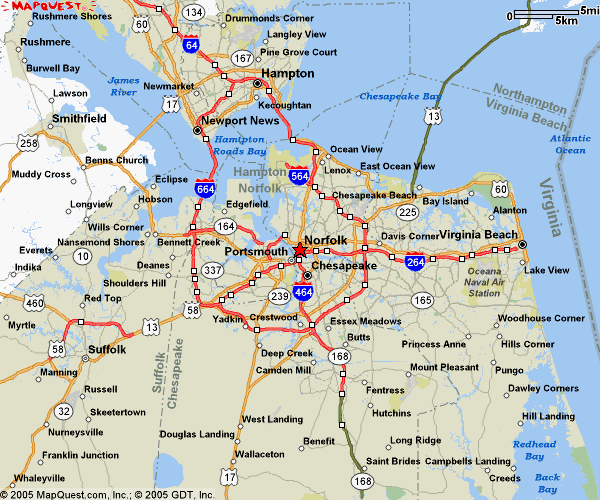
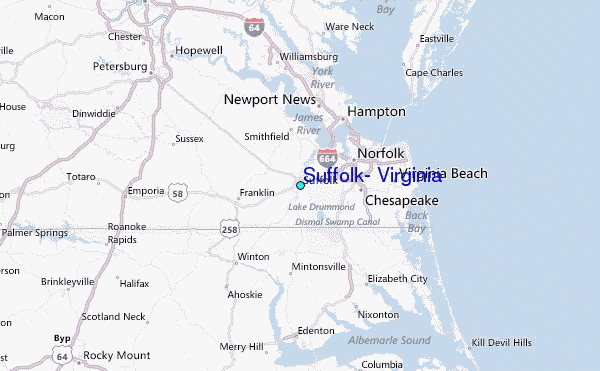
        When Taylor returned to Washington County, he was accompanied by an African-American from Virginia named Charles Cox. One source noted that Cox was from the area of Norfolk, Virginia. If so, they two probably met either when the regiment landed at Hampton Roads for the Peninsula Campaign in April of 1862 or while the regiment was stationed at nearby Suffolk, VA between September and December of 1862. Cox may have been a free man, but more likely a displaced slave who became employed by Taylor as a valet or cook during Taylor's time in the army. Cox may soon have tended to Taylor's physical needs in camp as a result of the paralysis.
      At the time of the meeting between Cox and Taylor, the issue of emancipation of slaves was highly controversial. President Abraham Lincoln had issued the Emancipation Proclamation on September 22, 1862. It was to take effect on January 1, 1863 for slaves in the states of the Confederacy. Many Americans, including Union soldiers, spent the fall of 1862 debating the issue. While abolitionists were pleased, many other northerners were concerned that the primary goal of the war, which so far had been saving the Union, would be superseded by freedom for slaves.
       Cox was around 50 or so years old when the two returned to western Pennsylvania together. Perhaps Taylor, who seems to have come from a well-to-do family (a brother became a college professor) felt he still needed help in his recovery. He may also have valued Cox's companionship and perhaps even friendship while camped at Suffolk.
        By 1880, Taylor was living in the western part of Washington County near the Monongahela River.  Cox had crossed the Monongahela River to live in Luzerne Township, a part of Brownsville, Fayette County. Cox probably did not work for Taylor at this time, but the two appear to have remained on friendly terms. By this time, Cox was married to Catherine (Peyton) and had two sons, Henry and William.
        Catherine was younger than Charles, by about 25 years, according to their shared headstone. The 1880 census lists her as having been born in Virginia, leading to the possibility that she traveled north with Taylor and Cox in 1862. Both sons are recorded as having been born Pennsylvania. Catherine would have been around 20 years of age when Taylor and Cox left the regiment.
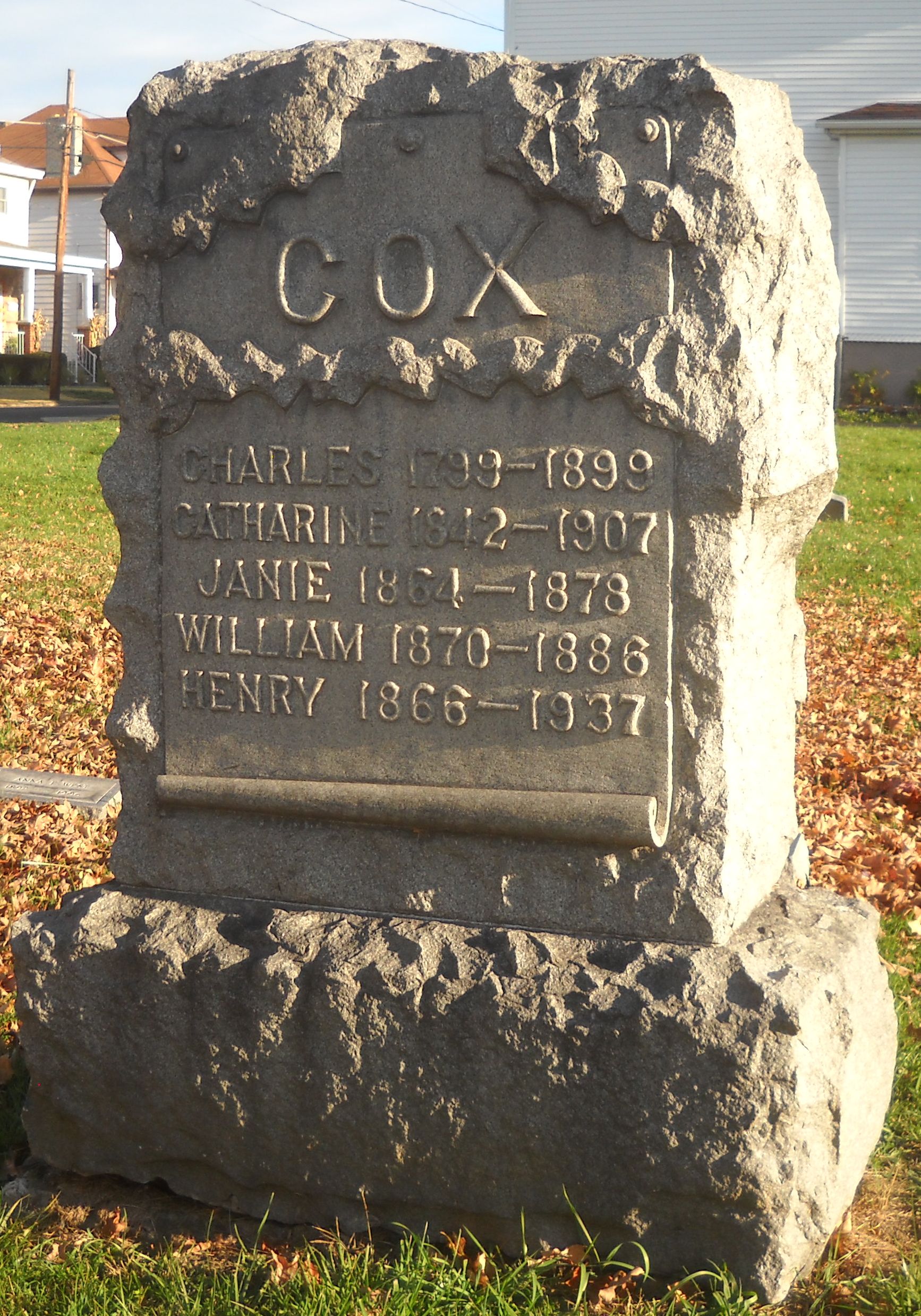
     Charles Cox is listed in the 1880 census as being employed as a laborer. Accounts of his age vary wildly. This census lists his age as 65, meaning his birth would have been round 1815. His headstone, however, lists his birth year as 1799, meaning he would have been over 80 years of age in 1880. In Percy Hart's history of Brownsville, Cox is noted as having been 107 years old at his death in 1899, making his birth year around 1792.
     Also perhaps noteworthy in the 1880 census is that Cox and his family lived among white neighbors at this time.
     In his 1904 history of the Brownsville area, local resident and author Percy Hart lists Cox among the three most prominent African American residents of the town. Hart includes a photo of Cox (top of page), who had died a few years earlier, but offers no other biographical information.
     In 1891, the Connellsville Weekly Courier carried this brief paragraph about Cox.


      Although the article highlights the fact that Cox was given a place of honor at the regimental reunion, the language used is cringe-worthy by modern standards. The article used the term "captured" to describe Cox's attachment to the regiment, which does not appear to be a matter of coercion, and does not mention Taylor's role in his migration to the North.
       Furthermore, City Point, VA was developed into a Union base in 1864, 19 months after Cox left Virginia for Pennsylvania.
     In reality, Cox probably was considered an honorary part of the regiment; his presence at the reunion may have reminded the veterans that the freedom of people like Cox was one of the positive outcomes of the war.
      The article also states Cox was captured by "the Brownsville company." This is incorrect. Company C was the company of the 85th Pennsylvania with men mostly from Brownsville and the immediate area. Taylor was a member of Company E, which were men from Washington and Greene Counties. Taylor did hail from East Bethlehem and Centreville, PA in Washington County, just a few miles from Brownsville. The fact that Cox settled near Brownsville may have led to the assumption in the article that he was first associated with the "Brownsville company."
    Taylor went on to a prominent career in local business and politics. After recovering from the paralysis, he worked as a clerk for a railroad company in Pittsburgh.  In 1886, he was appointed the commissioner of the Cumberland Road (today's Route 40 in Pennsylvania) by Governor Robert E. Pattison, replacing fellow 85th Pennsylvania veteran Moses McKeag, who had passed away. A year later, Taylor was elected as a commissioner for Washington County. (Commemorative Biographical Record of Washington County, Pennsylvania, Volume 1, 1893)

Hart's Directory, p.255

This death registry lists Taylor and Cox as having died on the same day.


Obituary for Robert G.  Taylor
Pittsburgh Daily Post, 11-21-1899, p.1


This article about the Taylor-Cox relationship seems to contain fairly accurate information about Cox, who very likely was a servant for Taylor during the war.


Obituary for Charles Cox
Pittsburgh Press, 11-21-1899, p.8
     This article notes Cox's nickname as "Captain Charlie." It is unknown where Cox picked up this moniker. If he were born near Norfolk, he may have worked at the port there. Or he may have worked on the river at Brownsville, where passenger and cargo ships were docked and maintained during the 1800's. The article notes that Cox was financially successful but does not state the kind of work in which he had engaged. 
     Cox was buried in Brownsville and has a rather prominent headstone for himself and his family, perhaps denoting that he did indeed find financial success after he crossed the Mason-Dixon Line into Pennsylvania. 


New Bethlehem (PA) Vindicator
11-24-1899, p.6


     Finally, this article from a newspaper in northeast Pennsylvania focuses on the unusual matter of the two men passing away on the same day: November 20, 1899. It also implies that they maintained some sore of relationship after returning from the war.
    Robert G. Taylor is buried in the Taylor Cemetery in Centreville, Washington County, PA.

Monday, February 10, 2020

A Poem From Fort Good Hope (Washington, DC)

Interior of a Fort in Washington, DC During the Civil War

          The anonymous poem below was contributed by a member of the 85th Pennsylvania for a reunion in 1885 held in Canonsburg, Washington County. This regimental reunion was held jointly with the 10th Pennsylvania Reserves.
         First, some information about the reunion. A local newspaper noted of the event, "The town was in gay attire, the buildings being decked with flags,
From Boyd Crumrine
History of Washington County
1882
banners and evergreens. On the arrival of the 10:30 a.m. train from Pittsburgh, the visiting comrades were met at the station by the resident members of the regiments, and falling in line they all marched to the Jefferson Academy building..." 

       After several addresses, the veterans continued to the town's skating rink where a banquet dinner was served. At a campfire later in the day, Reverend Jacob L. Thompson, a veteran of Company A, shared some remarks. Another address was made by Alexander Pollock of Company A entitled, "Our Country: The Best Government on Earth." Reverend James S. Speer, a veteran of Company B also made a speech entitled, "Our Absent Comrades."
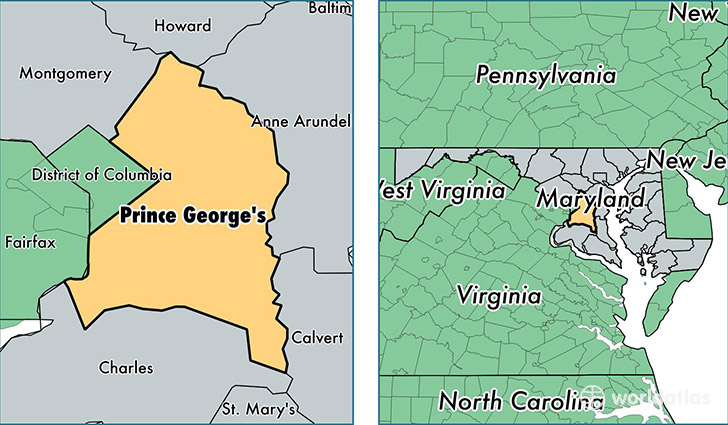
      During their stay at Fort Good Hope in the District of Columbia during the winter of 1861-1862, the regiment constructed its own fortification (one of 33 that ringed the nation's capital during the war)  and performed duties at several other facilities in the vicinity. Fort Good Hope was located across the eastern branch of the Potomac River, in the southwest corner of Washington, DC near the border with Prince Georges County, Maryland. When they had time, the men would tour the nation's capital. Several claimed to have encountered President Abraham Lincoln near the Capitol Building on various occasions.
        The poem,written during the 85th Pennsylvania's third month in Washington, DC and sixth overall in the army, reflects the writer's homesickness, restlessness in not yet having participated in battle, and frustration with the cold winter weather.


Washington Daily Reporter
October 2, 1885


WINTER IN CAMP
   The following lines were written by a member of Company E, 85th regiment PA. Vols. In February, 1862, at Camp Good Hope, Washington, D.C. and are handed us with a request to publish,


Alas the pleasant days have fled,
The rude storm king has come,
And I’m nodding in my canvass bunk,
With thoughts of “Home” sweet home.

I’m nodding by my friends,
The snow falls thick and fast,
And I’m thinking of the joy’d ones left
And happy hours we’ve passed.

I’m thinking of the little ones,
Now distant many miles,
Their childish glee, their numerous pranks,
Their tears and gentle smiles.

I’m thinking of the good things too,
Roasts, jellies, cakes and cream,
But oh! Alas such dainty things,
In camp are seldom seen.

I’m thinking of the merry dance,
I see each fairy form
As gracefully they promenade,
And smiling partners turn.

But Oh! How different here the scene;
My heart grows faint and sick,
“Tis shoulder arms,” “Right shoulder shift,”
“Now forward” “Double quick.”

The glorious orb of day is hid,
Nor sheds its genial heat,
To cheer the shivering sentinel,
While on his lonely beat.

The silver moon, the twinkling stars,
With clouds are overcast,
And each in haste a shelter seeks,
To shield him from the storm.

And still the storm king rages on,
With unrelenting will,
As though it were his chief delight,
Our icy cups to fill,

The rain, the hail, the sleet and snow,
Continue to descend,
Old Boreas blows his bitter blast,
That seem to have no end.

But cease complaint, my country calls,
Away with idle thought,
We came to save the stars and stripes,
Our fathers dearly bought.

No blood yet trickling from our feet,
We’re amply clothed and fed,
‘Twas not so with our noble sires
When forth to battle led.

Their footsteps left a bloody path,
As o’er the clods they passed,
Undaunted still they forward pressed,
To triumph at the last.

Though kinds and crowns may threaten us,
Though wild rebellion rolls,
Undaunted by our flag we’ll stand,
Or sleep beneath its folds.

Then comrades on with heart and hand,
We’ll show the gazing world.
While life and through and being lasts,
Our flag remains unfurled.

When limbs are stiff and ache with toil,
The cure lies in St. Jacobs Oil.
New York Illustrated Times
May 24, 1862


Monday, December 9, 2019

SW Pennsylvania Invasion Threats Part 6 John Hunt Morgan

           
John Hunt Morgan
LOC
                  Once the Confederate invasion threat from Confederate General William "Grumble" Jones subsided in May of 1863, the attention of Greene County and Washington County soon turned from the south to the west and to another prominent Confederate raider, John Hunt Morgan. Reports were that Morgan and his band of 2,500 rebels intended to attack Pittsburgh by marauding their way from Kentucky through Indiana, Ohio and West Virginia. From there, they had only to travel through the Pennsylvania counties of Greene and/or Washington in order to threaten Pittsburgh.


Joseph Markle
History of the County of
Westmoreland, PA
  p.653


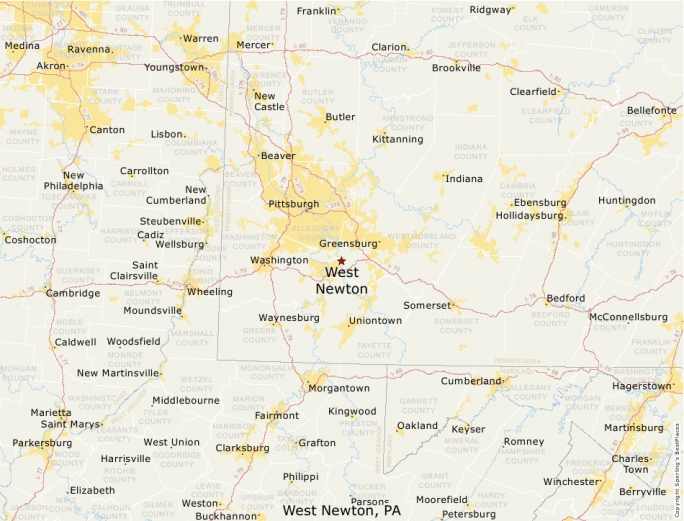
FOOTNOTE: The town of West Newton in nearby Westmoreland County, east of Pittsburgh, responded to the Morgan’s threat by forming a company led by Joseph Markle. The 86-year old Markle was born during the Revolutionary War, had served in the War of 1812 and was a former general of the Pennsylvania militia. When Markle was 17 years old in 1794, Major General Daniel Morgan used the Markle family farm as a stopover as he led his wing on the Federal army against the Whiskey Rebellion. [Robert Van Atta, Pittsburgh Tribune-Review, April 9, 2000] 


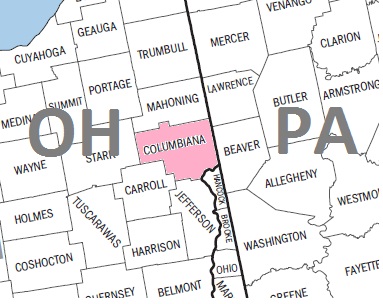
               Morgan’s raid began in June of 1863 in Tennessee and moved in a northern direction. From southern Indiana, Morgan’s Raiders headed due east until they reached Buffington Island, West Virginia. From here, Morgan took a northerly path once more and passed through Steubenville, Ohio. He was captured in late July near West Point in Columbiana County, Ohio, not far from Beaver County, Pennsylvania and just 60 miles northeast of Pittsburgh. 
       
Route of Morgan's Raid
Scott Mingus for Wikipedia
           Morgan began his raid upon the orders of General Braxton Bragg in Kentucky to create a diversion for Robert E. Lee's Army of the Potomac as Lee was marching towards central Pennsylvania and the epic confrontation at Gettysburg. Morgan was under orders from Bragg not to cross the Ohio River into northern territory, an order that Morgan ultimately ignored.

           On his 1000-mile trek, Morgan captured and paroled 6000 Union soldiers, destroyed 34 bridges, disrupted railroad traffic and generally put fear into the populace of several states, including Pennsylvania. Although Morgan never entered Pennsylvania, it was thought that the foundries, factories and federal arsenal in Pittsburgh might be a target.
         

Frank Leslie's Illustrated, 8-8-1863
Looting in Indiana by Morgan's Raiders


              In June, prior to Morgan’s capture, a small meeting of civic leaders was held at the Washington, Pennsylvania courthouse to prepare a defense of the city. Included in the four-man committee were two former officers of the 85th PA, Lieutenant Colonel Norton McGiffin and Harvey Vankirk. Like Vankirk, McGiffin had been medically discharged from the 85th PA in 1862. [Earle R. Forest, History of Washington County, Forest, 1926, p.1029] 

           A warning came from political leader James S. Jennings on June 17 for Greene and Fayette Counties to assemble local militias to meet this potential threat. “An invasion of this State by a large rebel force would be a great public calamity. It would be especially unfortunate for the farmers, who would be robbed of their stocks and produce, or paid in worthless Confederate shin-plaster [paper money]. I incline to the opinion that the Rebels will strike at Pittsburgh. The Cannon Foundries here, the Arsenal, and other establishments render this an important point just now, and it should be held at any expense or sacrifice.” [Waynesburg Messenger, June 17, 1863, p.3] 
             
John Hunt Morgan raid on Washington, Ohio
Harper's Weekly, August 15, 1863

             Local patrols began riding through both Greene and Washington counties. On one evening, some mounted men from Washington County rode into in Greene County. Fearful that they had spotted a Confederate raiding party, they burst through Waynesburg in the style of Paul Revere warning the townspeople that Morgan was on his way. The Confederate raiding party turned out to be simply a Greene County scouting party headed home from their mission to Waynesburg. [Forest, History of Washington County, 1026]


Pittsburgh Daily Post
7-28-1863


Coupled with the Confederate defeat at Gettysburg, PA in early July, the capture of Morgan's men and his imprisonment in Pittsburgh led one newspaper in that city to boast in the article at left: