Showing posts with label Camp Lafayette. Show all posts

Monday, June 15, 2020

"If I Never Get Home, I Hope to Meet You in Heaven."

  •          
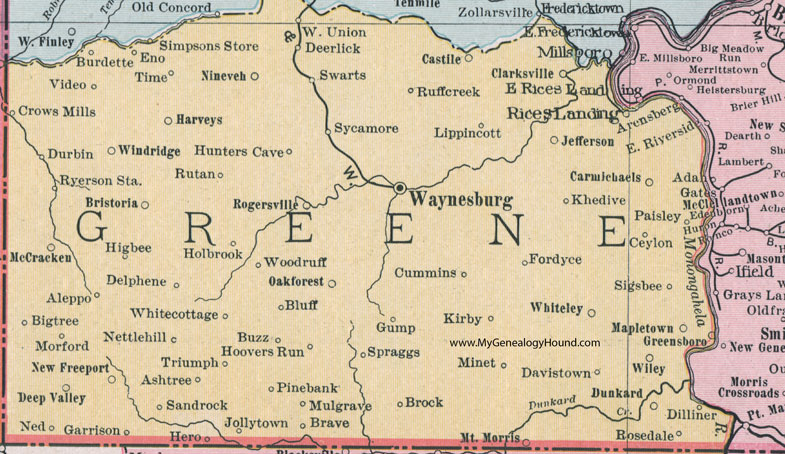
  • Clarksville, Greene County
    from J.A. Caldwell Greene County 1876
    (Pryor household may be in pink section of map)


            One of the saddest stories in the history of the 85th Pennsylvania was that of Wilson and Robert Pryor. They were father and son, both members of Company D from Clarksville, Greene County. The remaining members of their family, particularly Wilson's wife, Catherine, were dealt a cruel fate during the course of the war.

          Wilson and Robert enlisted together into Company D of the 85th Pennsylvania in September of 1861. Wilson was 49 years of age; his son was 18. They served in the regiment together from training camp  in Uniontown, PA,  to fort construction in Washington, DC and  through the Peninsula Campaign in Virginia.

      There are hints that young Robert was the male figurehead of the family for his mother and younger siblings even before the pair went off to war. Wilson Pryor seems to have had an alcohol problem for many years before his enlistment. Robert may have wanted his father in Company D with him to perhaps help him cope with life; their service would also provide a steady income in order to send money home to Clarksville to support the rest of the family.

        Wilson Pryor apparently was ailing during the Peninsula Campaign. Robert wrote home to his mother sometime in the summer of 1862 that, "Pap [Wilson] wants you to try and stay where you are till he gets home if you can. That is if he ever gets home. I hope to God we may both get home safe again. If I ever get home safe you shall never want for anything, but if I never get home I hope to meet you in heaven."

        After 14 months in the regiment, Wilson Pryor was sent home on a medical discharge in early 1863. Mr. Pryor was in poor health when he died a few months later on June 4, 1863. The cause of death was an apparent suicide by hanging in his hometown. He was buried in the Burson Cemetery in Clarksville, Greene County.

         A local newspaper recorded Pryor's death in this blunt manner.  Wilson Prior of Clarksville, in this [Greene] County, committed suicide in an old, unoccupied dwelling of that village on Thursday last. It is supposed he was laboring under mental aberration. His body was not found till Monday morning, when an inquest was held. The deceased was a returned volunteer, and left a large family of children.”'

        In the months between is father's discharge and his death, Mrs. Pryor had to go to efforts to conceal the money sent home by her son. Catherine later stated in an affidavit that Wilson Pryor "...was of intemperate habits [drinking] and that in order to prevent him from squandering the money sent by Robert Pryor, her said son, it was necessary for her to conceal the fact of having received said money from her husband."


Harper's Weekly  February 28,  1863

           The affidavit also stated that Robert was supporting his family even before joining the 85th Pennsylvania regiment. "[he contributed]...two hundred dollars...by laboring at home for his parents." During his nearly three years in the service, he sent $115 home to Catherine as well. The strain to provide for his mother and siblings only increased in the months following his father's death. Plus Robert had to deal with the harsh conditions of the war itself.


           In the late summer of 1863, with his regiment stationed on Morris Island, SC, Robert and his regiment were digging trenches to prepare for a third assault on Fort Wagner. Robert wrote home that, "We are now in sight of Charleston and its defenses. we go within 100 yards of their forts every night and are very much exposed to their shell and canister. One day there was a shell come over and blowed one man all to pieces and wounded 5 men."


LOC


         Writing from Folly Island, SC in the spring of 1863, Robert discussed with his mother the death of his father. Robert wrote, "You said it was reported around Greene County that Pap tryed to hang himself [while he was] in the army. There is nothing of it. It is a lie...Let me know if you can get a house and a lot of about 3 or 4 acres. I don't want you to go back to the old place."

         Several months later, Robert wrote, "You told me Pap was in his right mind when he killed himself. I don't believe he was or he would not have done it."

         Robert, however, added a warning for his younger brother, David. "Tell David to never touch whiskey, Mother. I want you to raise them children wright. I know you can do it and keep on good terms with all the neighbors...Let's quit talking about Pap."

         Robert Pryor remained with the regiment through the Siege of Charleston, South Carolina, and then the  Bermuda Hundred Campaign in Virginia in 1864. 

        At the Second Battle of Deep Bottom, Robert was captured. He may have been a part of a contingent of troops who, after capturing a Confederate earthwork, became overzealous and pursued the retreating enemy into Confederate lines where they were taken prisoner.

         Robert died in captivity from exposure and malnutrition at the infamous


Andersonville prison camp in Georgia. 

        Along with fellow Company D comrade James Meeks, it was assumed the pair had been killed at Second Deep Bottom. But another captured member of Company D, Joseph Burson, lived long enough upon his release to disclose the fates of Meeks and Pryor to his father.


LOC


        Just prior to his capture, Pryor wrote home to his mother that, "I expect to be home in two months. my time is out the 15 of September, that is when my inlistment runs out."

         Corporal Burson of Company D was exchanged but died on the way back to western Pennsylvania. Catherine Pryor received a letter from Burson's uncle informing him of Robert's death in Andersonville. It said, "I received a letter from my brother last night [Joseph] is lying in bed in Annapolis [hospital]. He tells me your son Robert Pryor is dead. My brother said he died of starvation."  

The fate of Catherine Pryor and her family is unknown.                                                                   


Monday, April 27, 2020

Captain John A. Gordon of Greene County

Lt. John Adam Gordon
from M.L.Gordon's Experiences in the Civil War

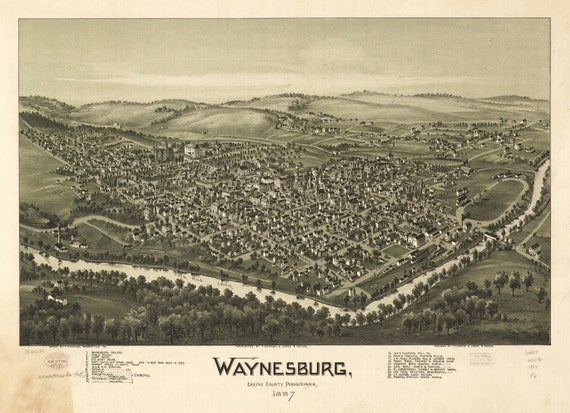
         In 1861, Greene County, Pennsylvania School Superintendent John Adam Gordon was committed to developing news schools and helping to establish a teacher's college when the Civil War broke out. As a pro-Union member of the Democrat party, he resigned from his school position and went organizing a company of soldiers that included
John A. Gordon
his son, Marquis Lafayette Gordon. His troop paraded through the streets of Waynesburg before marching on to the training camp of the 85th Pennsylvania, established at Camp Lafayette in nearby Uniontown, Fayette County. 
     Gordon and his son probably assumed that, as long as they were not wounded or killed, that they would serve together throughout the Civil War. But although both survived the conflict, they actually spent little time together due to shifting responsibilities.
      When Captain Gordon's company arrived at Uniontown to enlist and train, it turned out his unit of about 50 men was too small to sustain a full company, so they were combined with another small company from Fayette County. In this new grouping, Isaac M. Abraham would be the captain and Gordon would serve as his lieutenant.
        After a few months of being stationed at Fort Good Hope near Washington, DC, Lieutenant Gordon was sent back home for recruiting duty at Brownsville, Fayette County in the spring of 1862.


M.L. Gordon
Experiences in the Civil War
         While Lieutenant Gordon was away, his son Sergeant Marquis "Mark" Gordon explained in his postwar memoir, the young man became ill in early May on the Virginia peninsula, spent time in a New York City hospital and did not rejoin his regiment until July. By that time, his father had been transferred out of the 85th Pennsylvania on a semi-permanent basis.
         Wrote Mark, "[My father] returned to the regiment about the end of May, expecting to see me, as he had heard nothing of my sickness. Colonel [Joshua B.] Howell met him with his usual smile, telling him what a splendid soldier I was proving myself to be. When my father told him I was not with the regiment, the colonel was somewhat taken aback. My father was with the regiment at the battle of Fair Oaks [Seven Pines] and through the Seven Days Battles [and] on the retreat to Harrison's Landing. A part of this time he was command of Company I. He knew nothing of me until he saw my name in the list of soldiers taken to New York, and the people of Waynesburg heard nothing either, so some thought I was dead, and I made quite a sensation when I got home."

       Lieutenant Gordon had returned to the regiment in time to participate in the Battle of Seven Pines near Richmond, which Mark Gordon had missed due to his illness. The division leader of the 85th Pennsylvania, General Silas Casey, was unfairly blamed for his men's retreat on the first day of the battle. He was replaced as division commander by General John J. Peck. 
     Mark Gordon continued, "A few days after I got back to the regiment, my father was placed in charge of the Ambulance Corps of General J. J. Peck's division. This made him a staff officer, his designation being 'Acting Assistant Adjutant General of the Ambulance Corps.' The position was a good one, giving him a horse and easier duties but was not quite so much as the high-sounding name would imply. As he did not really return to duty with my company until the last few months of the expiration of our term of service [in November, 1864], it will be seen that, although we were in the same company and regiment we really served together for only a very short time. He was often near us for quite a long while at a time, so I had many pleasant rides on his horse."
LOC
        A clerical error  nearly caused John A. Gordon to be sent to prison as a deserter in early 1863. With then 85th Pennsylvania stationed on Folly Island and Morris Island near Charleston, South Carolina, Lieutenant Gordon had remained at Suffolk with Peck's division. Colonel Howell of the 85th Pennsylvania made a strong request that Gordon be returned to his regiment.
        While Howell's request was being processed by the War Department, Confederate General James Longstreet made several movements towards Suffolk. General Peck's medical director requested that Gordon remain in Suffolk for the time being.
    When Gordon did return to the 85th Pennsylvania a few weeks late, he found that he had been mistakenly listed as
Civil War Ambulance Wagon
National Tribune  3-5-1903  
"absent without leave."  He was set to be court martialed and tried for desertion. But the court martial was overturned by General Quincy Gillmore and President Lincoln, and Gordon quietly returned to the 85th Pennsylvania.
      Later in 1863, Gordon was commissioned to captain.
       John A. Gordon performed one more voluntary service before returning home. As most of the regiment went home in November of 1864 at the end of their three-year enlistments, Captain Gordon was one of 55 men who took part in a special two-month duty. They served as guards for a large-scale prisoner exchange between Point Lookout, Maryland and Savannah, Georgia. Most of the Union prisoners with whom they sailed to the North were in extremely poor physical condition. Gordon may have volunteered because of his familiarity with sick soldiers from his duties in Peck's ambulance corps.

        Prior to the war, Gordon was elected the first Greene County school superintendent in 1854. His first order of business was to take an inventory of schools throughout the county, He determined that Greene County had 154 public schools, almost all one-room school houses, then called common schools. The schools included 167 teachers, ninety percent of whom were males.
     
Early Pennsylvania School House     LOC
          During John A.Gordon's first three-year term, 30 more schools were built that would provide education for "several hundred" more students than in 1854. His four goals were obtaining state funds to defray costs, more visitations to the schools, higher cooperation of parents, and higher quality teachers. Gordon set as a goal keeping the schools open for four months per year.
     Gordon served from 1854-57 and then ran for the office again in 1860. After winning that election, one of his main goals was the establishment of a normal school in the county to train teachers, but this endeavor was interrupted by the outbreak of the Civil War. The war also produced a shortage of teachers, as many of the young men, including Gordon's son, left the classroom to enlist into military service. Instead, Waynesburg College became the main local training ground for local teachers. [Samuel P. Bates, History of Greene County, Pennsylvania, 1888]
       Gordon died in 1898 at the age of 82 and is buried in the Green Mount Cemetery in Waynesburg.