Monday, May 11, 2020

Private Henry K. Atchison of Company G

     
Canning Jar by Henry K. Atchison
Circa 1860
Courtesy of  crockerfarm.com

From the 1890 Veterans Schedule
Special Census of Civil War Veterans
           About 20 or so members of the 85th Pennsylvania regiment suffered the amputation of an arm or leg during the war. One who did and survived was Henry K. Atchison of Company G, who suffered the loss of his right arm in 1864. Atchison did not suffer from a gunshot wound; his arm was not cut off by a doctor. His arm was instantly detached by an artillery shell while Atchison was sitting calmly in camp.
        Atchison was born in 1820 and was 41 years of age when he enlisted into the 85th Pennsylvania in 1861. Like his colonel, Joshus B. Howell, Atchison was born in New Jersey. His parents were Robert and Jane Parshall Atchison. While growing up Henry learned the pottery trade from his father. [Samuel Bates, History of Greene County, 762-3]
        At age 35, he moved to New Geneva, PA in Fayette County and continued his trade for the next six years. He lived in Butler County, PA before moving to Greene County just before the outbreak of the Civil War. He enlisted in Company G, a unit from Greene County, that eventually became part of Howell's 85th regiment.
        Atchison was nearing the end of his three-year enlistment when he was wounded. The regiment spent the summer stationed in the Bermuda Hundred peninsula of Virginia between the James and Appomattox Rivers south of Richmond.
       In August of 1864, they had just returned to their camp near Ware Bottom Church from a grueling week-long campaign north of the James River that culminated in the Second Battle of Deep Bottom that resulted in scores of casualties in the regiment.
      Just three days after their return, they were ordered to march to the Petersburg,VA front upon the orders of General Benjamin Butler of the Army of the James. When the regiment got there in late August, they prepared to attack the Petersburg defenses but the attack was called off. They instead were sent to Fort Morton, perhaps a mile from the famous Battle of the Crater where one month earlier, Union forces ignited a massive explosion beneath a Confederate position but failed in the follow-up assault to pierce the enemy position.
Fort Morton   LOC
        Fort Morton was perhaps less than a mile from the Crater across a valley, In the valley was a stream where soldiers from both sides would meet and exchange items during lulls in the shelling.
     Colonel Howell described the position in a letter to his family. "...here we are in front of the celebrated city of Petersburgh. My command is a mile and a quarter from the city. The steeples of the churches and the clock are plainly in sight of my forts. The celebrated Burnside mine and crater are directly in front of us. About 300 yards from us are two of my forts. We are under heavy fire of artillery and musketry the entire day and night --shell and ball (rifle and artillery) fly about headquarters with a 'perfect looseness.' An orderly's horse was shot this morning just in front of my quarters. A shell exploded over my quarters about 30 paces beyond it in front whilst I was asleep yesterday morning." [Book of John Howell and His Descendants, Volume II, 452]
     Indeed their position seemed to be perilous. Two privates, John Cairney and Joseph Banks, were struck with the same bullet from a Confederate sharpshooter as they were delivering food to the soldiers on the picket line.
   
LOC
      There are several versions of Atchison's wounding which occurred on September 1, 1864 that all basically tell the same story. The first comes from Sergeant M.L. Gordon who was a member of Atchison's company
         "We were right in front of the mine that had exploded a few weeks before. Here firing was going on almost all the time, day and night. Our camp was in easy range of the enemy's guns. One day I was standing in camp, talking to a friend named Myers Titus, when a cannon-ball came over, struck in a tent near us, where 'Skeety' Atkinson [sic] was writing, cut his arm off near the shoulder, and passed on between my friends and me as we were talking."  [M.L. Gordon, Experiences in the Civil War, 20]
        Regimental historian Luther S. Dickey recorded that, "...on September 1, Private Henry K. Atchison of Company G, while sitting in camp making our muster rolls, had an arm shot off by a solid shot or unexploded shell from the enemy's artillery." [Dickey, History of the Eighty-Fifth Regiment Pennsylvania Volunteer Infantry, 374]
        A soldier from another regiment in their brigade, Homer Plimpton of the 39th Illinois, mentioned Atchison's wounding in his journal. "...an old man of the 85th Pa. was struck in the shoulder by a fragment of a shell while making out company payroll in the captain's tent. The arm was so shattered that it hung merely by the nerve and artery and a small bridge of integument. It was removed at the shoulder joint and although he was sixty years of age [actually 44] he bids fair to make a good recovery." [The Civil War Journals of Col. Homer A. Plimpton, John L. Dodson, ed. 2012, p . 354]
      Atchison survived the wound. He was a prominent potter prior to the war. Several of his pre-war creations have recently been sold at online auctions for thousands of dollars.They can be seen here,  here and here.
       Atchison began receiving a government pension for the loss of his arm in 1874. By 1883, he was receiving a payment of $24 per month.
        After the war, he is still listed as a potter in the 1870 census. More likely is that he was either running the family business or training two of his sons in the trade. Sons James and Henry are listed as potters still living with their parents.


        Ten years later, Atchison is listed in the census as a "U.S. Storekeeper," [below] a government position that often went to soldiers who had suffered from amputations in the war. A third son, Charles,was now listed as a potter.


        Atchison died in 1893 at the age of 73 and is buried in the Monongahela Hill Cemetery in Greensboro, PA in Greene County.
 
Headstone Application


Monday, May 4, 2020

The 85th Pennsylvania and the Peninsula Campaign


Map by Hal Jespersen       www.cwmaps.com
 
     [NOTE: The participation of the 85th Pennsylvania is described in more detailed fashion in a Chapter 4 of my book, "Such Hard and Severe Service: The 85th Pennsylvania in the Civil War."
          I am also currently chronicling the 85th Pennsylvania during the Peninsula Campaign on my Facebook blog called "85th Pennsylvania Civil War Page." That blog  follows the regiment on a day to day basis.]

          The Peninsula Campaign was the costliest military campaign in which the 85th Pennsylvania was ever involved. Seventy-eight men died during the approximately four-month operation from April to early July of 1862. Two thirds of the deaths resulted from diseases. Another seventy-two men were medically discharged and sent home.
General George B. McClellan   LOC
          After initially being stationed in Washington, DC in 1861-62, the 85th Pennsylvania sailed away from the nation's capital in the spring of 1862 to participate in the Peninsula Campaign. This was General George B. McClellan's grand effort to capture the Confederate capital city of Richmond, VA by executing an amphibious landing at Fort Monroe and marching up the Virginia peninsula between the James and York rivers towards their objective seventy miles away.
        Due to McClellan's delays, misjudgment of the enemy strength and the emergence of Robert E. Lee as the leader of the Army of Northern Virginia, the Union campaign ended in failure. McClellan withdrew his army from the peninsula in July of 1862. It took two years for the Union to once again threaten the capital city of the Confederacy.
       The Peninsula Campaign had long-term repercussions, mainly the cold realization for the Union that the war would not end quickly. President Lincoln called for a draft in which the states would provide 300,000 additional troops to subdue the rebellion.
       The Peninsula Campaign would comprise a series of battles beginning with the Yorktown siege and Battle of Williamsburg in early May, at Seven Pines and then the Seven Days Battles. The 85th Pennsylvania was heavily involved in the first-day fighting at Seven Pines but sent to the rear for the ensuing Seven Days Battles. Finally, the 85th Pennsylvania was among the Union regiment which were tasked with helping guard McClellan's retreat to Harrison's Landing in July.
       At the outset, the march up the peninsula took its toll on McClellan's army. This was especially true for the regiments (including the 85th) of General Silas Casey's Division of Erasmus Keyes' IV Corps. Casey's Division was the most inexperienced in McCellan's army, not yet fully trained when they left Washington, DC. Casey's men lacked basic supplies for weeks and often had to haul supplies over rain-soaked and muddy roads.
       The 85th regiment marched out of Newport News at the bottom of the peninsula on April 16 and
Soldiers Assisting with Lowe's Balloon    LOC
were soon encamped at Camp Winfield Scott near Warwick Court House. They were stationed here for two weeks on McClellan's left flank while Union forces prepared for a siege of Yorktown, famous of being the site of the British defeat at the hands of George Washington's Continental Army in 1781 that effectively ended the Revolutionary War. Immediately upon arriving at Warwick Court House, Company A of the 85th Pennsylvania was detailed to help Professor Thaddeus Lowe launch his observation balloon on April 17.
         McClellan finally struck at Yorktown on May 4, only to find the much smaller Confederate force had abandoned the fortification the previous night. As the Confederates were marching away from Yorktown,  Union forces caught up to their rearguard. The Battle of Williamsburg ensued on May 5. During this battle, casualties numbered 4000 (2300 on the Union side).With Colonel Joshua B. Howell of the 85th Pennsylvania replacing the severely ill brigade leader General William Keim, the regiment was called into a line of attack in a reserve role. Although they stayed aligned in formation during a cold night of freezing rain and were targeted by Confederate artillery, the regiment was not called upon to enter the battle. Two of their men were wounded by shells; one (Sergeant Daniel Miller of Company K, the regiment's first man to fall in battle) fatally.
         The IV Corps of General Erasmus Keyes, which included the divisions of Casey and Darius Couch, continued towards Richmond and crossed the Chickahominy River in late May. The III Corps of Samuel Heintzelman soon followed. While the III Corps stayed close to the Chickahominy, Keyes' Corps advanced. Couch's Division established a camp at Seven Pines; Casey's Division advance another 3/4 of a mile and set up a camp at Fair Oaks. Why McClellan would place his smallest and least-experienced division at the vanguard of his army just three miles from Richmond in an exposed position remains a mystery.
      Noting the vulnerable position of McClellan's split army, Confederate General Joseph Johnston decided to attack the two Union corps on the last day of May following a torrential rainstorm that swelled the Chickahominy. This would make it difficult or perhaps impossible for McClellan to reinforce Keyes and Heintzelman across the suddenly fast-moving waters of the  Chickahominy.
Map by Hal Jespersen           www.cwmaps.com
     Despite being severely reduced by disease and being outnumbered 2-to-1 or 3-to-1, Casey's Division valiantly held off the Confederates for 2-3 hours before being enveloped on three sides and retreating. For this they were severely rebuked by McClellan, who was far behind the fight hobbled by an attack of malaria. But because of the effort of Casey's men, the Union had time to get additional men into the fight from across the Chickahominy that stabilized the field for the Union and kept the Confederates from swallowing up nearly half of McClellan's army.   
        The two-day battle of Seven Pines ended with no decisive winner. It did result in 11,000 casualties, mostly on the Confederate side. It was the largest battle in the East up until that time and the closest ever fought near Richmond.
        Casey's Division, which took more casualties than any other Union division on the first day of the fight,was sent to the rear for the next month. Silas Casey, erroneously scapegoated for retreating on the first day, was replaced by John J. Peck.
       For three weeks, the 85th Pennsylvania was stationed on McClellan's extreme left near White Oak Swamp. The had no tents or knapsacks, which were left behind at Seven Pines. Scores of men got sick in this environment and many died. Camp hospitals were filled; their doctors were called away to help with the wounded from the Seven Days Battles. The 85th Pennsylvania did no fighting during the Seven Days Battles; instead they were tasked with several reconnaissance missions and with digging entrenchments, They were in a reserve role for the final encounter Malvern Hill.
       When McClellan decided to abandon the peninsula, his army was ordered to march from Malvern Hill to Harrison's Landing for the withdrawal. Peck's division was tasked with guarding the withdrawal. The irony did not escape the 85th Pennsylvania and other regiments from Casey's former command. Once shamed for retreating from Seven Pines,  it was now their task to monitor the retreat of the rest of McClellan's huge army.
    The 85th Pennsylvania, now part of a brigade led by General Henry Wessells who was named Keim's permanent replacement, marched back down the peninsula to Hampton, VA. While the rest of McClellan's army was shipped to northern Virginia for the Battle of Second Bull Run, Wessells' Brigade was sent to Suffolk, VA where they spent the next four months.
Union Retreat from Harrison's Landing, VA
Frank Leslie's Illustrated


Monday, April 27, 2020

Captain John A. Gordon of Greene County

Lt. John Adam Gordon
from M.L.Gordon's Experiences in the Civil War

         In 1861, Greene County, Pennsylvania School Superintendent John Adam Gordon was committed to developing news schools and helping to establish a teacher's college when the Civil War broke out. As a pro-Union member of the Democrat party, he resigned from his school position and went organizing a company of soldiers that included
John A. Gordon
his son, Marquis Lafayette Gordon. His troop paraded through the streets of Waynesburg before marching on to the training camp of the 85th Pennsylvania, established at Camp Lafayette in nearby Uniontown, Fayette County. 
     Gordon and his son probably assumed that, as long as they were not wounded or killed, that they would serve together throughout the Civil War. But although both survived the conflict, they actually spent little time together due to shifting responsibilities.
      When Captain Gordon's company arrived at Uniontown to enlist and train, it turned out his unit of about 50 men was too small to sustain a full company, so they were combined with another small company from Fayette County. In this new grouping, Isaac M. Abraham would be the captain and Gordon would serve as his lieutenant.
        After a few months of being stationed at Fort Good Hope near Washington, DC, Lieutenant Gordon was sent back home for recruiting duty at Brownsville, Fayette County in the spring of 1862.


M.L. Gordon
Experiences in the Civil War
         While Lieutenant Gordon was away, his son Sergeant Marquis "Mark" Gordon explained in his postwar memoir, the young man became ill in early May on the Virginia peninsula, spent time in a New York City hospital and did not rejoin his regiment until July. By that time, his father had been transferred out of the 85th Pennsylvania on a semi-permanent basis.
         Wrote Mark, "[My father] returned to the regiment about the end of May, expecting to see me, as he had heard nothing of my sickness. Colonel [Joshua B.] Howell met him with his usual smile, telling him what a splendid soldier I was proving myself to be. When my father told him I was not with the regiment, the colonel was somewhat taken aback. My father was with the regiment at the battle of Fair Oaks [Seven Pines] and through the Seven Days Battles [and] on the retreat to Harrison's Landing. A part of this time he was command of Company I. He knew nothing of me until he saw my name in the list of soldiers taken to New York, and the people of Waynesburg heard nothing either, so some thought I was dead, and I made quite a sensation when I got home."

       Lieutenant Gordon had returned to the regiment in time to participate in the Battle of Seven Pines near Richmond, which Mark Gordon had missed due to his illness. The division leader of the 85th Pennsylvania, General Silas Casey, was unfairly blamed for his men's retreat on the first day of the battle. He was replaced as division commander by General John J. Peck. 
     Mark Gordon continued, "A few days after I got back to the regiment, my father was placed in charge of the Ambulance Corps of General J. J. Peck's division. This made him a staff officer, his designation being 'Acting Assistant Adjutant General of the Ambulance Corps.' The position was a good one, giving him a horse and easier duties but was not quite so much as the high-sounding name would imply. As he did not really return to duty with my company until the last few months of the expiration of our term of service [in November, 1864], it will be seen that, although we were in the same company and regiment we really served together for only a very short time. He was often near us for quite a long while at a time, so I had many pleasant rides on his horse."
LOC
        A clerical error  nearly caused John A. Gordon to be sent to prison as a deserter in early 1863. With then 85th Pennsylvania stationed on Folly Island and Morris Island near Charleston, South Carolina, Lieutenant Gordon had remained at Suffolk with Peck's division. Colonel Howell of the 85th Pennsylvania made a strong request that Gordon be returned to his regiment.
        While Howell's request was being processed by the War Department, Confederate General James Longstreet made several movements towards Suffolk. General Peck's medical director requested that Gordon remain in Suffolk for the time being.
    When Gordon did return to the 85th Pennsylvania a few weeks late, he found that he had been mistakenly listed as
Civil War Ambulance Wagon
National Tribune  3-5-1903  
"absent without leave."  He was set to be court martialed and tried for desertion. But the court martial was overturned by General Quincy Gillmore and President Lincoln, and Gordon quietly returned to the 85th Pennsylvania.
      Later in 1863, Gordon was commissioned to captain.
       John A. Gordon performed one more voluntary service before returning home. As most of the regiment went home in November of 1864 at the end of their three-year enlistments, Captain Gordon was one of 55 men who took part in a special two-month duty. They served as guards for a large-scale prisoner exchange between Point Lookout, Maryland and Savannah, Georgia. Most of the Union prisoners with whom they sailed to the North were in extremely poor physical condition. Gordon may have volunteered because of his familiarity with sick soldiers from his duties in Peck's ambulance corps.

        Prior to the war, Gordon was elected the first Greene County school superintendent in 1854. His first order of business was to take an inventory of schools throughout the county, He determined that Greene County had 154 public schools, almost all one-room school houses, then called common schools. The schools included 167 teachers, ninety percent of whom were males.
     
Early Pennsylvania School House     LOC
          During John A.Gordon's first three-year term, 30 more schools were built that would provide education for "several hundred" more students than in 1854. His four goals were obtaining state funds to defray costs, more visitations to the schools, higher cooperation of parents, and higher quality teachers. Gordon set as a goal keeping the schools open for four months per year.
     Gordon served from 1854-57 and then ran for the office again in 1860. After winning that election, one of his main goals was the establishment of a normal school in the county to train teachers, but this endeavor was interrupted by the outbreak of the Civil War. The war also produced a shortage of teachers, as many of the young men, including Gordon's son, left the classroom to enlist into military service. Instead, Waynesburg College became the main local training ground for local teachers. [Samuel P. Bates, History of Greene County, Pennsylvania, 1888]
       Gordon died in 1898 at the age of 82 and is buried in the Green Mount Cemetery in Waynesburg.

Monday, April 20, 2020

Profile of Principal Musician Henry L. Regar

   
Henry L.Regar
Courtesy of John Regar

         When Henry L. Regar died at the age of 86 in 1912 in his hometown of Connellsville, Fayette County, it marked the end of an era. Regar was the last surviving Pennsylvanian who had served in both the Mexican War and the Civil War. A drummer boy during the Mexican War, he rejoined the 85th Pennsylvania during the Civil War and became the drum major of the regimental band.
          A 1903 profile stated, "It takes quite an effort to imagine that the quiet, peaceful tailor who cuts and rips and sews in Mace & Co.'s department store helped charge the City of Mexico with the gallant Eleventh infantry and fought with McClellan at Coal [sic] Harbor and Malvern Hill." [Weekly Courier, Connellsville, PA, 2-13-1903]
        The article exaggerated on a few points. General George B. McClellan was not at "Cold" Harbor, and neither was Regar and the rest of the 85th Pennsylvania for that matter. Nonetheless, the point was that a resident of Connellsville at that time would not have assumed that the soft-spoken Regar was a veteran of two wars.
        He enlisted into Company H of the 85th Pennsylvania as a musician in 1861. Regar was 35 years of age but felt the desire to serve his country once again. Near the end of 1862, he was promoted to one of two principal musicians in the regimental band along with Samuel Woods of Company C.
        After the Civil War, besides working as a tailor, Regar worked in the theatrical business for twenty years. He is buried in the Hill Grove Cemetery in Connellsville, Fayette County.
        Regar was born in 1826 in Connellsville to parents Solomon and Rebecca Vance Regar [the name has also been variously spelled, Reger, Reager, Regour and Reggar] Henry was about 20 years of age when he left Fayette County to join the 11th United States Infantry regiment during the Mexican War.
        A newspaper account from the 20th century stated that Regar tried to enlist into a Connellsville regiment but was turned down as being too young at age 14. [Again this appears to be an exaggeration. Interestingly, the same article states that Regar was 87 at the time of this profile (1912), making his birth year around 1826. If he had tried to enlist at age 14, he would have been born around 1832]. The article goes on to state that Regar then went to Pittsburgh and successfully joined the 11th U.S. Volunteers. [Daily Courier, 2-26-1912]
       The 11th infantry was under the command of Colonel Albert C. Ramsey in the brigade of Brigadier General George Cadwalader and included future Civil War officers William Taliaferro and John Gregg. Taliaferro, from Virginia, became a Confederate general in the Civil War. Gregg earned the rank of brevet general for the Union in the cavalry by the end of the Civil War. Most of the men in the regiment were from Pennsylvania; some came from Virginia and Delaware.
       The 11th participated in the battles of Cerro Gordo, Chapultapec and Mexico City. Regar remembered,
        “I served throughout the war in Company K, Eleventh United States Infantry.  The Eleventh Regulars lost over two-thirds of its members in the battles in and around the City of Mexico…The bloody climax…came when the regiment entered the city, crowding the aqueduct and battering down the heavy gates of the city. Once inside, the fighting coursed up the plaza…fighting their way from square to square and from street to street…Of the 800 men which started in the campaign with the regiment, only 200 were left. My regiment followed the defeated and retreating Mexican Army, after the battle and capture of the City of Mexico, over the mountains and into the Valley of Lerna.” [Weekly Courier, 2-12-1903]
Thomas Knox, Decisive Battles Since Waterloo, 1887

         A Pennsylvania soldier from the 11th regiment gave this account about a fight at Molina del Rey in September of 1847.

         "The 11th was ordered to charge the battery....The 11th had to charge over the same ground where fell so many of our gallant troops....They advanced steadily, but now the enemy is vomiting his grapeshot and canister upon them, and they leave a train of dead and dying. Do they falter? No -- their gallant commander is waving his sword, and they are now rushing forward at a full run...Did you hear that shout? Comes it from the Mexican ranks? No! That is true Pennsylvania shout,and tells of danger defied, and glory to be won. Here they go, onward, up to the enemy's guns.  Huzza for the old Keystone! The Mexicans are giving way before our gallant little band..." [Public Ledger, Philadelphia, 11-8-1847]

        In the Civil War, Regar stayed with his regiment for three years until his enlistment expired.

        “I entered the service as a private. I was afterward promoted to Corporal, and later, after the battle of Fair Oaks [Seven Pines], was made Drum Major for bravery in action. This position, although on the non-commissioned staff, I did not like. I accepted it at the suggestion of the Colonel [Joshua B. Howell], who promised me a commission, but the commission never came my way.” [Weekly Courier, 2-13-1903]

LOC
       After the war, Regar worked as a tailor and was a member of the Connellsville school board for two terms. He was also a member of the Silver Coronet Band of Connellsville. The group, clad in gray uniforms with red-plumed helmets, won numerous competitions. They participated in the Philadelphia Centennial in 1876 and the inauguration of Pennsylvania Governor Henry M. Hoyt in 1878. [Daily Courier, 3-1-1913]


         In 1906, during the centennial celebration for the town of Connellsville, double-war veteran Regar was an honored guest who was part of an automobile parade through the city streets. [Daily Courier, 11-17-1952]
Decorated Street of Connellsville for 1906 Parade
Centennial History of the Borough of Connellsville, Pennsylvania 1806-1906

             Regar's obituary in 1912 mentioned that he "was an entertaining conversationalist and had a host of friends in and around Connellsville." He was married to his wife, Rebecca Robbins Regar, for 64 years and was the father of seven children. The story also mentioned that he was wounded during both wars. [Daily Courier, 9-21-1912]
            In a 1903 profile of Regar by a local newspaper, Regar stated, "My opinion of the two wars is that the Mexican was more terrific and successful for it was fought from start to finish without a single drawback of defeat, although at all times we were fighting against long odds. i will say in conclusion, however, that I want to live to see the time when wars are over and when arbitration will settle disputes, for war is of the devil and not of God."

Monday, April 13, 2020

Profile of Surgeon Samuel Longacre Kurtz

       
Dr. Kurtz and wife Sarah   1861
Courtesy of Eleanor Hancock
             The above photo shows Army Surgeon Samuel L. Kurtz and his wife, Sarah Morgan Kurtz. The photo was taken in late 1861 when Sarah visited her husband at training camp in Philadelphia. At the time, the 28-year old Kurtz was an assistant surgeon with the 11th Pennsylvania Reserves, also known as the 40th Volunteer Regiment. On June 3, 1862, just days after the Battle of Seven Pines, Kurtz was transferred to the 85th Pennsylvania and was promoted to head surgeon. He held this position for the next 32 months until he completed his service and returned home to Reading, Pennsylvania.
         Kurtz replaced Surgeon John B. Laidley of Carmichaels, Greene County, who was medically discharged from the 85th Pennsylvania in May of 1862.
        In the photo, Kurtz is proudly dressed in his uniform including his officer's sword. Years later,
LOC
Kurtz' granddaughter, Georgeine, asked him about the sword that he wore in the photograph. Kurtz replied, "The Rebels sank it in the James River." He state that the sword was on a baggage raft that was sunk by the enemy, probably in August of 1864 when the regiment was returning to their base in the Bermuda Hundred area of Virginia after a bloody fight at Second Deep Bottom.
        Kurtz lost a prized sword, but later, acquired an even more precious possession. When the men in the 85th Pennsylvania were winding down their three-year enlistment in the fall of 1864, they pooled their money and bought a complete surgeon kit in an engraved chest for Dr. Kurtz. It was one of his proudest possessions for the remainder of his life. It was a striking gesture for the man who cared for them when they were wounded, sick and for many, on their deathbeds. It was somewhat ironic because Kurtz was from eastern Pennsylvania, unlike most of the regiment than hailed from the southwestern corner of the state.

Reading Times   1-2-1865


       The presentation of the gift was chronicled in a Reading, PA newspaper shortly after Kurtz returned home from the war in early 1865. 


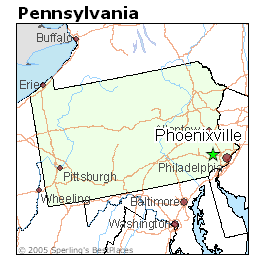
       Kurtz was born on September 27, 1832 in Chester County, PA. He graduated from Jefferson Medical College in Philadelphia in 1854. Prior to the war he practiced medicine in Phoenixville (Chester County) and Oakland Mills (Juniata County). He settled in Reading  (Berks County) and practiced medicine there for 40 years. In 1891, he was elected as the president of the Pennsylvania State Medical Society. 

Gift Medical Chest of Dr. Samuel L. Kurtz
On the right is Kurtz' granddaughter Georgeine Gruver
Reading Eagle   2-19-1967   p.44


        During the Civil War, Kurtz was involved in a bizarre battlefield incident that resulted the the death of musician Lemuel Thomas. It occurred on the first day of the regiment's six-day mission near Richmond in which they fought at Second Deep Bottom. 
        Musicians often served as doctor's assistants during a fight. As described by 85th Pennsylvania historian Luther S, Dickey, “Musician Lemuel Thomas of Company C, was on duty with Surgeon Kurtz of the Regiment assisting in caring for the wounded. Surgeon Kurtz was standing with an arm resting against a tree when a cannon ball from a battery of the enemy ricocheted, striking the heel of his shoe and then bounded to the head of Musician Thomas, fracturing his skull from which he died the following day. Although painfully wounded by the enemy's missile Surgeon Kurtz remained on duty.” [Dickey, History of the 85th Regiment Pennsylvania Volunteer Infantry,  p. 377]
      The 24-year old Thomas was from Fayette City, Fayette County. He is buried in the Hampton (VA) National Cemetery. 
       Kurtz was later involved in helping the wounded at the Battle of Darbytown Road near Richmond on October 13, 1864. By this point in the war, according to the following account by Dr. Charles Clark of the 39th Illinois, Kurtz and other surgeons of their brigade were moved close to the battlefield to provide more immediate care to the wounded. Both the 85th Pennsylvania and the 39th Illinois were part of the First Brigade of Colonel Francis B. Pond during the battle. The 85th Pennsylvania suffered only a few wounded at Darbytown Road but losses by the rest of their brigade were in the hundreds.
       Dr. Clark wrote, "The writer’s experiences at this battle [Darbytown Road] were unusually disagreeable…On the morning of the 13th [of October], he with other surgeons of the First Division of the Tenth Corps were ordered by the Medical Director to take the field and follow the command with strict orders to keep within 300 yards of the line of battle. When the First Brigade were preparing and forming to assault the rebel redoubt, he took the position behind a corn-crib in the yard of the Gerault house. As the Brigade advanced, there was a painful hush, like that of an audience awaiting some terrible denouement. Then came the roar and rattle of guns and a rain of shell and grapeshot in a most careless manner, shattering the old crib and scattering splinters and debris in all directions. One ambulance horse was killed and the driver wounded, and much other damage done. The wounded soon came back in numbers…Finding our position untenable, we felt justified in transgressing orders and removed to the left and rear inside an old earthwork where at last we could give our undivided attention to our work without fear of being either killed or wounded. The wounded…were sent back to the corps hospital some three miles distant." [Clark, Yates Phalanx, p. 179]
     
     After the war, upon reestablishing his practice in Reading, Kurtz won the trust of local residents when he treated a group of children involved in an accidental explosion. A group of boys were playing with gunpowder at a canal near his office when the explosion occurred. Kurtz treated their injuries effectively and the new doctor won the trust of his neighbors. 
        Kurtz married Sarah Morgan in 1854. Together they had two sons and a daughter. His two sons, Julius and Clarence, also became doctors. (Morton Montgomery, Biographies from Historical and Biographical Annals, p.399)
        Kurtz died on April 21, 1921 at the age of 88. He had practiced medicine for 60 years. At the time of his death, he was the oldest practicing physician in Reading. He is buried in the Charles Evans Cemetery in Reading. 
   

Monday, April 6, 2020

Home on Furlough 1864


Harper's Weekly
February, 1864

        After a hard campaign around Charleston, SC that resulted in the capture of Morris Island (but not the fall of Fort Sumter and Charleston) the 85th Pennsylvania spent the first few months of 1864 in relaxed duty on Hilton Head Island.
        While stationed there, the Union hierarchy made a concerted effort to have as many regiments as possible reenlist beyond their original 3-year commitments. If a certain percentage of men in a regiment re-enlisted, they earned the designation of being called "veteran volunteers."
      The other three regiments in the brigade of the 85th Pennsylvania all earned this distinction. They were the 62nd Ohio, 67th Ohio and 39th Illinois. Although a number of 85th Pennsylvanians re-enlisted, not enough extended their service to earn the distinction of being called a veteran volunteer regiment.
Waynesburg (PA) Messenger     3-16-1864,    p.3
       In my book, Such Hard and Severe Service: The 85th Pennsylvania in the Civil War, I detail the efforts of their officers to encourage their men to re-enlist and explore the reason more men did not sign on for extended service.
       Those that did re-enlist earned an immediate 30-day furlough to go back home to visit family and friends; also some states used the furloughed men to recruit new men from their home areas. Another inducement may have been cash payments in the hundreds of dollars from their local and/or county government. This helped fill a quota of men the locality was expected to furnish towards the war effort.
       Only about a hundred or so men re-enlisted from the 85th Pennsylvania. The article at the right is from a Greene County newspaper of the time, the Waynesburg Messenger. It lists a number of Greene Countians, mostly from Companies F and G, who returned home on leave in early 1864 under the command of Lieutenant Levi Rogers.
       Unfortunately, when they returned to army duty, less than half of the men in this group made it unscathed through the rest of the war. The article mentions 23 men from the 85th Pennsylvania who visited Waynesburg. When their month was over and they returned to the war, three were killed, seven were wounded, two died from disease and one was captured. The rest returned to the war and survived without dying or being wounded.
    It should also be noted that none of the men who were killed or hurt died as a result of extending their service. All fell during the period of their original enlistment, which ended in November of 1864.

           Below is the list of the men in the same order they are named in the news article, as well as what happened to them during and after the war.


Soldiers Home on Furlough
Harper's Weekly
January 23, 1864
Lieutenant Levi Muncy Rogers was severely wounded in the hip at the Battle of Second Deep Bottom outside of Richmond in August of 1864. He died three weeks later at a hospital at Fort Monroe, VA. He is buried in the Hampton (VA) National Cemetery.
Sergeant Elmore A. Russell was wounded four times during the war. His most severe wound was suffered at Second Deep Bottom where he was shot in the arm. Russell survived the war and settled in Texas for the last four decades of his life. His occupations included teacher, farmer, fruit-grower, postmaster and city councilman. He died in 1912 at Lamar, TX at the age of 70.
Sergeant Alonzo Lightner was killed at the Second Battle of Deep Bottom. He was about 24 years of age.
Corporal Thomas J. White survived the war and settled in Nebraska where he worked as a printer. He was one of eight members of the regiment who earned a "Gillmore" Medal for meritorious service during operations on Morris Island, SC in 1863. White died in 1896 and is buried in Arlington National Cemetery in Virginia. 
Corporal John N. Durbin was wounded in the leg at Darbytown Road near Richmond on October 13, 1864. He died in 1897 and is buried in Greene County.
Corporal Thomas M. Sellers was wounded at the Battle of Second Deep Bottom but survived. He became a farmer in Kansas and a horticulturalist in Texas after the war. He died at the age of 86 in 1932 and is buried in Houston.
Civil War Song Sheet  LOC
Corporal John D. Haveley was wounded at Second Deep Bottom but stayed in the army until the end of 1865. He died around 1880.
Private William E. Leonard was awarded a Medal of Honor for the capture of an enemy flag at Second Deep Bottom, where he also suffered a head wound.
Private Lisbon Scott was captured in May of 1864 during the Bermuda Hundred Campaign. After nearly a year, he was released from Andersonville Prison in Georgia. He went home to Greene County and served as a county commissioner. Scott died in 1917.
Private John Rizor was born in Marshall County, VA (later West Virginia) and served until 1865. He died in 1919 and is buried in Belmont County, Ohio.
Private Isaac Gray was wounded twice prior to his furlough. He served until 1865 and then returned to his life as a farmer in Greene County. He died in 1906.
Private George Pettit suffered a facial wound at Second Deep Bottom. He returned home and worked as a farmer in West Virginia. He patented a self-closing farm gate in 1897. Pettit died in 1917.
Private Jackson Kimble had his right arm amputated after being wounded at Second Deep Bottom. He died in 1913 and is buried in Greene County.
Private James Huffman returned to Greene County and his life as a farmer after the war. He died in 1911.
Private Jacob Huffman was wounded at Darbytown Road in October of 1864. He died in 1927 at the age of 86 and is buried in Illinois.
Private David Fry served in the regiment for four years and three months. Returning after the war to Greene County, he had a wife, Mary, and four children. He died in 1907.
Private Henry Fry was shot and killed while on picket duty at Ware Bottom Church on June 17, 1864. He was survived by his wife and three children.
Private Andrew J. Morris returned from his furlough and soon died from smallpox in April of 1864. He is buried in the Beaufort National Cemetery in South Carolina.
Private Alfred McDonald returned from his furlough and contracted jaundice. He died in October of 1864 at the age of 44. He is buried in the Hampton (VA) National Cemetery. McDonald was survived by his wife, Christina, and four children.
LOC


Private John Rush was one of three men named John Rush in the regiment, all from Greene County. This is probably John J. Rush, who returned to Greene County after the war. He died in 1914.
Private William Seabold survived the war and moved to Ohio. He died in 1918 and is buried in West Jefferson, Ohio.
Private Thomas Rinehart returned home to Greene County after four years of service. He died in 1922 at the age of 86.
Private Andrew Frakes lived in Ohio and West Virginia after the war before returning to Greene County. He died in 1922 at the age of 76.


Monday, March 30, 2020

Charles Cox and Lt. Robert G. Taylor

 
Charles Cox
from  Percy Hart's History and Directory of the Three Towns, 1904, p.167
        
        An interesting relationship that developed in the 85th Pennsylvania during the war was between Lieutenant Robert Gillis Taylor of Company E and Charles Cox of Virginia. It was a relationship that seemingly lasted nearly 40 years and ended with a strong sense of irony as the two men passed away on the same day in 1899.
        To be frank, this article includes much speculation about Cox because records of his life are extremely sparse. The writer hopes the reader will indulge his speculations and assumptions.
         Two questions about the Taylor-Cox connection remain unanswered. What was their relationship after the Civil War, and how did Charles Cox become a prosperous member of the Brownsville, Pennsylvania community?
         Let us begin with Taylor's war service. Lieutenant Taylor enlisted at the age of 27 into Company E at Washington, PA. He was likely recruited by Captain Henry A. Purviance, the co-publisher of a Washington, PA newspaper. [See last week's post for a profile of Purviance].  Taylor served as a first lieutenant along with Thompson Purviance, a young cousin of Henry Purviance who was killed at Seven Pines.
        Taylor spent 13 months in the 85th Pennsylvania. He is listed as having been wounded at Seven Pines on May 31, 1862. He was medically dismissed for "partial paralysis" almost six months later on November 22, 1862.
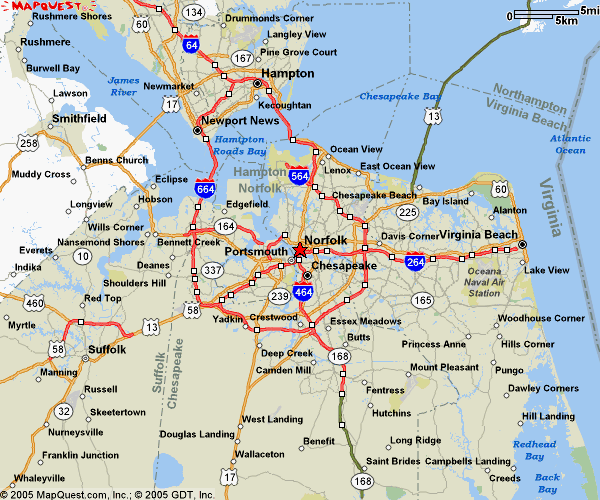
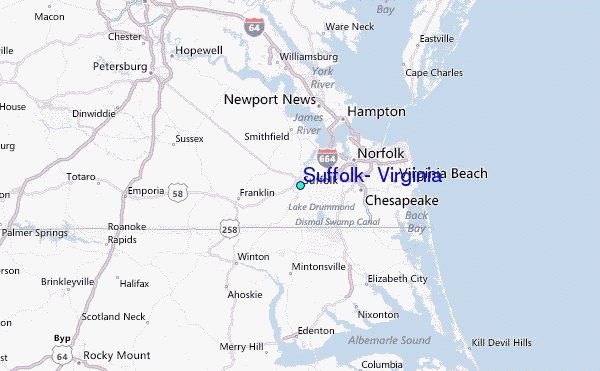
        When Taylor returned to Washington County, he was accompanied by an African-American from Virginia named Charles Cox. One source noted that Cox was from the area of Norfolk, Virginia. If so, they two probably met either when the regiment landed at Hampton Roads for the Peninsula Campaign in April of 1862 or while the regiment was stationed at nearby Suffolk, VA between September and December of 1862. Cox may have been a free man, but more likely a displaced slave who became employed by Taylor as a valet or cook during Taylor's time in the army. Cox may soon have tended to Taylor's physical needs in camp as a result of the paralysis.
      At the time of the meeting between Cox and Taylor, the issue of emancipation of slaves was highly controversial. President Abraham Lincoln had issued the Emancipation Proclamation on September 22, 1862. It was to take effect on January 1, 1863 for slaves in the states of the Confederacy. Many Americans, including Union soldiers, spent the fall of 1862 debating the issue. While abolitionists were pleased, many other northerners were concerned that the primary goal of the war, which so far had been saving the Union, would be superseded by freedom for slaves.
       Cox was around 50 or so years old when the two returned to western Pennsylvania together. Perhaps Taylor, who seems to have come from a well-to-do family (a brother became a college professor) felt he still needed help in his recovery. He may also have valued Cox's companionship and perhaps even friendship while camped at Suffolk.
        By 1880, Taylor was living in the western part of Washington County near the Monongahela River.  Cox had crossed the Monongahela River to live in Luzerne Township, a part of Brownsville, Fayette County. Cox probably did not work for Taylor at this time, but the two appear to have remained on friendly terms. By this time, Cox was married to Catherine (Peyton) and had two sons, Henry and William.
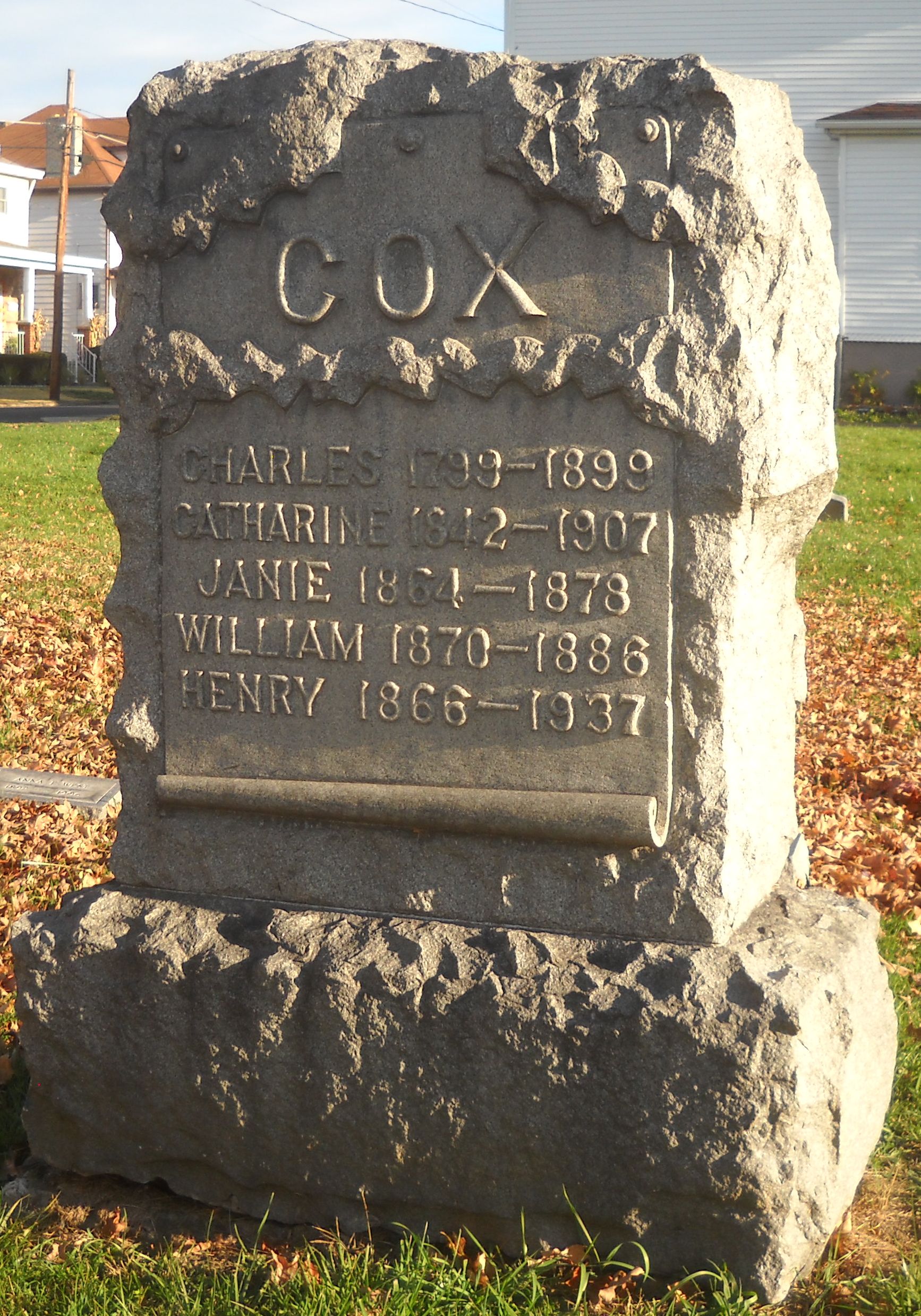
        Catherine was younger than Charles, by about 25 years, according to their shared headstone. The 1880 census lists her as having been born in Virginia, leading to the possibility that she traveled north with Taylor and Cox in 1862. Both sons are recorded as having been born Pennsylvania. Catherine would have been around 20 years of age when Taylor and Cox left the regiment.
     Charles Cox is listed in the 1880 census as being employed as a laborer. Accounts of his age vary wildly. This census lists his age as 65, meaning his birth would have been round 1815. His headstone, however, lists his birth year as 1799, meaning he would have been over 80 years of age in 1880. In Percy Hart's history of Brownsville, Cox is noted as having been 107 years old at his death in 1899, making his birth year around 1792.
     Also perhaps noteworthy in the 1880 census is that Cox and his family lived among white neighbors at this time.
     In his 1904 history of the Brownsville area, local resident and author Percy Hart lists Cox among the three most prominent African American residents of the town. Hart includes a photo of Cox (top of page), who had died a few years earlier, but offers no other biographical information.
     In 1891, the Connellsville Weekly Courier carried this brief paragraph about Cox.


      Although the article highlights the fact that Cox was given a place of honor at the regimental reunion, the language used is cringe-worthy by modern standards. The article used the term "captured" to describe Cox's attachment to the regiment, which does not appear to be a matter of coercion, and does not mention Taylor's role in his migration to the North.
       Furthermore, City Point, VA was developed into a Union base in 1864, 19 months after Cox left Virginia for Pennsylvania.
     In reality, Cox probably was considered an honorary part of the regiment; his presence at the reunion may have reminded the veterans that the freedom of people like Cox was one of the positive outcomes of the war.
      The article also states Cox was captured by "the Brownsville company." This is incorrect. Company C was the company of the 85th Pennsylvania with men mostly from Brownsville and the immediate area. Taylor was a member of Company E, which were men from Washington and Greene Counties. Taylor did hail from East Bethlehem and Centreville, PA in Washington County, just a few miles from Brownsville. The fact that Cox settled near Brownsville may have led to the assumption in the article that he was first associated with the "Brownsville company."
    Taylor went on to a prominent career in local business and politics. After recovering from the paralysis, he worked as a clerk for a railroad company in Pittsburgh.  In 1886, he was appointed the commissioner of the Cumberland Road (today's Route 40 in Pennsylvania) by Governor Robert E. Pattison, replacing fellow 85th Pennsylvania veteran Moses McKeag, who had passed away. A year later, Taylor was elected as a commissioner for Washington County. (Commemorative Biographical Record of Washington County, Pennsylvania, Volume 1, 1893)

Hart's Directory, p.255

This death registry lists Taylor and Cox as having died on the same day.


Obituary for Robert G.  Taylor
Pittsburgh Daily Post, 11-21-1899, p.1


This article about the Taylor-Cox relationship seems to contain fairly accurate information about Cox, who very likely was a servant for Taylor during the war.


Obituary for Charles Cox
Pittsburgh Press, 11-21-1899, p.8
     This article notes Cox's nickname as "Captain Charlie." It is unknown where Cox picked up this moniker. If he were born near Norfolk, he may have worked at the port there. Or he may have worked on the river at Brownsville, where passenger and cargo ships were docked and maintained during the 1800's. The article notes that Cox was financially successful but does not state the kind of work in which he had engaged. 
     Cox was buried in Brownsville and has a rather prominent headstone for himself and his family, perhaps denoting that he did indeed find financial success after he crossed the Mason-Dixon Line into Pennsylvania. 


New Bethlehem (PA) Vindicator
11-24-1899, p.6


     Finally, this article from a newspaper in northeast Pennsylvania focuses on the unusual matter of the two men passing away on the same day: November 20, 1899. It also implies that they maintained some sore of relationship after returning from the war.
    Robert G. Taylor is buried in the Taylor Cemetery in Centreville, Washington County, PA.