Showing posts with label Fort Morton. Show all posts

Friday, August 14, 2020

Tributes to Colonel Joshua B. Howell

From L.S.Dickey's 1915 History of the 85th Pennsylvania


             Colonel Joshua B. Howell, founder and leader of the 85th Pennsylvania regiment, died on September 14, 1864. While his regiment was encamped at Fort Morton near the famous Petersburg (VA)  Crater, Howell's death occurred nearby at the X Corps headquarters. His death came as the result of a fall from his horse. He was 58 years of age. His long-sought after promotion to general came posthumously.
          Howell had had several close calls with death in the previous year, mostly notably in August of 1863 on Morris Island near Fort Sumter, South Carolina. A bombproof under Howell's command was hit by an enemy shell. Buried under a pile of rubble, Howell nearly died, and was left with a severe concussion from which he never fully recovered. He took several medical leaves from his beloved regiment in the following 12 months, the second time under the supervision of his brother, Dr. Benjamin Howell
      
            
Dr. Charles Clark
Howell's death was remembered twenty-five years later by his friend, Dr. Charles Clark, the surgeon and later historian for the 39th Illinois who had treated him after his riding accident. In 1889, Clark wrote. "On the morning of the 13th, we were painfully shocked to hear that Colonel Howell, then temporarily commanding the Third Division, had been seriously injured the previous evening by the falling of his horse. His clothing and even his sash and sword were still on him...the Colonel was placed aboard and taken to the Brigade Hospital...he was suffering from a severe concussion of the brain and possible hemorrhage. it was evident, however, that he could not live. He remained unconscious up to a few moments before dissolution, when he opened his eyes an effort to speak, but was unintelligible." [Yates Phalanx, Charles Clark, 171]
          Colonel Howell's untimely death was a dark day in the history of the 85th Pennsylvania regiment. Had he lived another month, he would have had the opportunity to return home to western Pennsylvania with the majority of his regiment, whose three-year enlistments were about the expire 
          Weeks prior to his death, Howell had been promoted to acting commander of the Third Division in the X Corps of the Army of the James. Howell's personal horse had been injured so he was riding a substitute at the time that was said to have a sensitive mouth and did not respond well to its reins being pulled. Howell's body was sent back to New Jersey near his boyhood home for burial
          Nine days prior to his death, Howell wrote proudly to his daughter that, "To my great surprise I received an order last week assigning me to the command of this [Third] Division due to the illness of [the] General commanding, who had gone on to Fort Monroe. It is a high compliment from Corps Head Qrs. and a responsible command." [Book of John Howell and his Descendants, p.453]
        This account of Howell's death appeared in the Philadelphia Inquirer five days after the event.
       "A very great calamity befell the Tenth Army Corps in the sudden and lamentable death of Brigadier-General [actually his rank in the state militia] Joshua B. Howell , commanding a brigade in Major General A.H. Terry's division.The circumstances were as follows: Shortly after dinner, Gen. Howell proposed to mount his horse and ride to a point somewhat distant from his quarters. He had only succeeded in gaining his position on his horse, which was exceedingly uneasy at the bit, when the general unfortunately grasping the wrong rein, the horse suddenly careened and fell backward, falling wholly on the person of the deceased, where he remained. His orderly at once rushed to the general's rescue, and with much exertion got his prostrate form from beneath the vicious animal. Being borne to his quarters he was found to be insensible, and did not rally to the last. He died in the evening, and his embalmed body is now on its way to his Pennsylvania [actually New Jersey] home."
        Howell's posthumous promotion to Brigadier General was confirmed by the U.S. Senate in February of 1865, to be postdated from the day of his death. 
         Howell's last corps commander. General Alfred Terry, wrote this touching tribute to Howell in 1882. "At this distance of time, I cannot speak of General Howell's military career, but my recollection of him as a man and an officer are as clear and distinct as they were eighteen years ago. I have never known a more courteous gentleman; I never saw a more gallant and devoted officer. The record of his service was without spot or blemish...His untimely death was lamented by all his comrades as a loss wellnigh irreparable..." [The Book of John Howell and His Descendants, pp. 429-30]
             Soon after his death, General John G. Foster named a fort in Howell's honor at Mitchelville on
Hilton Head Island, South Carolina, near where Howell and his regiment were stationed in early 1863. The structure, built by the 32nd U.S. Colored Regiment,  has been historically preserved. 
           Furthermore, a Grand Army of the Republic post, Post #31 in Woodbury,  New Jersey, was named in Howell's honor. Howell was born in New Jersey in 1800 and lived there until moving to Uniontown in the late 1820's.


The Morning Post   Camden, NJ   8-19-1887


The article at left from 1887 describes the donation of Howell's sword to the G.A.R. Post named in his honor by his second wife, Katherine. Joshua B. Howell's first wife, Mary, died in 1852. Howell married Katherine two years later. Katherine Howell died in 1898 and is buried in Delaware.


            In the years following his death, his regiment worked to keep Howell's memory alive. In 1890, a Washington County newspaper reported that, "The local committee of the 85th regiment yesterday made a contract with C.S. Kilpatrick, the Connellsville artist, to paint a life-size picture of Col. Joshua B. Howell. The canvas will be about 4 x 7 feet and the painting will represent the colonel in a standing posture, dressed in full uniform, with sword in hand, a camp scene in the rear. It is to be completed in September [in one month] and will be on exhibition at the regimental reunion [at Uniontown] here September 1." [The Canonsburg [PA] Notes, 8-16-1890, p.2]
       Around 1904, it seems that the portrait of Howell was donated to the Fayette County Courthouse in Uniontown. As of 1964, according to a local newspaper, it was still hanging in Courtroom No. 1. But at some point it the next nine years, the portrait became lost. 
        In 1973, the Evening Standard newspaper of Uniontown carried a headline that read, "Judge Feigus Seeks Portrait of Howell." The accompanying story outlined the mission of Judge Samuel Feigus. 
        "An oil portrait that hung in Courtroom No. 1 here at the courthouse for many years is being sought by Judge Samuel J. Feigus. Judge Feigus has been working on a history of the county bar Association, the courts, its judges, and other famous figures associated with the court in past years. The picture in question is a full-length portrait of Brig. Gen. Joshua B. Howell, at one time a member of the county bar association. 
      "It was procured on April 11, 1904 and for dozens of years adorned Courtroom No. 1...Anyone with information on the missing portrait who would like to aid Judge Feigus in his historical research is asked to contact him..." [Evening Standard, 5-2-1973,  p.6]
      It is unknown if Judge Feigus successfully tracked down the location of the Howell portrait or its current whereabouts. Feigus died a year later in 1974.
        More recently, Howell's likeness was recently added to the Gloucester County Wall of Heroes in the county justice complex in New Jersey. 
Glouceser County, NJ Wall of Heroes
https://www.nj.com/gloucester-county/2011/02/wall_of_heroes_brig_gen_joshua.html


Monday, May 11, 2020

Private Henry K. Atchison of Company G

     
Canning Jar by Henry K. Atchison
Circa 1860
Courtesy of  crockerfarm.com

From the 1890 Veterans Schedule
Special Census of Civil War Veterans
           About 20 or so members of the 85th Pennsylvania regiment suffered the amputation of an arm or leg during the war. One who did and survived was Henry K. Atchison of Company G, who suffered the loss of his right arm in 1864. Atchison did not suffer from a gunshot wound; his arm was not cut off by a doctor. His arm was instantly detached by an artillery shell while Atchison was sitting calmly in camp.
        Atchison was born in 1820 and was 41 years of age when he enlisted into the 85th Pennsylvania in 1861. Like his colonel, Joshus B. Howell, Atchison was born in New Jersey. His parents were Robert and Jane Parshall Atchison. While growing up Henry learned the pottery trade from his father. [Samuel Bates, History of Greene County, 762-3]
        At age 35, he moved to New Geneva, PA in Fayette County and continued his trade for the next six years. He lived in Butler County, PA before moving to Greene County just before the outbreak of the Civil War. He enlisted in Company G, a unit from Greene County, that eventually became part of Howell's 85th regiment.
        Atchison was nearing the end of his three-year enlistment when he was wounded. The regiment spent the summer stationed in the Bermuda Hundred peninsula of Virginia between the James and Appomattox Rivers south of Richmond.
       In August of 1864, they had just returned to their camp near Ware Bottom Church from a grueling week-long campaign north of the James River that culminated in the Second Battle of Deep Bottom that resulted in scores of casualties in the regiment.
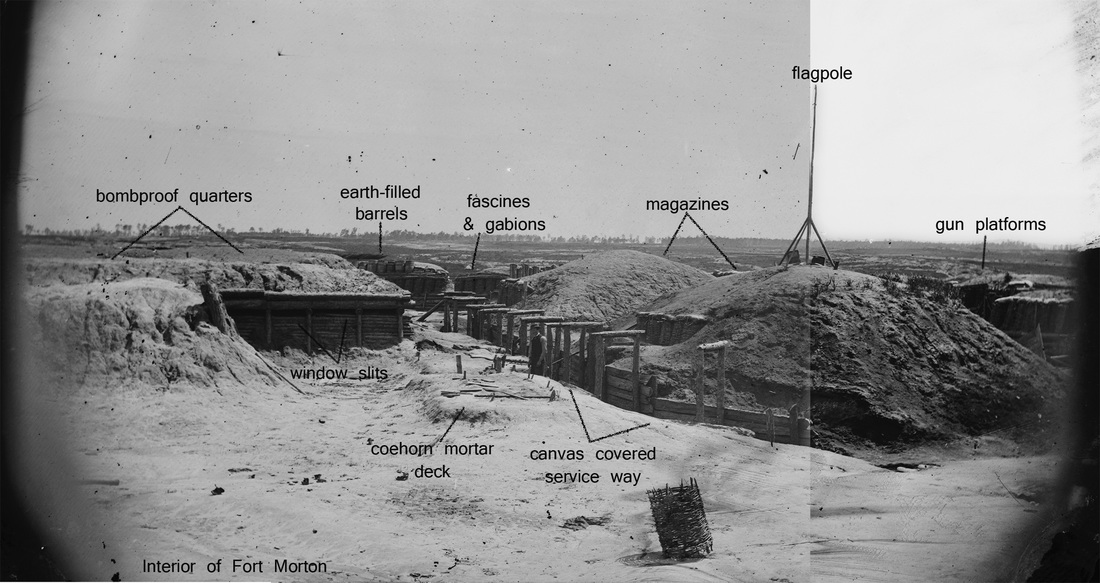
      Just three days after their return, they were ordered to march to the Petersburg,VA front upon the orders of General Benjamin Butler of the Army of the James. When the regiment got there in late August, they prepared to attack the Petersburg defenses but the attack was called off. They instead were sent to Fort Morton, perhaps a mile from the famous Battle of the Crater where one month earlier, Union forces ignited a massive explosion beneath a Confederate position but failed in the follow-up assault to pierce the enemy position.
Fort Morton   LOC
        Fort Morton was perhaps less than a mile from the Crater across a valley, In the valley was a stream where soldiers from both sides would meet and exchange items during lulls in the shelling.
     Colonel Howell described the position in a letter to his family. "...here we are in front of the celebrated city of Petersburgh. My command is a mile and a quarter from the city. The steeples of the churches and the clock are plainly in sight of my forts. The celebrated Burnside mine and crater are directly in front of us. About 300 yards from us are two of my forts. We are under heavy fire of artillery and musketry the entire day and night --shell and ball (rifle and artillery) fly about headquarters with a 'perfect looseness.' An orderly's horse was shot this morning just in front of my quarters. A shell exploded over my quarters about 30 paces beyond it in front whilst I was asleep yesterday morning." [Book of John Howell and His Descendants, Volume II, 452]
     Indeed their position seemed to be perilous. Two privates, John Cairney and Joseph Banks, were struck with the same bullet from a Confederate sharpshooter as they were delivering food to the soldiers on the picket line.
   
LOC
      There are several versions of Atchison's wounding which occurred on September 1, 1864 that all basically tell the same story. The first comes from Sergeant M.L. Gordon who was a member of Atchison's company
         "We were right in front of the mine that had exploded a few weeks before. Here firing was going on almost all the time, day and night. Our camp was in easy range of the enemy's guns. One day I was standing in camp, talking to a friend named Myers Titus, when a cannon-ball came over, struck in a tent near us, where 'Skeety' Atkinson [sic] was writing, cut his arm off near the shoulder, and passed on between my friends and me as we were talking."  [M.L. Gordon, Experiences in the Civil War, 20]
        Regimental historian Luther S. Dickey recorded that, "...on September 1, Private Henry K. Atchison of Company G, while sitting in camp making our muster rolls, had an arm shot off by a solid shot or unexploded shell from the enemy's artillery." [Dickey, History of the Eighty-Fifth Regiment Pennsylvania Volunteer Infantry, 374]
        A soldier from another regiment in their brigade, Homer Plimpton of the 39th Illinois, mentioned Atchison's wounding in his journal. "...an old man of the 85th Pa. was struck in the shoulder by a fragment of a shell while making out company payroll in the captain's tent. The arm was so shattered that it hung merely by the nerve and artery and a small bridge of integument. It was removed at the shoulder joint and although he was sixty years of age [actually 44] he bids fair to make a good recovery." [The Civil War Journals of Col. Homer A. Plimpton, John L. Dodson, ed. 2012, p . 354]
      Atchison survived the wound. He was a prominent potter prior to the war. Several of his pre-war creations have recently been sold at online auctions for thousands of dollars.They can be seen here,  here and here.
       Atchison began receiving a government pension for the loss of his arm in 1874. By 1883, he was receiving a payment of $24 per month.
        After the war, he is still listed as a potter in the 1870 census. More likely is that he was either running the family business or training two of his sons in the trade. Sons James and Henry are listed as potters still living with their parents.


        Ten years later, Atchison is listed in the census as a "U.S. Storekeeper," [below] a government position that often went to soldiers who had suffered from amputations in the war. A third son, Charles,was now listed as a potter.


        Atchison died in 1893 at the age of 73 and is buried in the Monongahela Hill Cemetery in Greensboro, PA in Greene County.
 
Headstone Application